
A drawer full of tangled whisks, ladles, and tongs slows down every meal. The right utensil organizer gives each tool a home, so cooking feels calm and cleanup feels quick. This guide covers five organizers that fit different kitchens: compact drawer trays for narrow drawers, an expandable bamboo insert for wide drawers, and countertop crocks for tools that earn a permanent spot beside the stove.
- 1. Joseph Joseph DrawerStore Compact Utensil Organizer, Large, Grey
- 2. OXO Good Grips Compact Utensil Organizer
- 3. Utoplike Bamboo Expandable Kitchen Drawer Organizer
- 4. Le Creuset Stoneware Utensil Crock, 1 Quart, Shallot
- 5. Haiyouneer 360-Degree Rotating Utensil Holder
- How to Choose a Utensil Organizer
- Keeping Drawers and Counters Tidy
- FAQ


Utensil organizers differ from generic drawer dividers in one key way. Dividers split a drawer into empty boxes. Utensil organizers shape each compartment around the tools themselves, with angled slots for flatware, long channels for whisks and spatulas, and deep cups for gadgets. That shaping is what keeps a drawer tidy after a month of daily use instead of only on the day you organize it.
Before choosing, measure the drawer or counter space. Drawer organizers need the right width, depth, and height, while countertop crocks need a footprint that leaves room for a cutting board and a kettle. The five picks below cover the most common situations, and the buying guide near the end explains how to match each type to your kitchen.
1. Joseph Joseph DrawerStore Compact Utensil Organizer, Large, Grey
The Joseph Joseph DrawerStore Compact takes a clever approach to a familiar problem. Instead of laying flatware flat in a wide tray, it stacks forks, knives, and spoons in angled, overlapping compartments. The design fits a full set of flatware into a tray only a few inches wide, which makes it a strong choice for narrow drawers and small kitchens.
Each compartment carries a small icon, so everyone in the household knows where each piece belongs. The tray holds larger cooking tools too, with a center channel sized for long handles such as whisks and tongs. Non-slip feet keep the tray in place when the drawer opens and closes, and the whole unit lifts out for washing.
This organizer suits cooks who want flatware and a few everyday tools in one drawer without giving up half the drawer to a tray. The grey finish blends with most drawer interiors, and the compact footprint leaves room beside it for a knife block or a small gadget tray. It needs a drawer at least 3.25 inches deep, so measure height before ordering, especially in older kitchens with shallow drawers.
Specs
- Material: BPA-free plastic
- Capacity: Up to 48 pieces of flatware
- Dimensions: About 15.6 x 5.5 x 2.25 inches
- Compartments: 5 stacked, angled compartments with icons
- Care: Hand wash
- ASIN: B078ZLXPRC
2. OXO Good Grips Compact Utensil Organizer
The OXO Good Grips Compact Utensil Organizer is built for tight, shallow drawers. Its narrow profile slides into drawers that wider trays cannot fit, yet it still separates forks, spoons, knives, and small gadgets into distinct sections. The stacked layout keeps handles from sliding over each other, which is the usual cause of drawer chaos.
Square corners help the tray sit flush against drawer walls, eliminating the small gaps where stray measuring spoons and corn holders tend to hide. Rubberized feet grip the drawer base, so the organizer stays put during daily use. A removable caddy lifts out for cleaning and for carrying flatware to the table at serving time.
This pick works well in rental kitchens and compact apartments, where drawer space is limited and every inch matters. The white finish looks clean against wood or painted drawers, and the plastic construction wipes clean with a damp cloth. Pair it with a second small tray if the drawer also holds larger tools such as peelers and can openers.
Specs
- Material: Plastic with TPE non-slip feet
- Capacity: Forks, spoons, knives, plus small gadgets
- Dimensions: About 16.35 x 6.75 x 2.36 inches
- Compartments: 3 main sections plus removable caddy
- Care: Hand wash
- ASIN: B09B19RZG2
3. Utoplike Bamboo Expandable Kitchen Drawer Organizer
The Utoplike Bamboo Expandable Organizer brings warmth and flexibility to a utensil drawer. Made from organic bamboo, it expands from three compartments to five, stretching from about 13 inches to about 21.6 inches wide. That adjustability lets it fit drawers of many sizes, and the bamboo finish suits kitchens that favor natural materials.
The compartments vary in size, so long tools such as spatulas and ladles get a wide channel while smaller items such as measuring spoons get a snug slot. Bamboo resists moisture better than many softwoods, and the smooth surface wipes clean. The organizer sits flat in the drawer, which keeps tall handles from catching on the drawer frame above.
This is a good pick for cooks who want one organizer that can move between drawers or adapt when the tool collection grows. It also works as a general drawer organizer beyond the kitchen, though its depth and slot sizes suit cooking tools best. Keep it dry between uses and wipe spills promptly to protect the bamboo finish over time.
Specs
- Material: Organic bamboo
- Capacity: 3 to 5 compartments, up to 9 slots in the largest layout
- Dimensions: About 17 inches long, expands from 12.6 to 22 inches wide
- Compartments: Expandable from 3 to 5
- Care: Wipe clean with a damp cloth
- ASIN: B08BJ32521
4. Le Creuset Stoneware Utensil Crock, 1 Quart, Shallot

Some tools deserve to live on the counter, within arm’s reach of the stove. The Le Creuset Stoneware Utensil Crock holds spatulas, spoons, whisks, and tongs upright in a heavy, stable vessel that will not tip when a full ladle goes in. The 1-quart size fits a working set of everyday tools without crowding the counter.
Stoneware brings two advantages over plastic crocks. It stays put, thanks to its weight, and it resists heat near the stove. The enamel glaze will not absorb odors, and it wipes clean after splashes of sauce or oil. The Shallot color adds a soft purple tone that pairs with many kitchen palettes, and the crock comes in several other colors for cooks who want a matched set.
This crock suits cooks who reach for the same tools at every meal and want them visible and ready. It also works as a serving piece, holding breadsticks or cutlery at a buffet. Because it is heavy, place it where it will stay, and avoid sliding it across a delicate countertop.
Specs
- Material: High-fired stoneware with enamel glaze
- Capacity: 1 quart
- Dimensions: About 6.6 x 5.3 x 5.2 inches
- Compartments: 1 open crock
- Care: Dishwasher safe
- ASIN: B0FH76TH7C
5. Haiyouneer 360-Degree Rotating Utensil Holder
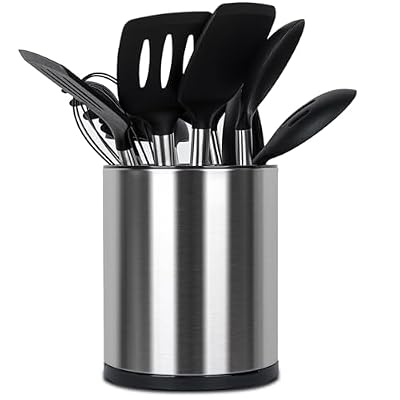
The Haiyouneer Rotating Utensil Holder adds a spin to countertop storage. The base turns a full circle, so the tool at the back of the crock comes to the front with a gentle push. That rotation matters in a busy kitchen, where the right spatula is often buried behind three others.
The holder is extra large, with room for long-handled tools, and its wide mouth keeps handles from jamming together. The smooth exterior wipes clean, and the sturdy base keeps the holder steady while it turns. It suits counters beside the stove, where quick access to tongs, turners, and ladles speeds up cooking.
This pick works well for cooks who keep a large tool collection on the counter and want every piece reachable without lifting the whole crock. It also helps in shared kitchens, where each cook can spin the holder to find a favorite tool. Measure the space above the counter, since tall tools plus the holder need clearance under upper cabinets.
Specs
- Material: Plastic with rotating base
- Capacity: Extra large, holds long-handled cooking tools
- Dimensions: About 7.6 inches in diameter
- Compartments: 1 open holder with 360-degree rotation
- Care: Wipe clean with a damp cloth
- ASIN: B0DDL8KH6L
How to Choose a Utensil Organizer
The best utensil organizer depends on where the tools live now and how much space the kitchen offers. A drawer organizer suits tools that are used a few times a week, while a countertop crock suits tools used at nearly every meal. Many kitchens benefit from both: a tray for flatware and a crock for cooking tools.
Measure first. For a drawer, note the width, depth, and interior height. Expandable organizers forgive a rough width measurement, while fixed trays need an exact fit. For a countertop crock, check the footprint and the height of the tools it will hold, plus clearance under cabinets. A crock that is too tall for its tools will let handles flop, while one that is too short will hide short tools inside.
Material matters for cleaning and durability. Plastic trays are light and easy to wash, bamboo adds warmth and needs wiping rather than soaking, and stoneware crocks are heavy, stable, and dishwasher safe. Metal holders look sharp and resist heat, but they can be noisy when tools clatter inside. Choose the material that fits the cleaning routine the household will actually follow.
Capacity should match the real tool collection, not an ideal one. Count the tools that need a home, including odd shapes such as a garlic press, a peeler, and a meat thermometer. An organizer with one spare compartment beats one that is full on day one, since collections tend to grow. If the drawer already overflows, consider moving rarely used tools to a second drawer before choosing a size.
Placement shapes daily habits. Keep the most-used tools closest to the stove or prep area, and group tools by task: stirring tools together, serving tools together, and measuring tools together. A consistent layout means anyone cooking in the kitchen can find a whisk without opening three drawers.
Cleaning keeps an organizer working well. Empty the tray or crock once a month, wipe the base, and remove crumbs and dust that collect underneath. Plastic trays can be hand washed, bamboo should be wiped dry, and stoneware can go in the dishwasher. A clean organizer also makes it easy to spot tools that are broken or no longer used.
Keeping Drawers and Counters Tidy
An organizer only helps if the tools inside it stay in their places. A simple habit makes the difference: return each tool to its compartment right after washing, rather than dropping it on top of the pile. Over a few weeks, that habit turns a tidy drawer into the normal state of the kitchen instead of a weekend project.
Rotate tools with the seasons. Grilling tools move to the front in summer, baking tools in winter, and holiday gadgets can live in a secondary drawer the rest of the year. A quick seasonal check also reveals duplicates, such as three vegetable peelers or two identical ladles, which can be donated or stored elsewhere.
For small kitchens, combine types. A compact drawer tray for flatware plus a single countertop crock for cooking tools covers most needs without filling the counter. For larger kitchens, an expandable bamboo insert in a wide drawer plus a rotating holder near the stove keeps the full collection within reach. The goal is not to own every organizer, but to give every tool one clear home.
Affiliate disclosure: As an Amazon Associate, this site earns from qualifying purchases made through links on this page.
FAQ
What size utensil organizer fits a standard kitchen drawer?
Measure the drawer interior first, since standard drawers vary in width and depth. Compact trays suit narrow drawers, while expandable organizers adjust to fit wide drawers. Check interior height too, because stacked trays need enough clearance for handles to sit below the drawer frame.
Are bamboo utensil organizers durable?
Bamboo is strong and resists moisture well, which makes it a durable choice for drawer organizers. Wipe it clean with a damp cloth and dry it promptly, and avoid soaking it in water. With basic care, a bamboo organizer lasts for years.
Should cooking utensils go in a drawer or a crock?
Tools used at nearly every meal, such as spatulas and tongs, work well in a countertop crock beside the stove. Flatware and tools used less often suit a drawer tray. Many kitchens use both, keeping daily tools on the counter and the rest in a drawer.
How do I keep a utensil drawer from getting messy again?
Return each tool to its compartment after washing, and give every tool one assigned spot. Empty the organizer once a month to remove crumbs and check for broken or duplicate tools. A consistent layout helps everyone in the household keep the drawer tidy.


Write Your Review
No reviews yet. Be the first to share your experience!