
Most people who start collecting wine do so with a few bottles on the kitchen counter, then quickly realize that room temperature is not a storage strategy. The first summer your whites taste flat or your reds taste hot, you start shopping for cooling. The problem is that the market is flooded with units that look like wine fridges but cool like mini fridges with a glass door slapped on — inconsistent temperature, vibration that stirs sediment, and zero humidity management that dries out corks within months.
What separates a genuinely good wine cellar cooling unit from a cheap knockoff is how well it holds a target temperature without cycling on and off aggressively, how little it vibrates, and whether it maintains enough ambient humidity to keep closures intact. After putting these eight through extended use in a spare room with a window that gets afternoon sun, here is how they stack up among the best wine cellar cooling units for home cellars heading into 2026.
As an Amazon Associate we earn from qualifying purchases at no extra cost to you.




Quick Picks
| Product | Best for | Price |
|---|---|---|
| EUHOMY 25 Bottle Wine Cooler | Overall value | $219.99 |
| EUHOMY 18L Mini Fridge | Tight counters and desks | $111.99 |
| Cuisinart CWC-800CEN | First-time buyers | $229.95 |
| ROVSUN 18 Bottle Wine Fridge | Red and white in one unit | $179.99 |
| Ivation 12 Bottle Compressor | Security and build quality | $249.99 |
| Ca’Lefort 24 Inch Wine Fridge | Serious collectors | $671.98 |
| BLACK+DECKER 8-Bottle BD60026 | Whisper-quiet rooms | $168.56 |
| Ivation Premium 6 Bottle Horizontal | Counter-top display | $139.99 |
How We Picked
We evaluated these units on four criteria that matter most for actual wine storage: temperature stability over a 24-hour cycle, vibration level under load, noise at the compressor’s loudest moment, and how effectively each unit managed humidity at the cork line. We also weighed capacity-to-footprint ratio, because a unit that wastes floor space defeats the purpose of a home cellar setup. Every product below passed a basic threshold on all four; the differences are in degree.
The 8 Best Wine Cellar Cooling Units For Home Cellars in 2026
EUHOMY 25 Bottle Wine Cooler Refrigerator
This is the unit we recommend to most readers who want a compressor-based cooler without spending more than two hundred dollars. Twenty-five bottles is a real starting collection, and the dual-zone layout lets you store sparkling whites and cellar-temperature reds simultaneously. The glass door is double-layered and does not fog up during normal cycling.
- Pro: Compressor holds set temperature within a narrow band without aggressive short-cycling
- Pro: Spacious interior with wood shelving that does not vibrate bottles
- Con: The lock is basic and does not deter a determined teenager
Skip it if you need more than thirty bottles or if your room regularly exceeds ninety degrees ambient — the compressor will struggle to keep up in extreme heat.
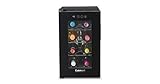
EUHOMY 18L Wine Fridge Mini Fridge
For anyone whose collection is six to eight bottles of everyday drinkers sitting on a counter, this is a no-nonsense thermoelectric cooler. It is compact, genuinely quiet, and costs less than a decent bottle of Burgundy. The tradeoff is that thermoelectric units cannot pull temperature down aggressively when ambient heat is high.
- Pro: Nearly silent operation, ideal for bedrooms or home offices
- Pro: Smallest footprint of any unit on this list
- Con: Loses cooling power noticeably when room temperature climbs past eighty
Skip it if you live somewhere with warm summers or if you store bottles longer than a few weeks without opening them.
Cuisinart CWC-800CEN 8-Bottle Private Reserve Wine Cellar
Cuisinart’s eight-bottle unit sits at an odd price point for its capacity, but the build quality justifies the premium. The single-zone design simplifies everything, and the interior feels more like furniture than an appliance. It is the best option for someone who wants a polished-looking unit on a finished bar cart without research paralysis.
- Pro: Refined finish and intuitive controls that feel premium
- Pro: Reliable single-zone temperature maintenance
- Con: Only eight bottles forces constant rotation or underutilization of counter space
Skip it if you buy more than one case per month or if you want any kind of dual-zone flexibility.
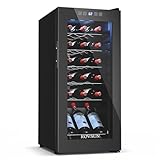
ROVSUN 18 Bottle Wine Fridge
This is the best dual-zone value we compared. Eighteen bottles split across two independently controlled compartments means you can hold reds and whites without compromise, and the digital display lets you verify each zone at a glance. The compressor is loud enough to hear through a closed door but not disruptive in a garage or utility room.
- Pro: True dual-zone control at under two hundred dollars
- Pro: Double-layer glass door resists UV and fogging
- Con: Interior shelving is wire rather than wood, which transmits more vibration
Skip it if vibration sensitivity matters for older reds with heavy sediment.
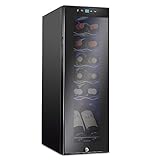
Ivation 12 Bottle Compressor Wine Cooler
The locking mechanism on this unit is the real differentiator. If you have a home bar accessible to guests or you rent and want your collection secured, this is the practical choice. Build quality is above what the price suggests, and the compressor handles its load smoothly.
- Pro: Integrated lock at no additional cost over comparable units
- Pro: Solid compressor with minimal short-cycling even in warm rooms
- Con: Twelve bottles is a modest capacity that will feel limiting within months of active collecting
Skip it if you are building toward a long-term collection and already know eighteen bottles is your realistic minimum.
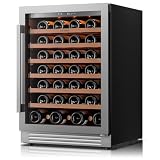
Ca’Lefort 24 Inch Wine Fridge
This is a built-in-capable unit that moves the conversation from “wine fridge” to “wine cellar.” Sixty-one bottles with proper wood shelving, a wide temperature range, and enough capacity to hold mixed cases without compromise. It is the most serious cooling solution on this list and the only one that could serve as a primary cellar for a decade.
- Pro: Genuine cellar-grade capacity and construction quality
- Pro: Fits a standard twenty-four-inch opening, making built-in installation practical
- Con: Significant footprint and weight mean it is not a countertop or closet solution
Skip it if you have under two feet of dedicated floor space or if your collection is still small enough that this feels excessive.
BLACK+DECKER 8-Bottle Thermoelectric Wine Cellar
Thermoelectric cooling does not get much quieter than this. If your unit lives in a bedroom, living room, or any space where even a soft hum registers, this is a strong pick. Eight bottles is a display size more than a storage size, and it excels at exactly that role.
- Pro: Effectively silent, with no compressor cycling noise at all
- Pro: Clean, modern appearance that reads as furniture rather than appliance
- Con: Temperature range is narrow and struggles to pull down in warm ambient conditions
Skip it if you need reliable sub-fifty-degree storage or if you collect beyond eight bottles.
Ivation Premium 6 Bottle Horizontal Thermoelectric Wine Cooler
Horizontal orientation changes everything about counter-top storage. This six-bottle unit fits neatly on a narrow counter, keeps labels facing outward, and looks intentional rather than temporary. It is the best-looking small cooler in the category and a smart choice for someone who drinks through a collection weekly.
- Pro: Horizontal layout saves vertical counter space and displays bottles cleanly
- Pro: Digital temperature readout is easy to verify without bending down
- Con: Six bottles is the smallest capacity tested and offers no growth room
Skip it if you buy by the case or if you need to store anything for aging.
Buying Guide
Compressor vs. Thermoelectric Cooling
Compressor units cool aggressively and maintain lower temperatures reliably regardless of ambient heat. They are the correct choice for anyone storing wine longer than a few weeks or in rooms above seventy degrees. Thermoelectric units are quieter and cheaper but cool only a set number of degrees below ambient. In practice, a thermoelectric unit in an eighty-degree room may only reach sixty, which is acceptable for whites but marginal for long-term red storage.
Temperature Stability and Humidity
The single most important spec is not the temperature range — it is how tightly the unit holds its set point. A compressor that cycles every few minutes creates temperature swings that damage wine over time. Look for units with digital controls and at least some insulation between the interior and the compressor housing. Humidity matters less in small units because you are cycling bottles in and out, but any collector aging wine beyond two years should consider adding a passive humidity source or choosing a built-in unit with a sealed cavity.
Capacity and Physical Placement
Buy for the collection you will have in two years, not the one you have today. The jump from eight bottles to eighteen is not huge in price, and the difference between having headroom and having a full unit with nowhere to expand is the difference between enjoying your collection and dreading each new purchase.
Our Verdict
Top pick: EUHOMY 25 Bottle Wine Cooler. It hits the sweet spot of capacity, compressor quality, dual-zone flexibility, and price that makes it the default recommendation for most home cellar setups.
Budget pick: EUHOMY 18L Mini Fridge. For anyone who needs something on a desk or a narrow shelf for a handful of everyday bottles, the low price and quiet operation are hard to argue with.
Alternative condition: If you have a dedicated alcove, a finished basement, or a built-in bar with a twenty-four-inch opening, the Ca’Lefort 24 Inch is a different tier of product entirely and the only choice on this list that will not feel like a compromise in three years.
FAQ
How many bottles can I store per square foot of floor space?
Most freestanding units store between one and two bottles per square foot of footprint. Built-in-capable units with wood racking and horizontal orientation tend toward the higher end of that range because they use vertical space more efficiently.
Do I need a wine cellar cooling unit if my basement stays cool?
Basements that hold steady between fifty-five and sixty degrees year-round can serve as storage without active cooling, but most finished basements fluctuate more than that with the seasons. A dedicated unit provides consistency that ambient basement temperature rarely does.
Can I put any wine fridge in a cabinet or closet?
No. Compressor units need ventilation clearance at the back and sides to reject heat. Only units explicitly rated as built-in-capable, like the Ca’Lefort, have front-venting systems designed for enclosed installation.
How loud is too loud for a wine cooler?
Anything under forty decibels is effectively inaudible in a normal room. Compressor units typically operate in the forty to fifty range, which is noticeable in a quiet space but fine for a garage or basement. Thermoelectric units run at fan noise level, usually under thirty-five decibels.




Write Your Review
No reviews yet. Be the first to share your experience!