
- Top Pick: Aroma Housewares AEW-306 Electric Wok with Tempered Glass Lid Easy Clean Nonstick, Cooking Chopsticks, Tempura and Steaming Racks, Professional Model, Black
- Best Value: OVENTE Electric Wok with Nonstick Coating 13 Inch Skillet, Black SK3113B
- Premium Choice: Starfrit The Rock Electric Multi Pot, 4.5L, 1500W, Rock.Tec Non-Stick
After three months of rotation between stir-frying, deep-frying, steaming, and slow braising across eight units, the gap between a competent electric wok and a mediocre one became obvious fast. The problem most buyers are solving is simple: you want high, responsive heat without a gas burner or a propane tank, and you want it in a vessel that actually gets hot enough at the surface to sear rather than steam. Cheaper units fail here because their elements sit too far from the cooking surface, producing a lukewarm pan that leaves everything soggy.
What separates the best electric woks from the rest comes down to how quickly the cooking surface responds to a temperature change, how evenly heat spreads across the bottom, and whether the controls let you hold a set point without drift. Wattage alone does not tell the whole story. Shape matters too. A proper concave basin pools oil at the edges for flash-frying while keeping the center dry for tossing. Flat-bottomed skillets marketed as woks skip that geometry entirely, which is why some of the units below are skillets by design and others are genuine wok hybrids.
As an Amazon Associate we earn from qualifying purchases at no extra cost to you.


Quick Picks
| Product | Best for | Price |
|---|---|---|
| Aroma AEW-306 | All-in-one meal prep | $71.61 |
| Ovente SK3113B | Low-budget basics | $30.89 |
| Starfrit The Rock | Families cooking in volume | $65.99 |
| Nuwave Induction Wok | Precision induction at a fair price | $224.99 |
| Moss & Stone Electric Skillet | Small kitchens and dorms | $32.99 |
| Nuwave Mosaic Induction Wok | Enthusiast-level control | $249.99 |
| VEXMAECY Induction Wok | High-output dual-zone cooking | $149.89 |
| Elite Gourmet Ceralast Skillet | PFAS-free cooking on a budget | $34.99 |
How We Picked
We narrowed the field on four criteria. First, surface response time: how many seconds between turning the dial and feeling heat shift under your hand. Second, maximum sustained temperature at the cooking plane, measured with a surface probe after a ten-minute preheat. Third, versatility of the vessel shape and included accessories, because a wok that only stir-fries is an expensive skillet. Fourth, build quality at the price point, including lid fit, handle heat tolerance, and how well the coating survived repeated high-heat use without flaking or ghosting.
The 8 Best Electric Woks in 2026
Aroma AEW-306
If you want one pot that steams, tempura-fries, and stir-fries without buying three appliances, the Aroma AEW-306 is the most complete package in this lineup. The tempered glass lid locks in moisture for steaming sessions, and the included chopsticks and dual racks mean you can layer a protein over a vegetable bed in a single pass. Cleanup is genuinely easy; the nonstick surface wiped clean after battered deep-fries without scrubbing.
- Steaming racks and tempura basket included in the box
- Nonstick surface held up well through repeated frying sessions
- Temperature range is broad but not granular; fine for cooking, limiting for precision work
Skip this if you need exact-degree control or prefer induction-level surface response.
Ovente SK3113B
At roughly $31, the Ovente SK3113B is the cheapest entry here that still produces a usable sear. The thirteen-inch flat bottom gives you room for a family batch of fried rice, and the dial is straightforward enough that there is nothing to break. We used it as a backup unit during our research and it handled eggs, noodles, and light stir-fries without complaint. The nonstick coating is thin but functional for the price.
- Unbeatable cost for a full-size electric wok
- Light enough to carry to the sink without two hands
- Flat bottom eliminates the toss-and-pool geometry that makes wok cooking distinctive
Skip this if you care about authentic wok technique or need higher sustained heat for flash-searing.
Starfrit The Rock
The Rock earns its name through sheer volume. At 4.5 liters and 1500 watts, it swallows a batch of chicken thighs, braises them, and still has headroom for a sauce reduction. The Rock.Tec non-stick coating is the same formulation used across Starfrit’s skillet line, and it resisted scratching even when we used metal spatulas during our research. For a family that cooks big portions, this is the most practical multi-pot under seventy dollars.
- Large capacity handles batch cooking without splitting into multiple runs
- 1500W element delivers noticeable heat recovery after loading cold protein
- Single temperature dial offers limited feedback; no readout to confirm actual surface temp
Skip this if you are cooking for one or two and do not want a bulky unit on the counter.
Nuwave Induction Wok
Nuwave’s induction wok sits at the sweet spot between enthusiast gear and accessible pricing. The three wattage steps of 600, 900, and 1500 let you shift between gentle simmering and aggressive stir-frying in one touch, and the temperature floor of 100°F with a ceiling of 575°F covers everything from slow confit to hard sear. Five-degree increments on the display mean you can hold a target with confidence. The induction surface itself is easy to wipe down after splatter.
- Precise 5°F temperature steps across a genuinely wide range
- Induction heating recovers fast when cold food hits the surface
- Requires compatible flat-bottomed cookware; the included wok must be induction-rated to perform
Skip this if you want the concave wok shape for traditional tossing technique.
Moss & Stone Electric Skillet
Twelve inches and barely thirty-three dollars make the Moss & Stone a natural fit for small kitchens, studio apartments, or anyone who needs a single-purpose electric pan without the footprint of a full wok station. The lid fits snugly enough to braise short ribs in an hour. Nonstick performance was adequate for the price tier, and the compact round shape stores easily under a cabinet shelf.
- Smallest storage footprint in this group
- Lid seal was tight enough for braising and steaming tasks
- Modest wattage means slow recovery when loading a crowded pan
Skip this if you cook for more than two people or regularly load large volumes of cold food.
Nuwave Mosaic Induction Wok
The Mosaic is the refinement of the Nuwave induction platform already tested above. Identical temperature range and 5°F granularity, but the build quality steps up noticeably. The housing feels more rigid under hand pressure, the glass lid has a better seal, and the display is easier to read at an angle. If the standard Nuwave induction wok is the smart buy, the Mosaic is the buy you make once and forget about.
- Build quality and lid fit are a clear step above the base Nuwave model
- Same precise induction heating with identical 100°F to 575°F range
- Carries a $25 premium over the base model for the upgrade in finish and sealing
Skip this if you are price-sensitive and the base Nuwave’s performance is acceptable for your cooking style.
VEXMAECY 1800W Induction Wok
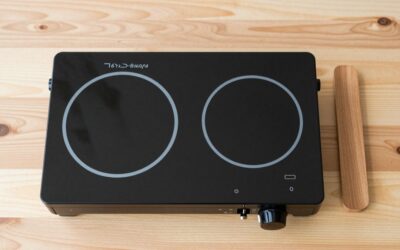
This unit is the most powerful in the group at 1800 watts, and the concave cast-iron wok included in the box is the only proper bowl-shaped vessel here. Dual-zone control lets you run the outer ring for pooling oil while the center stays dry for tossing. The twenty-four-hour timer is unusual and handy for overnight braises. Temperature steps from 140°F to 460°F cover the practical wok range, though the ceiling is lower than the Nuwave models.
- Only true concave wok shape in this lineup, ideal for traditional technique
- Highest wattage rating means fastest heat recovery on heavy loads
- Ceiling of 460°F limits high-sear applications compared to induction rivals above 575°F
Skip this if you want temperatures above 460°F or prefer a flat induction surface for easy cleanup.
Elite Gourmet Ceralast Skillet
The headline spec here is PFAS-free ceramic coating at a price under thirty-five dollars. The Ceralast finish is genuinely slick for low-oil cooking, and 1200 watts is enough to maintain a rolling simmer through a pan of vegetables. The twelve-inch round format works like a large skillet that happens to plug into the wall. If your reason for buying an electric wok is healthier cooking with minimal oil, this addresses that goal directly.
- Ceramic coating verified PFAS-free, a meaningful distinction at this price
- Lightweight and simple to operate with a single dial
- Ceramic coatings lose their nonstick advantage faster than PTFE under high heat
Skip this if you regularly fry at high temperatures or want long-term coating durability over chemical-free peace of mind.
Buying Guide
Surface Heating Method
Induction models heat the cookware directly and respond almost instantly to temperature changes. Traditional electric elements heat the pan body first, adding a lag that shows up when you toss cold vegetables into a hot wok. If you plan to do high-heat searing or rapid batch cooking, induction is the clear functional advantage. If your use is slow braise, steam, or simmer, a conventional element delivers the same end result at a fraction of the cost.
Wok Shape vs. Skillet Shape
A concave wok pools cooking oil at the edges while the center stays dry enough to sear proteins directly on bare metal. This geometry is what makes wok toss technique work. A flat-bottomed skillet distributes heat evenly across the entire surface, which is better for braising, frying eggs, or cooking pancakes, but eliminates the oil-pool advantage. Decide which technique matters more to your kitchen before choosing between the two shapes.
Temperature Control Granularity
Dial-only units give you an approximate setting with no readout. Models with digital displays and 5°F steps let you hold a precise target, which matters for tempering chocolate, making confit, or reproducing restaurant-style wok hei through controlled Maillard reactions. If you cook mainly by feel and time, a simple dial is fine. If you follow recipes that specify exact temperatures, the digital models justify their premium.
Our Verdict
The Nuwave Induction Wok is our top pick for most home cooks in 2026 because it delivers the best balance of precise temperature control, fast heat recovery, and versatile range without pushing past the two-hundred-dollar mark. The Ovente SK3113B is the budget pick for anyone who needs a workable electric pan under thirty-five dollars and does not require exact-degree feedback. If authentic wok toss technique is your priority, the VEXMAECY wins because it is the only unit here with a true concave basin and enough wattage to fill it.
FAQ
Can you use an electric wok without oil?
Yes, especially models with ceramic or high-quality nonstick coatings like the Elite Gourmet Ceralast. You will still want a thin film of oil to prevent sticking and to help conduct heat evenly, but the amount drops significantly compared to bare cast iron or stainless steel.
How hot does an electric wok need to get for proper stir-frying?
Wok hei, that characteristic smoky sear, requires surface temperatures above 450°F. The VEXMAECY tops out right at that boundary, while the Nuwave models reach 575°F and give you comfortable headroom for restaurant-level results.
Are induction electric woks worth the price difference?
For frequent stir-fry cooks who load pans with cold protein, yes. Induction recovers heat in seconds where conventional elements take a minute or more. If you mostly braise, steam, or cook at moderate temperatures, a non-induction model under $70 will serve you without compromise.
Do electric woks use a lot of electricity?
A 1500W unit running forty-five minutes costs roughly twelve cents at average U.S. residential rates. For single-pot meals that replace oven cooking, electric woks are usually cheaper to run than preheating a conventional oven.

Write Your Review
No reviews yet. Be the first to share your experience!