
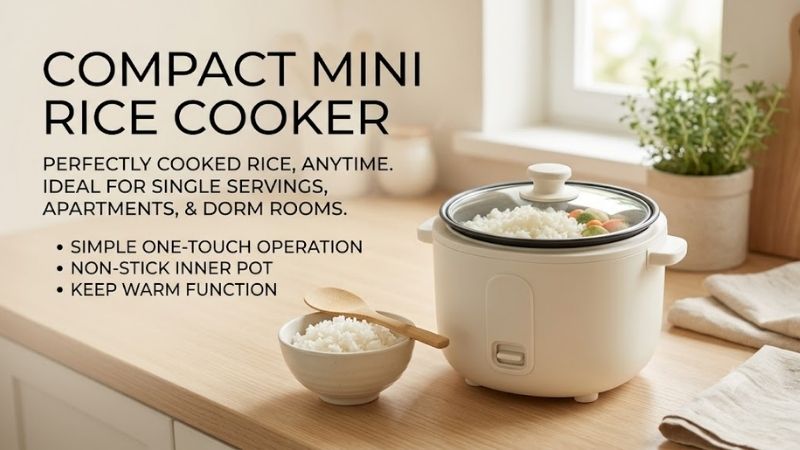
A mini rice cooker makes it easier to prepare fresh rice without using a full-size appliance or monitoring a pot on the stove. Whether you cook for one, share a small apartment, or need a compact appliance for quick meals, this guide compares six practical options based on cooking capacity, controls, versatility, cleanup, and everyday convenience.
- Quick Verdict: Which Mini Rice Cooker Should You Choose?
- Quick Comparison Table
- How We Selected These Mini Rice Cookers
- Detailed Mini Rice Cooker Reviews
- Mini Rice Cooker Buying Guide
- Which Mini Rice Cooker Is Right for Your Lifestyle?
- Common Mistakes to Avoid When Buying a Mini Rice Cooker
- Frequently Asked Questions
- Final Verdict
Quick answer: For most people in 2026, the best mini rice cooker is the Mini Rice Cooker — our #1 rated choice. See the full ranked comparison, alternatives and buying advice below.
Quick Verdict: Which Mini Rice Cooker Should You Choose?
The best mini rice cooker depends on how much rice you prepare, whether you want dedicated grain settings, and how much countertop space you can spare.
For straightforward white rice, a basic one-switch cooker may be sufficient. If you regularly prepare brown rice, mixed grains, or porridge, a digital model with dedicated programs is generally more useful.
Our six selections cover different household needs rather than assuming one design is best for everyone.
Quick Comparison Table
| Mini Rice Cooker | Best For | Key Feature | Main Trade-Off |
|---|---|---|---|
| Zojirushi NHS-06 | Simple rice cooking | 3-cup uncooked capacity, one-switch control | No keep-warm function |
| Aroma ARC-363NG | Everyday value | 3-cup uncooked capacity, automatic keep-warm | Basic controls |
| DASH Mini Rice Cooker | Small individual meals | Compact design, simple operation | Limited batch capacity |
| CUCKOO CR-0351F | Different rice varieties | Digital cooking programs | More involved controls |
| Toshiba TRCS02 | Versatile small-household cooking | Multiple cooking functions | More settings to learn |
| Zojirushi NS-LGC05 | Premium compact cooking | Micom cooking technology | Higher investment |
Capacities refer to uncooked rice unless otherwise stated. A rice cooker’s supplied measuring cup is commonly smaller than a standard US measuring cup.
How We Selected These Mini Rice Cookers
These recommendations emphasize practical differences that affect everyday ownership: capacity, cooking controls, supported rice varieties, pot design, cleanup, and suitability for limited kitchen space.
Manufacturer specifications and documentation are prioritized over unsupported performance claims. The selections are editorial assessments, not results of firsthand cooking tests.
A compact rice cooker does not automatically produce better rice than a larger one. Cooking consistency depends on the heating system, water measurements, rice variety, and operating instructions.
For that reason, the most useful comparison is not simply which machine has the most functions, but which functions you will actually use.
Detailed Mini Rice Cooker Reviews
1. Zojirushi NHS-06 — Best for Simple Rice Cooking
Best For: Beginners who want a dependable, straightforward rice cooker without digital menus.
Why We Picked It: The Zojirushi NHS-06 combines a 3-cup uncooked rice capacity with a single cooking switch and a transparent glass lid. Its conventional design suits people who mainly prepare white rice and prefer simple controls.
Key Specifications
| Specification | Details |
|---|---|
| Capacity | Up to 3 rice-cooker cups uncooked |
| Power | 300 watts |
| Dimensions | 9⅛ × 7½ × 7½ inches |
| Controls | Single cooking switch |
| Inner Pot | Nonstick-coated |
| Lid | Transparent glass |
| Keep-Warm Function | Not included |
Features & Benefits
The single-switch design eliminates the need to navigate cooking programs. Users measure rice, add water according to the instructions, and start cooking.
The transparent lid provides visibility during operation, while the removable nonstick inner pot makes serving and cleaning more convenient.
Performance & Practical Use
The NHS-06 is suited to basic rice preparation rather than specialized grain programs. Its conventional thermostat-controlled operation is uncomplicated, but it does not offer the programmable temperature adjustments found in Micom cookers.
An important limitation is the absence of automatic keep-warm on this 3-cup model. The keep-warm feature advertised for larger NHS-series machines does not apply to the NHS-06.
What Makes It Different: Its compact dimensions and uncomplicated controls distinguish it from more feature-heavy digital rice cookers.
Pros
-
Simple one-switch operation.
-
Compact countertop footprint.
-
Transparent lid and removable nonstick pot.
Cons
-
No automatic keep-warm function.
-
No dedicated settings for different rice varieties.
Buy If: You primarily cook white rice and prefer a straightforward appliance with minimal controls.
Skip If: You need automatic keep-warm, delayed cooking, or specialized settings for brown rice and other grains.
2. Aroma ARC-363NG — Best for Everyday Value
Best For: Small households seeking basic rice cooking with automatic keep-warm.
Why We Picked It: The Aroma ARC-363NG offers a practical combination of 3-cup uncooked capacity, one-touch cooking, and automatic keep-warm functionality.
Key Specifications
| Specification | Details |
|---|---|
| Capacity | 3 cups uncooked, approximately 6 cups cooked |
| Controls | One-touch cooking switch |
| Lid | Tempered glass |
| Cooking Pot | Removable inner pot |
| Keep-Warm | Automatic |
| Power Supply | 120V AC |
Features & Benefits
The ARC-363NG automatically transitions from cooking to keep-warm when its cooking cycle finishes. This can be useful when dinner preparation involves several dishes.
The glass lid lets users observe the contents without lifting it, although opening the lid during cooking can interfere with the cooking process.
Performance & Practical Use
Aroma’s cooking instructions provide separate guidance for white and brown rice. Brown rice generally requires more water and cooking time than white rice.
The machine’s simple heating system is convenient for everyday meals, but it does not provide independent cooking programs for different grains.
Its keep-warm function adds flexibility, although cooked rice should not be held indefinitely. Follow the manufacturer’s holding instructions and safe food-handling practices.
What Makes It Different: Compared with the Zojirushi NHS-06, the ARC-363NG includes automatic keep-warm while retaining basic one-switch operation.
Pros
-
Automatic keep-warm after cooking.
-
Suitable capacity for small households.
-
Simple controls and transparent lid.
Cons
-
No dedicated digital grain programs.
-
Limited control over cooking conditions.
Buy If: You want a straightforward mini rice cooker that can keep rice warm after cooking.
Skip If: You frequently prepare specialty grains and want individual cooking settings.
3. DASH Mini Rice Cooker DRCM200 — Best for Single Servings
Best For: Individuals, students, and apartment dwellers with very limited kitchen space.
Why We Picked It: The DASH DRCM200 is particularly compact and designed around small-batch cooking. Its simple controls make it approachable for people who only need modest quantities of rice.
Key Specifications
| Specification | Details |
|---|---|
| Cooked Rice Capacity | Approximately 2 cups |
| Power | 200 watts |
| Dimensions | 6.3 × 6.5 × 8.5 inches |
| Weight | Approximately 2.4 lb |
| Cooking Pot | Removable PTFE nonstick-coated pot |
| Keep-Warm | Included |
| Model | DRCM200 |
Features & Benefits
The DASH Mini Rice Cooker uses a simple cooking control and includes a keep-warm function.
Its removable cooking pot, glass lid, measuring cup, and rice paddle support straightforward meal preparation.
The compact dimensions are especially useful when countertop and cabinet space are limited.
Performance & Practical Use
The DASH is best suited to small portions rather than preparing rice for several people.
It can also accommodate certain simple recipes, including oatmeal and other foods covered by its recipe guide, provided quantities and preparation methods remain within manufacturer instructions.
Because of its limited capacity, careful measurement is particularly important. Overfilling a small cooker can lead to foaming, overflow, or uneven cooking.
What Makes It Different: Its approximately 2-cup cooked-rice capacity is smaller than the maximum output of the 3-cup uncooked models in this comparison.
Pros
-
Very compact design.
-
Straightforward operation.
-
Automatic keep-warm and removable cooking pot.
Cons
-
Limited capacity for batch cooking.
-
Not ideal for households serving several people.
Buy If: You usually prepare one serving at a time and need an appliance that occupies minimal space.
Skip If: You regularly cook for two or more people or want to prepare several portions for meal prep.
4. CUCKOO CR-0351F — Best for Different Rice Varieties
Best For: Small households that prepare white rice, mixed rice, brown rice, and porridge.
Why We Picked It: The CUCKOO CR-0351F offers more cooking flexibility than a conventional one-switch machine while retaining a relatively small 3-cup capacity.
Key Specifications
| Specification | Details |
|---|---|
| White Rice Capacity | ½–3 cups uncooked |
| Mixed/Brown Rice Capacity | ½–2½ cups uncooked |
| Porridge Capacity | ½–1 cup |
| Cooking Power | 425 watts |
| Keep-Warm Power | 65 watts |
| Dimensions | Approximately 8.9 × 11.5 × 7.8 inches |
| Power Supply | 120V, 60Hz |
Features & Benefits
The CR-0351F provides cooking options suited to different rice preparations.
This flexibility matters because brown rice and mixed grains often need different cooking conditions from polished white rice.
Its stated minimum white-rice capacity of half a cup also makes it practical for small meals.
Performance & Practical Use
The CR-0351F is particularly appealing to people who regularly alternate between rice types.
Unlike a basic one-switch model, its programmed operation provides more specific control over the cooking process.
However, its capacity limits differ by cooking mode. A full 3-cup load is not appropriate for every grain or recipe.
Users should follow the relevant markings and instructions for each cooking program rather than applying a universal rice-to-water ratio.
What Makes It Different: Its separate capacity guidance for white rice, mixed or brown rice, and porridge makes it a more specialized option for varied meals.
Pros
-
Multiple rice preparation options.
-
Supports small batches.
-
Specific capacity guidance for different cooking modes.
Cons
-
More controls to learn than a basic cooker.
-
Brown rice and porridge have lower maximum capacities than white rice.
Buy If: You regularly switch between white rice, brown rice, mixed grains, and porridge.
Skip If: You only need a simple machine for occasional white rice.
5. Toshiba TRCS02 — Best for Versatile Small-Household Cooking
Best For: Buyers who want a compact digital rice cooker with more cooking options than a basic one-switch model.
Why We Picked It: The Toshiba TRCS02 is a 3-cup-class digital rice cooker worth considering for households that prepare more than plain white rice.
Key Specifications
| Specification | Details |
|---|---|
| Model | TRCS02 |
| Capacity Class | 3-cup uncooked rice cooker |
| Controls | Digital |
| Cooking Functions | Multiple programmed settings |
| Intended Use | Rice and supported grain preparations |
Features & Benefits
The main attraction of the TRCS02 is its programmable approach to rice preparation.
For users who cook different grains throughout the week, selecting an appropriate cooking mode can be more convenient than manually adjusting cooking conditions.
Digital operation may also appeal to people who prefer selecting a cooking program instead of relying on a basic mechanical switch.
Performance & Practical Use
The TRCS02 is a more appropriate candidate for varied cooking routines than for someone seeking the simplest possible appliance.
However, exact program names, minimum batch sizes, dimensions, and included accessories should be checked against the US-market product listing and manual for the specific version being purchased.
Without comparable independent cooking tests, it would be inappropriate to claim that it consistently produces better rice than the other digital models here.
What Makes It Different: It provides another compact digital option for buyers who want to compare cooking programs, design, and usability before choosing a more advanced rice cooker.
Pros
-
Compact 3-cup capacity class.
-
Digital cooking controls.
-
Multiple cooking functions.
Cons
-
More involved operation than a one-switch model.
-
Exact functions and specifications require variant-specific confirmation.
Buy If: You want a compact digital rice cooker and can confirm that its programs match the rice varieties you prepare.
Skip If: You prefer the simplest possible controls or cannot verify the exact version’s specifications and support.
6. Zojirushi NS-LGC05 — Best Premium Mini Rice Cooker
Best For: Rice enthusiasts who regularly prepare different grains and want more precise automated cooking control.
Why We Picked It: The Zojirushi NS-LGC05 combines a 3-cup uncooked capacity with microcomputer-controlled cooking, multiple grain programs, and a heating system that distributes heat from the bottom, sides, and lid.
Key Specifications
| Specification | Details |
|---|---|
| Capacity | Up to 3 cups uncooked |
| Minimum Batch | As little as ½ cup for supported settings |
| Power | 450 watts |
| Dimensions | 9⅛ × 11⅞ × 7½ inches |
| Cooking Technology | Micom fuzzy logic |
| Heating | Bottom, side, and lid heaters |
| Keep-Warm | Automatic |
| Reheat Function | Included |
Features & Benefits
The NS-LGC05 uses microcomputer-controlled cooking to adjust heating conditions during operation.
Its programs include white and mixed rice, sushi rice, brown rice, GABA brown rice, long-grain white rice, steel-cut oatmeal, and quick cooking.
The machine also provides a timer, automatic keep-warm, and a reheating cycle.
A detachable inner lid and removable steam vent cap help make routine cleaning more manageable.
Performance & Practical Use
The NS-LGC05 is designed for buyers who want more cooking flexibility than a conventional rice cooker provides.
Its triple-heater arrangement and programmed cooking adjustments are meaningful design differences, although they do not independently establish superior results for every rice variety.
The ability to prepare small batches is particularly valuable for individuals and couples who do not want to cook a large quantity of rice.
One practical consideration is countertop depth. Despite its 3-cup capacity, the NS-LGC05 is noticeably deeper than some basic mini cookers.
What Makes It Different: Its combination of Micom cooking, specialized grain programs, timer controls, and removable cleaning components distinguishes it from the simpler models.
Pros
-
Multiple dedicated rice and grain programs.
-
Supports small batches.
-
Automatic keep-warm, reheating, and timer functions.
Cons
-
More expensive and complex than basic mini rice cookers.
-
Requires more countertop depth than some simpler models.
Buy If: You cook rice frequently, prepare several rice varieties, and want a compact cooker with advanced controls.
Skip If: You only make white rice occasionally or prioritize the lowest possible purchase cost.
Mini Rice Cooker Buying Guide
Choosing the right mini rice cooker involves more than comparing capacity and appearance.
The most important considerations are how much rice you actually cook, which varieties you prepare, and whether you prefer simple or programmable controls.
Understanding Uncooked vs. Cooked Rice Capacity
Rice cooker capacity descriptions can be confusing because manufacturers may advertise uncooked capacity, cooked capacity, or both.
A standard rice cooker measuring cup is commonly approximately 180 mL, equivalent to about three-quarters of a US measuring cup.
This means a 3-cup rice cooker usually refers to three supplied rice-cooker cups of uncooked rice, not three standard US cups.
Rice expands during cooking, so a 3-cup uncooked capacity can yield approximately six cups of cooked rice, depending on the variety and water absorption.
| Cooker Capacity | Approximate Cooked Yield | Practical Household |
|---|---|---|
| 1 cup uncooked | Around 2 cups | Individual portions |
| 2 cups uncooked | Around 4 cups | One or two people |
| 3 cups uncooked | Around 6 cups | Small households or meal prep |
These are approximate yields rather than guarantees.
For accurate results, use the supplied measuring cup and the water markings or instructions for your specific cooker.
Conventional vs. Micom Rice Cookers
Mini rice cookers generally fall into two broad categories.
Conventional rice cookers use relatively simple heating and temperature-responsive switching.
They are usually easier to operate and can be suitable for straightforward white-rice preparation.
Micom rice cookers use microcomputer-controlled cooking programs to adjust heating conditions.
These machines are particularly useful when preparing different rice varieties that benefit from different cooking profiles.
| Feature | Conventional Cooker | Micom Cooker |
|---|---|---|
| Controls | Usually simple switches | Digital menus |
| Cooking Programs | Limited | Multiple settings |
| White Rice | Suitable | Suitable |
| Brown Rice | May require manual adjustments | Often has dedicated settings |
| Initial Learning Curve | Low | Moderate |
| Purchase Cost | Generally lower | Generally higher |
Neither category is automatically the best choice.
For occasional white rice, simple controls may be sufficient. For regular brown rice, sushi rice, or mixed grains, specialized programs may justify the additional expense.
Choosing the Right Size for Your Kitchen
A mini rice cooker should fit comfortably in its intended storage and operating locations.
Measure the available countertop width, depth, and height.
Allow sufficient space for opening the lid, removing the cooking pot, and releasing steam safely.
Do not position a rice cooker directly beneath surfaces that could be damaged by repeated steam exposure.
Some digital 3-cup machines are deeper than basic 3-cup models because of their internal components and lid designs.
Capacity alone is therefore not a reliable indicator of external size.
Inner Pot Materials and Coatings
The inner cooking pot affects cleaning, rice release, and long-term maintenance.
Many mini rice cookers use nonstick-coated metal pots.
These can simplify serving and cleanup, but they require appropriate utensils and cleaning methods to avoid damaging the coating.
When comparing models, consider whether:
-
The inner pot is removable.
-
The coating has clear care instructions.
-
Replacement pots are available.
-
The manufacturer permits dishwasher cleaning.
-
The pot has easy-to-read water markings.
Do not assume every nonstick coating has the same composition.
Likewise, terms such as ceramic or granite do not automatically establish the exact material composition or the absence of particular chemicals.
Follow the manufacturer’s instructions for the specific cooking pot.
Automatic Keep-Warm: Is It Necessary?
Automatic keep-warm is useful when rice finishes cooking before the rest of the meal.
However, it should not be confused with indefinite safe food storage.
Cooked rice can support bacterial growth if held at unsafe temperatures.
For safe handling, keep rice at 135°F or hotter during hot holding, or refrigerate it promptly in shallow containers when it will not be served immediately.
Use the cooker’s keep-warm function only as directed, and avoid leaving rice at room temperature for extended periods.
If you routinely cook rice immediately before eating, automatic keep-warm may be less important.
Cleaning and Maintenance
A rice cooker with removable components is generally easier to maintain.
After use, allow the appliance to cool according to the manual before cleaning.
Remove the inner pot and wash it using the recommended method.
For models with detachable inner lids, steam vents, or condensation collectors, clean those components at the prescribed intervals.
Avoid immersing the electrical base in water.
Do not use abrasive scrubbers or metal utensils on nonstick surfaces unless the manufacturer specifically permits them.
Power Requirements and Electrical Compatibility
Most mini rice cookers sold for the US market are designed for standard 120V household electrical systems.
Confirm the voltage and frequency printed on the appliance before purchasing.
Imported models may use different electrical requirements.
A plug adapter does not convert voltage, and using an appliance with an incompatible power supply can damage it or create a safety hazard.
Always follow the manufacturer’s instructions regarding electrical outlets, extension cords, and operating clearance.
Which Mini Rice Cooker Is Right for Your Lifestyle?
For College Students
The DASH Mini Rice Cooker is a practical option for individual portions and limited storage space.
Its compact dimensions make it easier to store than many larger rice cookers.
However, students should confirm that cooking appliances are permitted in their residence before purchasing.
For Singles Living Alone
The Zojirushi NHS-06 is suitable for straightforward rice cooking, while the DASH Mini is more appropriate when minimal space is the priority.
Choose based on how much rice you typically prepare.
For Couples
The Aroma ARC-363NG provides a useful combination of small-household capacity and automatic keep-warm.
It is especially appealing when both people prefer basic white rice and do not need extensive cooking programs.
For Brown Rice and Mixed-Grain Enthusiasts
The CUCKOO CR-0351F is worth considering because of its cooking options and separate capacity guidance for different rice preparations.
The Zojirushi NS-LGC05 offers additional specialized programs for buyers who want more control.
For Frequent Rice Cooking
The Zojirushi NS-LGC05 is the strongest feature-based choice among these selections.
Its dedicated cooking programs, timer, reheating function, and small-batch capability are particularly relevant to frequent use.
However, buyers should weigh those benefits against its higher cost and larger countertop depth.
Common Mistakes to Avoid When Buying a Mini Rice Cooker
Choosing a Cooker That Is Too Small
A very compact cooker can be convenient for one person but frustrating when preparing several servings.
Think about your largest normal meal rather than only your smallest one.
Confusing Cooked and Uncooked Capacity
A 2-cup cooked-rice machine is not equivalent to a 2-cup uncooked-rice machine.
Always verify which measurement the manufacturer uses.
Ignoring Minimum Cooking Capacity
Some cookers work best above a particular minimum rice quantity.
If you regularly prepare half a cup of uncooked rice, choose a model that explicitly supports that amount.
Assuming Every Model Has Keep-Warm
Not every compact rice cooker includes automatic keep-warm.
For example, the 3-cup Zojirushi NHS-06 lacks this feature even though larger models in the same series offer it.
Paying for Features You Will Never Use
A digital rice cooker may provide useful flexibility, but advanced settings offer limited value if you only prepare plain white rice.
Prioritize features that match your actual cooking routine.
Frequently Asked Questions
What Is the Best Mini Rice Cooker for One Person?
The DASH Mini Rice Cooker is a practical choice for someone who usually prepares small individual portions and has limited kitchen space.
If you prefer larger batches or want to prepare rice for multiple meals, a 3-cup uncooked-capacity model may be more useful.
Is a 3-Cup Rice Cooker Enough for Two People?
Yes, a 3-cup uncooked rice cooker is generally sufficient for two people.
Depending on the rice variety, it may produce approximately six cups of cooked rice at full capacity.
The appropriate amount depends on serving size and whether rice is the main component of the meal.
Can You Cook Brown Rice in a Mini Rice Cooker?
Many mini rice cookers can prepare brown rice, but their capabilities vary.
Basic machines may require different water measurements and longer cooking times.
Digital models with dedicated brown-rice programs can simplify the process.
Always follow the model-specific instructions.
Can You Cook Oatmeal in a Mini Rice Cooker?
Some mini rice cookers support oatmeal and porridge.
The Zojirushi NS-LGC05 includes a dedicated steel-cut oatmeal program, while other models may support particular oatmeal recipes.
Do not assume all cookers can prepare every type of oatmeal safely without overflowing.
How Long Does a Mini Rice Cooker Take to Cook Rice?
Cooking time depends on the rice variety, batch size, water temperature, and cooking technology.
Some conventional mini cookers prepare white rice in roughly 20–30 minutes under the conditions specified by their manufacturers.
Specialized brown-rice or grain programs may take considerably longer.
Cooking times should be compared using the same rice variety and quantity.
Are Mini Rice Cookers Easy to Clean?
Many mini rice cookers are relatively easy to clean because they have removable inner pots.
Models with detachable lids and steam vents may require additional cleaning steps but can also provide better access to areas where residue collects.
Follow the manufacturer’s care instructions and avoid immersing the electrical base.
Final Verdict
For straightforward everyday cooking, the Aroma ARC-363NG offers a useful combination of 3-cup uncooked capacity, simple controls, and automatic keep-warm. The DASH Mini Rice Cooker is better suited to very small portions and limited countertop space, while the CUCKOO CR-0351F provides more flexibility for different rice varieties. Buyers who cook rice frequently and value specialized programs should consider the Zojirushi NS-LGC05. Ultimately, the best mini rice cooker is the one that matches your typical portion size, preferred grains, available kitchen space, and desired level of cooking control.
Ready to decide? Our #1 pick for 2026 is the Mini Rice Cooker.
Live price & availability on Amazon.




Write Your Review
No reviews yet. Be the first to share your experience!