
A good baking stone turns a home oven into something much closer to a brick oven. The stone soaks up heat, holds it steady, and pulls moisture from the bottom of the dough. That combination gives pizza a crisp base instead of a pale, soft one, and it gives bread a firm bottom crust with a light, open crumb inside. Without a stone, dough sits on a thin metal sheet that cools the moment cold dough touches it, so the base often stays underdone while the toppings finish first.
- How to Choose a Baking Stone
- 1. Love This Kitchen 16-Inch Round Pizza Stone
- 2. Culinary Couture 15 x 12-Inch Rectangular Cordierite Stone
- 3. 16-Inch Round Cordierite Stone with Rack and Scraper
- 4. Pizzacraft 16.5-Inch Round ThermaBond Stone
- 5. Chef Pomodoro 16-Inch Pizza Steel
- Baking Stones at a Glance
- How to Use a Baking Stone Well
- FAQ


Baking stones suit more than pizza night. They work for flatbread, calzones, artisan loaves, dinner rolls, cookies, and frozen pastries. A stone also steadies oven temperature, which helps when you bake several trays in a row. The five picks below cover the main materials and shapes: cordierite rectangles and rounds, a thermal-shock resistant composite round, and a steel plate for cooks who want the fastest heat transfer of all.
How to Choose a Baking Stone
Material
Cordierite is the workhorse material for baking stones. It is a mineral ceramic that handles high heat and sudden temperature changes without cracking, and its porous surface draws moisture from dough. Glazed ceramic trades some moisture absorption for a smooth surface that cleans with soap and water and resists staining. Steel is not stone at all, but it belongs in the same conversation because it heats faster and hotter than any ceramic. A steel plate suits cooks who bake pizza at the highest oven setting and want deep browning in a short bake.
Size and Shape
Measure your oven rack before you buy. A stone should leave at least an inch of open space on every side so hot air can circulate around it. Rectangular stones use rack space well and fit long loaves and two small pizzas at once. Round stones suit single pizzas and fit easily on a round rack or a grill. A 15 to 16 inch stone covers most family pizzas, while a 12 to 13 inch stone suits smaller ovens and single servings.
Thickness
Thickness decides how much heat a stone stores. A stone around half an inch thick holds enough heat for several pizzas in a row without a long reheat between them. Thinner stones heat faster and weigh less, which helps if you lift the stone in and out of the oven often, but they cool faster when cold dough lands on them. Thicker stones take longer to preheat, so allow a full 30 to 45 minutes at your target temperature before the first bake.
Care and Cleaning
Unglazed cordierite stains with use, and that is normal. The dark marks do not affect baking. Never soak an unglazed stone, and never use soap on it, because the porous surface absorbs liquid and odors. Scrape off stuck bits with a bench scraper or a stiff brush, then wipe with a damp cloth and let the stone dry fully in the oven. Glazed ceramic and steel are easier to clean, since both tolerate soap and water, and steel needs a light coat of oil after washing to prevent rust.
1. Love This Kitchen 16-Inch Round Pizza Stone
The Love This Kitchen round stone is the most forgiving pick in this guide for a first baking stone. Its 16-inch round surface fits a full family pizza, and the maker builds in ThermaShock protection, which guards the stone against the sudden temperature swings that crack cheaper ceramic. A no-spill stopper around the rim keeps sauce and cheese from running off the edge onto the oven floor.
The stone also uses what the maker calls Core Convection Tech, a design that moves hot air across the surface so the center bakes as evenly as the edge, with fewer pale spots in the middle of the crust. The round shape suits ovens with limited depth, since a round stone leaves airflow gaps at the corners of a square rack.
This pick suits cooks who bake pizza once or twice a week and want a stone that forgives small mistakes, such as sliding a pizza onto a stone that is not fully preheated.
Specs
- Shape: Round, 16 inches in diameter
- Material: Ceramic with ThermaShock protection
- Features: No-spill stopper rim, Core Convection Tech
- Use: Oven and grill
2. Culinary Couture 15 x 12-Inch Rectangular Cordierite Stone
The Culinary Couture rectangle is a classic cordierite stone at a practical size. At 15 by 12 inches, it fits most standard oven racks with room for air to flow around the edges, and the rectangular shape makes better use of rack space than a round stone of the same width. Two small pizzas, a long baguette, or a full tray of rolls all fit without crowding.
This pick suits cooks who bake bread as often as pizza. The rectangle fits a long loaf, a slab of focaccia, or a batch of dinner rolls, and the flat surface makes it easy to slide a peel underneath.
Specs
- Shape: Rectangular, 15 x 12 inches
- Material: Cordierite
- Thickness: 10 millimeters
- Maximum temperature: 1,000 degrees Fahrenheit
- Use: Oven and grill
3. 16-Inch Round Cordierite Stone with Rack and Scraper
This 16-inch round cordierite stone bundles the two accessories that matter most: a stainless steel rack and a scraper. The rack lifts the stone off the oven rack, which improves airflow underneath and makes it easier to slide the stone out when it is hot. The scraper handles stuck dough and baked-on cheese without gouging the surface.
At 16 inches across and 5/8 inch thick, this is one of the thickest cordierite stones in this guide. That thickness stores a lot of heat, so the stone recovers quickly after each pizza and keeps a steady temperature through a long baking session. The maker rates it to 1,800 degrees Fahrenheit, far above any home oven, which leaves a wide safety margin on a grill. Built-in handles help with lifting, which matters at this weight.
This pick suits cooks who bake several pizzas in one evening, such as a family pizza night or a small gathering. The thick stone holds heat through back-to-back bakes.
Specs
- Shape: Round, 16 inches in diameter
- Material: Cordierite
- Thickness: 5/8 inch
- Maximum temperature: 1,800 degrees Fahrenheit
- Included: Stainless steel rack, plastic scraper
- Use: Oven and BBQ grill
4. Pizzacraft 16.5-Inch Round ThermaBond Stone
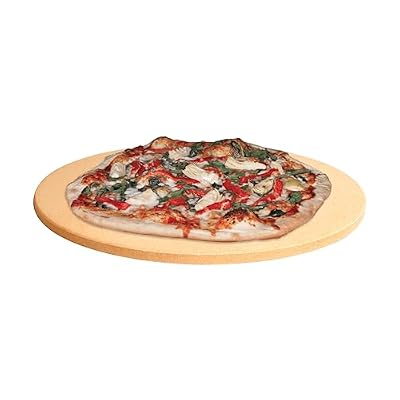
The Pizzacraft ThermaBond stone uses a patented composite material rather than plain cordierite or ceramic. ThermaBond is made from all-natural materials, and the maker designs it to resist thermal shock, so cold dough can land on a hot stone without the cracking risk that haunts thin ceramic. It handles temperatures up to 900 degrees Fahrenheit, which covers every home oven and most grills.
At 16.5 inches in diameter, this is the largest round stone in this guide, and the extra half inch matters when you roll dough to the edge. The stone needs no seasoning or conditioning before first use, and cleanup is simple: hot water and a non-abrasive scrubber, with no soap. Like other unglazed stones, it darkens and spots with age, and those marks are normal and harmless.
This pick suits cooks who want a stone that is ready to use on day one with no learning curve. It also suits anyone who has cracked a stone before, since thermal shock resistance is the core feature of the ThermaBond material.
Specs
- Shape: Round, 16.5 inches in diameter
- Material: ThermaBond composite, all-natural and FDA-safe
- Maximum temperature: 900 degrees Fahrenheit
- Care: No seasoning needed, clean with hot water only
- Use: Oven and grill
5. Chef Pomodoro 16-Inch Pizza Steel

The Chef Pomodoro steel is the outlier in this guide, and it earns its place because steel behaves differently from stone in a useful way. Steel conducts heat about twenty times faster than ceramic, so it transfers a blast of heat into the dough the moment the pizza lands. The result is a deeply browned, crisp base in a shorter bake, which suits thin-crust pizza and high-temperature baking.
This plate measures 16 by 13.25 inches and is a quarter inch thick, which gives it enough mass to hold heat while staying light enough to move with one hand. It arrives pre-seasoned, so the surface resists sticking from the first bake, and finger holes along the edge give you a safe grip when the plate is hot. It works in the oven and on the grill, and it doubles as a griddle for flatbread and roasting vegetables.
Steel needs different care from stone. Wash it with hot water, dry it fully, and keep a thin coat of oil on the surface to prevent rust. It does not absorb moisture the way cordierite does, so the crust browns through conduction rather than drying, which gives a crisp and deeply colored texture.
This pick suits cooks who bake at the highest oven setting and want the fastest, darkest crust possible. It also suits sourdough bakers and grill owners who want a plate that handles direct flame without cracking.
Specs
- Shape: Rectangular, 16 x 13.25 inches
- Material: Pre-seasoned carbon steel
- Thickness: 1/4 inch
- Features: Finger holes for lifting
- Use: Oven and grill
Baking Stones at a Glance
| Pick | Shape and Size | Material | Max Temperature |
|---|---|---|---|
| Love This Kitchen | Round, 16 inches | Ceramic, ThermaShock | Oven and grill safe |
| Culinary Couture | Rectangular, 15 x 12 inches | Cordierite | 1,000 degrees Fahrenheit |
| Round cordierite with rack | Round, 16 inches | Cordierite | 1,800 degrees Fahrenheit |
| Pizzacraft ThermaBond | Round, 16.5 inches | ThermaBond composite | 900 degrees Fahrenheit |
| Chef Pomodoro | Rectangular, 16 x 13.25 inches | Pre-seasoned steel | Oven and grill safe |
If you bake mostly pizza, the round stones cover a full pie with room to spare, while the rectangular picks use rack space better for bread and rolls. If you bake on a grill, cordierite and steel handle direct heat with the widest safety margin. If you want the simplest cleanup, the steel plate tolerates soap and water, while unglazed cordierite needs only a scrape and a wipe.
How to Use a Baking Stone Well
Preheat the stone with the oven, and give it time. Place the stone on the lowest or middle rack, set the oven to your target temperature, and wait at least 30 minutes after the oven signals it is ready. A stone that is only partly heated gives a pale base, which is the most common complaint from new stone owners.
Dust your peel with flour or cornmeal before you load the dough, and work quickly once the pizza is topped. A slow transfer lets the dough stick to the peel, and a stuck pizza tears when you try to slide it onto the stone. If the dough resists, lift the edge and toss a little more flour underneath rather than forcing it.
FAQ
Do I need to preheat a baking stone before every bake?
Yes. Place the stone in a cold oven, heat the oven to your target temperature, and wait at least 30 minutes after the oven reaches temperature. A stone that is not fully heated cannot crisp the base.
Can I use a baking stone on a grill?
Yes, most cordierite and steel stones work on a grill, and many are rated well above grill temperatures. Place the stone on the grates, close the lid, and let it heat for 20 to 30 minutes before you load the dough.
Why did my baking stone crack?
The usual cause is thermal shock, which happens when a cold stone meets sudden high heat or a hot stone meets cold water. Always heat the stone with the oven, never place a frozen pizza directly on a fully heated stone, and never run a hot stone under cold water.
How do I clean a baking stone without soap?
Scrape stuck food off with a bench scraper or a stiff brush, then wipe the surface with a damp cloth and let the stone dry fully in the oven. Unglazed cordierite absorbs liquid, so soap leaves a taste in later bakes. Stains and dark marks are normal and do not affect how the stone bakes.
As an Amazon Associate, I earn from qualifying purchases made through links on this page. This disclosure applies to the product links in this guide, and it does not change the price you pay.




Write Your Review
No reviews yet. Be the first to share your experience!