
As an Amazon Associate we earn from qualifying purchases.
A cleaver and a chef knife look nothing alike on the cutting board, yet both claim to be the one blade a home cook reaches for most. The confusion is fair. A Chinese cleaver is sometimes sold as a Chinese chef knife, and a chef knife is sometimes called an all-purpose knife, so the two categories overlap in name even though they work in different ways. This guide compares the two shapes side by side, explains what each one does best, and presents five real knives — two cleavers and three chef knives — so you can match the blade to the way you cook. This article contains affiliate links, and this disclosure is the only one in the article.


The Shape Tells the Story
A cleaver has a wide, rectangular blade with a straight edge and a flat face. The tall blade gives your knuckles clearance above the board, and the flat face works like a bench scraper: you can scoop a pile of chopped vegetables and carry it to the pan in one motion. A chef knife has a pointed tip and a curved belly. The curve lets the blade rock through herbs and onions, and the point handles detail work such as trimming fat, scoring skin, and cutting around a bone.
Weight is the second difference. A vegetable cleaver is usually lighter than it looks, because the blade is thin, and the weight sits close to the handle. A meat cleaver is heavier by design, built to chop through joints and bone. A chef knife sits between the two: heavier than a thin vegetable cleaver, lighter than a bone cleaver, with the balance point near the bolster so the blade feels nimble during long prep sessions.
The third difference is the edge. Cleavers made for vegetables have a thin, keen edge that slices cleanly through cabbage, scallions, and garlic. Chef knives have a slightly thicker edge that stands up to rocking cuts and contact with the board. Neither edge is better in the abstract. The right choice depends on whether your prep is mostly slicing and scooping, or mostly rocking and detail work.
When a Cleaver Wins
Choose a cleaver when most of your prep is vegetables. The tall blade moves through a head of cabbage in long, even strokes, and the flat face transfers everything to the pan without a second tool. A cleaver also minces garlic and ginger fast, because you can crush a clove with the flat of the blade, then mince it with the edge. Cooks who prepare stir-fry meals several times a week get the most from this shape, since the cleaver slices, scoops, and transfers in one continuous motion.
A cleaver is less useful for tasks that need a point. It cannot trim silver skin from a tenderloin, score the skin of a duck breast, or cut a neat pocket into a chicken breast. It also struggles with very large cuts of meat that need a long slicing stroke, because the rectangular blade has no tip to lead the cut. If your cooking leans toward roasts, whole birds, and butchery, a chef knife earns its place first.
When a Chef Knife Wins
Choose a chef knife when your prep is varied. The pointed tip and curved belly handle the full range of home cooking: dicing an onion, slicing a tomato, trimming a pork loin, mincing parsley, and portioning a cooked roast. The rocking motion suits cooks who chop in place, and the point reaches into corners that a rectangular blade cannot.
A chef knife is less efficient than a cleaver for one specific job: moving a large pile of chopped food. The narrow blade cannot scoop the way a tall cleaver can, so you end up using your hand or a bench scraper. Cooks who chop a lot of vegetables in bulk often keep both blades and reach for the cleaver when the pile grows.
The Cleaver Picks
1. ZWILLING TWIN Signature 7-Inch Chinese Chef Knife
The ZWILLING TWIN Signature cleaver is a German-made vegetable cleaver with a 7-inch blade. It is precision stamped from a single piece of German special-formula steel, then ice-hardened by the FRIODUR process, which the maker uses to set the edge and improve corrosion resistance. The blade is tall enough to clear your knuckles and flat enough to scoop chopped food, while the black handle keeps the knife light in the hand.
Specs
- Blade: 7 inches, straight edge; Steel: German special-formula stainless, FRIODUR ice-hardened; Construction: precision stamped from a single piece; Handle: black, ergonomic; Care: dishwasher safe; Made in: Germany
This cleaver suits cooks who want a premium vegetable cleaver from a long-established German maker. The stamped construction keeps it lighter than a forged cleaver of the same size, so it moves quickly through a pile of scallions or a head of napa cabbage. The straight edge is easy to maintain on a whetstone, and the flat face doubles as a scraper for transferring food from board to pan.
2. TUO Fiery Phoenix 7-Inch Vegetable Cleaver
The TUO Fiery Phoenix is a 7-inch vegetable cleaver built around a 45-layer Japanese AUS-10 stainless core. The blade is hardened to 62 on the Rockwell scale, plus or minus 2, and hand sharpened by the Honbazuke method to 18 degrees per side. The rose-pattern blade sits on a Pakkawood handle, and the knife weighs about 10.4 ounces.
Specs
- Blade: 7 inches, straight edge; Steel: 45-layer Japanese AUS-10 stainless; Hardness: 62 plus or minus 2 HRC; Edge: 18 degrees per side, Honbazuke sharpened; Handle: Pakkawood, ergonomic; Weight: about 10.4 ounces; Gift box included
This cleaver suits cooks who want a harder, finer edge than a typical German cleaver offers. The AUS-10 core holds a keen edge through long vegetable prep, and the layered pattern gives the blade a distinct look on the board. The harder steel needs a gentler touch than a soft German blade: it is a slicer and mincer, not a bone chopper, and it rewards careful handling with a very clean cut.
The Chef Knife Picks
3. Dalstrong Gladiator Series 8-Inch Chef Knife
The Dalstrong Gladiator 8-inch chef knife is a forged Western chef knife built from German X50CrMoV15 high-carbon stainless steel. The steel is heat treated to 54 to 56 on the Rockwell scale, and the edge is hand polished to 16 to 18 degrees per side. The blade is full tang with a triple-riveted G10 handle, and the knife is NSF certified for professional kitchens. A protective sheath is included.
Specs
- Blade: 8 inches, curved belly, pointed tip; Steel: German X50CrMoV15 high-carbon stainless; Hardness: 54 to 56 HRC; Edge: 16 to 18 degrees per side, hand polished; Construction: forged, full tang; Handle: G10, triple riveted; Certification: NSF certified; Sheath included
This chef knife suits cooks who want a forgiving, tough Western blade. The softer German steel hones back easily and resists chipping when it meets a chicken joint or a hard squash, and the G10 handle stays secure with wet hands. Note that some older listings describe a Pakkawood handle for this model; the maker lists G10 for the current Gladiator chef knife, and this article follows the maker.
4. HENCKELS Classic 8-Inch Chef Knife
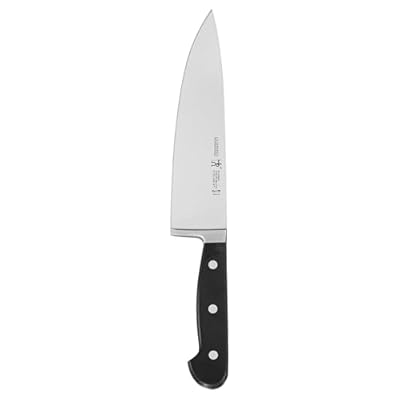
The HENCKELS Classic 8-inch chef knife is a German-engineered chef knife with a razor-sharp 8-inch blade. It is precision stamped from a single piece of German stainless steel, with a full tang and a triple-riveted handle. The blade has the classic Western profile: a pointed tip for detail work and a curved belly for rocking cuts.
Specs
- Blade: 8 inches, pointed tip, curved belly; Steel: German stainless steel; Construction: precision stamped from a single piece, full tang; Handle: triple riveted; Edge: razor-sharp factory edge
This chef knife suits cooks who want a dependable everyday blade at a modest size and weight. The stamped construction keeps it lighter than a forged knife of the same length, so it stays comfortable during long prep, and the full tang keeps the balance steady. It is the kind of knife that covers most home cooking without demanding special care beyond regular honing and hand washing.
5. Mercer Culinary Renaissance 8-Inch Chef Knife M23510

The Mercer Culinary Renaissance 8-inch chef knife, model M23510, is a high-carbon German steel chef knife built for culinary students and working kitchens. The 8-inch blade has a pointed tip and a curved belly, and the knife carries NSF certification. The handle is triple riveted and shaped for a secure grip during long shifts.
Specs
- Blade: 8 inches, pointed tip, curved belly; Steel: high-carbon German steel; Model: M23510; Construction: full tang; Handle: triple riveted; Certification: NSF certified
This chef knife suits cooks who want a professional-style blade without a premium label. The Renaissance line is a familiar sight in culinary schools, where knives are used hard every day, and the NSF certification reflects that working-kitchen intent. The 8-inch length is the standard all-purpose size, long enough for a cabbage and short enough for an onion.
Which One Fits Your Cooking
Match the blade to the food you cook most. If your week is built around stir-fries, salads, and vegetable prep, a cleaver does more work with less effort: the tall blade slices fast, and the flat face moves food without a second tool. If your week mixes roasts, whole chicken, fish, and vegetables, a chef knife covers more ground, because the point and the curved belly handle detail work a cleaver cannot.
Many cooks end up with both. A cleaver and a chef knife are not rivals so much as partners: the cleaver handles bulk vegetable prep, and the chef knife handles everything with a point, a curve, or a bone. If you can buy only one, count your meals. Vegetable-heavy cooking points to the cleaver. Mixed cooking points to the chef knife.
Care and Storage
Both shapes need the same basic care. Hand wash the blade and dry it right away, because a wet blade dulls faster and a wooden handle can swell. Hone the edge often with a honing steel, and sharpen it on a whetstone when honing no longer brings the edge back. Store the knife on a magnetic strip, in a block, or in a sheath, with the edge protected and the blade kept away from other metal. Never put a good knife loose in a drawer, and never use the edge to scrape food across the board — turn the blade over and use the spine, or use the flat face of a cleaver instead.
A cleaver needs one extra habit: keep the thin vegetable edge away from bone. A vegetable cleaver is a slicer, not a chopper, and hitting bone can chip the fine edge. A chef knife needs the opposite habit: use the heel of the blade for tough cuts and the tip for detail, and let the weight of the knife do the work rather than forcing it down.
FAQ
Can a cleaver replace a chef knife?
A cleaver can handle most vegetable prep and light meat slicing, but it cannot replace a chef knife for tasks that need a point, such as trimming fat, scoring skin, or cutting around a bone.
Is a Chinese cleaver the same as a meat cleaver?
No. A Chinese vegetable cleaver has a thin blade made for slicing and mincing, while a meat cleaver has a thick, heavy blade made for chopping through joints and bone.
What size chef knife should a home cook buy?
An 8-inch chef knife is the standard all-purpose size. It is long enough for a cabbage and short enough for an onion, and it suits most hands and most cutting boards.
How do I keep either blade sharp?
Hone the edge often with a honing steel, sharpen it on a whetstone when honing no longer restores the edge, and hand wash and dry the knife after every use.

Write Your Review
No reviews yet. Be the first to share your experience!