
A bench press rack is one of those pieces of home gym equipment that either quietly supports years of consistent training or becomes an expensive frustration sitting in a corner. The difference usually comes down to stability, weight capacity, and whether the adjustment mechanism stays put under load. Buyers shopping in this category typically want to add barbell work to a garage, spare room, or small apartment without sacrificing ceiling height or floor space to a full power cage.
The market is crowded with options that look similar at a glance but vary widely in steel thickness, pin quality, and footprint. Some stand-alone racks rated for moderate loads wobble noticeably once you load a barbell near the top of their range, while others hold firm at significantly higher weights. Owner feedback consistently highlights that build quality gaps appear within the first few months of use—loosening bolts, bent UHMW plastic pads, and frames that shift on slick flooring are the most common complaints. Price alone does not predict durability, and the cheapest rack in this lineup is not the same build as the cheapest rack from a different brand. This comparison looks at published specifications and verified owner reviews to help you identify which bench press rack fits your actual training pattern.
As an Amazon Associate we earn from qualifying purchases at no extra cost to you.




Quick Picks
| Product | Best for | Price |
|---|---|---|
| FitinOne Squat Rack | Compact home setups | $65.99 |
| F2C Adjustable Squat Rack | Value and load capacity | $66.98 |
| Adjustable Squat Rack Stand | Mid-range solid construction | $129.99 |
| CANPA Adjustable Squat Rack | Heaviest barbell loads | $93.57 |
| CAP FM-CS7000F Power Rack | Budget power rack with pull-up bar | $119.99 |
| Streamnova Adjustable Squat Rack | Beginners on a tight budget | $89.99 |
| BalanceFrom Steel Weight Bench | Combined bench and rack in one unit | $74.99 |
| CAP FM-8000F Deluxe Power Rack | Full power rack experience | $329.99 |
How We Picked
We filtered this category on four criteria that matter most for a bench press rack used in a home setting. First is rated weight capacity relative to actual frame dimensions—some racks advertise high numbers on thin-gauge steel that flexes noticeably, so we flagged that pattern in owner reviews. Second is adjustment ease: pin-lock versus bolt mechanisms, and whether the height range covers both low bench press positions and overhead squat starting points. Third is footprint and portability, which determines whether a rack can be moved out of the way in a shared room. Fourth is price-to-build-quality ratio, measured by comparing published specs against verified owner feedback on long-term durability.
The 8 Best Bench Press Rack in 2026
FitinOne Squat Rack
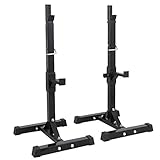
This height-adjustable multi-function rack suits apartment dwellers or anyone with limited floor space who still wants barbell capability at home. It doubles as a dumbbell organizer, which is genuinely useful when you are not training. Owners praise the compact footprint and the fact that it stores vertically against a wall when not in use. The adjustment mechanism uses a pin-lock system that is straightforward but not the smoothest at the extremes of its range.
- Pro: Extremely compact and easy to relocate between sessions.
- Pro: Serves as both a barbell rack and a dumbbell organizer.
- Con: Lower load tolerance means it is not ideal for heavy compound lifts beyond moderate weights.
Skip this if your primary goal is bench pressing above bodyweight or if you need a rack that stays permanently set up in one position.
F2C Adjustable Squat Rack
At 41 to 66 inches of adjustment range and a 550-pound max load, this pair delivers strong value under $67. The steel construction is described as sturdy by most owners, and the wide base gives a solid planted feel during setup. It works well as a standalone bench press rack without requiring a full cage. The trade-off is a somewhat basic finish and UHMW pad material that shows wear faster than higher-priced competitors.
- Pro: High load rating for the price point.
- Pro: Wide adjustment range covers bench press through overhead starting positions.
- Con: Pads and finish are utilitarian rather than premium.
Skip this if you want a rack that looks polished in a dedicated home gym or if you plan to use it as your sole squat setup for years.
Adjustable Squat Rack Stand
This stand sits in the middle of the price spectrum at just under $130 and offers a 350-pound capacity. Owners report solid construction with a focus on stability, and the pin-lock height adjustment is rated as smooth and secure. It occupies a reasonable footprint and works well alongside a standard flat or adjustable bench. Some users note the weight rating is lower than expected for the price, which may matter if you are approaching advanced bench press loads.
- Pro: Solid build quality with no reported wobble issues in reviews.
- Pro: Compact enough to pair with most home benches without crowding.
- Con: 350-pound cap limits headroom for lifters progressing quickly.
Skip this if you already bench above 300 pounds or expect to within the next year.
CANPA Adjustable Squat Rack
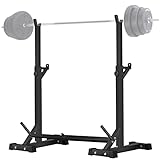
The standout spec here is the 600-pound load rating, making it the highest-capacity stand-alone rack in this comparison. At $93.57, it delivers a meaningful amount of strength headroom for intermediate and advanced lifters. The black finish is a practical choice for a garage or basement gym where scuffs are inevitable. Owner feedback highlights stability and solid pin engagement. The main drawback is weight and bulk—this is not a rack you move daily.
- Pro: Highest load capacity in this lineup at 600 pounds.
- Pro: Strong value relative to its rated strength.
- Con: Heavier and bulkier, less suited to small or shared spaces.
Skip this if you need portability or if your space genuinely cannot accommodate a wider footprint.
CAP FM-CS7000F Power Rack
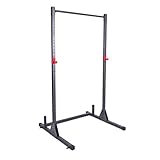
This is a full enclosed power rack rather than a pair of stands, and at $119.99 it is the cheapest true cage option here. The 300-pound capacity is adequate for most home lifters, and the integrated pull-up bar adds upper-body work without a separate attachment. The carbon finish looks clean for the price. The limitation is obvious: 300 pounds is a ceiling that serious bench press progressors will hit relatively quickly.
- Pro: Enclosed cage with safety bars eliminates the need for a spotter.
- Pro: Pull-up bar included at a price below most stand-alone racks.
- Con: 300-pound cap is the lowest in this comparison and may feel restrictive within a year of consistent training.
Skip this if you already bench near or above 300 pounds, or if your ceiling height cannot accommodate a full cage.
Streamnova Adjustable Squat Rack
Marketed explicitly for beginners, this 550-pound-capacity rack at $89.99 offers a comfortable margin above what a new lifter will load in their first year or two. The multi-function design and portability claim hold up in owner reviews, with several users noting it is easy to assemble and stable during use. The trade-off is that it shares some structural similarities with cheaper racks despite the higher price tag.
- Pro: High load rating suitable for multi-year progression from a beginner starting point.
- Pro: Straightforward assembly and portable enough for shared living spaces.
- Con: Pricing is close to the F2C option with fewer published specs per dollar.
Skip this if you are not a beginner and need more specific adjustment features or premium build quality.
BalanceFrom Steel Weight Bench with Squat Rack
This is a combined unit: a steel weight bench with an integrated squat rack, adjustable seat, and recliner function. At $74.99, it replaces the need to buy a separate bench and rack pair. The adjustable back support makes it useful for dumbbell work beyond barbell pressing. Owner feedback notes that the integrated rack is convenient but not the sturdiest component, and the bench pad is adequate rather than plush.
- Pro: Eliminates the need to purchase a separate bench, saving floor space and cost.
- Pro: Recline function expands exercise variety beyond flat pressing.
- Con: Integrated rack is less robust than dedicated stand-alone options at similar prices.
Skip this if you plan to load the rack heavily or if you already own a quality flat bench you prefer.
CAP FM-8000F Deluxe Power Rack
This is the premium option at $329.99 and functions as a full power rack rather than a bench press rack pair. It includes J-hooks, safety bars, a pull-up bar, and a footprint designed for serious home training. Owner reviews consistently note that the build quality justifies the price for lifters who train multiple times per week and need a permanent, secure setup. It is overkill for someone who only benches once a week with light loads.
- Pro: Full power rack features including safety bars that protect against failed reps.
- Pro: Build quality and long-term durability rated well above budget alternatives.
- Con: Price and footprint make it impractical for small spaces or casual users.
Skip this if you have limited floor space, a tight budget, or a training style that does not justify a permanent cage installation.
Buying Guide
Weight Rating vs. Real-World Stability
Published load ratings indicate a point before structural failure, not the threshold where a rack feels secure. A bench press rack rated at 550 pounds may begin to flex or shift perceptibly once you load 300 to 350 pounds on the barbell. Owner reviews are your best indicator of this gap. Look for complaints about wobble, walking, or pin slippage at moderate loads as a signal that the actual usable ceiling is lower than the sticker. Pair a rack rated for at least 1.5 times your working weight for comfortable headroom.
Height Adjustment Range and Mechanism
A bench press rack needs to start low enough for your shoulders at the bottom of a bench press (typically 12 to 16 inches off the floor) and go high enough for overhead squat rack positions. The adjustment mechanism matters too: pin-lock systems are fast but can loosen with vibration, while bolt-on brackets hold firm but take longer to reposition. If you train alone and switch between exercises frequently, prioritize a mechanism that you can operate with one hand and still feel confident in under load.
Footprint and Floor Surface Compatibility
Width between the uprights, base depth, and whether the rack uses rubber feet or plain metal on the bottom all affect usability in a home environment. On tile, hardwood, or polished concrete, a rack without wide rubberized feet will creep outward during a heavy unrack—this is one of the most common owner complaints in reviews. Measure your available floor space and confirm the base fits without blocking a doorway or forcing you to train at an awkward angle. If you must move the rack after each session, weight and a fold-flat design become decisive factors.
Our Verdict
The top pick is the CANPA Adjustable Squat Rack. Its 600-pound capacity provides the most strength headroom in this group, and the price sits well below comparable-rated options. For lifters who want a dedicated bench press rack they will not outgrow within a couple of years, it offers the best margin of safety and stability per dollar.
The budget pick is the F2C Adjustable Squat Rack at $66.98. Its 550-pound rating and wide adjustment range are nearly identical to options costing more than fifty percent above its price.
If you specifically need a bench and rack in one unit and do not want to source them separately, the BalanceFrom Steel Weight Bench with Squat Rack wins that condition at $74.99, provided your barbell loads stay moderate.
FAQ
Can I use a bench press rack for squats too?
Yes, provided the height range extends high enough for your standing rack position and the frame width accommodates your feet shoulder-width stance. Most stand-alone racks in this guide reach at least 41 inches and several go above 60 inches, which covers squat starting heights for most users.
Do I need a full power rack for safe bench pressing at home?
Not necessarily. A bench press rack works safely up to moderate loads if you use dumbbell chokes or a spotter arm on your bench. A full power rack becomes important when you train alone and approach weights where a failed rep could trap you under the bar.
How much should I expect to spend on a quality bench press rack?
Stand-alone racks with adequate load ratings and solid construction start around $65 to $90. Premium options with higher capacities, better finishes, or integrated features run $100 to $330. Spending more does not automatically mean better stability, so read owner feedback on wobble and pin quality before selecting.
Will a bench press rack damage my flooring?
Racks with bare metal feet can scratch hardwood or tile under dynamic loading. Adding a rubber mat or choosing a model with rubberized feet prevents this. For carpet, most racks hold position well, but heavy loads on soft carpet can cause the base to sink unevenly and introduce instability.







Write Your Review
No reviews yet. Be the first to share your experience!