
The Presto 23-quart pressure canner is the safest starting point for most glass top stove owners: it is a long-running, widely documented design with a flat bottom, a familiar weighted-regulator layout and clear manufacturer guidance for smooth-top ranges. If you cook on induction, or you want a bigger 24-quart kit with racks and tools included, several of the other listings below fit better. “Glass top” simply means a smooth ceramic-glass cooking surface, which needs a flat-bottomed pot, a burner of matching size and a load that will not stress the glass. This guide ranks six pressure canners with those limits in mind.
Quick List
- Presto 23-Quart Canner and Cooker – best for first-time canners who want a proven, well-documented design
- 24 Qt Canner with Gauge and 5/10/15 PSI Regulator – best for induction-ready kitchens that still want a dial gauge
- 24 Qt Induction and Gas Canner, 14.5 PSI – best for cooks who also want steamer inserts for pressure cooking
- T-fal 22-Quart Aluminum Canner – best for a lighter aluminum pot with three pressure settings
- 24 Qt 11-Piece Canning Kit – best for buyers who want tools bundled with the pot
- Kitchen Affections 24 Qt Kit – best for weighted-control fans who want racks and six tools included
Which One Is Right for You?
| If you… | Choose |
|---|---|
| want the most established design with plenty of published guidance | Presto 23-Quart |
| need a pot marked for induction as well as radiant glass | 24 Qt Canner with Gauge and 5/10/15 PSI Regulator |
| want stainless steel steamer inserts for everyday pressure cooking | 24 Qt Induction and Gas Canner, 14.5 PSI |
| prefer a lower-weight aluminum pot and a simple three-setting design | T-fal 22-Quart |
| are starting from zero and want jar tools in the same box | 24 Qt 11-Piece Canning Kit |
| like 10 and 15 PSI weights and want two racks plus six tools | Kitchen Affections 24 Qt Kit |
Start with your range manual, because the stove decides more than the canner does. If the manual allows canning and your largest burner is close to the pot’s base diameter, the Presto and T-fal are the most conservative choices. If you are induction-based, narrow the list to the listings that say induction or “induction ready” and confirm the base is magnetic on the product page.

Presto 01781 23-Quart Pressure Canner and Cooker
Included for '6 Best Pressure Canners for Glass Top Stoves (October 2026) Complete Guide' as a relevant option in this category; details come from the product listing.
View on Amazon
24 Qt Pressure Canner with Gauge, 5/10/15 PSI Regulator, Induction Ready | 24 Qt aluminum canner with gauge, 5/10/15 PSI regulator, rack & sealing ring; for induction, gas and electric cooktops.
Included for '6 Best Pressure Canners for Glass Top Stoves (October 2026) Complete Guide' because the listing specifies 5/10/15 PSI Regulator and Induction Ready, details this guide uses to compare options.
View on Amazon
24 QT Pressure Canner for Induction and Gas, 14.5 PSI Precision Pressure Cooker for Canning, includes 2 Stainless Steel & 1 Aluminum Steamer Racks, 7-Piece Canning Supplies Starter Kit
Included for '6 Best Pressure Canners for Glass Top Stoves (October 2026) Complete Guide' because the listing specifies 14.5 PSI Precision Pressure Cooker for Canning and includes 2 Stainless Steel & 1 Aluminum Steamer Racks, details this guide uses to compare options.
View on Amazon
T-fal 22-Quart Aluminum Pressure Canner, 3 PSI Settings, Home Canning, Includes Racks & Canning Guide, Large Capacity, Pressure & Water Bath Canning for Vegetables, Meats, Seafood & Fruits, Silver
Included for '6 Best Pressure Canners for Glass Top Stoves (October 2026) Complete Guide' because the listing specifies 3 PSI Settings and Home Canning, details this guide uses to compare options.
View on Amazon
24QT Pressure Canner, 11-Piece Kit, Gas & Induction, 5/10/15 PSI Regulator | Green complete 11-Piece Canning Kit with Pressure Gauge & Multi-Stovetop Compatibility
Included for '6 Best Pressure Canners for Glass Top Stoves (October 2026) Complete Guide' because the listing specifies 11-Piece Kit and Gas & Induction, details this guide uses to compare options.
View on Amazon
Kitchen Affections 24 Quart Pressure Canner Kit with Gauge, 10 & 15 PSI Weights, 2 Racks & 6 Canning Tools, Aluminum Canner for Induction, Gas & Electric Stoves
Included for '6 Best Pressure Canners for Glass Top Stoves (October 2026) Complete Guide' because the listing specifies 10 & 15 PSI Weights and 2 Racks & 6 Canning Tools, details this guide uses to compare options.
View on AmazonAll 6 Picks in Detail
1. Presto 23-Quart Pressure Canner and Cooker – Best for Proven Basics
As an Amazon Associate we earn from qualifying purchases at no extra cost to you.

This is the pot most home canners picture when they say “pressure canner.” The listing is a 23-quart canner and cooker from Presto, a brand that publishes extensive canning guidance, including notes on heat sources. Presto states that its current stovetop canners are intended for gas, electric coil and smooth-top ranges, while still telling owners to check the range manufacturer’s instructions first. That guidance, plus a flat-bottomed aluminum body, makes it the reference point for the rest of this list.
In day-to-day use, the appeal of this pot is predictability. Because the design has been sold for years, there are printed manuals, recipe booklets and replacement-part references that other canners rarely match, and extension-service classes often use the same layout when they teach beginners. On a glass top that predictability helps: you can follow Presto’s published advice about picking the element closest to the base and avoiding two heated elements at once, rather than improvising. Expect to heat slowly, vent steam for the full ten minutes and let the pot depressurize on its own.
- Capacity: 23 quarts, sized for quart jars in a single layer and pints stacked on a rack (confirm exact jar counts on the listing)
- Material: aluminum body, so it is not an induction pot
- Pressure control: a regulator-style system; confirm whether the listing includes a dial gauge
- Heat sources: gas, electric coil and smooth-top, subject to your range manual
- Included: canning rack and instructions; confirm contents on the listing
Pros
- Extensive manufacturer documentation and a long track record
- Flat base suited to radiant glass elements
Cons
- No induction compatibility
- Tall pot that is heavy once loaded with jars and water
Compared with the T-fal, it offers a better-documented path for beginners, but the T-fal gives you three pressure settings in a slightly smaller pot.
2. 24 Qt Pressure Canner with Gauge, 5/10/15 PSI Regulator – Best for Induction-Ready Kitchens

This 24-quart aluminum canner is listed as induction ready, comes with a gauge, a 5/10/15 PSI regulator, and a rack. The combination matters on glass: an induction-ready base is usually built with a magnetic layer and a flat bottom, which tends to sit well on a smooth cooktop, and the three-step regulator covers the common processing pressures. It suits cooks who move between a radiant glass stove and an induction hob, or who plan to upgrade soon.
The practical question with any induction-ready aluminum canner is how the magnetic layer is built into the base. A bonded or encapsulated plate sits flat and conducts heat across the pot, while a loose disc can rattle or leave gaps. The listing does not say which construction is used, so look at the product photos and any Q&A before buying. If you only own a radiant glass range today, you are paying for flexibility you might use later; if you are replacing a range with induction, this is the type of canner to shortlist first.
- Capacity: 24 quarts
- Material: aluminum body, described as induction ready
- Pressure control: gauge plus a 5, 10 and 15 PSI regulator
- Included: rack and extras as stated on the listing (confirm the full list)
- Heat sources: induction, gas and presumably radiant glass; confirm in the manual
Pros
- Works for induction owners without a separate pot
- Gauge and regulator give two ways to watch pressure
Cons
- Less published safety history than the Presto
- Gauge still needs yearly accuracy testing
Next to the 14.5 PSI model, this one offers a true 15 PSI setting, which matters for high-altitude weighted-gauge canning.
3. 24 QT Pressure Canner for Induction and Gas, 14.5 PSI – Best for Pressure-Cooking Versatility

This 24-quart pot is marketed for induction and gas, tops out at 14.5 PSI, and includes two stainless steel steamers and one aluminum steamer. The steamers lean toward everyday pressure cooking as much as canning, which suits someone who wants one large pot for both stock and jars. The 14.5 PSI ceiling is the detail to read carefully: it is below the 15 PSI that weighted-gauge canning calls for above 1,000 feet of elevation.
Think of this pot as a large pressure cooker that can also do canning duty. The three steamer inserts let you cook vegetables, tamales or seafood above the liquid, and the 24-quart volume handles big batches of stock. For canning, the 14.5 PSI limit means you should check every recipe’s required pressure against the elevation you live at before committing. Below 1,000 feet, a 10 PSI weighted process fits comfortably inside its range, so the limit only bites for people at higher elevations who need the 15 PSI step.
- Capacity: 24 quarts
- Stated heat sources: induction and gas; confirm radiant glass in the manual
- Pressure: up to 14.5 PSI
- Included: two stainless steel and one aluminum steamer
- Gauge or weights: confirm on the listing
Pros
- Several steamer inserts for flexible cooking
- Induction and gas listed
Cons
- 14.5 PSI may fall short for high-elevation recipes that call for 15 PSI
- Listing does not mention glass top explicitly
Compared with the 24 Qt gauge-and-regulator model, it trades a full 15 PSI setting for extra inserts.
4. T-fal 22-Quart Aluminum Pressure Canner – Best for Lighter Aluminum Simplicity
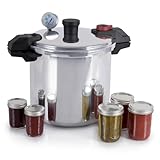
T-fal’s 22-quart canner is a polished aluminum pot with three PSI settings, racks and a canning guide, and it is described for both pressure and water bath canning. Manufacturer information describes 5, 10 and 15 PSI positions and a locking lid with a steam release valve. It does not claim induction support in its manufacturer copy, so treat it as a gas, coil and (after checking the range manual) glass-top pot.
This is the pot to look at if lifting is a concern. Manufacturer data lists a fairly modest empty weight compared with heavy cast designs, and the 22-quart size keeps the loaded total lower than a 24-quart. T-fal’s own copy also mentions water bath use for high-acid foods such as jams and pickles, which makes it a reasonable all-rounder for a household that cans both ways. Because sources disagree on its induction support, treat it as a gas, coil and radiant glass pot unless the product page clearly says otherwise.
- Capacity: 22 quarts, roughly seven quart jars per batch per manufacturer information
- Material: polished aluminum
- Pressure settings: 5, 10 and 15 PSI
- Included: racks and a canning guide
- Induction: not claimed by the manufacturer; confirm on the listing
Pros
- Brand with easy-to-find replacement parts and guides
- Three clear pressure positions
Cons
- Not intended for induction
- Smaller than the 24-quart options
Against the Presto, it is similar in size and design, with the Presto better documented for smooth tops.
5. 24QT Pressure Canner, 11-Piece Kit, Gas & Induction – Best for Starter Kit Buyers

This green 24-quart canner is sold as an 11-piece kit with a pressure gauge, a 5/10/15 PSI regulator and accessories for jars. For a first-time canner it removes the shopping-list problem: jar lifter, funnel and similar tools usually come together, though the exact pieces should be confirmed on the listing. The gas and induction compatibility suggests a flat base, but you should still confirm radiant glass use in the manual.
Kits are tempting because the first canning season requires so many small items: a jar lifter, a funnel, a bubble remover, a magnetic lid wand and a headspace tool. If the 11 pieces cover those, you avoid a separate shopping trip and can start the same weekend. The trade-off is that bundled tools are rarely premium, so plan on replacing the jar lifter if the grips feel flimsy. Hot jars are heavy and slippery, and a weak lifter is the item most likely to cause a spill.
- Capacity: 24 quarts
- Kit: 11 pieces; confirm the contents
- Pressure: gauge and 5/10/15 PSI regulator
- Heat sources: gas and induction listed
- Finish: green exterior per listing
Pros
- Tools bundled with the pot
- Full 5/10/15 PSI range
Cons
- Tool quality varies in bundles
- Limited track record compared with older brands
Compared with the Kitchen Affections kit, it is the broader bundle, while the Kitchen Affections spells out its weights and racks more specifically.
6. Kitchen Affections 24 Quart Pressure Canner Kit – Best for Weighted-Control Fans

The Kitchen Affections kit pairs a 24-quart aluminum canner with a gauge, 10 and 15 PSI weights, two racks and six canning tools. Weighted control is a plus because the weight rocks audibly and does not rely on a dial that can drift. The listing says it suits induction and gas; the rest of the title is cut off, so confirm radiant glass use on the product page.
Having both a gauge and weights is a sensible redundancy for a new canner. If the dial reads a little off, the weight still jiggles at the correct pressure, and the mismatch tells you the gauge needs testing. Two racks let you stack pint jars in two layers, which helps when you are doing a large harvest on a single burner. Because only 10 and 15 PSI weights are mentioned, anyone who wants a gentle 5 PSI setting for cooking will need to confirm whether one ships in the box.
- Capacity: 24 quarts
- Pressure: gauge plus 10 and 15 PSI weights
- Included: two racks and six canning tools
- Material: aluminum
- Heat sources: induction and gas listed; confirm others
Pros
- Weights plus gauge give a cross-check
- Two racks allow stacking pints
Cons
- No 5 PSI weight listed
- Less detailed documentation than the big brands
Next to the T-fal, it adds a gauge and tool bundle, while the T-fal has a 5 PSI setting.
Specs Compared
| Model | Capacity | Material | Pressure control | Stated heat sources | Included |
|---|---|---|---|---|---|
| Presto 23-Quart | 23 qt | Aluminum | Confirm on listing | Confirm on listing | Confirm on listing |
| 24 Qt Gauge and Regulator | 24 qt | Aluminum | Gauge, 5/10/15 PSI regulator | Induction ready | Rack and extras |
| 24 QT 14.5 PSI | 24 qt | Confirm on listing | Up to 14.5 PSI | Induction and gas | Two stainless and one aluminum steamer |
| T-fal 22-Quart | 22 qt | Aluminum | 5/10/15 PSI settings | Confirm on listing | Racks and canning guide |
| 24QT 11-Piece Kit | 24 qt | Confirm on listing | Gauge, 5/10/15 PSI regulator | Gas and induction | 11-piece kit |
| Kitchen Affections 24 Qt | 24 qt | Aluminum | Gauge, 10 and 15 PSI weights | Induction and gas | Two racks, six tools |
How We Chose These
This list is built from research, not bench work. We compared each listing name against its specification fields, then checked manufacturer pages where they exist for pot capacity, material, pressure settings and stated stove compatibility. Priority went to flat-bottomed canners with a clearly stated pressure system, because a smooth glass top punishes warped or ridged bases. We also weighted visible safety hardware (gauge, regulator or weights, locking lid), the presence of a rack, and whether the listing names the cooktops it supports. Where a detail was not stated, we say to confirm it on the product page rather than guess.
What to Look For
Check your range manual first
The stove is the limiting factor. Some range manufacturers explicitly forbid canning on a smooth top, others allow it only with flat-bottomed cookware that does not extend more than about an inch beyond the element. Read the section on cookware and canning before buying. If your manual prohibits canning, an outdoor propane burner or a portable induction hob rated for heavy loads is the safer route.
Base shape, size and weight
A glass top needs a perfectly flat base with no rim ridges or warping. Match the pot to the element: a canner with a base close to the burner diameter heats evenly, while a base much larger than the element leaves the edges cold and can trap heat in the glass. Loaded weight matters too. Seven quart jars, a few quarts of water and an aluminum pot can easily total 40 pounds or more, so lift jars rather than sliding a full canner across the surface, and never drop it on the glass.
Gauge, weights and PSI settings
Weighted gauges are generally described as 10 PSI for elevations up to 1,000 feet and 15 PSI above that, while dial gauges require 11 PSI up to 2,000 feet, then 12, 13 and 14 PSI as elevation climbs in 2,000-foot steps. A canner capped at 14.5 PSI is fine for most home recipes but cannot reach the 15 PSI figure. Dial gauges should be checked for accuracy every year; many cooperative extension offices do this for a small fee or free. A weight-based system does not drift, but the vent pipe still needs cleaning after each batch.
Induction versus radiant glass
Induction cooktops are also glass but heat the pot magnetically, so aluminum bodies need a bonded magnetic plate. “Induction ready” listings promise that, but confirm it on the product page. On a radiant glass range, induction compatibility is not required; a smooth, heavy base matters more.
Venting, cooling and everyday care
Good habits matter as much as hardware. Vent steam for ten minutes before closing the vent so air is purged from the pot, because trapped air lowers the true temperature inside. Keep the heat steady while the canner holds pressure; large swings can cause the weight to drop out of pressure and force you to restart timing. When processing ends, turn off the heat, slide the pot only if the manual allows it, and wait for the pressure to reach zero before opening the lid. Wash the lid, vent pipe and gasket by hand, and check the gasket for cracks at the start of each season. On a glass top, wipe sugar or food spills from the surface immediately, since baked-on residue scratches the glass when a heavy pot moves over it.
A worked example
Say you can green beans in quart jars at 600 feet with a weighted-gauge pot. You would process at 10 PSI, vent steam for 10 minutes before adding the weight, and time the batch from when pressure is reached. With seven quarts in a 23-quart pot and an 8-inch element, you would keep the heat moderate so the element cycles less often, then let the pot cool naturally rather than forcing it with cold water. Always follow a validated recipe from a source such as the USDA or your extension service.
Questions
Can you pressure can on a glass top stove?
Often yes, but only if the range manual allows it and the canner has a flat bottom that matches the element. Presto states that its current stovetop canners work on smooth-top ranges. If your stove maker forbids canning, use a different heat source.
Will a heavy canner crack the glass?
A loaded canner is heavy, and impact or dragging causes damage more than steady weight. Lift it into place, avoid sliding it and do not exceed the weight limit in the range manual.
Do I need an induction canner for a glass top?
Not for a radiant glass stove. Induction compatibility only matters if your cooktop is induction. An induction-ready pot can still be a good fit for radiant glass if its base is flat.
Should I choose a gauge or weights?
Weights are simple and do not drift, while dial gauges let you see pressure at a glance but need yearly testing. Models offering both give a useful cross-check.
How big should a pressure canner be?
A canner that holds seven quart jars suits most households. Larger pots are heavier and harder to heat evenly on a single glass element.
Can I use a pressure canner for water bath canning?
Many can, if the listing says so, since high-acid foods are processed in boiling water without pressure. Leave the lid unlocked and follow a validated water bath recipe.
Update History
- October 20, 2026 – Initial publication; product set drawn from current catalog listings.
- Check the product page for current specifications and availability before buying.
Sources
- Manufacturer product and specification pages for Presto and T-fal
- Manufacturer canning guidance on heat sources for smooth-top ranges
- Retailer listing titles and specification fields
- Pressure and altitude figures follow commonly published USDA home canning guidance
Write Your Review
No reviews yet. Be the first to share your experience!