
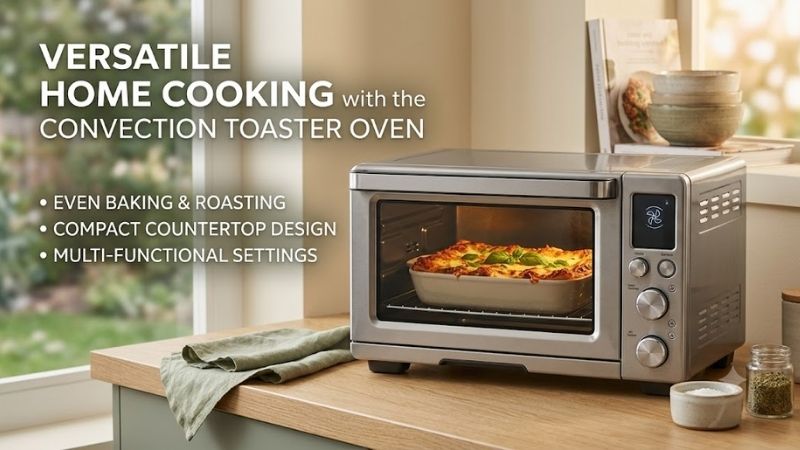
A convection toaster oven can handle everyday baking, roasting, toasting, and reheating without requiring a full-size oven for every meal. The right model depends on cooking capacity, countertop space, temperature controls, and cleaning needs. This guide compares six options to help you choose an oven that fits your kitchen and cooking routine.
- Quick Verdict: Which Convection Toaster Oven Should You Buy?
- Quick Comparison Table
- How We Selected These Convection Toaster Ovens
- Detailed Convection Toaster Oven Reviews
- Convection Toaster Oven Buying Guide
- Which Convection Toaster Oven Fits Your Cooking Routine?
- Common Mistakes When Using a Convection Toaster Oven
- Frequently Asked Questions
- Conclusion
Quick Verdict: Which Convection Toaster Oven Should You Buy?
The Breville Smart Oven Pro BOV845 is our best overall recommendation for home cooks who want a traditional countertop convection oven with versatile cooking functions, practical accessories, and straightforward digital controls.
However, not every household needs the same combination of features and capacity.
-
Best Overall: Breville Smart Oven Pro BOV845 — A balanced choice for baking, roasting, reheating, and everyday convection cooking.
-
Best Budget-Oriented Option: BLACK+DECKER Extra-Wide 8-Slice TO3250XSB — Prioritizes useful oven capacity and simple controls over advanced presets.
-
Best for Air Frying and Grilling: Cuisinart Air Fryer Toaster Oven with Grill TOA-70 — Combines convection baking, air frying, and a dedicated grill/griddle accessory.
-
Best for Large Families: Breville Smart Oven Air Fryer Pro BOV900 — Offers a spacious cooking cavity, multiple rack accessories, and 13 cooking functions.
-
Best for Roasting Meat: KitchenAid Dual Convection Countertop Oven KCO224BM — Includes a temperature probe and convection cooking functions.
-
Best for High-Capacity Everyday Cooking: Ninja Foodi XL Pro Air Oven DT201 — A multifunction countertop oven designed for larger meals and air frying.
These recommendations reflect published product specifications, cooking functionality, and practical buyer needs rather than standardized hands-on performance tests. Actual cooking results depend on food quantity, rack placement, temperature selection, and preparation methods.
Quick Comparison Table
| Product | Best For | Key Specifications | Main Advantage | Trade-Off |
|---|---|---|---|---|
| Breville Smart Oven Pro BOV845 | Overall cooking versatility | 1800W; 10 presets; six-slice capacity | Traditional convection oven with broad cooking functionality | No dedicated air-fry preset |
| BLACK+DECKER TO3250XSB | Budget-focused shoppers | Eight slices; 12-inch pizza; convection baking | Extra-wide interior with simple controls | Fewer cooking modes |
| Cuisinart TOA-70 | Air frying and grilling | 1800W; 0.6 cu. ft.; eight functions | Dedicated air-fry basket and grill/griddle plate | Smaller cavity than large family ovens |
| Breville Smart Oven Air Fryer Pro BOV900 | Large households | 1800W; 1 cu. ft.; 13 presets | Large capacity with air fry and dehydrate modes | Substantial footprint and weight |
| KitchenAid KCO224BM | Roasting and temperature monitoring | 12 presets; 9 × 13-inch included pan | Integrated temperature probe | More features than basic users need |
| Ninja Foodi XL Pro Air Oven DT201 | Large-batch multifunction cooking | 1800W; 120V; XL countertop format | Broad cooking flexibility | Requires considerable counter space |
Capacity claims should be interpreted alongside interior dimensions and accessory requirements. An oven advertised to fit a particular pizza or baking pan does not necessarily accommodate every pan of the same nominal size, especially when handles or raised rims are included.
How We Selected These Convection Toaster Ovens
The six models were selected by comparing manufacturer-published specifications, cooking functions, included accessories, size, and suitability for different household requirements.
Our evaluation focused on practical features rather than unsupported claims about which oven cooks fastest or produces the most evenly browned food.
Convection Cooking Capability
Every selected oven uses fan-assisted heat circulation for at least part of its cooking functionality.
Convection can help expose food surfaces to moving hot air, supporting browning and moisture removal. However, fan placement, heating-element design, food arrangement, and temperature control influence real cooking results.
An air-fry function generally uses convection principles, but it does not automatically mean one appliance performs identically to another.
Usable Capacity and Countertop Footprint
We prioritized cooking capacity that translates into recognizable household tasks, such as preparing toast, roasting vegetables, reheating leftovers, or using a standard baking pan.
Exterior dimensions also matter. A larger oven may hold more food but occupy valuable preparation space and require additional ventilation clearance.
Controls and Cooking Flexibility
Traditional toaster ovens may provide manual temperature and timer controls, while advanced models offer digital presets, specialized convection modes, and additional functions.
More settings are useful only when they support the foods a household regularly prepares.
Cleaning and Maintenance
Removable crumb trays, accessible racks, practical interior surfaces, and replaceable accessories can simplify maintenance.
Air-fry baskets and specialized grilling accessories increase functionality but also create additional surfaces that need cleaning.
Specification and Evidence Limitations
The recommendations use documented manufacturer features and technical reasoning. They are not based on a single controlled testing program.
Therefore, differences in temperature accuracy, energy consumption, cooking noise, long-term reliability, and actual browning uniformity should not be treated as independently established rankings.
Detailed Convection Toaster Oven Reviews
1. Breville Smart Oven Pro BOV845 — Best Overall
Best For: Home cooks who want a versatile countertop convection oven for everyday meals without prioritizing dedicated air frying.
Why We Picked It: The Breville Smart Oven Pro combines conventional countertop oven functions with fan-assisted cooking, electronic controls, and a practical six-slice capacity.
Its combination of baking, roasting, broiling, reheating, and slow cooking makes it a suitable alternative to a full-size oven for many smaller cooking tasks.
Key Specifications
| Specification | Details |
|---|---|
| Model | BOV845 |
| Power | 1800W |
| Voltage | 110–120V |
| Cooking Functions | 10 presets |
| Toast Capacity | Six slices |
| Pizza Capacity | 13 inches |
| Temperature Range | 120–450°F |
| Dimensions | 18.9 × 15.9 × 10.9 inches |
| Convection | Yes |
| Interior | Nonstick-coated cavity |
Features & Benefits
The Smart Oven Pro uses Breville’s Element IQ system, which manages power distribution among five quartz heating elements.
Its convection fan circulates heated air around food, making it useful for roasting vegetables, baking smaller dishes, and preparing foods that benefit from a drier cooking environment.
The LCD interface provides access to toast, bagel, bake, roast, broil, pizza, cookies, reheat, warm, and slow cook functions.
The slow cook setting allows extended low-temperature cooking for suitable recipes and compatible cookware.
Performance & Practical Use
For everyday cooking, the BOV845 is especially appealing to households that frequently alternate between breakfast preparation and simple dinners.
The six-slice capacity is useful for toast, while the 13-inch pizza accommodation makes the oven practical for frozen pizzas and smaller homemade pizzas.
Convection can improve hot-air circulation around roasted foods, although crowded pans still interfere with browning.
The temperature-controlled presets reduce the need to manually configure every setting, but they do not eliminate the need to monitor food.
What Makes It Different
Unlike air-fryer-focused countertop ovens, the Smart Oven Pro emphasizes traditional oven versatility and includes a dedicated slow cook function.
It offers a more conventional cooking workflow than models whose main selling point is high-speed crisping.
Pros
-
Ten preset functions cover a wide range of everyday cooking tasks.
-
Six-slice and 13-inch pizza capacities suit many small households.
-
Convection fan, interior light, and digital controls improve usability.
Cons
-
No dedicated air-fry or dehydrate mode.
-
Nonstick interior surfaces require appropriate cleaning methods.
Buy If: You frequently bake, roast, toast, and reheat food and prefer a traditional countertop oven with additional cooking flexibility.
Skip If: Dedicated air frying, very large baking pans, or the smallest possible countertop footprint are higher priorities.
2. BLACK+DECKER Extra-Wide 8-Slice TO3250XSB — Best Budget-Oriented Option
Best For: Budget-conscious households that need a spacious convection toaster oven with uncomplicated controls.
Why We Picked It: The BLACK+DECKER TO3250XSB concentrates on useful cooking capacity instead of extensive digital programming.
Its extra-wide design accommodates up to eight slices of toast, a 12-inch pizza, or a compatible 9 × 13-inch baking pan.
That makes it an appealing choice for households interested in practical cooking space without paying primarily for advanced presets.
Key Specifications
| Specification | Details |
|---|---|
| Model | TO3250XSB |
| Toast Capacity | Eight slices |
| Pizza Capacity | 12 inches |
| Pan Accommodation | 9 × 13 inches |
| Cooking Functions | Bake, broil, toast, keep warm |
| Convection | Yes, for baking |
| Timer | 60 minutes with stay-on function |
| Dimensions | 22 × 14.5 × 11.5 inches |
| Weight | 17.5 pounds |
| Rack Positions | Three |
Features & Benefits
The oven uses convection technology to circulate heated air during baking.
Its mechanical controls provide straightforward temperature, function, and timing adjustments without requiring users to navigate digital menus.
Three rack positions help accommodate different food heights, while the dedicated toast timer provides a separate control for browning toast.
A removable crumb tray makes routine cleanup more convenient.
Performance & Practical Use
The extra-wide interior is its most important practical advantage.
A compatible 9 × 13-inch pan allows users to prepare dishes such as brownies, baked pasta, or roasted vegetables using cookware they may already own.
However, the width of the oven also means it is not necessarily a compact choice despite its relatively simple design.
Its four-function control system covers common tasks but lacks the specialized air-fry, proofing, and dehydration programs available on more expensive models.
What Makes It Different
The TO3250XSB prioritizes interior width over advanced automation.
It is particularly relevant to shoppers who care more about fitting common baking dishes than choosing among numerous presets.
Pros
-
Extra-wide cooking cavity accommodates compatible 9 × 13-inch pans.
-
Mechanical controls are straightforward to operate.
-
Multiple rack positions increase flexibility.
Cons
-
Limited cooking functions compared with multifunction alternatives.
-
Its 22-inch exterior width requires substantial countertop space.
Buy If: You want a straightforward convection toaster oven and prioritize cooking capacity over advanced features.
Skip If: You need precise digital programming, a dedicated air-fry mode, or an especially narrow appliance.
3. Cuisinart Air Fryer Toaster Oven with Grill TOA-70 — Best for Air Frying and Grilling
Best For: Households that want a convection toaster oven capable of air frying and using a dedicated grill/griddle accessory.
Why We Picked It: The Cuisinart TOA-70 combines traditional convection oven functions with specialized accessories for preparing crispy foods and using its grilling feature.
Its 0.6-cubic-foot cavity provides a middle ground between compact ovens and larger countertop cooking appliances.
Key Specifications
| Specification | Details |
|---|---|
| Model | TOA-70 series |
| Power | 1800W |
| Capacity | 0.6 cubic feet |
| Cooking Functions | Eight |
| Maximum Adjustable Temperature | 450°F |
| Advertised Air-Fry Capacity | 3 pounds |
| Timer | 60 minutes with automatic shutoff |
| Interior | Stainless steel |
| Convection Bake | Yes |
| Convection Broil | Yes |
Features & Benefits
The TOA-70 includes air fry, convection bake, convection broil, standard bake, broil, warm, toast, and grill settings.
Its accessories include an oven rack, baking pan, air-fry basket, and dual-sided ceramic nonstick grill/griddle plate.
The air-fry basket helps expose more food surface area to moving hot air than a solid baking pan would.
The grill/griddle accessory broadens the oven’s functionality for foods suited to that specialized cooking surface.
An interior light allows users to inspect cooking progress without repeatedly opening the door.
Performance & Practical Use
For everyday meals, the Cuisinart is particularly useful when a household alternates between toast, roasted vegetables, chicken pieces, and air-fried side dishes.
The convection settings move heated air around food, while the dedicated air-fry basket supports airflow around appropriately spaced ingredients.
Although Cuisinart advertises a three-pound air-fry capacity, that figure should not be interpreted as a guarantee of uniform crisping with every three-pound food load.
Food arrangement, moisture content, and basket crowding still affect results.
The grill/griddle plate adds versatility, but it also requires cleaning after use and may demand more careful handling than a standard oven rack.
What Makes It Different
The included grill/griddle accessory distinguishes the TOA-70 from traditional convection toaster ovens.
It provides another cooking option without requiring a separate countertop appliance for every task.
Pros
-
Eight cooking functions include convection baking and air frying.
-
Dedicated air-fry basket and grill/griddle accessory increase versatility.
-
Stainless steel cavity and interior light support practical everyday use.
Cons
-
Smaller cooking cavity than large family-oriented ovens.
-
Multiple accessories require additional storage and cleaning.
Buy If: You regularly prepare air-fried foods and want grilling functionality in the same countertop appliance.
Skip If: You mainly bake large casseroles or prefer a simpler oven without specialty accessories.
4. Breville Smart Oven Air Fryer Pro BOV900 — Best for Large Families
Best For: Households that frequently cook larger meals and want one countertop appliance for roasting, baking, air frying, and dehydration.
Why We Picked It: The Breville BOV900 combines a one-cubic-foot interior with 13 preset cooking functions and a convection system offering a stronger airflow setting.
Its larger interior accommodates a broader range of cookware and meal sizes than most conventional six-slice toaster ovens.
Key Specifications
| Specification | Details |
|---|---|
| Model | BOV900 |
| Power | 1800W |
| Voltage | 110–120V |
| Interior Capacity | 1 cubic foot |
| Cooking Functions | 13 |
| Toast Capacity | Nine slices |
| Pizza Capacity | 13 inches |
| Pan Accommodation | Compatible 9 × 13-inch pans |
| Temperature Range | 80–480°F |
| Dimensions | 21.4 × 17.3 × 12.7 inches |
| Weight | 38.89 pounds |
Features & Benefits
The BOV900 includes toast, bagel, broil, bake, roast, warm, pizza, proof, air fry, reheat, cookies, slow cook, and dehydrate functions.
The convection system includes a higher-airflow setting designed for applications such as air frying.
Breville’s Element IQ technology manages heating-element operation, while PID temperature control is intended to help regulate the cooking environment.
The oven includes two racks, a pizza pan, a roasting pan with broiling rack, and a mesh basket for air frying and dehydrating.
This combination is useful when a household frequently switches among different cooking tasks.
Performance & Practical Use
A larger cavity provides greater flexibility for roasting vegetables, baking sheet-style meals, and preparing family-size portions.
Breville specifies accommodation for a 14-pound turkey, although the actual suitability of a particular bird depends on its dimensions, safe clearance, and the cooking instructions.
The dehydration setting is helpful for recipes that require controlled, lower-temperature airflow.
For air frying, the mesh basket permits hot air to circulate around foods more effectively than a solid-bottom pan, provided the food is arranged correctly.
The primary limitation is physical size. At nearly 39 pounds, the oven is not especially convenient to move between a cabinet and the countertop.
What Makes It Different
Compared with the BOV845, the BOV900 offers more capacity and specialized air-fry, proofing, and dehydration functions.
These differences are meaningful for households that regularly prepare varied meals rather than using a toaster oven mainly for toast and leftovers.
Pros
-
Spacious one-cubic-foot cooking cavity.
-
Thirteen cooking functions cover diverse household tasks.
-
Includes multiple racks and accessories for different cooking methods.
Cons
-
Large footprint requires dedicated countertop space.
-
More functions and accessories increase operating and cleaning complexity.
Buy If: You prepare larger family meals and want a countertop convection oven capable of handling many cooking methods.
Skip If: You mainly reheat single servings or have limited counter space.
5. KitchenAid Dual Convection Countertop Oven KCO224BM — Best for Roasting Meat
Best For: Home cooks who frequently roast poultry, meat, or other foods where monitoring internal temperature is important.
Why We Picked It: The KitchenAid KCO224BM combines dual-convection cooking with an integrated temperature probe.
The temperature probe offers a practical advantage for recipes that depend on reaching a particular internal temperature rather than relying exclusively on cooking time.
Key Specifications
| Specification | Details |
|---|---|
| Model | KCO224BM |
| Cooking Functions | 12 presets |
| Convection | Dual convection |
| Temperature Probe | Included |
| Baking Pan | 9 × 13 inches |
| Air-Fry Basket | Included |
| Interior Light | Yes |
| Display | Digital |
| Interior | Nonstick |
| Dehydration Function | Yes |
Features & Benefits
KitchenAid’s convection system uses fan-assisted air circulation alongside upper and lower heating elements.
The oven features 12 cooking presets, including air frying, baking, dehydration, pizza, and dough proofing.
Its included temperature probe provides an additional way to monitor the progress of suitable recipes.
The 9 × 13-inch baking pan accommodates larger dishes, while the air-fry basket provides another cooking surface for foods that benefit from greater air exposure.
An interior light lets users inspect food during cooking.
Performance & Practical Use
The KCO224BM is particularly relevant to households that prepare roasted chicken, pork, or other substantial main dishes.
A temperature probe can help cooks make decisions using the food’s internal temperature rather than assuming a fixed cooking duration will always produce the same result.
However, the probe must be inserted according to the manufacturer’s instructions, positioned correctly in the food, and used with appropriate food-safety temperature guidance.
The included air-fry basket also supports cooking smaller foods that benefit from circulating hot air.
KitchenAid advertises rapid preheating, but actual preheat behavior varies with the selected mode, target temperature, and starting conditions.
What Makes It Different
The temperature probe is the defining feature.
For cooks who prepare larger proteins regularly, this functionality may be more valuable than an additional collection of convenience presets.
Pros
-
Includes a temperature probe for monitoring suitable recipes.
-
Large baking pan supports family-oriented cooking.
-
Combines convection, air frying, dehydration, and proofing.
Cons
-
More complex than a basic manual toaster oven.
-
Temperature-probe use requires careful placement and cleaning.
Buy If: You frequently roast meat and value internal temperature monitoring alongside convection cooking.
Skip If: Your main tasks are toast, small snacks, or occasional reheating.
6. Ninja Foodi XL Pro Air Oven DT201 — Best for High-Capacity Everyday Cooking
Best For: Families seeking a multifunction countertop convection oven for larger meals, roasting, and air frying.
Why We Picked It: The Ninja DT201 belongs to Ninja’s Foodi XL Pro Air Oven series, which emphasizes larger-capacity countertop cooking and multiple heating modes.
Its 1800-watt electrical rating and broad oven functionality make it relevant to households that want more than a conventional toaster oven.
Key Specifications
| Specification | Details |
|---|---|
| Model | DT201 |
| Product Series | Foodi XL Pro Air Oven |
| Power | 1800W |
| Voltage | 120V |
| Frequency | 60Hz |
| Convection | Fan-assisted cooking |
| Air Frying | Supported |
| Oven Type | Multifunction countertop oven |
Features & Benefits
The Foodi XL Pro platform is designed to handle several cooking tasks using a countertop oven format.
Its cooking functionality includes convection-based applications, making it useful for preparing foods that benefit from hot-air circulation.
The larger oven format is intended for households that frequently prepare more than one or two servings.
Digital cooking controls provide access to different cooking settings without relying entirely on traditional mechanical dials.
Performance & Practical Use
For family meals, an XL countertop oven is useful when preparing roasted vegetables, reheating multiple portions, or cooking foods that require more room than a compact toaster oven offers.
The DT201’s 1800-watt rating identifies its maximum advertised electrical power, not its measured cooking speed or efficiency.
Actual results depend on the selected function, food load, cookware, and arrangement.
As with other large convection ovens, crowded racks can obstruct airflow and reduce the benefit of fan-assisted heating.
A larger cavity also requires more countertop space, and the oven’s accessories must be cleaned and stored after use.
What Makes It Different
The Ninja emphasizes multifunction cooking in an XL countertop format.
It is an alternative to the Breville BOV900 for buyers who want a family-oriented convection and air-fry oven but prefer Ninja’s cooking interface and appliance design.
Pros
-
Designed for larger countertop cooking tasks.
-
Combines convection cooking with air-fry functionality.
-
Digital controls support multiple cooking applications.
Cons
-
Large oven format is less suitable for cramped kitchens.
-
More functionality and accessories create additional cleaning and storage requirements.
Buy If: You frequently cook larger portions and want an XL convection countertop appliance.
Skip If: You only need occasional toast or reheating and prefer minimal countertop equipment.
Convection Toaster Oven Buying Guide
Choosing the right convection toaster oven starts with understanding how often you cook, what you prepare, and how much space you can dedicate to the appliance.
A model with more cooking modes is not automatically the best choice. Interior dimensions, controls, cleaning requirements, and accessory compatibility often have a greater effect on everyday satisfaction.
Convection vs. Conventional Heating
A conventional toaster oven primarily uses heating elements to transfer heat through radiation and natural air movement.
A convection toaster oven adds a fan that circulates heated air inside the cooking cavity.
This moving air can help transfer heat to food surfaces and remove moisture during roasting and browning.
Convection is particularly useful for:
-
Roasting vegetables.
-
Baking foods that benefit from more uniform air circulation.
-
Reheating foods where preserving a crisp surface matters.
-
Cooking smaller portions of poultry.
-
Preparing certain frozen foods.
However, delicate baked goods may respond differently to strong fan-assisted airflow.
Recipes developed for conventional ovens sometimes require temperature or timing adjustments when convection is enabled.
Follow the appliance’s recommended settings and check foods before the expected completion time when adapting a recipe.
Choose the Right Cooking Capacity
Cooking capacity should reflect the amount of food prepared most often, not the largest meal you might make once a year.
| Household Need | Useful Capacity Consideration |
|---|---|
| One person | Small oven accommodating one or two portions |
| Couple | Four- to six-slice oven for common daily tasks |
| Small family | Six- to eight-slice oven with practical baking-pan space |
| Larger family | XL oven that accommodates larger pans and multiple portions |
| Frequent baking | Confirm actual pan clearance and usable rack positions |
Advertised slice counts can be useful starting points, but bread size varies considerably.
Likewise, a stated pizza capacity does not necessarily indicate that all pans of the same diameter fit.
Measure the cookware you intend to use, including handles, and compare it against the oven’s internal dimensions.
Evaluate Countertop Space and Ventilation
Exterior dimensions are only part of the space requirement.
Convection toaster ovens release heat through vents and surrounding surfaces. Manufacturer-specified clearance must remain available during operation.
Before purchasing, measure:
-
Available countertop width.
-
Depth from the backsplash to the front edge.
-
Vertical space below overhead cabinets.
-
Clearance needed around vents.
-
Door-opening space.
-
Distance to a suitable electrical outlet.
Do not place a toaster oven inside an enclosed cabinet during operation unless the specific installation is expressly approved by the manufacturer.
Avoid storing objects on top of the appliance unless the manufacturer explicitly permits it.
Understand Wattage and Electrical Requirements
Many full-size countertop convection ovens use approximately 1800 watts, although electrical requirements vary by model.
Higher wattage does not necessarily mean faster cooking because temperature regulation, insulation, food quantity, and heating-element design also affect performance.
For US households, a 120V appliance rated at 1800 watts can draw approximately 15 amps at its rated load.
This matters because many household kitchen circuits also supply other appliances.
Avoid operating multiple high-power appliances on a circuit when their combined electrical demand could exceed its rating.
Plug the oven directly into an appropriate grounded outlet and follow the manufacturer’s electrical instructions. Avoid extension cords and power strips unless expressly permitted by the appliance manufacturer.
Decide Whether Air Frying Is Necessary
Air frying and convection cooking use related principles, but the cooking chamber and airflow design influence the results.
A dedicated air-fry setting may use stronger airflow, specialized heating behavior, or a mesh basket.
These features can help expose food surfaces to circulating hot air.
However, an air-fry preset does not guarantee that one oven produces crispier food than another.
If your main goal is baking cakes, reheating casseroles, and roasting vegetables, a traditional convection toaster oven may be sufficient.
If frozen fries, chicken wings, and similarly textured foods are frequent menu items, a model with a dedicated air-fry basket may offer a more convenient workflow.
Check Temperature Range and Cooking Functions
A broad temperature range provides flexibility, but not every household needs specialized settings.
Common features include:
Toast and Bagel: Designed for everyday bread preparation.
Bake: Used for pastries, casseroles, and smaller baked dishes.
Convection Bake: Adds air circulation for suitable recipes.
Broil: Uses strong upper heating for browning and finishing foods.
Roast: Intended for vegetables, meat, and similar dishes.
Warm: Maintains food at a selected temperature for appropriate holding periods.
Dehydrate: Uses controlled low-temperature heating and airflow.
Proof: Provides a controlled environment for suitable yeast doughs.
Air Fry: Uses convection heating and airflow for foods intended to develop crisp surfaces.
Choose cooking modes you are likely to use regularly rather than paying for a long feature list with little practical benefit.
Consider Digital Controls vs. Manual Dials
Digital controls make it easier to select presets, view programmed temperatures, and adjust timing.
They may be particularly useful for households that regularly cook several different kinds of food.
Manual controls can be easier for users who prefer direct adjustments and a simple interface.
Neither control type guarantees superior temperature accuracy.
Actual temperature stability depends on the appliance’s heating system, sensing components, and control behavior.
Examine Included Accessories
Accessories determine which cooking tasks are convenient immediately after purchase.
Useful accessories may include oven racks, baking pans, broiling trays, air-fry baskets, and removable crumb trays.
Before buying, check whether replacement accessories are available for the exact model.
Do not assume accessories from another brand or a similar-looking oven will fit correctly.
Improper accessories may interfere with rack placement, airflow, heating elements, or door closure.
Prioritize Practical Cleaning
Convection toaster ovens accumulate crumbs, oil residue, and cooking splatter.
Routine maintenance helps reduce smoke, odors, and residue buildup.
Useful cleaning features include removable crumb trays and accessible interior surfaces.
For normal cleaning:
-
Turn off and unplug the appliance.
-
Allow it to cool completely.
-
Remove crumbs and loose food debris.
-
Wash removable accessories according to the manual.
-
Wipe approved interior surfaces with suitable cleaning materials.
-
Dry all components before reassembly.
Do not immerse the oven body in water.
Avoid abrasive tools or harsh chemicals unless expressly approved for the particular surface.
Do not assume that every air-fry basket, nonstick tray, or removable accessory is dishwasher-safe.
Account for Long-Term Ownership
The purchase price is only one part of overall value.
A suitable convection toaster oven should also offer reasonable cleaning effort, accessible accessories, manageable storage requirements, and controls that fit the household’s routine.
Replacement racks, crumb trays, and pans may matter more over several years than an extra preset used only occasionally.
Warranty coverage is also model-specific. Confirm the applicable coverage and conditions rather than assuming models from the same brand share identical terms.
Which Convection Toaster Oven Fits Your Cooking Routine?
The best choice becomes clearer when matched to specific kitchen needs.
For Apartment Kitchens and Smaller Households
The Breville Smart Oven Pro BOV845 is an appealing choice for smaller households that frequently cook rather than merely toast bread.
Its traditional convection functions provide flexibility without the size of the largest XL models.
However, renters with especially limited counter space should still compare exterior dimensions and required clearances before choosing it.
For Everyday Baking on a Budget
The BLACK+DECKER TO3250XSB is worth considering when usable baking space is more important than extensive programming.
Its compatibility with suitable 9 × 13-inch pans makes it practical for brownies, baked pasta, and similar dishes.
The trade-off is fewer cooking modes and a relatively wide exterior.
For Air-Fried Snacks and Mixed Meals
The Cuisinart TOA-70 offers a convenient combination of toaster oven, convection oven, air-frying equipment, and grilling accessory.
It suits households that regularly prepare smaller portions of several different foods.
Buyers should consider the additional storage and cleaning needs associated with the grill plate and air-fry basket.
For Large Family Dinners
The Breville BOV900 offers a particularly useful combination of cooking capacity and specialized functions.
Its large cavity is appropriate for many family-oriented cooking tasks, while the proofing and dehydration programs extend its usefulness beyond conventional baking.
The size and weight are important considerations for households without permanent countertop space.
For Roasting Meat
The KitchenAid KCO224BM is especially relevant to cooks who want an integrated temperature probe.
The ability to monitor internal temperature can improve the process of determining when appropriate foods are cooked to the desired and safe endpoint.
The probe does not replace correct food handling, placement, or temperature guidance.
For XL Multifunction Cooking
The Ninja DT201 is a reasonable option for households interested in larger-batch convection cooking and air frying.
It is more appropriate for a kitchen with ample counter space than for one where the oven must be stored after every use.
Common Mistakes When Using a Convection Toaster Oven
Overcrowding the Cooking Rack
Overcrowding restricts airflow around food.
This can produce less consistent browning, especially when cooking vegetables, fries, or breaded foods.
Arrange ingredients with sufficient spacing whenever the recipe and appliance instructions permit.
Using the Wrong Baking Pan
A pan that physically fits inside the oven may still be unsuitable if it touches heating elements, blocks required airflow, or lacks adequate clearance.
Check the manufacturer’s cookware guidance.
Avoid assuming that every pan labeled oven-safe is suitable for broiling or for every countertop oven configuration.
Ignoring Recipe Adjustments
Convection may affect cooking time and surface browning.
When adapting a conventional-oven recipe, begin with the appliance manufacturer’s recommended conversion guidance and monitor the food.
Do not automatically apply the same temperature reduction or cooking-time adjustment to every recipe.
Neglecting the Crumb Tray
Crumbs and grease residues can accumulate in the bottom of the appliance.
Regular removal and cleaning reduce the likelihood of smoke and unpleasant odors.
Never line the crumb tray or oven bottom with aluminum foil unless the manufacturer specifically allows it.
Leaving the Appliance Unattended
A convection toaster oven contains exposed or enclosed high-temperature heating components.
Food can smoke or burn when inappropriate settings, incorrect cooking times, or unsuitable materials are used.
Keep the appliance away from combustible objects, supervise cooking, and follow the instructions for safely removing hot cookware.
Frequently Asked Questions
Is a convection toaster oven better than a regular toaster oven?
A convection toaster oven offers fan-assisted heat circulation, which can be useful for roasting, browning, and certain baked foods.
A conventional toaster oven may be sufficient for toast, simple reheating, and occasional baking.
The better option depends on cooking frequency, food types, and whether convection provides a meaningful benefit for your meals.
Can a convection toaster oven replace a full-size oven?
A sufficiently capable convection toaster oven can replace a full-size oven for many small and medium cooking tasks.
However, its interior dimensions, rack arrangement, and total cooking capacity are more limited.
Large holiday meals, oversized cookware, and recipes requiring substantial vertical clearance may still require a full-size oven.
Is a convection toaster oven the same as an air fryer?
Not exactly.
Both can use heated air circulation, but dedicated air-fry functions may involve stronger airflow, different heating patterns, or specialized baskets.
A convection toaster oven with an air-fry setting combines the two cooking approaches within one appliance.
Results still vary by design, food load, and preparation method.
Can you put aluminum foil in a convection toaster oven?
Some manufacturers permit limited aluminum foil use in specific situations, while others prohibit certain placements.
Foil must never obstruct required airflow, contact heating elements, or cover surfaces against manufacturer instructions.
Check the manual for your exact model before using foil.
How do you clean a convection toaster oven?
Unplug the oven, allow it to cool, and remove loose crumbs.
Wash removable accessories using methods approved by the manufacturer, then wipe accessible interior surfaces with suitable cleaning materials.
Avoid immersing electrical components or using abrasive cleaners on surfaces that may be damaged.
Cleaning frequency depends on usage, particularly when preparing greasy foods.
How long should a convection toaster oven last?
There is no reliable universal lifespan for convection toaster ovens.
Service life depends on build quality, heating components, electronic controls, maintenance, cooking frequency, and the availability of replacement parts.
Regular cleaning, proper ventilation, suitable cookware, and adherence to manufacturer instructions can help reduce avoidable damage.
Conclusion
The Breville Smart Oven Pro BOV845 is the best overall convection toaster oven in this comparison for versatile everyday cooking. Choose the BLACK+DECKER TO3250XSB for simpler, capacity-focused baking; the Cuisinart TOA-70 for air frying and grilling; the Breville BOV900 for larger meals; the KitchenAid KCO224BM for temperature-monitored roasting; or the Ninja DT201 for XL multifunction cooking. Prioritize usable capacity, countertop clearance, cooking functions, and cleaning requirements over the number of advertised presets.







Write Your Review
No reviews yet. Be the first to share your experience!