
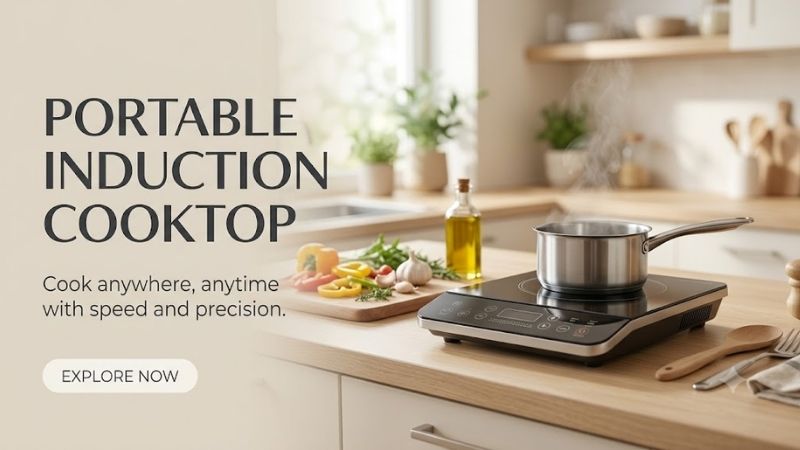
A portable induction cooktop offers a convenient way to prepare meals without installing another stove. It works especially well in small apartments, home kitchens that need an extra burner, and temporary cooking spaces with suitable electrical power. Unlike a traditional electric hot plate, induction technology generates heat directly in compatible cookware. That can provide responsive cooking control while reducing some heat losses associated with conventional electric cooking.
However, choosing the right portable induction cooktop involves more than looking at its maximum wattage. Pan compatibility, low-temperature control, ventilation, electrical requirements, and cooking-zone size all affect daily use. This guide compares six induction cooktops for different cooking needs, including everyday meal preparation, temperature-sensitive recipes, and two-burner cooking.
Quick Verdict
The Duxtop 9600LS is our best overall portable induction cooktop for its 1800-watt maximum output, 20 power levels, 20 temperature settings, and straightforward digital interface.
Our six recommendations are:
-
Best Overall: Duxtop 9600LS — Flexible controls for everyday cooking.
-
Best for Beginners: Duxtop 8100MC — Simple operation without excessive settings.
-
Best for Temperature Selection: Nuwave Gold Precision Induction Cooktop — Broad temperature-setting options.
-
Best for Two Dishes: Duxtop 9620LS — Two independently controlled cooking zones.
-
Best for Probe-Assisted Cooking: Nuwave Diamond Precision Induction Cooktop — External temperature-probe capability.
-
Best for Frequent Heavy-Pot Cooking: Duxtop P961LS — A professional-oriented single-burner design.
Quick Comparison Table
| Model | Maximum Power | Main Features | Best For |
|---|---|---|---|
| Duxtop 9600LS | 1800W | 20 power levels, 20 temperatures, LCD | Overall use |
| Duxtop 8100MC | 1800W | 10 power levels, digital controls | Beginners |
| Nuwave Gold | Selectable wattage | Wide temperature range, digital controls | Temperature flexibility |
| Duxtop 9620LS | 1800W total | Two cooking zones, separate controls | Two-pot meals |
| Nuwave Diamond | Model-dependent selectable power | Temperature probe, adjustable settings | Temperature-focused cooking |
| Duxtop P961LS | 1800W | Commercial-oriented housing, touch controls | Frequent use |
How We Selected These Cooktops
Our selection considers product documentation, control options, physical design, and the kinds of cooking tasks each model supports.
We prioritized four practical criteria: control flexibility, cookware compatibility, electrical requirements, and ease of storage.
A higher wattage rating does not necessarily mean better cooking results. Cookware construction, pan diameter, power cycling, and the selected settings can significantly affect heating.
These recommendations are based on published product features and practical suitability, not personally conducted laboratory tests.
Detailed Product Reviews
1. Duxtop 9600LS — Best Overall
Best For: Home cooks who want a reliable extra cooking zone for everyday meals.
Why We Picked It: The Duxtop 9600LS provides extensive power and temperature adjustment within a compact single-burner design.
Key Specifications
| Specification | Details |
|---|---|
| Model | 9600LS / BT-200DZ |
| Maximum Power | 1800W |
| Voltage | 120V / 60Hz |
| Power Levels | 20 |
| Temperature Settings | 20 |
| Temperature Range | 100–460°F |
| Timer | Up to 10 hours |
| Control Panel | Sensor touch with LCD |
Features & Benefits
The 9600LS offers separate power and temperature modes. Power mode allows cooks to adjust heating intensity, while temperature mode provides preset targets for suitable recipes.
Its sensor-touch interface is relatively easy to wipe clean, and the integrated timer helps manage cooking periods.
Cookware detection and automatic shutoff functions add practical safeguards when cooking conditions change.
Performance & Practical Use
For everyday cooking, the 9600LS handles tasks such as heating soup, boiling pasta water, sautéing vegetables, and preparing skillet meals in induction-compatible cookware.
The 20 power levels can be useful for adjusting heat gradually, particularly when compared with models offering fewer settings.
However, the selected temperature is not a guaranteed measurement of the entire pan surface. Food quantity, cookware materials, and heat distribution all matter.
What Makes It Different: A broad range of adjustments without requiring a complicated multi-burner setup.
Pros
-
Extensive heat adjustment.
-
Compact design.
-
Digital timer and clear display.
Cons
-
Requires compatible magnetic cookware.
-
Temperature settings should not replace a food thermometer.
Buy If: You want a versatile portable induction burner for frequent cooking.
Skip If: You mostly use incompatible cookware or need two cooking zones.
2. Duxtop 8100MC — Best for Beginners
Best For: Occasional cooks who want simple induction operation.
Why We Picked It: The 8100MC offers the essential heating capabilities of a portable induction burner without as many adjustment levels as the 9600LS.
Key Specifications
-
Maximum power: 1800W
-
Voltage: 120V
-
Power levels: 10
-
Temperature settings: 10
-
Temperature range: 140–460°F
-
Timer: Up to 170 minutes
-
Cooking zones: One
Features & Benefits
The straightforward control panel makes basic cooking tasks accessible.
Its compact size is convenient for small kitchens, while adjustable power allows users to move between gentler heating and boiling.
Performance & Practical Use
The 8100MC is particularly suitable for reheating soups, making noodles, and occasional one-pan cooking.
It provides fewer low-level adjustment increments than the 9600LS, which may matter for delicate sauces.
What Makes It Different: An uncomplicated control arrangement at a generally more accessible product tier.
Pros
-
Straightforward interface.
-
1800-watt maximum rating.
-
Small storage footprint.
Cons
-
Fewer temperature increments.
-
Shorter timer range.
Buy If: You mainly prepare straightforward stovetop meals.
Skip If: Precise low-temperature adjustments are a frequent requirement.
3. Nuwave Gold Precision Induction Cooktop — Best for Temperature Selection
Best For: People who want extensive selectable cooking temperatures.
Why We Picked It: The Nuwave Gold provides a wider advertised temperature-selection range than many conventional portable burners.
Key Specifications
-
Single induction cooking zone
-
Approximately 6.5-inch heating coil
-
Advertised selectable temperature range: 100–575°F
-
Multiple power options
-
Digital controls
-
Ceramic-glass cooking surface
Features & Benefits
Its temperature selections give users flexibility for different types of cooking.
Selectable power output can also be useful when choosing an appropriate operating mode for a particular meal or electrical setup.
Performance & Practical Use
The Nuwave Gold can be used for soups, vegetables, sauces, and skillet dishes.
However, the cooktop’s chosen temperature does not necessarily equal the temperature everywhere in the cookware. A separate thermometer remains important when exact food temperatures matter.
What Makes It Different: Its broad selectable heating range.
Pros
-
Extensive temperature options.
-
Portable construction.
-
Digital operation.
Cons
-
Actual cookware temperature varies.
-
Needs magnetic cookware.
Buy If: You frequently adjust cooking temperatures.
Skip If: A basic high-power burner is sufficient.
4. Duxtop 9620LS — Best for Two Dishes
Best For: Households that need two portable cooking zones.
Why We Picked It: The 9620LS offers two independently controlled induction zones in one appliance.
Key Specifications
-
Model: 9620LS / BT-350DZ
-
Combined maximum output: 1800W
-
Voltage: 120V
-
Two induction cooking zones
-
Digital controls
-
Timer functionality
-
Compatible cookware detection
Features & Benefits
Two independent zones make it possible to cook a sauce and side dish simultaneously.
This is useful for households without a conventional multi-burner stove.
Performance & Practical Use
The main consideration is power sharing. The 1800-watt rating applies to the appliance’s combined maximum output, not 1800 watts for each zone simultaneously.
Cooking two foods at lower power settings may be practical, but the appliance cannot provide the same unrestricted electrical output as two separate full-power units.
What Makes It Different: Two-zone cooking from a compatible household electrical supply.
Pros
-
Two cooking zones.
-
Separate controls.
-
Useful for more complex meals.
Cons
-
Shared maximum power.
-
Larger footprint.
Buy If: You need to prepare more than one stovetop component at a time.
Skip If: You only want an occasional extra burner.
5. Nuwave Diamond Precision Induction Cooktop — Best for Probe-Assisted Cooking
Best For: Cooks who want additional feedback about food temperature.
Why We Picked It: The Nuwave Diamond supports cooking with an external temperature probe.
Key Specifications
-
Single induction cooking zone
-
Selectable temperature range: 50–500°F
-
91 temperature selections
-
Digital temperature probe
-
Ceramic-glass cooking surface
-
Digital controls
Features & Benefits
The external probe can monitor food or liquid temperature during suitable recipes.
This may be useful when preparing temperature-sensitive dishes rather than relying exclusively on the burner setting.
Performance & Practical Use
Probe-assisted cooking can provide better information about a specific location in a food or liquid.
Nevertheless, accurate results still depend on correct probe placement and appropriate cooking procedures.
What Makes It Different: Additional temperature monitoring beyond standard cooktop controls.
Pros
-
External temperature probe.
-
Many temperature selections.
-
Compact format.
Cons
-
More accessories to manage.
-
More complicated than basic induction cooking.
Buy If: Food-temperature monitoring is important to your recipes.
Skip If: You primarily boil water and sauté vegetables.
6. Duxtop P961LS — Best for Frequent Heavy-Pot Cooking
Best For: Households regularly using substantial stockpots and compatible cast iron cookware.
Why We Picked It: The P961LS is positioned as a more robust, professional-oriented single-burner model.
Key Specifications
-
Model: P961LS / BT-C35-D
-
Maximum output: 1800W
-
Sensor-touch control panel
-
LCD display
-
Single induction cooking zone
-
Heavier-duty housing
-
Advertised support for cookware and contents up to approximately 65 pounds
Features & Benefits
The cooktop’s stronger-duty orientation is useful for people who frequently prepare large pots of food.
Touch controls and a digital display support straightforward adjustments.
Performance & Practical Use
The P961LS may be especially appropriate for stockpots, batch cooking, and heavier cookware within the manufacturer’s limits.
However, load capacity should not be confused with heating capacity. A heavy pot containing a large quantity of water can still take considerable time to heat.
What Makes It Different: Its housing and supported cookware load distinguish it from lighter-duty models.
Pros
-
Designed for frequent use.
-
Supports substantial cookware loads.
-
Digital controls.
Cons
-
May be unnecessary for occasional cooking.
-
Still limited by a 120V household electrical supply.
Buy If: You frequently use large compatible pots.
Skip If: Portability and minimal appliance size matter most.
Portable Induction Cooktop Buying Guide
Check Your Cookware First
Induction requires an appropriate magnetic cookware base.
Cast iron and many types of stainless steel work well. Ordinary glass, copper, and aluminum cookware generally do not, unless they contain a compatible induction base.
A magnet can help screen cookware compatibility, but the manufacturer’s recommendations should take precedence.
Understand Electrical Demand
An 1800-watt cooktop operating on a 120V supply may draw approximately 15 amps at its rated load.
That makes circuit capacity important.
Avoid connecting several high-power appliances to one overloaded circuit. Follow the cooktop’s outlet and electrical instructions.
Consider Cooking-Zone Diameter
The active induction coil may be smaller than the visible glass cooking surface.
A very large skillet may experience different heating conditions toward its outer edges.
A very small pot may not activate pan detection.
Check supported pan dimensions before purchasing.
Choose Between Power and Temperature Controls
Power settings regulate heating output.
Temperature settings attempt to maintain a selected target based on the cooktop’s sensing system.
For boiling, direct power adjustment is often enough. For slower cooking, more temperature options may be useful.
Think About Ventilation and Storage
Portable induction cooktops contain electronic components that need cooling.
Keep the appliance’s ventilation openings unobstructed.
Allow it to cool completely before storing it.
Clean the Glass Correctly
Use approved nonabrasive cleaning materials.
Avoid dragging rough cast iron cookware across the glass.
Although induction heats the pan directly, residual heat transferred from cookware can leave the cooktop surface hot.
Frequently Asked Questions
Can a portable induction cooktop replace a stove?
A portable unit can handle many ordinary stovetop tasks, but one cooking zone does not replace the capacity of a full kitchen range.
Does induction work with nonstick cookware?
Yes, when the cookware has a compatible magnetic base and is approved for induction use.
Do portable induction cooktops need special outlets?
Many US models use standard 120V outlets, but electrical loads can be substantial. Check the appliance’s requirements and the circuit’s capacity.
Can induction cooktops maintain a low simmer?
Some models offer low-power or temperature settings, although heating may cycle. Results depend on cookware and the particular control system.
Are induction cooktops safe to touch after use?
No. The glass can remain hot from contact with the cookware.
Conclusion
The Duxtop 9600LS offers the strongest all-around balance of portable size and adjustable controls in this comparison. The 8100MC is a practical simpler option, the 9620LS suits two-pot cooking, and the P961LS is more appropriate for frequent use with heavier cookware. Choose according to your normal cooking tasks, compatible pans, and electrical setup.






Write Your Review
No reviews yet. Be the first to share your experience!