
Fresh pasta making involves a combination of ingredient preparation, dough development, shaping, and cooking. A pasta maker simplifies the shaping process, but different machines handle very different tasks. Manual pasta rollers turn prepared dough into sheets and ribbons. Electric attachments use a separate stand mixer motor to drive rollers and cutters. Automatic pasta extruders can mix ingredients and produce shaped pasta through interchangeable discs. The best pasta maker depends on whether you prefer traditional hand-rolled noodles or the convenience of automatic extrusion. This guide compares six identifiable pasta makers for home kitchens, focusing on pasta shapes, dough handling, cleaning, and long-term practicality.
Quick Verdict
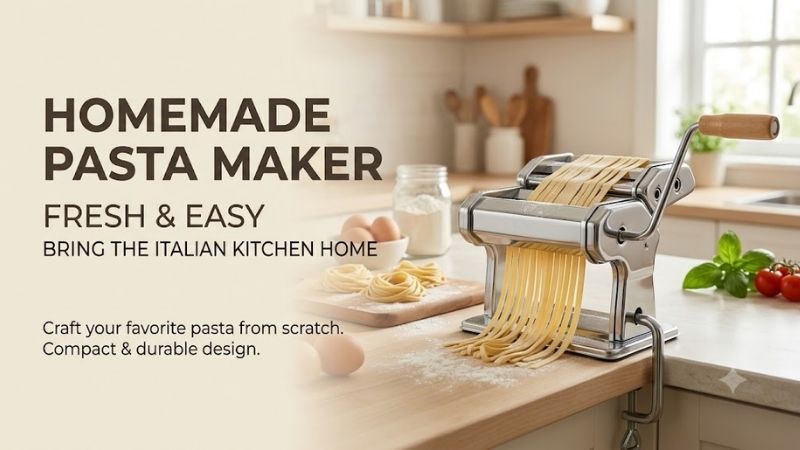
The Marcato Atlas 150 Classic is our best overall pasta maker for people who enjoy traditional homemade pasta.
Its 150mm rollers, adjustable thickness settings, and included ribbon cutters make it useful for lasagna sheets, fettuccine, and other rolled pasta.
For users seeking automated dough mixing and extrusion, the Philips 7000 Series offers a substantially different approach.
-
Best Overall: Marcato Atlas 150 — Versatile manual rolling and cutting.
-
Best Automatic Pasta Maker: Philips 7000 Series HR2660/03 — Automated mixing and extrusion.
-
Best for KitchenAid Owners: KitchenAid KSMPRA — Motorized roller and cutter attachments.
-
Best Traditional Alternative: Imperia SP150 — Manual pasta rolling with classic controls.
-
Best for Wide Pasta Sheets: Marcato Atlas 180 — Wider rollers for large sheets.
-
Best Compact Electric Extruder: Philips Viva HR2371/05 — Automatic pasta shaping in a smaller format.
Quick Comparison Table
| Product | Mechanism | Main Specifications | Best For | Trade-Off |
|---|---|---|---|---|
| Marcato Atlas 150 | Manual roller | 150mm width; 10 thickness settings | Traditional pasta | Prepare dough separately |
| Philips 7000 HR2660/03 | Electric extruder | Automatic mixing; eight discs | Automatic pasta | More parts to clean |
| KitchenAid KSMPRA | Powered roller attachment | Roller plus two cutters | Stand mixer owners | Needs a stand mixer |
| Imperia SP150 | Manual roller | 150mm width; hand crank | Classic pasta methods | Manual operation |
| Marcato Atlas 180 | Manual roller | 180mm width | Wide dough sheets | Larger machine |
| Philips Viva HR2371/05 | Electric extruder | Compact mixing and extrusion | Small automatic batches | Limited batch size |
How We Selected These Pasta Makers
Our recommendations consider the shapes each machine can produce, the preparation required before shaping, the consistency of operation, and cleaning.
We deliberately include manual rollers, powered stand mixer attachments, and automatic extruders because they satisfy different buyer needs.
A pasta roller is particularly useful for sheets, ribbons, and filled pasta.
An extruder is more appropriate for producing certain shaped pastas without manually rolling dough.
These products are compared using published capabilities and practical differences, not independently measured extrusion speed, pasta texture, or durability.
Detailed Product Reviews
1. Marcato Atlas 150 Classic — Best Overall
Best For: Home cooks who want to learn traditional rolled-pasta techniques.
Why We Picked It: The Atlas 150 provides adjustable rollers and useful included cutting functions in a mechanically operated machine.
Key Specifications
| Specification | Details |
|---|---|
| Model | Atlas 150 Classic |
| Roller Width | 150mm |
| Thickness Positions | 10 |
| Included Pasta Styles | Lasagna sheets, fettuccine, tagliolini |
| Operation | Hand crank |
| Mounting | Countertop clamp |
| Construction | Metal |
| Motor Accessory | Compatible option available |
Features & Benefits
The adjustable rollers allow users to gradually reduce dough thickness.
The included cutting mechanism produces traditional ribbon-style pasta.
The hand crank makes it possible to adjust feeding speed manually.
Additional compatible attachments can expand shaping options.
Performance & Practical Use
The Atlas 150 is suitable for homemade egg pasta and other dough recipes designed for rolling.
A typical process includes mixing and kneading dough, resting it according to the recipe, and passing it through progressively thinner settings.
The resulting sheets can be cut into ribbons or used for lasagna and filled pasta.
The machine does not automatically prepare the dough.
What Makes It Different
Its versatility lies in controllable rolling thickness and traditional pasta shapes.
Pros
-
Ten thickness settings.
-
Included ribbon cutters.
-
No electricity required.
Cons
-
Manual effort.
-
Requires separately prepared dough.
Buy If: You enjoy making pasta by hand.
Skip If: You want a machine that measures, mixes, and extrudes pasta automatically.
2. Philips 7000 Series HR2660/03 — Best Automatic Pasta Maker
Best For: Households wanting automated dough mixing and shaping.
Why We Picked It: The Philips 7000 Series combines ingredient mixing and extrusion in one machine.
Key Specifications
| Specification | Details |
|---|---|
| Model | HR2660/03, US configuration |
| Power | 150W |
| Voltage | 120V / 60Hz |
| Dough Capacity | Up to 700g |
| Shaping Discs | Eight |
| Mixing | Automatic |
| Extrusion | Automatic |
| Controls | Digital |
Features & Benefits
Users add ingredients according to a suitable recipe.
The appliance mixes the dough and moves it through a selected shaping disc.
Eight discs allow different pasta styles to be prepared.
Accessory storage helps organize the attachments between uses.
Performance & Practical Use
This machine is useful for home cooks who want fresh pasta without manually rolling sheets.
The main limitation is dough consistency.
Extrusion recipes often use mixtures that differ from the smooth, cohesive dough required by traditional rollers.
Accurate liquid measurements are important.
What Makes It Different
Automated mixing and extrusion reduce manual shaping work.
Pros
-
Mixes and extrudes pasta.
-
Eight shaping discs.
-
Suitable for family batches.
Cons
-
More components to clean.
-
Large appliance.
Buy If: You want automated fresh pasta preparation.
Skip If: You mainly prepare traditional lasagna sheets.
3. KitchenAid KSMPRA — Best for Stand Mixer Owners
Best For: Households already using a compatible KitchenAid stand mixer.
Why We Picked It: The three-piece set uses the stand mixer’s motor to drive pasta rollers and cutters.
Key Specifications
| Specification | Details |
|---|---|
| Model | KSMPRA |
| Attachments | Three |
| Pasta Roller | Included |
| Spaghetti Cutter | Included |
| Fettuccine Cutter | Included |
| Roller Width | 6 inches |
| Thickness Settings | Eight |
| Power | Compatible KitchenAid stand mixer |
Features & Benefits
The powered roller moves dough through the attachment while users guide it with their hands.
This eliminates manual cranking.
Separate spaghetti and fettuccine cutters produce two common noodle styles.
Performance & Practical Use
The KSMPRA is useful for people who already prepare dough in a KitchenAid mixer.
Users can knead the dough with appropriate equipment, then attach the pasta roller.
However, the attachments cannot operate without a compatible stand mixer.
Cleaning also requires attention because the internal roller mechanisms should not simply be submerged in water.
What Makes It Different
It integrates pasta preparation with a powered kitchen platform that many home cooks already own.
Pros
-
Motorized rolling.
-
Multiple cutters.
-
Convenient for stand mixer owners.
Cons
-
Requires separate stand mixer.
-
Multiple attachments to maintain.
Buy If: You already own a compatible KitchenAid mixer.
Skip If: You want a complete standalone pasta machine.
4. Imperia SP150 — Best Traditional Alternative
Best For: Home cooks who prefer a classic mechanical pasta roller.
Why We Picked It: The Imperia SP150 offers a conventional hand-crank design for flattening dough and producing ribbon-style pasta.
Key Specifications
-
Model: SP150
-
Roller width: 150mm
-
Manual hand crank
-
Adjustable roller thickness
-
Traditional pasta cutting mechanism
-
Countertop clamp
-
Chrome-plated steel housing
Features & Benefits
The SP150 allows dough to pass between adjustable rollers.
By reducing the roller gap gradually, users can produce thinner pasta sheets.
Its mechanical operation avoids the need for electricity.
Performance & Practical Use
The Imperia is appropriate for preparing traditional pasta with pre-kneaded dough.
Because the machine is hand-operated, users control feeding speed.
It is particularly useful for learning the practical differences between thick and thin pasta sheets.
What Makes It Different
A straightforward classic design without electronic components.
Pros
-
Traditional construction.
-
Adjustable rollers.
-
No electrical power required.
Cons
-
Requires manual operation.
-
Does not mix or knead dough.
Buy If: You want a traditional pasta-making experience.
Skip If: Automatic processing is important.
5. Marcato Atlas 180 — Best for Wide Pasta Sheets
Best For: Home cooks preparing large lasagna sheets or wide dough pieces for filled pasta.
Why We Picked It: The Atlas 180 provides a wider rolling surface than the Atlas 150.
Key Specifications
| Specification | Details |
|---|---|
| Product | Marcato Atlas 180 |
| Roller Width | 180mm |
| Operation | Manual |
| Thickness Control | Adjustable |
| Mounting | Countertop clamp |
| Primary Application | Wider pasta sheets |
Features & Benefits
The 180mm rollers produce broader sheets of dough.
This can be useful for ravioli, lasagna, and other pasta forms requiring more surface area.
Performance & Practical Use
A wider sheet can reduce the need to join smaller pieces of dough.
However, handling broader sheets requires enough worktop space.
The larger machine may also be less convenient to store.
What Makes It Different
Its additional roller width is the key advantage.
Pros
-
Wider pasta sheets.
-
Adjustable thickness.
-
Traditional manual control.
Cons
-
Larger than the Atlas 150.
-
Wide dough requires careful handling.
Buy If: You frequently prepare large sheets.
Skip If: Standard-width noodles are your main priority.
6. Philips Viva HR2371/05 — Best Compact Electric Extruder
Best For: Smaller households seeking automated pasta preparation.
Why We Picked It: The Philips Viva combines mixing and extrusion in a more compact format than many larger pasta machines.
Key Specifications
-
Model: HR2371/05
-
Product series: Viva Collection
-
Automatic mixing
-
Automatic extrusion
-
Interchangeable shaping discs
-
Compact countertop design
-
Electrically powered
Features & Benefits
The appliance mixes a suitable pasta dough and extrudes it through a shaping disc.
This reduces the need for manual rolling and cutting.
Its compact design is useful for smaller kitchens.
Performance & Practical Use
The Viva is appropriate for preparing modest quantities of fresh pasta.
Its smaller capacity makes it less suitable for frequent large family batches.
As an older model, buyers should confirm current availability and replacement-accessory support.
What Makes It Different
It offers automatic shaping in a smaller appliance format.
Pros
-
Automatic mixing.
-
Compact construction.
-
Multiple shape options.
Cons
-
Limited batch capacity.
-
Availability of model-specific accessories may vary.
Buy If: You want automatic pasta for smaller meals.
Skip If: You prepare large quantities frequently.
Pasta Maker Buying Guide
Manual Rollers vs. Electric Extruders
These two systems produce pasta in different ways.
A manual roller takes prepared dough and gradually flattens it into sheets.
An electric extruder mixes or accepts dough and pushes it through a shaping disc.
| Feature | Manual Roller | Electric Extruder |
|---|---|---|
| Dough Preparation | Separate | Often integrated |
| Pasta Sheets | Excellent | Model-dependent |
| Ribbon Pasta | Common | Disc-dependent |
| Shaped Pasta | Limited | Common |
| Electricity | Not needed | Required |
| Cleaning | Rollers and cutters | Mixing chamber and discs |
| Storage | Usually smaller | Often larger |
Choose the Pasta Shapes You Actually Make
For fettuccine, tagliolini, lasagna, and filled pasta, a roller is often the most practical choice.
For penne and other extruded shapes, an automatic extruder may provide greater convenience.
Check included accessories rather than assuming all shapes are available.
Understand Dough Hydration
Traditional rolled dough and extruded pasta dough may use different ingredient ratios.
Roller dough generally needs to form a cohesive sheet.
Extruder dough must have a texture suitable for the machine’s mixing and extrusion mechanism.
Using the wrong recipe can produce sticking, tearing, or unsuccessful extrusion.
Roller Thickness Settings
Thickness adjustment helps users prepare pasta for different recipes.
Start with a wider roller opening and reduce the gap gradually.
Skipping directly to a thin setting may tear the dough.
Countertop Stability
Manual machines usually include a clamp.
Attach the machine securely before rolling.
Motorized attachments require a stable stand mixer or appliance base.
Cleaning
Manual rollers are generally not designed to be immersed in water.
Follow the manufacturer’s instructions for removing dried dough with approved brushes or tools.
Automatic extruders may include detachable washable components, but not all parts are dishwasher-safe.
Fresh Pasta Storage
Fresh pasta has higher moisture content than commercially dried pasta.
Depending on ingredients, it may also contain raw eggs.
Follow safe refrigeration or freezing guidance and avoid leaving fresh pasta at room temperature for extended periods.
Common Pasta Maker Problems
Dough Sticks to the Rollers
The dough may contain too much moisture or may require additional flour handling as directed by the recipe.
Pasta Sheets Tear
The dough may be too dry, insufficiently rested, or passed through a setting that is too thin too quickly.
Pasta Fails to Extrude
Ingredient ratios may be unsuitable for the specific machine.
Use the manufacturer’s recommended recipes and measure liquids carefully.
Noodles Stick Together
Freshly cut pasta can stick if handled improperly.
Follow recipe-specific instructions for dusting, separating, and cooking.
Cleaning Takes Too Long
Avoid allowing sticky dough to accumulate inside attachments.
Follow the manufacturer’s recommendations for drying and removing residual dough.
Frequently Asked Questions
Is a pasta maker worth buying?
A pasta maker is useful for people who regularly prepare fresh pasta or enjoy hands-on cooking. Occasional users may find it more convenient to purchase ready-made pasta.
Is manual or electric better?
Manual rollers provide direct control over traditional sheets and ribbons. Electric extruders simplify mixing and shaping for compatible pasta styles.
Can a pasta maker make spaghetti?
Yes. Some rollers use spaghetti-style cutting attachments, while extruders can use spaghetti shaping discs.
Can you make gluten-free pasta?
Some machines support gluten-free pasta, but recipes and dough handling differ. Use a formulation intended for the appliance.
Can a pasta maker knead dough?
Some automatic extruders mix dough. Traditional manual rollers usually require dough to be prepared separately.
How long does fresh pasta take to cook?
Cooking time depends on pasta thickness, shape, ingredients, and recipe. Fresh pasta often cooks faster than fully dried pasta, but there is no universal cooking duration.
Conclusion
The Marcato Atlas 150 Classic is our best overall pasta maker for traditional home pasta preparation, with adjustable rolling and cutting in one mechanical machine. Choose the Philips 7000 Series for automated mixing and extrusion, KitchenAid KSMPRA if you already have a compatible stand mixer, Imperia SP150 for a classic manual alternative, Atlas 180 for wider sheets, or Philips Viva for smaller automatic batches.





Write Your Review
No reviews yet. Be the first to share your experience!