
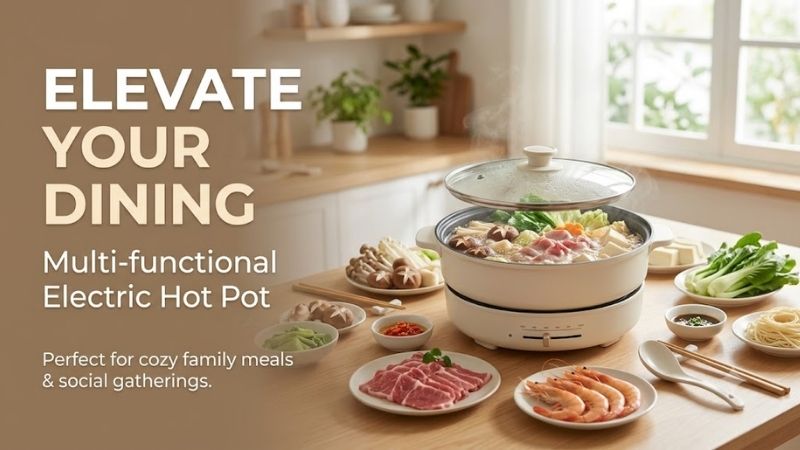
An electric hot pot combines a cooking vessel and heating system in one appliance. Some models are designed for preparing a personal serving of ramen or soup, while larger versions support communal meals with broth, vegetables, tofu, noodles, and thinly sliced meat. The right electric hot pot should match how you cook. A compact 1.5-liter pot may be convenient for one person, but it cannot offer the same shared-dining experience as a larger shabu-shabu cooker. Heating control, food-contact materials, electrical safety, and cleaning are equally important. This guide examines six options with different capacities and cooking designs.
Quick Verdict
For families and shared meals, the Aroma Housewares ASP-610 Dual-Sided Shabu Hot Pot is our best overall choice. Its divided cooking vessel lets diners enjoy two different broths during one meal.
For individual cooking, the Dezin 1.5L Electric Cooking Pot offers a more compact alternative.
-
Best Overall for Shared Hot Pot: Aroma ASP-610 — Two broth compartments.
-
Best for Individual Cooking: Dezin 1.5L Electric Cooking Pot — Compact multipurpose design.
-
Best for Small Kitchens: Topwit 1.5L Electric Hot Pot — Simple dual-power operation.
-
Best for Communal Shabu-Shabu: Aroma ASP-600 — Dedicated electric hot pot format.
-
Best for Stainless Steel Cooking: Sonya Shabu Shabu Hot Pot — Divided stainless steel vessel.
-
Best for Occasional Noodle Meals: Stariver 1.5L Electric Hot Pot — Compact personal cooking.
Quick Comparison Table
| Product | Cooking Format | Capacity / Configuration | Best For | Main Limitation |
|---|---|---|---|---|
| Aroma ASP-610 | Divided shared hot pot | Two broth compartments | Families | Large footprint |
| Dezin Electric Pot | Personal cooker | 1.5L | Solo meals | Small capacity |
| Topwit Electric Hot Pot | Personal cooker | 1.5L | Small kitchens | Basic heat settings |
| Aroma ASP-600 | Communal hot pot | Shared cooking vessel | Shabu-shabu meals | Requires table space |
| Sonya Shabu Shabu | Divided cooker | Two sections | Two broth styles | More cleaning |
| Stariver Electric Pot | Personal cooker | 1.5L | Noodles and soup | Limited versatility |
How We Selected These Electric Hot Pots
We evaluated identifiable electric cooking pots based on intended meal size, cooking-vessel design, temperature adjustment, food-contact materials, and maintenance.
We separated personal cooking pots from larger communal appliances because their practical uses are different.
A personal hot pot typically excels at preparing a simple meal with minimal equipment. A communal hot pot needs sufficient broth volume and cooking space to accommodate ingredients added by several diners.
The recommendations reflect published product characteristics and practical suitability, not independent comparisons of boiling speed or durability.
Detailed Product Reviews
1. Aroma Housewares ASP-610 — Best Overall for Shared Hot Pot
Best For: Families who enjoy preparing different broth flavors at the same table.
Why We Picked It: The ASP-610 features a divided cooking vessel for two broth options.
Key Specifications
| Specification | Details |
|---|---|
| Model | ASP-610 |
| Cooking Style | Electric shabu-shabu |
| Vessel | Dual-sided |
| Broth Compartments | Two |
| Heating | Electric |
| Temperature Adjustment | Supported |
| Main Use | Shared hot pot |
Features & Benefits
The divided vessel lets users prepare mild and spicy broths simultaneously.
It can make a shared meal more convenient when diners have different flavor preferences.
The tabletop arrangement allows ingredients to be cooked in broth during the meal.
Performance & Practical Use
The ASP-610 is most appropriate for gatherings rather than quick individual lunches.
A family might use one side for chicken broth with mushrooms and the other for a spicy vegetable broth.
However, the divided sections do not establish complete separation for food allergens. Utensils and ingredients can still cross between compartments.
What Makes It Different: It emphasizes two-flavor communal cooking.
Pros
-
Two separate broth sections.
-
Useful for group dining.
-
Adjustable heating.
Cons
-
Requires substantial table space.
-
Divided construction adds cleaning surfaces.
Buy If: You regularly serve hot pot to several people.
Skip If: You mainly cook one bowl of noodles.
2. Dezin 1.5L Electric Cooking Pot — Best for Individual Cooking
Best For: Singles and couples preparing noodles, soup, and simple stovetop-style dishes.
Why We Picked It: The Dezin offers a compact cooking vessel with selectable power settings.
Key Specifications
-
Capacity: 1.5 liters
-
Common US configuration: up to 700W
-
Two heating levels
-
Integrated electric heater
-
Nonstick-coated cooking surface in common configurations
-
Compact countertop design
Features & Benefits
The small bowl size is useful for personal meals without bringing out a large pot.
Selectable heating levels can help switch between heating liquid and maintaining gentler cooking conditions.
Performance & Practical Use
The Dezin suits ramen, oatmeal, boiled vegetables, and appropriately prepared soups.
It may also support additional cooking methods where the exact model’s instructions permit them.
However, avoid assuming every portable pot is suitable for frying or cooking raw meat.
What Makes It Different: Personal meal convenience is its strongest advantage.
Pros
-
Compact.
-
Two heating levels.
-
Suitable for small portions.
Cons
-
Limited cooking volume.
-
Nonstick coating requires careful utensil selection.
Buy If: You frequently prepare meals for one.
Skip If: You need a communal hot pot.
3. Topwit 1.5L Electric Hot Pot — Best for Small Kitchens
Best For: Apartment residents seeking a compact alternative for basic hot meals.
Why We Picked It: The Topwit uses a simple integrated electric cooking design.
Key Specifications
-
Capacity: 1.5 liters
-
Common configuration: 600W
-
Two heating settings
-
Electric cooking base
-
Compact single-pot construction
Features & Benefits
The appliance does not require a separate stovetop burner.
Its small footprint makes it convenient for kitchens where storage is limited.
The basic controls also reduce the learning curve.
Performance & Practical Use
The Topwit works for appropriate noodle, soup, and boiling recipes.
Users should leave enough room for liquids to bubble during cooking.
A nominal 1.5-liter capacity is not necessarily the safe working volume when boiling soup.
What Makes It Different: Simple cooking in a space-saving format.
Pros
-
Small appliance.
-
Straightforward heating.
-
Suitable for personal meals.
Cons
-
Limited capacity.
-
Fewer controls than a conventional stove.
Buy If: Space is your primary constraint.
Skip If: You regularly cook elaborate meals in larger pots.
4. Aroma Housewares ASP-600 — Best for Communal Shabu-Shabu
Best For: Households that want a dedicated shared hot pot without focusing on personal portability.
Why We Picked It: The ASP-600 is a purpose-built electric appliance for shabu-shabu-style dining.
Key Specifications
| Specification | Details |
|---|---|
| Model | ASP-600 |
| Format | Electric communal hot pot |
| Cooking Method | Heated broth |
| Temperature Control | Adjustable |
| Intended Use | Shared tabletop dining |
Features & Benefits
A communal cooking vessel provides space for broth and compatible ingredients.
Adjustable heating helps bring the broth to cooking temperature and maintain a simmer.
Performance & Practical Use
The ASP-600 can be practical for preparing vegetables, tofu, noodles, and thinly sliced proteins during a meal.
Always use separate utensils for raw ingredients and ready-to-eat portions.
Foods added to broth must be cooked thoroughly before serving.
What Makes It Different: It prioritizes the traditional shared hot pot experience.
Pros
-
Designed for communal meals.
-
Adjustable heat.
-
Dedicated tabletop cooking format.
Cons
-
Takes more space than a personal cooker.
-
Less convenient for occasional individual soup.
Buy If: Shared hot pot is your main cooking goal.
Skip If: You primarily need a travel-friendly appliance.
5. Sonya Shabu Shabu Hot Pot — Best for Stainless Steel Cooking
Best For: Diners who want two broth compartments and a stainless steel cooking vessel.
Why We Picked It: Its divided stainless steel pot provides an alternative to other shared hot pot designs.
Key Specifications
-
Electric heating
-
Divided stainless steel cooking vessel
-
Two broth compartments
-
Adjustable operation
-
Shared tabletop format
Features & Benefits
Stainless steel provides a practical cooking surface for simmering broth when maintained properly.
Separate compartments also support different broth recipes.
Performance & Practical Use
The Sonya is useful for gatherings where guests prefer different flavors.
However, a divided vessel is not a substitute for allergy-safe food preparation.
Keep utensils and ingredients separate when needed.
What Makes It Different: Two-broth cooking with stainless steel construction.
Pros
-
Stainless steel vessel.
-
Two broth styles.
-
Appropriate for shared meals.
Cons
-
Larger cleaning requirements.
-
Not ideal for one-person meals.
Buy If: You frequently prepare two types of hot pot broth.
Skip If: You need the smallest possible cooker.
6. Stariver 1.5L Electric Hot Pot — Best for Occasional Noodle Meals
Best For: People who occasionally need a compact appliance for soup and noodles.
Why We Picked It: The Stariver is designed around a small integrated cooking pot.
Key Specifications
-
Capacity: 1.5 liters
-
Electric heating
-
Personal cooking format
-
Integrated pot-and-heater construction
-
Intended for compatible simple recipes
Features & Benefits
The small vessel is convenient for preparing a single hot meal.
It avoids the need for separate cookware and a stovetop burner.
Performance & Practical Use
The Stariver can be useful for noodle soups, porridge, and reheating suitable foods.
It is not necessarily appropriate for deep frying, dry roasting, or recipes requiring precise control.
What Makes It Different: A compact format focused on basic meal preparation.
Pros
-
Space-saving.
-
Simple to operate.
-
Suitable for personal portions.
Cons
-
Limited capacity.
-
Fewer specialized cooking functions.
Buy If: You want a personal electric cooking pot.
Skip If: You need larger shared-meal capacity.
Electric Hot Pot Buying Guide
Start With Meal Size
Individual electric pots generally provide around 1–2 liters of nominal capacity.
That may be enough for noodles or soup, but it is restrictive when several people need to cook ingredients simultaneously.
Communal hot pots are better suited to family meals.
Consider Divided vs. Single Compartments
Divided pots allow two broth flavors to be prepared at once.
Single-compartment models are simpler to clean and may provide more uninterrupted cooking space.
Choose based on whether diners genuinely need separate broths.
Compare Heating Settings
Two-power systems are adequate for many simple soups.
Larger hot pots benefit from adjustable heating that helps regulate boiling and simmering.
A control setting is not a substitute for checking the temperature of cooked food.
Evaluate Cooking Materials
Stainless steel is often used in communal hot pots.
Nonstick coatings are common in compact personal pots.
Follow the manufacturer’s cleaning and utensil instructions, particularly for coated surfaces.
Understand Electrical Safety
Use the correct voltage and an appropriate outlet.
Keep the appliance on a stable heat-resistant surface.
Avoid using damaged cords or leaving a hot pot unattended.
Clean Electrical Components Safely
Some hot pots have removable cooking vessels. Others integrate the heating element into the pot body.
Never immerse an electrical housing unless the manufacturer explicitly permits it.
Handle Raw Ingredients Properly
Raw meat, seafood, and poultry used in hot pot require particular attention.
Prevent cross-contamination and cook foods to safe internal temperatures.
Do not rely solely on thin slicing or a brief dip in broth to establish safe cooking.
Frequently Asked Questions
Can you make ramen in an electric hot pot?
Yes. Many compact electric pots are designed for suitable noodle and soup recipes.
Can you use an electric hot pot for frying?
Only if the exact product instructions approve that use. Do not assume a soup-oriented pot is suitable for frying.
How big should an electric hot pot be for two people?
Capacity depends on whether you are preparing two small meals or a shared hot pot with several ingredients. A larger communal vessel is generally more flexible for shared dining.
Can you cook raw chicken in an electric hot pot?
You can cook chicken in suitable heated broth, but it must reach a safe internal temperature of 165°F.
Are electric hot pots allowed in dorm rooms?
Policies vary. Check housing rules before using any countertop heating appliance.
Conclusion
The Aroma ASP-610 is our leading choice for shared electric hot pot meals because its divided vessel supports two broth styles. For smaller servings, Dezin and Topwit offer practical personal cooking formats. Aroma ASP-600 and Sonya suit communal dining, while Stariver is more appropriate for occasional simple meals.





Write Your Review
No reviews yet. Be the first to share your experience!