
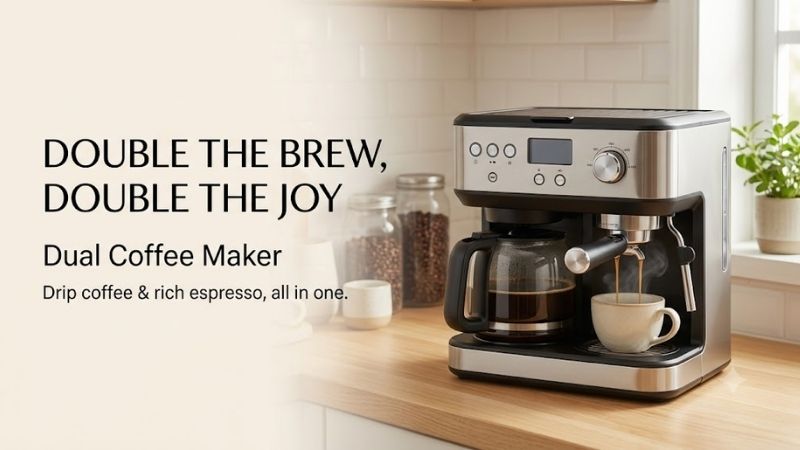
A dual coffee maker lets you brew one quick cup on busy mornings and a full carafe when family or guests need coffee. We compare six machines that combine single-serve convenience with batch brewing, focusing on pod compatibility, ground-coffee options, reservoir design, cleaning requirements, and everyday household value.
Quick Verdict: The Best Dual Coffee Makers
Best Overall: Ninja DualBrew Pro Specialty Coffee System CFP307. Its ability to brew compatible pods, ground coffee, single servings, and full carafes makes it a flexible choice for households with varied habits. Specialty and iced-coffee settings broaden its usefulness, although they also introduce additional components.
For a simpler arrangement, the Hamilton Beach FlexBrew Trio is a practical alternative. The Keurig K-Duo Hot & Iced makes more sense for households already committed to K-Cups. If you want to avoid capsules entirely, Hamilton Beach’s 2-Way Brewer deserves particular attention.
Quick Comparison Table
| Coffee Maker | Best For | Single-Serve Side | Carafe Side | Main Compromise |
|---|---|---|---|---|
| Ninja DualBrew Pro CFP307 | Overall versatility | Pods and grounds | 12-cup glass carafe | More complex controls and accessories |
| Hamilton Beach FlexBrew Trio | Everyday mixed households | Pods and grounds | 12-cup carafe | Separate components require cleaning |
| Keurig K-Duo Hot & Iced | K-Cup users | K-Cup pods | Ground coffee | Limited coffee format flexibility on pod side |
| Cuisinart Coffee Center SS-15 | Dedicated two-station operation | K-Cup-compatible | 12-cup carafe | Broad countertop footprint |
| Hamilton Beach 2-Way Brewer 49980A | Pod-free households | Ground coffee | 12-cup carafe | No capsule convenience |
| Ninja DualBrew Hot & Iced | Hot and iced coffee drinkers | Pods and grounds | Carafe | Fewer specialty-drink features than Pro |
How We Selected These Dual Coffee Makers
A dual brewer should genuinely improve a household’s coffee routine. Simply attaching two brewing methods to one housing is not enough if water filling, cleaning, or switching formats becomes inconvenient.
We evaluated each machine against six practical considerations.
Single-serve flexibility: Does it accept sealed coffee pods, loose grounds, or both? Some households want pod convenience for weekdays but more economical ground coffee for larger batches.
Carafe functionality: Does the machine prepare enough coffee for shared meals? Is the carafe glass or thermal, and how does the design keep coffee ready to serve?
Water-system convenience: A shared reservoir may simplify refilling, but separate brewing stations can offer familiar operation. We considered the implications for everyday use.
Beverage variety: Stronger brew settings, iced-coffee programs, and specialty drink features can be worthwhile if regularly used.
Cleaning: A dual-format system may involve several baskets, pod holders, brew paths, and a full carafe.
Long-term value: Running two brewing formats can reduce the need for separate appliances, but it does not eliminate filter, capsule, cleaning, or replacement-part expenses.
These recommendations are based on published product designs and relevant buyer scenarios. We do not claim personally measured temperature stability, coffee extraction, or long-term reliability.
Detailed Reviews of the Best Dual Coffee Makers
1. Ninja DualBrew Pro Specialty Coffee System CFP307 — Best Overall
Best For: Families that make pods, ground-coffee servings, full pots, iced coffee, and occasional milk-based drinks.
Why We Picked It
The DualBrew Pro is one of the more complete interpretations of the dual coffee maker concept. Rather than simply providing a pod slot beside a drip machine, it supports multiple drink sizes and brewing styles.
It is particularly valuable when household members have different beverage preferences.
Key Specifications and Features
- Model: CFP307
- Single-serve formats: Compatible pods and grounds
- Carafe: 12-cup glass carafe
- Brew styles: Classic, Rich, Over Ice, Specialty
- Frother: Fold-away
- Hot-water dispensing: Independent system
- Reservoir: Removable
- Grinder: Not included
Features and Benefits
The combination of pod and grounds brewing means users can choose convenience without abandoning favorite fresh-ground coffee.
A full carafe is useful for weekend breakfasts, while smaller servings avoid unnecessary batch brewing on weekdays.
The Specialty setting provides a concentrated coffee base intended for café-inspired beverages. It does not create pump-extracted espresso.
The frother can aerate milk for compatible drinks, and the independent hot-water dispensing function adds utility for tea.
Performance and Practical Use
Suppose one family member leaves early for work, another works from home, and everyone drinks coffee together on Sunday.
The Ninja allows those routines to be handled by the same appliance.
Its versatility becomes less compelling, however, if the household only drinks black filter coffee. The extra attachments and specialized controls may then create clutter without delivering meaningful benefits.
Careful accessory management is important. Users need to install the correct brew basket or pod adapter and clean the relevant coffee-contact components.
What Makes It Different
It behaves more like a multifunction coffee station than a conventional two-way brewer.
Pros
- Pods, grounds, individual servings, and carafes.
- Several brewing styles.
- Built-in milk frother.
- Independent hot-water dispensing.
- Suitable for varied household routines.
Cons
- Multiple accessories require storage.
- More complicated than a basic dual brewer.
- No integrated grinder.
- Specialty brewing is not espresso.
Buy If: Your household genuinely uses several beverage formats.
Skip If: You want a minimal coffee maker with only standard single-cup and pot functions.
2. Hamilton Beach FlexBrew Trio — Best for Everyday Mixed Households
Best For: People who want pods, loose grounds, and a full pot without extensive specialty beverage features.
Why We Picked It
The FlexBrew Trio offers an unusually practical combination of the three formats most likely to matter in a home kitchen: a capsule serving, a ground-coffee single serving, and a carafe.
That makes it useful without requiring the owner to adopt a complicated café-style workflow.
Key Specifications and Features
- Type: Three-way coffee maker
- Single-serve brewing: Compatible pods or grounds
- Carafe: 12-cup
- Brewing stations: Individual and carafe
- Scheduling: Programmable carafe functionality on supported versions
- Grinder: Not included
Features and Benefits
The pod side is helpful for someone who wants a familiar, low-effort cup.
The grounds option provides an alternative when buyers prefer a particular roast.
The carafe side makes shared coffee more efficient than brewing consecutive individual cups.
Performance and Practical Use
The main advantage is a practical division of responsibilities.
One user can choose a single cup while another prepares a pot for several people. However, the appliance is still subject to model-specific water and operation requirements, and not every configuration supports simultaneous brewing.
Users should also distinguish between the capacity of the carafe and the quantity of finished coffee produced in a normal batch.
What Makes It Different
Its format flexibility comes without requiring specialty milk preparation or advanced connected features.
Pros
- Three coffee-preparation methods.
- Full-carafe capacity.
- Suitable for several household preferences.
- More straightforward than specialty systems.
Cons
- Multiple filters and accessories.
- Requires regular cleaning on both sides.
- More counter space than a simple single-serve appliance.
Buy If: You want flexible everyday coffee without extra café-style features.
Skip If: You mainly make concentrated specialty drinks.
3. Keurig K-Duo Hot & Iced — Best for K-Cup Households
Best For: Homes that already use K-Cup pods but sometimes need a full carafe.
Why We Picked It
The K-Duo Hot & Iced combines two familiar ways of preparing coffee: quick capsule brewing and a larger ground-coffee batch.
It is particularly relevant to families that use pods during the week but want a full pot on weekends.
Key Specifications and Features
- Single-serve format: K-Cup pods
- Carafe format: Ground coffee
- Carafe size: Up to 12 coffee-maker cups
- Hot and iced options: Supported
- Brewing controls: Selected strength and serving-size adjustments
- Reservoir: Large shared water supply on current configurations
Features and Benefits
The machine preserves Keurig’s familiar pod routine.
Its carafe side avoids consuming several capsules when serving multiple people.
An iced-coffee option is useful for people who regularly prepare beverages over ice.
Performance and Practical Use
The K-Duo is a good option for buyers who already have preferred K-Cup varieties.
It is less compelling for someone who wants to use ordinary ground coffee on the single-serve side, because the machine’s format choices are more restricted than those of certain hybrid models.
The product family has also changed over time. Check the exact generation and model specifications before purchasing.
What Makes It Different
It is a direct bridge between K-Cup convenience and traditional drip coffee.
Pros
- Familiar K-Cup operation.
- Full-carafe ground-coffee brewing.
- Hot and iced functionality.
- Useful for varying daily serving needs.
Cons
- Pod-side capsule costs.
- Less flexible for fresh-ground single cups.
- Features differ between K-Duo generations.
Buy If: K-Cups are already part of your household routine.
Skip If: You want ground coffee available in every brewing mode.
4. Cuisinart Coffee Center SS-15 — Best for Separate Brewing Stations
Best For: Households that want visibly separate controls for single servings and full pots.
Why We Picked It
The SS-15 combines a 12-cup programmable coffee maker with a separate K-Cup-compatible single-serve brewer.
That traditional two-station approach is especially useful for owners who prefer familiar layouts.
Key Specifications and Features
- Carafe: 12-cup glass
- Single-serve format: K-Cup-compatible capsules
- Single-serve sizes: 6, 8, and 10 oz
- Reusable-filter option: Supported with compatible filter
- Carafe scheduling: Programmable
- Keep-warm function: Supported
- Grinder: Not included
Features and Benefits
The carafe side provides conventional drip-coffee preparation with scheduling.
The single-serve side is convenient when someone wants coffee outside the usual family brewing schedule.
A reusable filter offers additional ground-coffee flexibility.
Performance and Practical Use
The Coffee Center suits a family that prefers separating weekday and weekend routines.
A scheduled pot can be useful for regular morning coffee, while the individual station can serve someone who wakes later.
However, the side-by-side layout occupies more horizontal space than many vertically arranged hybrid systems.
Users must also maintain the carafe components and single-serve system.
What Makes It Different
Its brewing stations are organized around clearly distinct tasks rather than a shared multifunction brewing head.
Pros
- Separate carafe and single-serve stations.
- Programmable full-pot brewing.
- Reusable-filter flexibility.
- Familiar controls.
Cons
- Wide footprint.
- Two areas require maintenance.
- No built-in specialty milk system.
Buy If: You want a conventional coffee maker combined with a dedicated single-serve station.
Skip If: You have very little available counter width.
5. Hamilton Beach 2-Way Brewer 49980A — Best for Pod-Free Households
Best For: People who prefer ground coffee and want to avoid proprietary capsules entirely.
Why We Picked It
The 49980A combines a ground-coffee single-serve brewer with a full 12-cup carafe system.
Unlike many dual machines, it does not rely on K-Cups for its individual servings.
Key Specifications and Features
- Single-serve format: Ground coffee
- Carafe format: Ground coffee
- Carafe: 12-cup glass
- Single-serve accessory: Reusable scoop-style filter
- Programming: Carafe scheduling
- Brewing strength: Regular and bold settings
- Capsule system: No K-Cup brewing
Features and Benefits
The machine allows users to buy a preferred roast and prepare either one cup or a larger batch.
It can also reduce reliance on disposable coffee capsules.
The reusable single-serve filter is useful for measuring and brewing a personal serving.
Performance and Practical Use
This is a sensible option for people who grind beans at home or purchase ground coffee in larger bags.
It may be less convenient during a rushed morning because the scoop filter must be emptied and cleaned.
But for someone who prefers a consistent coffee blend and wants to control costs, that trade-off may be worthwhile.
What Makes It Different
It is a genuine two-way coffee maker without a proprietary capsule requirement.
Pros
- Both sides use ground coffee.
- No required capsule purchases.
- 12-cup carafe.
- Programmable carafe brewing.
Cons
- No K-Cup convenience.
- Ground-coffee cleanup after single servings.
- Lacks advanced specialty options.
Buy If: You want individual and batch coffee without pods.
Skip If: You specifically want one-touch capsule brewing.
6. Ninja DualBrew Hot & Iced — Best for Hot and Iced Coffee Routines
Best For: Households that alternate between hot coffee, iced beverages, single servings, and carafe brewing.
Why We Picked It
This Ninja DualBrew variant focuses on the core dual-format brewing experience and hot-and-iced versatility without emphasizing every specialty feature of the Pro series.
Key Specifications and Features
- Coffee formats: Compatible pods and ground coffee
- Brewing volumes: Individual servings and carafe
- Drink options: Hot and iced preparations
- Reservoir: Removable
- Brewing head: Format-compatible configuration
- Frother: Not a defining feature of this version
Features and Benefits
The machine allows users to choose a pod for speed or grounds for greater coffee flexibility.
Its iced-coffee mode is helpful during warmer weather.
The carafe option serves larger groups without repeated capsule brewing.
Performance and Practical Use
This version makes sense when iced coffee is a regular part of the household routine but integrated frothing and specialty drinks are not essential.
Buyers should check the precise model number because the DualBrew family includes several generations and configurations.
What Makes It Different
It emphasizes two-way hot-and-iced coffee rather than functioning as a more elaborate beverage station.
Pros
- Pods and grounds.
- Individual and carafe options.
- Dedicated iced-coffee functionality.
- Suitable for varying household size.
Cons
- Model variations can be confusing.
- Multiple accessories require cleaning.
- Less suited to milk-based specialty drinks.
Buy If: You want flexible coffee volumes and regularly drink iced coffee.
Skip If: A simple pod-free two-way brewer would meet all your needs.
Dual Coffee Maker Buying Guide
1. Define What Dual Means for Your Household
The term dual coffee maker is used in several ways.
Most commonly, it describes an appliance that can brew both a single serving and a full carafe.
Some products instead emphasize two brewing formats, such as pods and grounds. Others combine hot and iced preparation.
Before comparing products, decide which combination you need.
For most families, single cup plus carafe is the defining feature.
2. Choose Between Pods, Grounds, and Hybrid Brewing
Pods are convenient when only one person wants coffee.
Ground coffee is often more practical when preparing a full pot.
Hybrid machines provide both options, but the exact coffee-format compatibility differs across models.
Do not assume that a machine supporting pods on its individual side also supports loose grounds without an accessory.
3. Understand Carafe Cup Measurements
A coffee-maker cup is commonly smaller than an ordinary US measuring cup.
A machine labeled 12-cup does not necessarily produce twelve 8-ounce mugs.
Check the manufacturer’s fluid-ounce capacity and compare it with how many people you normally serve.
4. Shared vs. Separate Reservoirs
Some dual brewers share a large reservoir across preparation modes.
Others have different fill points or reservoirs for individual and carafe brewing.
A shared tank can simplify refilling, but its location matters.
Consider whether the machine can be refilled easily under cabinets.
5. Programmable Brewing
Scheduled carafe brewing can be useful for households that follow a predictable morning routine.
However, leaving prepared coffee grounds in a machine overnight may affect freshness compared with grinding immediately before brewing.
If taste is the priority, consider whether programming is worth that compromise.
6. Glass vs. Thermal Carafes
Glass carafes are easy to inspect and generally rely on a warming plate.
Thermal carafes are designed to retain heat through insulation.
A warming plate can keep coffee hot, but holding brewed coffee for extended periods may alter flavor.
Choose according to how quickly your household drinks a pot.
7. Brewing Strength and Serving Size
A stronger brew setting may change contact time or extraction behavior.
It cannot automatically compensate for using too little coffee.
For full pots, use an appropriate coffee-to-water ratio rather than simply filling the basket without measurement.
8. Iced Coffee vs. Cold Brew
Iced brewing generally uses hot extraction or a programmed concentrated brew intended for serving over ice.
Cold brew uses prolonged contact between grounds and cool water.
A dual coffee maker with an iced setting is not automatically a dedicated cold brew machine.
9. Countertop Dimensions
Dual coffee makers can be considerably wider or deeper than single-purpose brewers.
Measure room for opening lids, accessing reservoirs, removing carafes, and switching accessories.
A machine that technically fits under a cabinet may still be awkward to operate.
10. Cleaning Responsibilities
Two brewing paths mean several coffee-contact components.
Wash carafes and baskets regularly.
Empty used pods promptly.
Follow manufacturer-specific descaling instructions for internal water systems.
Extra functionality should not make cleaning so inconvenient that the machine is neglected.
11. Ownership Costs
A dual machine can replace two appliances, but it does not remove recurring consumable expenses.
Consider paper filters, pods, coffee grounds, water filters, and approved cleaning products.
If you plan to use pods only occasionally, the overall running cost may be modest compared with relying on pods for every cup.
Common Dual Coffee Maker Problems
Single-Serve Coffee Tastes Weak
Check beverage size, selected coffee format, and dose. A large serving from a small pod may taste diluted.
Carafe Brewing Seems Slow
Review water level, filter placement, and descaling needs. Do not assume slower brewing always indicates a defect.
The Machine Leaks Near the Basket
Incorrect filter seating, excess grounds, or a blocked outlet may be responsible. Follow the manufacturer’s troubleshooting instructions.
The Coffee Is Too Cool
Preheating a thermal carafe or serving promptly may help. Confirm that the machine is operating according to its intended brewing mode.
Switching Modes Becomes Confusing
Store the brewing accessories together and follow the product-specific installation steps.
Frequently Asked Questions
What is the best dual coffee maker for pods and grounds?
The Ninja DualBrew Pro CFP307 offers broad brewing flexibility. Hamilton Beach FlexBrew Trio is a simpler option for everyday use.
Can a dual coffee maker brew a single cup and a pot at the same time?
Not necessarily. Many models provide two brewing formats but do not permit simultaneous operation. Check the exact manual.
Is a dual coffee maker worth buying?
It can be worthwhile when a household regularly alternates between individual coffee and larger batches.
What is the difference between a dual coffee maker and a combination espresso machine?
A typical dual brewer makes single-serving and carafe drip coffee. A coffee-and-espresso combination machine includes a separate espresso-style extraction system.
Can you use ground coffee in both sides?
Some models permit this. The Hamilton Beach 2-Way Brewer is designed around ground coffee for both formats.
Does a 12-cup coffee maker make twelve large mugs?
Usually not. Manufacturer coffee-cup measurements are typically smaller than standard drinking mugs.
Are dual coffee makers difficult to clean?
They involve more parts than simple brewers. Maintenance is manageable when components are cleaned regularly.
Which dual coffee maker is best for iced coffee?
The Ninja DualBrew Hot & Iced and Keurig K-Duo Hot & Iced are worth considering when iced beverages are a regular priority.
Conclusion
The Ninja DualBrew Pro CFP307 is the best dual coffee maker for households switching between pods, grounds, single cups, and full carafes. Choose Hamilton Beach FlexBrew Trio for simpler flexibility, Keurig K-Duo for K-Cup routines, or Hamilton Beach 2-Way for pod-free brewing. Match the machine to how often you make full pots.



Write Your Review
No reviews yet. Be the first to share your experience!