
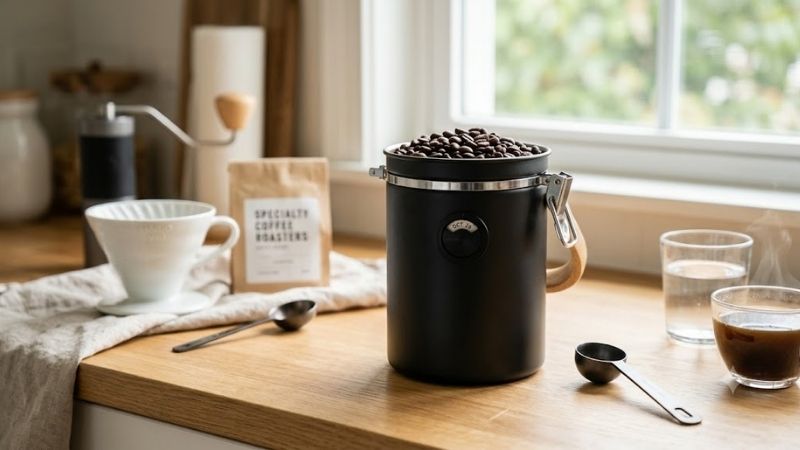
A coffee storage canister helps protect your beans from repeated exposure to air, moisture, heat, and light after the original bag is opened. We compare six containers with different sealing systems, materials, and capacities, explaining which designs suit daily brewing, bulk purchases, small kitchens, and households that switch coffee beans frequently.
Quick Verdict: Which Coffee Storage Canister Is Best?
Best Overall: Planetary Design Airscape Stainless Steel Canister. Its adjustable inner plunger lid allows users to reduce the air space above stored coffee as the bean level changes. Unlike a pump-style vacuum container, it does not require a separate vacuum operation.
The Fellow Atmos Manual Vacuum Canister is a stronger candidate for buyers who specifically want a vacuum-sealing mechanism. The OXO POP Container is practical for straightforward airtight storage, while the Coffee Gator Coffee Canister adds a familiar clasp-lid design and a date-tracking feature.
Quick Comparison Table
| Canister | Best For | Sealing Design | Material | Main Trade-Off |
|---|---|---|---|---|
| Planetary Design Airscape Stainless Steel | Best overall | Adjustable inner plunger with valve | Stainless steel | Two lids require handling |
| Fellow Atmos Manual Vacuum | Vacuum-style preservation | Twist-operated vacuum lid | Steel or glass versions | Requires periodic resealing |
| Coffee Gator Stainless Steel Canister | Traditional airtight storage | Clasp lid and gasket | Stainless steel | Date wheel must be updated manually |
| OXO POP Coffee Container | Everyday kitchen convenience | Push-button airtight lid | Clear plastic | Does not block light |
| Friis Coffee Vault | Opaque storage | Airtight lid with replaceable valve | Stainless steel | Valve replacement adds maintenance |
| Planetary Design Airscape Glass | Visual bean monitoring | Adjustable inner plunger | Glass | Transparent construction admits light |
How We Selected These Coffee Canisters
The main purpose of a coffee-storage container is to maintain suitable storage conditions after opening the original packaging.
Roasted coffee gradually changes through oxidation, volatile-aroma loss, and other aging processes. Storage cannot stop those changes completely, but reducing avoidable exposure is sensible.
We considered sealing design, light exposure, practical capacity, material, cleaning, and the number of steps required each time a user prepares coffee.
We also distinguished airtight containers from vacuum containers. These terms are related but not equivalent.
An airtight seal restricts exchange with surrounding air. A vacuum system attempts to lower the pressure inside the container by removing some of the air. Air-displacement designs reduce the available headspace without necessarily creating the same kind of vacuum.
The products below are compared on those real design differences, not on unsupported claims that a particular container will preserve every coffee for an exact number of additional days.
Detailed Coffee Storage Canister Reviews
1. Planetary Design Airscape Stainless Steel — Best Overall
Best For: Households storing whole beans and making coffee regularly from a changing quantity of beans.
Why We Picked It
The Airscape uses an adjustable inner lid that moves downward toward the stored coffee.
This design addresses a simple issue with fixed-size containers: as coffee is removed, the air space above the remaining beans becomes larger.
The inner plunger reduces that headspace.
Key Features
- Stainless steel body
- Adjustable inner plunger lid
- One-way valve arrangement
- Separate outer lid
- Multiple canister sizes
- Replaceable inner lids for supported versions
- No electricity required
Features and Benefits
The plunger system lets users adjust the storage space after every refill or removal.
The opaque steel body also limits light exposure.
Replacement-lid support is valuable because the sealing components are among the parts most likely to need attention after extended use.
Performance and Practical Use
The Airscape is a useful option for people who buy whole beans in medium-sized bags and consume them over several weeks.
The inner lid must be positioned properly each time.
It is also important not to confuse displaced air with a complete vacuum. The primary mechanism reduces headspace rather than evacuating the container using a dedicated vacuum pump.
What Makes It Different
It adapts its internal storage space as the coffee supply decreases.
Pros
- Adjustable headspace.
- Opaque housing.
- Replacement components available.
- Multiple sizes.
- No batteries.
Cons
- Two lids to handle.
- Additional surfaces to clean.
- Not a pump-operated vacuum canister.
Buy If: You want practical everyday bean storage without a powered vacuum system.
Skip If: You specifically need pressure-reducing vacuum storage.
2. Fellow Atmos Manual Vacuum Canister — Best for Vacuum-Style Storage
Best For: Coffee enthusiasts who want a reusable manual vacuum-sealing system.
Why We Picked It
The Fellow Atmos uses a twist-operated lid mechanism intended to remove air and establish a vacuum seal.
This makes it meaningfully different from conventional airtight containers.
Key Features
- Manual twist-operated vacuum lid
- Available steel and glass configurations
- Selected sizes include 0.7L and 1.2L
- Vacuum-release button
- Silicone sealing components
- Intended primarily for whole-bean coffee
Features and Benefits
Twisting the lid operates the vacuum mechanism.
The release button allows the pressure to equalize before opening.
The steel version provides light protection, while the glass version makes it easier to see the remaining bean quantity.
Performance and Practical Use
The Atmos suits users who appreciate a deliberate preservation routine and are willing to reseal the canister after each use.
Fellow recommends periodically restoring the vacuum by twisting the manual lid.
The manufacturer also advises against storing fine ground coffee in the Atmos because particles can interfere with the valve.
This is an important limitation. A container suitable for whole beans is not necessarily suitable for every finely powdered ingredient.
What Makes It Different
It uses a dedicated mechanical vacuum system instead of relying only on a conventional airtight lid.
Pros
- Vacuum-sealing mechanism.
- Manual operation.
- Multiple material options.
- Release button.
- Compact capacities.
Cons
- Requires resealing.
- Fine coffee grounds can interfere with the valve.
- Not dishwasher-safe.
- Higher cost than basic airtight containers.
Buy If: You want a vacuum-style container for whole beans.
Skip If: You mainly store pre-ground coffee or want a simple one-motion lid.
3. Coffee Gator Stainless Steel Coffee Canister — Best Traditional Design
Best For: Buyers who want an opaque, clasp-style container with a roast-date tracking feature.
Why We Picked It
Coffee Gator uses a conventional airtight storage approach supplemented by a date wheel and valve arrangement.
It is a recognizable alternative to plunger and vacuum-based products.
Key Features
- Stainless steel body
- Clasp-style lid
- Sealing gasket
- Date-tracking wheel
- Valve-equipped design on selected versions
- Multiple capacities
Features and Benefits
The date wheel helps users record a relevant date, such as when a bag was opened.
However, it must be set manually, and it does not measure coffee freshness.
The metal body limits light reaching the beans.
Performance and Practical Use
This model is suitable for households that want familiar operation.
Open the clasp, remove coffee, and close the container securely.
Its valve should not be treated as proof that the coffee is stored under vacuum. Valve-based gas handling and active vacuum pumping are different functions.
What Makes It Different
It combines conventional airtight storage with a visible date reminder.
Pros
- Straightforward opening.
- Opaque metal body.
- Date-tracking feature.
- Familiar clasp mechanism.
Cons
- Date wheel is manual.
- Seal requires inspection.
- Does not actively evacuate air like a vacuum pump.
Buy If: You prefer a conventional canister with simple organizational features.
Skip If: You want active vacuum storage.
4. OXO POP Coffee Container — Best for Everyday Kitchen Convenience
Best For: Households that want a simple airtight container for a frequently used coffee supply.
Why We Picked It
The OXO POP approach emphasizes one-touch opening and a relatively easy-to-organize kitchen-storage format.
Key Features
- Push-button lid
- Airtight-style seal
- Clear container body
- Stackable product family
- Multiple sizes
- Removable lid components for approved cleaning
Features and Benefits
The push-button operation is convenient when brewing coffee early in the morning.
A transparent body makes it easy to see how much coffee remains.
The rectangular format also fits organized pantry shelves.
Performance and Practical Use
The major weakness for coffee is light exposure.
If using a clear POP container for roasted beans, store it inside a dark cupboard rather than on a sunny counter.
The product does not actively create a vacuum.
What Makes It Different
It prioritizes accessible storage and kitchen organization over specialized coffee-preservation mechanisms.
Pros
- Convenient push-button opening.
- Clear visibility.
- Organized storage shape.
- Multiple capacities.
Cons
- Transparent construction.
- No vacuum system.
- Light exposure must be managed.
Buy If: You store coffee in a cupboard and want convenient daily access.
Skip If: You need an opaque countertop canister.
5. Friis Coffee Vault — Best for Buyers Who Prefer Opaque Storage
Best For: Coffee drinkers who want a stainless steel canister with a valve-based storage arrangement.
Why We Picked It
The Friis Coffee Vault focuses on a conventional metal container with a sealing lid and replaceable valve feature.
Key Features
- Stainless steel construction
- Airtight lid
- Valve component
- Opaque body
- Multiple available sizes
- Replacement valve requirements
Features and Benefits
The opaque steel body keeps light away from the coffee.
The valve-equipped lid is designed around the gas behavior associated with stored roasted coffee.
Performance and Practical Use
The Friis is useful for people who prefer metal storage over clear containers.
However, the valve system should not be treated as equivalent to active vacuum pumping.
Owners must also account for recommended valve replacement and other maintenance.
What Makes It Different
A conventional steel vault with a valve-equipped lid rather than an adjustable plunger.
Pros
- Opaque storage.
- Durable material.
- Familiar lid arrangement.
- Multiple capacities.
Cons
- Valve replacement.
- Does not create an active pump vacuum.
- Cannot prevent all coffee aging.
Buy If: You want an opaque metal canister with a traditional storage routine.
Skip If: You want to avoid replacement consumables.
6. Planetary Design Airscape Glass — Best for Seeing the Remaining Beans
Best For: Coffee drinkers who prefer the Airscape plunger approach but want a transparent container.
Why We Picked It
The glass Airscape offers visible bean storage while retaining the inner air-displacement system.
Key Features
- Glass body
- Adjustable inner lid
- Air-displacement design
- External top lid
- Multiple sizes
- No electricity
Features and Benefits
The glass vessel provides a direct view of the remaining beans.
The adjustable lid reduces the air space above the coffee as the supply decreases.
Performance and Practical Use
The design is convenient for visually monitoring the quantity left.
However, the clear body does not block light.
For best storage practice, place it in a shaded cupboard or another cool, dark location.
Glass also requires more careful handling than metal.
What Makes It Different
It combines the adjustable Airscape design with transparent storage.
Pros
- Visible contents.
- Adjustable headspace.
- No powered parts.
- Reusable.
Cons
- Admits light.
- Breakable glass.
- Additional lid components.
Buy If: You like seeing your coffee supply and can store the container away from light.
Skip If: You need a rugged opaque canister for an exposed countertop.
Coffee Storage Canister Buying Guide
Airtight vs. Vacuum vs. Air Displacement
These systems should not be confused.
An airtight lid helps prevent air exchange.
A vacuum system attempts to remove part of the air within the container.
An air-displacement plunger physically reduces the empty space above the coffee.
Each approach can help manage storage conditions, but none guarantees that beans will remain unchanged indefinitely.
Why Light Matters
Light exposure can contribute to deterioration of stored coffee.
An opaque canister or a dark cupboard is preferable to leaving clear containers in direct sunlight.
The storage location matters as much as the container itself.
Why Heat Matters
Excessive heat can accelerate unwanted changes in coffee.
Keep beans away from ovens, stovetops, sunny windows, and other warm areas.
A cool indoor cupboard is generally more appropriate than a frequently heated counter.
Moisture Control
Coffee storage containers should be clean and dry.
Avoid introducing water into a sealed supply of beans.
Moisture can affect grinding and storage quality.
Whole Beans vs. Ground Coffee
Whole beans generally retain volatile aromas better than coffee that has already been ground, because grinding increases exposed surface area.
If practical, store beans whole and grind just before brewing.
Check whether a specialized vacuum mechanism is approved for fine grounds.
Choose Capacity by Coffee Consumption
A very large container is not automatically better.
A household using 250 grams of beans per week may prefer a different canister size from one consuming a full pound every few days.
Buy a container that accommodates your usual purchasing quantity without excessive empty space.
Dark and Light Roasts Occupy Different Volumes
Bean density varies with roast level.
A one-pound bag of dark-roasted beans can occupy more space than one pound of denser, lighter-roasted beans.
Do not assume the same canister capacity holds every roast equally.
Date Wheels and Freshness Labels
A date wheel can help track the opening date.
However, it cannot measure oxidation or remaining flavor.
Recording the roast date and bag-opening date is more informative than treating the canister itself as a freshness detector.
Should You Refrigerate Coffee Beans?
Routine refrigerator storage can create concerns involving moisture and repeated temperature changes.
For frequently accessed beans, a cool, dark cupboard in a suitable airtight container is usually simpler.
Longer-term freezer storage may be useful when coffee is portioned and sealed appropriately, but repeated condensation should be avoided.
Cleaning and Seal Maintenance
Clean the vessel according to manufacturer guidance.
Avoid immersing vacuum lids, valves, or mechanisms unless specifically approved.
Inspect gaskets for damage or contamination.
A visually attractive canister cannot preserve coffee effectively if its seal is compromised.
Common Storage Problems
Beans Lose Aroma Quickly
Review purchase quantity, roast age, air exposure, heat, and storage location.
The Vacuum Seal Does Not Hold
Check the lid, sealing surface, valve, and manufacturer’s maintenance instructions.
Moisture Appears Inside
Stop storing coffee until the container is dry and the source of moisture is addressed.
The Lid Becomes Difficult to Open
Follow the product’s release procedure. Do not force vacuum lids without equalizing pressure.
Frequently Asked Questions
What is the best coffee storage canister overall?
The Planetary Design Airscape Stainless Steel is our preferred everyday choice for its adjustable inner lid and opaque body.
Does vacuum storage keep coffee fresher?
Reducing oxygen exposure may help, but outcomes vary with the coffee and storage conditions. It cannot stop all aging.
Can you store ground coffee in a vacuum canister?
Not every model permits it. Fellow advises against fine grounds in its Atmos because they can interfere with the valve.
Is stainless steel better than glass?
Stainless steel is usually more impact-resistant and opaque. Glass provides visibility but needs protection from light and breakage.
Should coffee beans be stored in the refrigerator?
For frequently accessed beans, a suitable cool, dark cupboard is generally more convenient and avoids repeated condensation risks.
How large should a coffee canister be?
Match the container to your usual bag size and consumption rate, accounting for differences in bean density.
Do coffee canisters need cleaning?
Yes. Coffee oils and residue can accumulate, especially around seals and movable lids.
Conclusion
The Planetary Design Airscape Stainless Steel is our best coffee storage canister for adjustable headspace and everyday bean access. Choose Fellow Atmos for vacuum sealing, Coffee Gator for a familiar clasp lid, or OXO POP for simple cupboard organization. Protect beans from heat, light, and moisture, and buy quantities you can use while fresh.





Write Your Review
No reviews yet. Be the first to share your experience!