
A dual coffee maker for busy mornings can prepare a full carafe for the household and a separate single cup when someone needs a different drink. However, dual brewing does not automatically mean faster coffee preparation. Brewing systems, shared water tanks, scheduling, and cleanup determine whether the appliance genuinely saves time. This guide explains how to choose a dual coffee maker that fits your morning routine.
- Quick Verdict: What Dual Coffee Maker Should You Buy?
- What Is a Dual Coffee Maker?
- Why Dual Coffee Makers Appeal to Busy Households
- Understanding Carafe Capacity
- Single-Serve Brewing Options
- Does Dual Brewing Mean Simultaneous Brewing?
- Programmable Brewing for Busy Mornings
- Coffee Temperature and Extraction
- Glass vs. Thermal Carafes
- Water Reservoir Design
- Countertop Footprint and Kitchen Layout
- Cleaning a Dual Coffee Maker
- Calculating Cost and Value
- Choosing by Household Scenario
- Common Buying Mistakes
- Frequently Asked Questions
- Conclusion
Quick Verdict: What Dual Coffee Maker Should You Buy?
For most households with different coffee schedules or serving preferences, a dual coffee maker combining a carafe brewer and a single-serve system is the most versatile starting point.
A programmable carafe function is particularly helpful when several people drink coffee around the same time.
The single-serve side can prepare an additional cup later without brewing another full pot.
However, the appliance must be evaluated as two brewing systems rather than one.
| Buying Feature | Why It Matters | Priority |
|---|---|---|
| Full-carafe capacity | Supports household coffee demand | High |
| Single-serve options | Accommodates individual drinks | High |
| Independent brewing controls | Simplifies switching between modes | High |
| Programmable carafe brewing | Helps organize morning preparation | Useful |
| Water reservoir design | Determines refill effort | High |
| Thermal or glass carafe | Affects coffee holding and maintenance | High |
| Brew basket access | Simplifies loading and cleaning | High |
| Countertop footprint | Determines kitchen compatibility | Essential |
| Brewing temperature consistency | Influences extraction quality | High |
| Descaling and cleaning procedures | Affects ownership effort | Essential |
The best dual machine should solve a real scheduling problem. If everyone drinks coffee together and prefers the same brew, a reliable standard drip machine may be simpler and more economical.
What Is a Dual Coffee Maker?
Understanding Dual Brewing
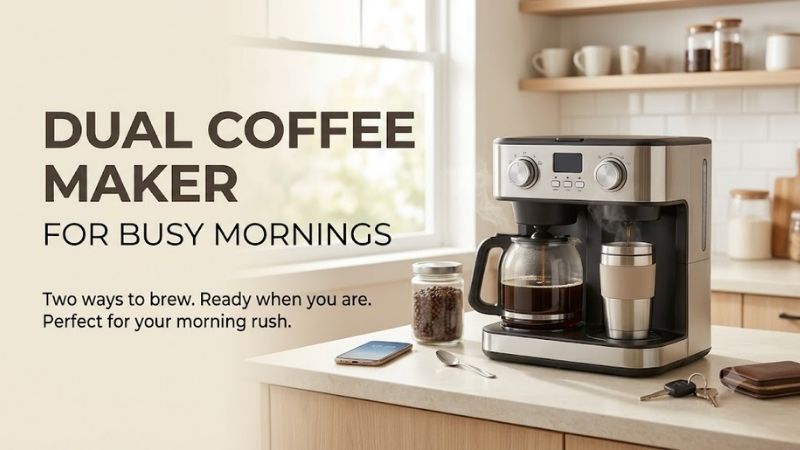
A dual coffee maker combines two coffee preparation options in one housing.
The most common arrangement includes a carafe brewer and a separate single-cup system.
Some machines use ground coffee for both modes.
Others combine a ground-coffee carafe side with a capsule-compatible single-serve side.
There are also specialized machines combining drip coffee and espresso preparation.
These categories are not interchangeable.
When comparing products, identify precisely which beverages each side prepares.
Dual Coffee Maker vs. Ordinary Drip Brewer
A conventional drip brewer prepares coffee in a carafe or other collection vessel.
A dual machine adds a separate brewing option.
This may be useful when one person wants a small cup while the rest of the household needs a larger batch.
However, the additional system increases complexity and usually takes more room.
If you always brew the same amount of coffee, dual operation may provide little practical benefit.
Dual Coffee Maker vs. Two Separate Machines
Two separate machines can provide flexibility and allow independent replacement.
However, they occupy more counter space and require two sets of cleaning procedures.
A combined machine may reduce equipment clutter.
On the other hand, a fault in the shared electrical or water system could affect both brewing functions.
A dual machine is most attractive when its combined size and workflow are genuinely better than owning two separate brewers.
Dual Coffee vs. Espresso-and-Drip Combinations
Some products marketed as dual coffee makers combine an espresso machine and a drip coffee brewer.
These may suit households with different beverage preferences.
However, espresso preparation involves different equipment, extraction conditions, and cleaning requirements.
Do not assume that a dual coffee maker with two coffee outlets can prepare traditional espresso.
Check the specific brewing system.
Why Dual Coffee Makers Appeal to Busy Households
Different Morning Schedules
Consider a household where one person leaves for work at 6:30 a.m., another starts working from home at 8:00 a.m., and a third wants coffee after breakfast.
A programmable carafe can provide coffee for the early part of the morning.
A single-serve function can prepare a later drink without making another full pot.
This can reduce waste and simplify preparation.
However, whether the system saves time depends on brewing speed, heating behavior, and availability of both functions.
Different Beverage Sizes
One person may prefer a large mug of regular coffee.
Another may want a small serving.
A dual brewer can accommodate these preferences more easily than a fixed-volume machine.
However, cup-size flexibility should be evaluated alongside coffee strength.
Passing more water through an unchanged coffee dose can produce a weaker beverage.
Guests and Weekend Breakfasts
A carafe is useful when several people want coffee together.
The single-serve side can also prepare a separate drink for someone who prefers decaf or another compatible coffee.
However, preparing specialty drinks sequentially can interrupt service.
If entertaining is a frequent priority, consider whether the appliance’s total capacity suits your needs.
Reducing Coffee Waste
Brewing a full pot for one person can waste coffee.
A single-serve option allows more appropriate quantities.
However, capsule-based single-serve brewing introduces packaging and recurring costs.
The best waste-reduction approach depends on how much coffee is brewed and consumed.
Understanding Carafe Capacity
What Does a 10-Cup or 12-Cup Rating Mean?
Coffee maker cup measurements are often smaller than a standard 8-fluid-ounce measuring cup.
Many carafe systems use approximately 5 or 6 fluid ounces per advertised cup, although the exact definition varies.
A machine described as a 12-cup brewer may therefore produce substantially less than twelve large mugs.
Check the manufacturer’s stated fluid-ounce capacity.
This is particularly important for families.
Choosing for Two Coffee Drinkers
A modest carafe may be sufficient when both people drink one or two cups.
However, timing matters.
If one person drinks coffee much later, keeping a large batch hot may compromise flavor.
A dual machine can be useful when the later drink is prepared separately.
Choosing for Families
A larger carafe may accommodate multiple coffee drinkers.
However, more water requires sufficient coffee grounds for balanced extraction.
Do not assume a full reservoir automatically produces coffee of suitable strength.
Follow an appropriate ratio and the manufacturer’s filter-basket limits.
Small-Batch Brewing
Some dual machines include a small-batch carafe setting.
This may adjust the brewing process for reduced water volumes.
A normal full-pot brewing system may not perform identically with a very small quantity.
If you frequently brew half a carafe, a documented small-batch function can be valuable.
However, verify actual performance rather than relying solely on the button name.
Single-Serve Brewing Options
Capsule-Based Single Serve
A capsule side can simplify individual preparation.
However, it creates dependence on compatible capsules.
If one person prefers specialty roasts or decaf, check whether those choices are available.
Capsules can also increase cost per drink.
Ground-Coffee Single Serve
Some dual machines allow loose ground coffee in a reusable or paper-lined filter.
This can reduce proprietary capsule costs.
It also provides greater flexibility over coffee selection.
However, grounds and filter cleaning add work.
For households that buy whole beans, a podless single-serve function may be more practical.
Machines Supporting Both Pods and Grounds
Certain appliances support more than one single-cup format.
However, the correct basket or adapter may need to be installed for each method.
This adds components to store and clean.
Choose the extra compatibility only if your household will use it regularly.
Single-Serve Cup Sizes
Evaluate the supported cup sizes and whether larger servings require additional coffee.
A 12-ounce beverage made from one small coffee portion may be weaker than preferred.
Some systems provide stronger brewing settings or different pods.
Check the machine’s actual preparation method.
Does Dual Brewing Mean Simultaneous Brewing?
Shared Heating Systems
Some dual coffee makers use components shared between their brewing functions.
They may not allow the carafe and single-cup side to operate simultaneously.
Others have more independent arrangements.
The word dual does not guarantee concurrent operation.
Why Simultaneous Brewing Matters
If two people need different coffees at the same moment, being able to run both sides together could save time.
However, simultaneous use may increase electrical load or introduce other design limitations.
Check whether the manufacturer explicitly supports it.
Sequential Brewing
A sequential system can still be useful.
You may brew the carafe first and then prepare a separate cup.
The important question is whether switching modes requires waiting, refilling water, or changing accessories.
Electrical Requirements
A dual coffee maker may contain substantial heating components.
Follow the rated electrical requirements.
Do not assume that having two brewing stations means the appliance can be safely operated through an ordinary power strip.
Use an appropriate outlet and comply with the manufacturer’s instructions.
Programmable Brewing for Busy Mornings
Delayed-Start Carafe Brewing
Some dual machines allow users to schedule carafe brewing for a selected time.
This can make coffee available shortly before breakfast or the morning commute.
However, the function must be configured correctly.
Check whether the clock retains settings after a power interruption.
Preparing Coffee the Night Before
You may be able to place appropriate ground coffee and potable water in the machine before a scheduled cycle.
However, the method should comply with manufacturer instructions.
Do not add milk, cream, or other perishable ingredients to a coffee brewing reservoir.
Ground coffee can lose aroma during storage, so there may be a flavor trade-off compared with freshly grinding beans.
Auto-Shutoff
An automatic shutoff function is useful when mornings are busy.
However, the shutoff behavior may differ between the brewing system and warming plate.
Check whether the appliance stops heating after a defined period.
Automatic shutoff should not justify leaving an unsafe setup unattended.
Brew-Completion Alerts
Some coffee makers provide audible signals.
These can be convenient but may be undesirable in a quiet household.
Check whether alerts can be disabled.
For apartment dwellers, a quiet operating routine may be valuable.
Coffee Temperature and Extraction
Brewing Water Temperature
Proper water temperature helps extract coffee solubles.
For conventional filter coffee, approximately 195–205°F is a common reference range.
However, the relevant temperature is where water contacts the grounds.
Heating-system specifications alone do not prove that the machine maintains appropriate brewing conditions.
Even Water Distribution
A showerhead or other water-distribution system can help wet the coffee bed.
However, visible design features do not guarantee even extraction.
Basket geometry, coffee dose, grind, and flow all matter.
Coffee-to-Water Ratio
A useful starting reference for filter coffee is approximately 55 grams of coffee per liter of water.
Adjust according to taste and brewing equipment.
When using the carafe side, calculate coffee quantity based on actual water volume rather than the advertised number of cups alone.
Extraction Differences Between Sides
A dual coffee maker’s carafe and single-serve systems may use different filters, flow rates, and coffee quantities.
Therefore, two beverages made with the same coffee beans may taste different.
Do not assume that the machine automatically produces identical extraction quality from both sides.
What SCA Certification Means
Some automatic filter coffee brewers are evaluated under the Specialty Coffee Association’s home brewing equipment program.
Certification provides evidence that a particular tested model meets the program’s specified performance requirements.
However, certification should not be assumed to apply equally to capsule brewing or espresso functions.
For a dual machine, confirm the exact certified model and the scope of the certification.
Glass vs. Thermal Carafes
Glass Carafes
Glass carafes allow users to see the coffee volume.
They are commonly paired with warming plates.
However, extended heating can affect flavor.
Glass can also break if dropped or mishandled.
If you consume coffee shortly after brewing, a glass carafe may be entirely practical.
Thermal Carafes
Thermal carafes use insulation to retain heat without relying on a continuously heated plate.
This can suit households where people drink coffee at different times.
However, thermal carafes vary in heat retention and pouring behavior.
Some have narrow openings that complicate cleaning.
A thermal carafe is not automatically better in every respect.
Choosing Based on Drinking Schedule
If everyone drinks coffee within a short window, a glass carafe may be sufficient.
If coffee is consumed over several hours, a thermal carafe may offer advantages.
However, freshly brewed coffee generally changes in flavor over time regardless of holding method.
Cleaning Carafes
Coffee oils and stains can accumulate in both types.
Choose a design with an opening large enough for appropriate cleaning.
Follow manufacturer instructions regarding dishwasher compatibility.
Water Reservoir Design
Shared vs. Separate Tanks
Some dual coffee makers use one water tank for both brewing sides.
Others provide separate reservoirs.
A shared tank can simplify the exterior design, but users may need to monitor the available water carefully.
Separate tanks may make the functions more independent while increasing cleaning and refill requirements.
Removable Reservoirs
A removable reservoir can make filling easier.
However, check the direction in which it detaches.
A machine placed beneath low cabinets may require more clearance than expected.
Water-Level Markings
Clear markings can reduce measuring errors.
However, coffee maker cup markings may use smaller-than-standard cup volumes.
For accurate brewing, understand the machine’s unit definitions.
Water Filtration
Some machines include water filters.
Their maintenance requirements vary.
Follow replacement schedules and use suitable potable water.
Do not assume that a filter eliminates mineral-scale concerns entirely.
Countertop Footprint and Kitchen Layout
Width and Depth
Dual coffee makers often occupy more space than ordinary single-serve machines.
Measure both dimensions carefully.
A narrow model may still be relatively deep.
Open-Lid Clearance
Carafe brewing requires access to the filter basket.
Single-serve brewing may require opening a capsule chamber.
Both functions must remain accessible in the intended location.
Mug and Carafe Clearance
Ensure that the machine accommodates your normal mugs and its own carafe.
Do not overlook handles and lids.
Nearby Appliances
Keep the machine away from hot burners, excessive steam, and sink splashes.
Avoid positioning the carafe where it can be knocked over during meal preparation.
Storage of Accessories
If the machine uses capsule adapters, reusable baskets, and different filters, those accessories require storage.
A dual appliance may reduce the number of machines but still create accessory clutter.
Cleaning a Dual Coffee Maker
Two Brewing Systems Mean More Cleaning Areas
A dual machine may have two coffee outlets, multiple filters, capsule mechanisms, and separate collection areas.
Even when both systems share a housing, their cleaning requirements can differ.
Cleaning the Carafe Side
Remove used grounds and filters.
Wash the basket and carafe according to the manual.
Avoid allowing coffee residue to remain overnight.
Cleaning the Single-Serve Side
For capsule systems, remove spent pods and clean accessible components.
Do not touch piercing needles.
For ground-coffee systems, wash the filter basket and remove grounds.
Drip Trays
A single-serve outlet may have its own tray.
Check whether the machine includes separate spill-collection areas.
Descaling
Both brewing pathways may need descaling.
Some machines require separate descaling procedures for each side.
Follow the manual carefully.
Do not assume that running one cleaning cycle maintains every water pathway.
Cleaning Time as a Buying Factor
An inexpensive dual machine can become inconvenient if cleaning both systems is difficult.
Examine removable parts and maintenance instructions before purchasing.
Calculating Cost and Value
Initial Purchase Price
A dual coffee maker may cost more than a simple drip brewer.
However, it can potentially replace two separate appliances.
The value depends on actual use.
Capsule Expenses
If the single-serve side uses capsules, estimate monthly consumption.
For example, two daily capsule drinks equal approximately 60 capsules over 30 days.
Use actual compatible capsule prices to estimate recurring cost.
Ground Coffee Costs
The carafe and podless single-serve functions can use ground coffee.
Compare the amount consumed per beverage.
Filter Costs
Some machines use disposable paper filters.
Others include reusable filters.
Check ongoing expenses and cleaning preferences.
Maintenance Costs
Descaling products, water filters, replacement carafes, and other components can affect long-term ownership.
When a Standard Drip Machine Costs Less Overall
If you rarely use the single-serve function, a simpler drip brewer may offer better value.
The additional feature should solve a real problem.
Choosing by Household Scenario
Couples With Different Work Schedules
A programmable carafe plus occasional single-serve brewing may be useful.
Families With Several Coffee Drinkers
Carafe capacity becomes important.
Check whether the single-serve option provides enough additional flexibility to justify its cost.
Shared Apartments
Different coffee preferences may favor a dual system.
However, cleaning responsibility and capsule costs should be considered.
Work-From-Home Households
A carafe may serve breakfast, while the single-serve side prepares a fresh afternoon cup.
Households With Very Limited Counter Space
A dual machine may be too large.
A compact drip brewer or single-serve system may be more practical.
Common Buying Mistakes
Assuming Both Sides Work Simultaneously
Check the manufacturer’s operating specifications.
Ignoring Total Countertop Size
A combined appliance can still be bulky.
Comparing Cup Counts Without Fluid Ounces
Carafe cup measurements are not always standard eight-ounce cups.
Forgetting Capsule Compatibility
The single-serve side may support only certain formats.
Overlooking Separate Cleaning Procedures
A dual machine may require maintaining two brewing pathways.
Choosing More Features Than You Use
If you only brew one type of coffee, the extra complexity may not help.
Frequently Asked Questions
Is a Dual Coffee Maker Worth It for Busy Mornings?
It can be when household members need different coffee quantities or brew at different times. A standard drip brewer may be better for a single shared routine.
Can a Dual Coffee Maker Brew a Cup and Carafe at the Same Time?
Some designs may support concurrent operation, but many do not. Verify the exact manufacturer’s instructions.
Do Dual Coffee Makers Use Coffee Pods?
Some do, while others use ground coffee for both brewing functions. Compatibility varies.
Are Dual Coffee Makers Hard to Clean?
They can require more maintenance because they contain multiple brewing pathways. Cleaning convenience depends on component access and manufacturer procedures.
Are Thermal Carafes Better for Busy Households?
They can retain heat without a warming plate, which may be convenient when people drink coffee at different times.
Should I Buy a Dual Coffee Maker or Two Separate Machines?
Choose a dual system when it saves space and supports your routine. Separate machines may provide greater flexibility and independent replacement.
Conclusion
The best dual coffee maker for busy mornings combines useful carafe capacity, a practical single-serve option, dependable brewing controls, and manageable cleaning. It should accommodate different coffee schedules without adding unnecessary work. Check whether the brewing functions operate independently, compare capsule and ground-coffee costs, and measure the complete countertop footprint before purchasing.




Write Your Review
No reviews yet. Be the first to share your experience!