
A drip coffee maker for small spaces should prepare good coffee without crowding your kitchen or forcing you to brew more than you need. Yet compact coffee makers vary in capacity, brewing consistency, water access, and cleaning convenience. A small exterior does not guarantee practical operation. This guide explains how to choose a space-efficient drip brewer that suits your household and coffee preferences.
- Quick Verdict: What Drip Coffee Maker Is Best for a Small Kitchen?
- Understanding Compact Drip Coffee Makers
- Measuring the Complete Operating Footprint
- Understanding Coffee Maker Cup Capacity
- Small-Batch Brewing Performance
- Brewing Temperature and Coffee Quality
- Coffee-to-Water Ratio and Grind
- Glass vs. Thermal Carafes
- Programmable Features
- Cleaning and Maintenance
- Choosing by Household Type
- Budget and Total Ownership Cost
- Common Buying Mistakes
- Frequently Asked Questions
- Conclusion
Quick Verdict: What Drip Coffee Maker Is Best for a Small Kitchen?
For most one- or two-person households, a compact automatic drip coffee maker with a practical four- to six-cup capacity is a useful starting category.
However, some coffee makers use relatively small serving measurements, so advertised cup count should always be checked against actual fluid ounces.
If you prepare only one mug at a time, a single-cup ground-coffee brewer may be more appropriate.
If you regularly prepare coffee for several people, a slightly larger carafe brewer may be worth the additional counter space.
| Buying Factor | What to Prioritize | Why It Matters |
|---|---|---|
| Complete exterior dimensions | Suitable width, depth, and operating height | Determines kitchen fit |
| Actual brewed capacity | Fluid ounces rather than advertised cups alone | Matches household consumption |
| Small-batch performance | Appropriate extraction with reduced coffee quantities | Avoids weak or uneven brewing |
| Water access | Easy filling without moving the appliance | Improves daily convenience |
| Filter-basket design | Accessible and appropriately sized | Simplifies preparation |
| Brewing temperature | Suitable contact temperature for filter coffee | Supports extraction quality |
| Carafe type | Glass or thermal according to routine | Affects heat retention |
| Automatic shutoff | Clear, safe operation | Reduces unnecessary heating |
| Cleaning access | Removable basket, carafe, and accessible reservoir | Supports maintenance |
| Storage weight | Manageable when moved regularly | Important for limited counters |
A simple, well-performing small brewer can be a better purchase than an oversized machine with numerous settings.
Understanding Compact Drip Coffee Makers
How Automatic Drip Brewing Works
An automatic drip coffee maker heats water and distributes it over ground coffee inside a filter basket.
The brewed liquid passes through the filter and collects in a carafe or cup.
This process is a form of gravity-based percolation.
Coffee quality depends on several interacting variables, including brewing temperature, grind size, coffee-to-water ratio, contact time, and water distribution.
The machine influences some of these variables, while the user controls others.
A compact brewer should therefore be evaluated as a brewing system rather than only a small electrical appliance.
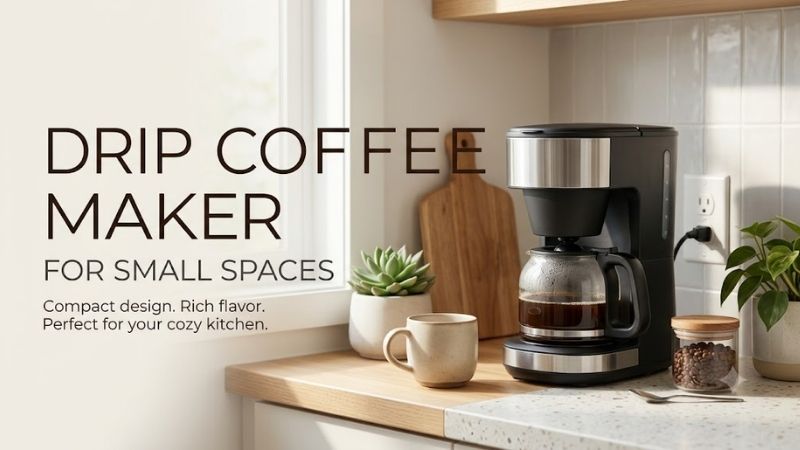
What Counts as a Compact Drip Brewer?
There is no universal size standard for compact coffee makers.
Some are narrow and tall.
Others are shorter but have a wider body.
A model with a small carafe may still require substantial counter depth because of its filter basket or water reservoir.
Compare complete dimensions and operating requirements.
Compact Drip vs. Single-Serve Pod Machines
A drip brewer uses ground coffee and a filter.
A pod machine uses pre-portioned coffee in compatible packaging.
A compact drip machine often provides more flexibility over coffee selection and brewing ratio.
However, it requires handling grounds and cleaning the basket.
A capsule machine may be more convenient for one cup, but recurring costs and packaging are additional considerations.
Compact Drip vs. Pour-Over
A manual pour-over dripper can be extremely small.
However, it typically requires a separate kettle and user-controlled pouring.
An automatic drip brewer handles water heating and distribution.
For busy mornings, this automation can be more convenient.
For someone who enjoys brewing technique and already owns a kettle, pour-over may occupy less permanent counter space.
Measuring the Complete Operating Footprint
Width and Depth
Measure the area where the machine will sit.
Remember that handles, water tanks, and controls may extend beyond the central housing.
Leave enough room for removing the carafe and accessing the filter basket.
A coffee maker that extends into your food preparation area may be inconvenient even when its width is narrow.
Height Beneath Cabinets
Many automatic drip machines have lids that open upward.
A machine may fit under a cabinet when closed but require extra height for filling water or loading coffee.
Measure the open-lid configuration.
If you must pull the machine forward every morning, the setup may become frustrating.
Side Access
Some machines have side-mounted water reservoirs or filter baskets.
These can be useful when overhead clearance is limited.
However, side access requires enough horizontal room.
Choose according to your actual kitchen arrangement.
Cord Placement
Keep the power cord away from sinks and hot cooking surfaces.
Avoid routing it across a frequently used preparation area.
If the cord is longer than necessary, manage it according to the manufacturer’s instructions.
Do not trap the cord beneath a hot appliance.
Storage Between Uses
If the coffee maker will be stored in a cabinet, evaluate its weight and dimensions.
A machine that is difficult to lift may end up permanently occupying the counter.
Check whether the glass carafe and other components can be stored securely.
Do not stack heavy objects on top of the machine.
Understanding Coffee Maker Cup Capacity
Coffee Maker Cups vs. Measuring Cups
A standard US measuring cup is eight fluid ounces.
However, many coffee makers use smaller cup definitions, often around five or six fluid ounces.
For example, a brewer advertised as six cups may produce roughly 30–36 fluid ounces depending on the manufacturer.
That is not the same as six ordinary eight-ounce mugs.
Always check actual fluid-ounce capacity.
Two-Cup and Four-Cup Brewers
Very small drip coffee makers may be suitable for one person or a couple.
However, their usefulness depends on actual beverage yield.
A machine advertised as four cups might provide enough coffee for two modest mugs.
It may not accommodate two large travel mugs.
Five- to Six-Cup Brewers
This category can be practical for small households that want more than one serving but do not need a large carafe.
However, brewing performance varies.
A small machine is not automatically better at brewing small batches than a larger machine with an appropriate setting.
Eight-Cup and Larger Machines
Some relatively compact brewers support eight cups or more.
These may be useful for households that prepare coffee for several people.
However, they require more counter space and may encourage oversized batches.
Choose based on normal demand.
Small-Batch Brewing Performance
Why Small Batches Can Be Challenging
Filter coffee extraction depends partly on the depth and shape of the coffee bed.
When a large filter basket contains only a small dose, water may interact with the grounds differently.
This can affect extraction consistency.
A dedicated small-batch brewer or a machine with an appropriate reduced-batch function may perform better for one or two cups.
However, actual results require model-specific testing.
Coffee Bed Depth
The depth of coffee grounds in the filter influences how water flows through the bed.
An overly shallow bed may contribute to uneven extraction in certain designs.
A very deep bed can create other flow limitations.
The ideal arrangement depends on basket geometry and coffee dose.
Cone vs. Flat-Bottom Baskets
Cone-shaped baskets concentrate grounds toward a narrower area.
Flat-bottom baskets distribute grounds across a broader base.
Both can produce excellent coffee when properly designed.
However, they may require different grind settings and coffee amounts.
A cone design is not automatically superior for small batches, nor is a flat-bottom design inherently better for large ones.
Small-Batch Programs
Some machines adjust brewing behavior when preparing a partial carafe.
This may influence water delivery or heating cycles.
However, a small-batch button is not evidence of superior coffee quality by itself.
Look for credible brewing-performance information when possible.
Brewing Temperature and Coffee Quality
Why Water Temperature Matters
Water temperature affects extraction.
For conventional filter coffee, a commonly used brewing reference is approximately 195–205°F at the coffee bed.
However, the appliance’s heater temperature is not necessarily identical to the temperature of water contacting the grounds.
A coffee maker may advertise precise heating while losing heat elsewhere in the brewing pathway.
SCA Certified Home Brewers
The Specialty Coffee Association operates a certification program for qualifying automatic home filter coffee brewers.
Models that complete the program meet defined requirements involving brewing quality and consistency.
This can provide useful purchasing evidence.
However, certification applies to specific tested models.
Do not assume that all products from a certified brand are certified.
A machine without certification is not automatically poor.
It may simply not have participated in the program.
Brewing Time
For standard automatic drip preparation, water contact time influences extraction.
However, appropriate duration depends on coffee grind and brewer design.
A very fast cycle may not allow sufficient extraction under some conditions.
A slow cycle can also produce undesirable results if the grind or flow is unsuitable.
Choose a machine with sound brewing performance rather than relying solely on advertised speed.
Water Distribution
The showerhead or dispensing system determines how water reaches the grounds.
A design that wets the coffee bed appropriately can contribute to consistent extraction.
However, the appearance of a large showerhead does not prove uniform flow.
Basket geometry, flow rate, and coffee preparation still matter.
Brew Consistency
A useful coffee maker should produce comparable results across repeated cycles when ingredients and settings remain consistent.
Look for testing involving brewing temperature, beverage strength, and repeatability.
Do not assume a digital display guarantees consistent coffee.
Coffee-to-Water Ratio and Grind
Starting With a Useful Ratio
A common starting reference for filter coffee is around 55 grams of coffee for each liter of water.
For 500 milliliters of water, that is approximately 27.5 grams of coffee.
This is a starting point rather than a requirement.
Adjust according to taste, roast, and machine performance.
Measuring Coffee by Weight
Coffee scoops are convenient, but the weight of coffee in a scoop varies with grind and bean density.
A kitchen scale can improve consistency.
However, beginners can also use a repeatable measuring method recommended by the coffee maker.
The important factor is avoiding arbitrary changes in coffee quantity.
Choosing Grind Size
Drip coffee generally requires a grind appropriate for the filter basket and flow rate.
If the grind is too fine, drainage may slow.
If it is too coarse, extraction may be insufficient.
Follow the manufacturer’s guidance and adjust carefully.
Pre-Ground vs. Whole-Bean Coffee
Pre-ground coffee offers convenience and requires no separate grinder.
Whole beans can be ground closer to brewing time, which may help preserve aroma.
However, a grinder adds cost, noise, and storage requirements.
For small kitchens, fresh pre-ground coffee stored appropriately may be a practical compromise.
Built-In Grinders
Some drip machines include grinding mechanisms.
This can reduce the need for a separate grinder housing.
However, the combined appliance may be larger and harder to clean.
A built-in grinder is useful only when its performance and maintenance suit your routine.
Glass vs. Thermal Carafes
Glass Carafes
Glass carafes are common on compact drip machines.
They allow easy viewing of coffee volume.
Some machines use a warming plate to maintain beverage temperature.
However, prolonged heating can affect flavor.
Glass is also vulnerable to breakage.
For households that drink coffee soon after brewing, a glass carafe can be practical.
Thermal Carafes
A thermal carafe retains heat through insulation.
It usually does not rely on a continuously operating warming plate.
This can be convenient when coffee is consumed over an extended morning.
However, thermal carafes may be heavier or harder to clean.
Some have narrow openings and complicated pouring lids.
Which Carafe Is Better for Small Spaces?
The answer depends on the complete appliance dimensions and your drinking habits.
A compact glass carafe may be easier to wash and replace.
A thermal carafe may improve heat retention without a warming plate.
Choose based on practicality rather than assuming one material is universally superior.
Carafe Replacement
Accidental breakage or loss can make a coffee maker unusable.
Check whether compatible replacement carafes are available.
This is particularly important for unusually shaped compact models.
Programmable Features
Delayed Brewing
Some drip machines allow scheduled brewing.
This may be useful for busy mornings.
However, scheduling requires setting up water and coffee beforehand.
A timer does not eliminate preparation.
Automatic Shutoff
Automatic shutoff is a useful convenience and safety feature.
Check whether it switches off the warming plate and heating system.
Do not assume every machine has the same shutoff timing.
Brew Pause
Some brewers allow the carafe to be removed briefly during brewing.
However, doing so may affect the distribution of coffee strength within the pot.
Coffee collected early in a brewing cycle can differ in concentration from the finished blended batch.
For best consistency, allow the full cycle to complete when practical.
Strength Controls
Certain machines offer a strong setting.
This may change contact time or water delivery.
However, it does not automatically increase the quantity of coffee grounds.
A strong button should not replace an appropriate coffee-to-water ratio.
Digital Controls vs. Simple Switches
A digital display may add convenience.
However, a basic switch can be sufficient for a small household.
Choose features that solve real problems rather than increasing operating complexity.
Cleaning and Maintenance
Filter Basket Cleaning
Remove used grounds after brewing.
Wash the basket according to the manufacturer’s instructions.
Coffee oils and fine particles can accumulate.
Paper vs. Reusable Filters
Paper filters are convenient to discard after brewing.
Reusable filters reduce disposable filter use but require washing.
Their mesh design may also allow different amounts of coffee oils and sediment into the cup.
Choose according to flavor and cleaning preferences.
Carafe Cleaning
Wash the carafe regularly.
Avoid letting coffee residue dry inside.
Follow dishwasher compatibility instructions.
Water Reservoir Maintenance
Keep the reservoir clean and use fresh potable water.
A narrow reservoir opening may make direct cleaning difficult.
Evaluate access before purchase.
Descaling
Mineral buildup can interfere with heating and water flow.
Use approved descaling procedures.
Frequency depends on water hardness and machine use.
Do not assume vinegar is suitable for every model.
Warming Plate Cleaning
If the machine uses a warming plate, allow it to cool before cleaning.
Remove spills according to the manual.
Do not use abrasive tools that may damage the surface.
Choosing by Household Type
Studio Apartment
A small four- to six-cup drip brewer may be sufficient when counter space is limited.
However, check actual beverage volume and operating height.
One-Person Household
A one-cup ground-coffee brewer may be more efficient than a carafe model.
Choose according to whether you want one cup or several servings at different times.
Couple
A compact carafe model can support two coffee drinkers.
A thermal carafe may be helpful when drinking schedules differ.
Small Family
A six- to eight-cup category may offer sufficient capacity.
However, count actual mugs rather than advertised cups.
Shared Kitchen
Choose a straightforward machine with easy cleaning.
Consider noise, carafe handling, and responsibility for disposing of used grounds.
Budget and Total Ownership Cost
Entry-Level Models
A basic compact drip brewer may provide useful performance without expensive features.
However, low price does not guarantee suitable brewing temperature or durability.
Midrange Models
Additional features may include improved temperature management, thermal carafes, and small-batch settings.
Consider whether they improve your normal coffee routine.
Premium Compact Brewers
Certain premium machines emphasize brewing consistency and refined construction.
However, higher price does not necessarily mean better fit for your kitchen.
Filters and Cleaning Supplies
Paper filters, water filters, descaling products, and replacement parts contribute to ongoing costs.
Grinder Expenses
A separate grinder can improve flexibility but adds cost.
For a budget-conscious small kitchen, purchasing suitable pre-ground coffee may be a reasonable option.
Longevity
Check warranty coverage and replacement-part availability.
A machine with serviceable components can offer better long-term value than one whose carafe is difficult to replace.
Common Buying Mistakes
Trusting Advertised Cup Count
Always verify actual fluid-ounce capacity.
Measuring Only Closed Height
Filter-basket and water-tank access require additional clearance.
Buying Too Much Capacity
An oversized machine may waste counter space and encourage unnecessary brewing.
Ignoring Small-Batch Extraction
Not every large drip brewer performs well with very small coffee doses.
Choosing Only by Brew Speed
Fast brewing does not guarantee proper extraction.
Overlooking Carafe Cleaning
Narrow thermal carafes may be inconvenient to wash.
Paying for Unused Smart Features
A simple machine may be more practical when you only need reliable morning coffee.
Frequently Asked Questions
What Size Drip Coffee Maker Is Best for a Small Kitchen?
A compact four- to six-cup model is a useful category for many small households, but actual fluid-ounce capacity matters more than advertised cup count.
Is a Small Drip Coffee Maker Better Than a Single-Serve Machine?
A small drip brewer suits households that want several servings of ground-coffee brew. A single-serve machine may be more convenient for one cup at a time.
Do Compact Drip Coffee Makers Brew Good Coffee?
They can. Brewing quality depends on temperature, water distribution, basket design, grind, and coffee-to-water ratio rather than exterior dimensions alone.
Are Thermal Carafes Worth It?
They can be useful when coffee is consumed over time, but they may be harder to clean and are not necessary for everyone.
How Often Should I Descale a Drip Coffee Maker?
Follow the manufacturer’s recommendations and account for water hardness and use.
Can I Use Pre-Ground Coffee?
Yes, provided the grind is appropriate for the brewer. Whole beans ground shortly before brewing may provide greater freshness, but a grinder is not mandatory.
Conclusion
The best drip coffee maker for small spaces combines manageable operating dimensions, appropriate batch capacity, consistent brewing, and easy maintenance. Choose a compact carafe brewer when several servings are needed, or a single-cup drip system when you usually prepare one mug. Verify actual fluid-ounce capacity, cabinet clearance, water access, and filter cleaning before buying, because a compact machine should save space without making coffee preparation less convenient.

Write Your Review
No reviews yet. Be the first to share your experience!