
Choosing a pour over coffee filter for small spaces starts with the dripper you already own or plan to buy. A paper filter may take up almost no countertop room, but the wrong size or shape can interfere with brewing. Reusable metal and cloth filters reduce paper purchases but introduce cleaning and drying requirements. This guide explains filter compatibility, materials, flow behavior, storage, and how to build a practical pour-over routine in a small apartment kitchen.
- Quick Verdict: Which Pour-Over Filter Is Best for Small Kitchens?
- Why Filter Choice Matters in Pour-Over Coffee
- Cone, Flat-Bottom, and Specialty Filter Shapes
- Understanding Common Pour-Over Filter Sizes
- Paper Filters: White vs. Natural Brown
- How Paper Thickness Affects Brewing
- Reusable Stainless Steel Filters
- Cloth Filters and Their Trade-Offs
- Measuring Storage Space for Filters
- Brewing for One Cup vs. Several Cups
- Filter Storage Near Cooking Equipment
- A Practical Pour-Over Workflow
- Troubleshooting Filter Problems
- Cost per Brew
- Health and Dietary Considerations
- Choosing by Household Type
- Common Buying Mistakes
- Frequently Asked Questions
- Conclusion
Quick Verdict: Which Pour-Over Filter Is Best for Small Kitchens?
For most people using a compact manual dripper, compatible paper filters are the easiest starting choice.
They require little storage space, separate coffee grounds effectively, and simplify disposal after brewing.
However, a reusable stainless steel filter may be attractive when you prefer a fuller-bodied cup, want to avoid recurring paper purchases, or need a setup with fewer consumables.
The right option depends on the dripper’s geometry, your coffee preferences, and available cleaning facilities.
| Filter type | Space advantage | Brewing characteristic | Main drawback |
|---|---|---|---|
| Cone paper filters | Store flat in small packs | Generally clear, low-sediment coffee | Requires restocking |
| Flat-bottom paper filters | Compact stacked storage | Designed for corresponding basket geometry | Shape-specific compatibility |
| Thick specialty paper | Folded sheets store compactly | Distinct drainage and oil retention | Higher paper volume and specific fit |
| Reusable stainless steel cone | One permanent brewing accessory | Often fuller body, some sediment | Requires rinsing and deeper cleaning |
| Cloth filter | Compact when stored appropriately | Different oil and fine-particle retention | Hygiene and storage demands |
| Synthetic reusable mesh | Lightweight, reusable construction | Varies with mesh size | Must meet hot-beverage and cleaning requirements |
Best overall approach: Match the filter to the exact dripper first. Then choose paper or reusable material according to flavor, cleaning effort, and how much storage space you actually have.
Why Filter Choice Matters in Pour-Over Coffee
The Filter Controls More Than Grounds Separation
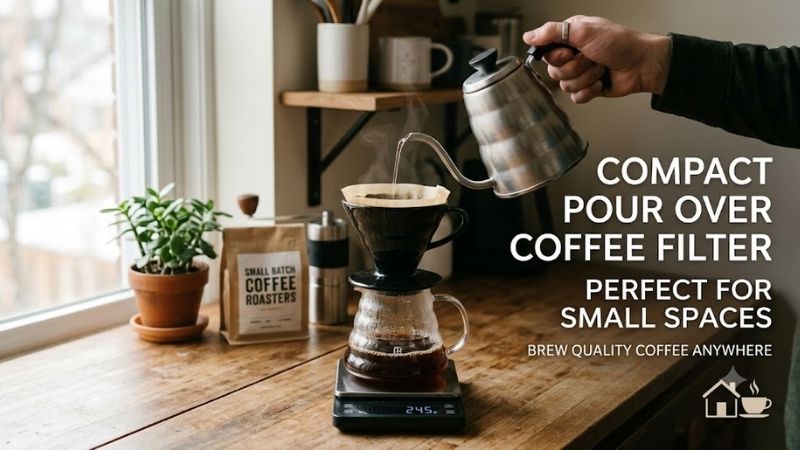
Pour-over brewing uses water flowing through ground coffee inside a supported filter.
The filter prevents most of the grounds from entering the cup.
However, its material, thickness, permeability, shape, and fit also influence how water moves through the coffee bed.
Different filters can therefore produce different brewing behavior even when the same coffee and water are used.
Flow Resistance and Extraction
Water must pass through both the coffee bed and the filter.
If either creates excessive resistance, the brew may drain slowly.
A slower brew can influence extraction, but it does not automatically produce a stronger or better beverage.
Likewise, a fast-draining filter is not inherently superior.
Coffee grind, dose, pouring technique, and dripper geometry interact with the filter.
Coffee Oils and Fine Particles
Paper filters generally retain more oils and suspended fine particles than typical metal mesh.
Metal filters may allow more of those components into the beverage.
That can affect mouthfeel and perceived clarity.
However, the exact result depends on the filter design and coffee preparation.
Choose based on the cup you enjoy rather than assuming one material always creates better flavor.
Cone, Flat-Bottom, and Specialty Filter Shapes
Cone-Shaped Paper Filters
Cone filters taper toward a lower point.
They are used by many manual drippers.
However, cone angle, seam structure, and dimensions vary.
A filter described as cone-shaped is not necessarily compatible with every cone dripper.
The correct filter should fit the walls and outlet geometry as intended.
Flat-Bottom Filters
Flat-bottom drippers use a comparatively broad lower brewing area.
Some employ wave-shaped paper filters.
Others use different flat-bottom designs.
The shape can influence coffee-bed depth and water distribution.
However, flat-bottom brewing is not automatically easier or more consistent in every situation.
Trapezoid or Wedge Filters
Some traditional pour-over brewers use wedge-shaped filters with a relatively flat lower edge.
These may be sold using number systems such as No. 2 or No. 4.
However, those numbers refer to particular filter families.
They are not universally equivalent to V60 sizes.
Specialty Bonded Filters
Certain large glass brewers use thicker specialty paper designed for their particular geometry.
These filters may require specific folding patterns.
A generic cone paper should not automatically be substituted.
Why Shape Comes Before Material
Before choosing between bleached, natural, metal, or cloth filtration, identify the dripper.
An excellent filter in the wrong shape is not a good purchase.
Understanding Common Pour-Over Filter Sizes
V60-Style Size 01
In the Hario V60 family, size 01 filters are designed for corresponding size 01 drippers.
They are commonly intended for relatively small batches.
This can be practical for a compact single-cup coffee station.
However, the actual beverage volume depends on the brewing recipe.
V60-Style Size 02
Size 02 filters match corresponding size 02 V60 drippers.
They offer flexibility for a broader range of small-to-medium batches.
For households preparing one or two mugs, this size may be convenient.
However, compatibility should be checked for the exact brewer rather than assumed from a generic label.
V60-Style Size 03
Size 03 filters are intended for larger compatible drippers.
They may be useful when preparing coffee for several people.
However, larger papers occupy more storage room and may be unnecessary for one daily cup.
Other Size Systems
Some flat-bottom drippers use size designations such as 155 and 185.
Other filter families use No. 2, No. 4, or proprietary numbers.
These systems are not interchangeable.
A numerical label only makes sense when considered with the manufacturer’s specific dripper.
Filter Size Comparison
| Filter family | Typical consideration | Best buying check |
|---|---|---|
| V60 01 | Smaller compatible V60 drippers | Exact 01 dripper |
| V60 02 | Medium compatible V60 drippers | Exact 02 dripper |
| V60 03 | Larger compatible V60 drippers | Exact 03 dripper |
| Wedge No. 2 | Certain traditional cone brewers | Manufacturer’s specified filter |
| Wedge No. 4 | Certain larger wedge brewers | Manufacturer’s specified filter |
| Flat-bottom wave sizes | Matching flat-bottom designs | Exact model and size |
| Specialty folded sheets | Specific integrated brewers | Approved paper type and folding method |
Do not choose based solely on the advertised number of coffee cups.
Paper Filters: White vs. Natural Brown
What Are White Coffee Filters?
White paper filters have undergone a whitening process.
However, manufacturing processes and certifications vary.
A white filter is not automatically unsafe or better than a natural brown one.
Choose products intended for food-contact brewing from a reputable manufacturer.
What Are Natural Brown Filters?
Natural-colored paper filters have a different appearance and may be marketed as unbleached.
However, color alone does not reveal every manufacturing detail or environmental impact.
Do not assume all brown papers are chemically identical.
Does Paper Color Change Coffee Flavor?
Some drinkers report noticeable paper-associated flavors with certain filters.
However, results depend on paper manufacturing and brewing conditions.
A suitable rinse can help with some filters when recommended.
Should You Rinse Paper Filters?
Many pour-over methods recommend rinsing paper with hot water before brewing.
This can help seat the filter and warm the dripper.
However, a rinse is not universally required for every filter and brewing method.
Follow the intended procedure.
Environmental Considerations
Paper production, treatment, packaging, transportation, and disposal all contribute to environmental impact.
A brown color alone does not establish superior sustainability.
When environmental considerations matter, look for credible product-specific claims rather than appearance.
How Paper Thickness Affects Brewing
Thicker Paper
Some specialty filters use relatively thick paper.
This can alter filtration and water drainage.
However, thick paper does not universally mean slower brewing under all conditions.
Pore structure and manufacturing characteristics matter.
Thin Paper
Thinner paper can offer different flow behavior.
However, it may also be more vulnerable to tearing if handled improperly.
Different Manufacturing Batches
Even papers with similar labels may behave somewhat differently.
For brewing consistency, use one suitable filter type while developing a recipe.
Why Changing Filters May Require a New Grind Setting
Suppose your coffee drains in three minutes using one paper.
After switching to another filter, it drains more slowly.
The filter may be contributing to the change.
Rather than assuming the beans are defective, evaluate grind, dose, water, and filter together.
Avoid Chasing Brew Time Alone
There is no universal ideal pour-over time for every dripper and dose.
Taste, coffee characteristics, and the complete recipe matter.
Use time as a diagnostic variable, not the sole measure of success.
Reusable Stainless Steel Filters
How Metal Filtration Works
Reusable metal filters commonly use fine mesh or perforated metal.
Water passes through the coffee, while the filter retains a substantial portion of the grounds.
However, more fines and oils may pass compared with paper.
Standalone Metal Drippers
Some stainless steel filters rest directly over a mug.
This can reduce the need to purchase a separate dripper and paper filters.
For a small kitchen, the integrated design may be attractive.
However, it still requires a kettle and a stable brewing surface.
Fit Over Your Mug
Check the support base diameter.
An unstable dripper can tip when filled with hot water.
Do not assume every reusable cone fits every mug.
Cleaning Requirements
Wet grounds must be removed.
Fine mesh can trap coffee oils and particles.
Choose a design with accessible internal surfaces.
Durability
Stainless steel construction can provide long service life.
However, thin mesh can bend or tear.
Protect the filter during storage.
Does Metal Save Space?
It can eliminate paper-filter boxes.
However, a rigid metal cone may occupy more cabinet volume than a flat packet of paper.
For very small drawers, paper may actually be easier to store.
Cloth Filters and Their Trade-Offs
Why Cloth Is Different
Cloth filtration retains and passes different amounts of oils and fine particles compared with paper and metal.
Some coffee enthusiasts enjoy the resulting texture.
However, results depend on fabric, care, and brewing technique.
Cleaning Immediately After Use
Cloth filters can trap coffee oils and particles.
They generally require careful cleaning.
Leaving used cloth with wet grounds inside can create hygiene problems.
Storage Requirements
Some cloth filter systems have specific wet or dry storage instructions.
Follow the manufacturer or established brewing method.
Do not improvise long-term damp storage.
Replacement
Cloth wears over time.
Inspect for damage, odors, or other signs that replacement is necessary.
Is Cloth Good for a Busy Small Kitchen?
It can be suitable for enthusiasts who enjoy careful maintenance.
However, paper or easy-clean metal may be more practical for ordinary daily use.
Measuring Storage Space for Filters
Paper Filter Packs
Paper filters are lightweight and relatively flat.
A suitable package may fit in a small drawer.
However, paper should be protected from moisture and kitchen grease.
Filter Holders
A dedicated paper holder can make access convenient.
However, it is not essential.
A simple dry drawer can work.
Countertop Displays
Decorative filter holders can look attractive but occupy space.
For limited kitchens, avoid purchasing storage accessories that defeat the original purpose.
Reusable Metal Filter Storage
A rigid filter needs protection from crushing and deformation.
Do not stack heavy cookware on top.
Cloth Storage
Follow the particular fabric’s hygiene requirements.
Choosing by Available Space
If you have shallow drawers but little cabinet height, paper may be easiest.
If you have a single open shelf and dislike consumable storage, a reusable metal dripper may be convenient.
Brewing for One Cup vs. Several Cups
Single-Cup Brewing
A small compatible paper filter can be sufficient.
However, choose a dripper that remains stable over your preferred mug.
Two-Cup Brewing
A medium dripper may offer flexibility.
However, the coffee dose must match the filter capacity.
Larger Batches
A larger filter can accommodate more grounds, but brew behavior changes with coffee-bed depth.
Do not assume that simply doubling the coffee and water reproduces the same cup.
Avoid Overfilling
A filter must have enough space for grounds and pouring water.
Overflow creates burn and spill risks.
Use a Suitable Carafe
When brewing more than one serving, a compatible carafe can simplify collection.
Check the dripper’s supported resting surface.
Filter Storage Near Cooking Equipment
Keep Paper Dry
Steam from kettles, boiling pots, and dishwashers can introduce moisture.
Store unused paper away from direct steam.
Avoid Grease and Odors
Cooking grease can collect on exposed paper.
For a small kitchen where coffee preparation shares space with frying or baking, a closed drawer can be useful.
Protect From Accidental Spills
A packet of filters placed beside the sink can be damaged by splashes.
Do Not Store Loose Paper Beside Heat
Keep paper away from open flames and hot surfaces.
Use the Original Packaging When Practical
A simple package may provide sufficient protection without requiring a separate storage product.
A Practical Pour-Over Workflow
Step 1: Identify the Dripper
Confirm the exact model and correct filter.
Step 2: Prepare a Stable Surface
Place the dripper on a suitable cup, carafe, or approved stand.
Step 3: Install the Filter
Seat the paper or reusable filter as instructed.
Step 4: Rinse When Recommended
Use hot water to prewet paper if the method specifies it.
Discard rinse water.
Step 5: Measure Coffee
Use a suitable ratio.
For example, 20 grams of coffee with 320 grams of brewing water is a 1:16 starting ratio.
Step 6: Grind Appropriately
Choose a grind suited to the dripper and filter.
Step 7: Add Coffee
Level the bed gently as appropriate.
Step 8: Begin Pouring
Follow a repeatable brewing recipe.
Step 9: Monitor Drainage
Observe the brew rather than relying only on an arbitrary timer.
Step 10: Remove and Dispose Safely
Allow hot grounds to cool sufficiently.
Discard paper filters or clean reusable filters according to their instructions.
Troubleshooting Filter Problems
Coffee Drains Too Slowly
Check grind size, coffee dose, filter seating, and filter condition.
A clogged metal mesh or paper filter can affect flow.
Coffee Drains Too Quickly
Check whether the coffee is too coarse, the filter is poorly seated, or the recipe is unsuitable.
Do not assume the paper itself is the only cause.
Filter Collapses
The filter may be the wrong size or incorrectly folded.
Review the dripper’s instructions.
Paper Tears
Avoid rough handling and excessive pressure.
Use the appropriate paper for the brewer.
Sediment Appears
Some reusable filters permit fine particles.
If you prefer cleaner coffee, consider paper filtration.
Coffee Tastes Different After a Filter Change
Keep the coffee dose and water quantity consistent while evaluating the new filter.
Adjust gradually.
Cost per Brew
Paper Filter Example
Suppose a pack of 100 compatible paper filters costs $8.
That equals $0.08 per filter.
At one brew daily, the annual paper cost would be approximately $29.20.
These are illustrative figures, not current market prices.
Reusable Filter Example
Suppose a reusable filter costs $24.
Ignoring cleaning costs and replacements, the purchase price equals 300 paper filters at $0.08 each.
Cleaning Costs Matter
Reusable products require washing.
Water, detergent, and time should be considered.
Buying in Bulk
Large paper packs can reduce shopping frequency.
However, buying excessive quantities may create storage problems.
Durability and Replacement
A reusable filter only provides long-term value if it remains functional.
Choose construction suitable for regular use.
Health and Dietary Considerations
Paper vs. Unfiltered Coffee Oils
Certain coffee compounds, including diterpenes such as cafestol and kahweol, are more effectively retained by some paper filtration methods than by typical metal mesh.
For people managing cholesterol-related dietary concerns, filtration choice may be worth discussing with a qualified healthcare professional.
However, this general observation does not establish the clinical effect of an individual filter.
Avoid Universal Health Claims
A reusable filter is not automatically healthier because it avoids paper.
Likewise, a paper filter is not automatically the right choice for every person.
Beverage intake, preparation, and individual health context matter.
Food-Contact Materials
Choose filters intended for hot beverage preparation.
Do not use improvised household mesh or fabric with unknown coatings.
Cleaning Hygiene
A reusable filter must be cleaned and dried properly.
The absence of disposable paper does not remove sanitation requirements.
Choosing by Household Type
Studio Apartment
A small paper-filter dripper may be easiest to store.
Minimalist Kitchen
A standalone stainless steel dripper can reduce the number of components.
One Coffee Drinker
Choose a compact filter size suited to the normal dose.
Couple
A medium dripper may accommodate larger batches.
Frequent Entertaining
Consider higher-capacity filters and a suitable serving vessel.
Coffee Enthusiast
Experimenting with different filter materials may be enjoyable, but establish one repeatable baseline recipe first.
Common Buying Mistakes
Confusing Filter Size Systems
V60, wedge, wave, and specialty papers are not interchangeable by number.
Choosing a Reusable Filter Only for Environmental Marketing
Cleaning and durability matter.
Assuming Thick Paper Always Produces Better Coffee
Filter behavior depends on construction and brewing conditions.
Storing Filters Near Steam
Unused paper should remain dry.
Ignoring Mug Stability
A metal dripper must sit securely.
Overbuying Accessories
An expensive filter holder may provide little benefit in a small kitchen.
Frequently Asked Questions
What Pour Over Coffee Filter Is Best for Small Spaces?
A correctly sized paper filter is often the simplest option, while a reusable metal dripper can reduce consumables. Choose according to compatibility and storage.
Can I Use a V60 02 Filter in Any Cone Dripper?
Not automatically. Shape and size compatibility vary. Use the filter specified for the exact brewer.
Are Brown Coffee Filters Better Than White?
Neither color guarantees superior flavor, safety, or environmental performance. Product construction and brewing results matter.
Do Metal Coffee Filters Make Stronger Coffee?
They can allow more oils and fine particles through, creating a fuller mouthfeel. Actual beverage concentration still depends on the brewing recipe.
Should I Rinse Pour-Over Paper Filters?
Many brewing methods recommend it, but follow the filter and dripper instructions.
Do Reusable Filters Save More Space?
Sometimes. They eliminate paper packs, but a rigid metal filter may occupy more cabinet volume than flat paper.
How Should I Store Pour-Over Filters?
Keep unused paper dry and protected from heat, moisture, and grease. Clean and dry reusable filters according to their instructions.
Conclusion
The best pour over coffee filter for small spaces is one that fits your dripper correctly, supports your preferred coffee texture, and stores conveniently without creating extra maintenance. Compatible paper filters are often easiest for daily brewing, while stainless steel and cloth options suit people who value reusability or different flavor characteristics. Choose the exact filter shape and size before evaluating material, and keep the complete brewing workflow simple enough for your available kitchen space.







Write Your Review
No reviews yet. Be the first to share your experience!