
A travel coffee mug for entertaining can help guests enjoy coffee during outdoor gatherings, holiday events, road trips, and celebrations that continue beyond the dining table. However, choosing mugs for several people involves different priorities from buying one for a daily commute. Capacity, lid security, insulation, cleaning, guest identification, and bulk value all matter. This guide explains how to select practical travel coffee mugs that make serving and transporting beverages easier without sacrificing safety or convenience.
- Quick Verdict: What Travel Coffee Mug Is Best for Entertaining?
- What Does Entertaining Mean for a Travel Coffee Mug?
- Travel Mugs vs. Ordinary Coffee Cups
- Understanding Leakproof vs. Leak-Resistant
- Choosing the Right Mug Capacity
- Insulation and Temperature Retention
- Choosing the Right Lid
- Cleaning Lids: The Most Overlooked Buying Factor
- Stainless Steel, Ceramic, Glass, and Plastic
- Handles, Grip, and Accessibility
- Cupholder and Bag Compatibility
- Matching Sets vs. Individual Mugs
- Coffee Service for Different Events
- Serving Coffee Safely to Guests
- Milk-Based Coffee and Food Safety
- A Practical Entertaining Workflow
- Cleaning Multiple Travel Mugs
- Storage in Small Homes
- Cost and Group Buying
- Environmental Considerations
- Choosing for Different Hosts
- Common Buying Mistakes
- Frequently Asked Questions
- Conclusion
Quick Verdict: What Travel Coffee Mug Is Best for Entertaining?
For most casual gatherings, a reusable insulated travel mug in the 12- to 16-fluid-ounce category, with a comfortable grip, easy-clean lid, and reliable spill resistance, is a versatile starting choice.
If guests will carry mugs in bags or transport them by car, a properly designed leakproof closure may be preferable.
For seated gatherings or events where the mug remains upright, a convenient sip lid can be sufficient.
If you want a matching set, prioritize dishwasher compatibility, replacement lids, stackability where applicable, and easy identification before decorative finishes.
| Mug type | Best entertaining use | Main advantage | Main limitation |
|---|---|---|---|
| Insulated 12–16 oz travel mug | Coffee service and casual gatherings | Versatile serving size | Insulation varies |
| Leakproof commuter mug | Guests traveling after an event | Better transport security when properly closed | Lid may require more cleaning |
| Handle-equipped insulated tumbler | Outdoor gatherings and relaxed service | Comfortable carrying | Often less secure for bags |
| Small 6–10 oz travel cup | Espresso-style or after-dinner coffee | Compact and easy to portion | May be too small for large drinks |
| Stackable reusable cup | Group events and limited storage | Efficient cabinet organization | May offer less insulation |
| Matching personalized mugs | Celebrations and guest gifts | Helps identify owners | Higher total cost and replacement complexity |
| Large 20–24 oz insulated tumbler | Extended outdoor activities | Generous beverage capacity | Bulky and potentially heavy |
Best overall approach: Choose mugs according to how guests will use them. For seated coffee service, easy sipping and cleaning matter most. For departure gifts or outdoor travel, secure lids and portability become more important.
What Does Entertaining Mean for a Travel Coffee Mug?
Serving Coffee During Gatherings
Travel mugs are not traditionally necessary for an indoor dinner party.
Ordinary ceramic mugs can be more comfortable and visually appropriate for seated service.
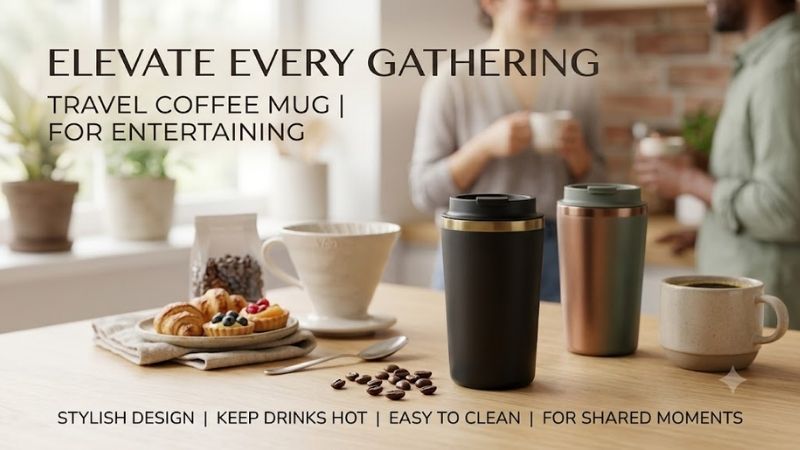
However, travel mugs may be useful for casual brunches, backyard gatherings, and events where guests move between different areas.
They help reduce open-cup spills and can retain beverage temperature longer than some uninsulated cups.
Sending Guests Home With Coffee
A host may prepare coffee for guests who are leaving after a meal.
A secure travel mug allows the beverage to be taken away.
However, the mug must be appropriate for transport, and the coffee should be at a safe drinking temperature.
A lid described as spill-resistant should not automatically be treated as suitable for carrying horizontally inside a bag.
Picnics and Outdoor Events
Outdoor gatherings often involve moving between tables, chairs, and activity areas.
A travel mug can protect a drink from some accidental splashes.
However, it does not make hot coffee harmless.
Hot beverages can still cause burns.
Choose stable, comfortable vessels and avoid overfilling them.
Party Favors and Guest Gifts
Reusable coffee mugs can also serve as take-home gifts.
In this situation, appearance, personalization, durability, and packaging matter.
However, a decorative mug that leaks or is difficult to wash is unlikely to become a favorite everyday item.
A functional product usually provides greater lasting value.
Travel Mugs vs. Ordinary Coffee Cups
Ceramic Coffee Mugs
Ceramic cups are useful for indoor coffee service.
They can be attractive and comfortable to drink from.
However, they are usually open at the top and may break if dropped.
Disposable Coffee Cups
Disposable cups can simplify cleanup at large events.
However, they create recurring waste and may require separate lids and sleeves.
The environmental trade-offs depend on materials, disposal options, and actual reuse.
Reusable Travel Mugs
Travel mugs provide additional portability.
They may include insulation and spill-resistant closures.
However, they require thorough cleaning after use.
Insulated Tumblers
Some tumblers are suitable for coffee but have lids designed mainly to reduce splashing rather than prevent leaks.
This can be acceptable for upright table use.
However, the distinction matters during transportation.
Which Is Best?
Choose ordinary mugs for formal seated occasions, travel mugs for mobile gatherings, and properly sealed travel vessels for guests who need to carry beverages away.
Do not assume one drinkware design is ideal for every type of hospitality.
Understanding Leakproof vs. Leak-Resistant
Leakproof Closures
A mug advertised as leakproof is intended to resist leakage under specified conditions when correctly closed.
However, the claim should be evaluated against the manufacturer’s instructions.
A mug may perform differently when inverted, shaken, or exposed to pressure changes.
Leak-Resistant Lids
A leak-resistant lid may help prevent ordinary splashes while the vessel remains upright.
It may not prevent liquid from escaping when tipped over or placed in a bag.
This distinction is important for entertaining.
Splash-Resistant Openings
Some lids have simple openings or sliding covers.
These can be convenient for sipping.
However, they may leave gaps through which liquid can escape.
Why Labels Matter
A host giving guests coffee for a drive home should not assume that a sliding lid provides the same security as a fully closed transport lid.
Check the actual product design.
Practical Spill-Test Considerations
For a newly purchased mug, follow the manufacturer’s recommendations for checking closure operation.
Do not perform risky tests with boiling water.
A room-temperature water check can help identify an incorrectly assembled lid, but it does not replace manufacturer specifications or independent leak testing.
Choosing the Right Mug Capacity
Small After-Dinner Coffee
A compact 6- to 10-fluid-ounce mug may be appropriate for modest servings.
This can be useful after dessert or during a tasting event.
However, a small mug may not accommodate large milk-based beverages.
Standard Coffee Servings
A 12- to 16-fluid-ounce travel mug is versatile for many American-style coffee drinks.
It can accommodate a normal coffee serving with practical headroom.
However, the exact capacity should be checked against the maximum safe fill level.
Large Beverages
A 20- to 24-fluid-ounce travel mug may suit long outdoor gatherings or people who prefer large drinks.
However, it is bulkier and heavier.
Why Bigger Is Not Always Better
A large mug can be awkward for an elderly guest or someone with smaller hands.
It also occupies more storage space.
For hosting, a consistent moderate size may be more practical than buying the largest available option.
Capacity Comparison
| Event type | Practical capacity to compare | Main consideration |
|---|---|---|
| After-dinner espresso-style drinks | 6–10 fl oz | Small portion and compact handling |
| Casual indoor gathering | 12–16 fl oz | Balance of capacity and portability |
| Backyard brunch | 12–16 fl oz | Easy sipping and spill resistance |
| Outdoor event | 16–20 fl oz | Insulation and carrying comfort |
| Long road trip | 16–24 fl oz | Secure closure and cupholder fit |
| Personalized guest gifts | 12–16 fl oz | Broad everyday usefulness |
These are suggested shopping ranges, not universal serving requirements.
Insulation and Temperature Retention
Double-Wall Vacuum Insulation
Many travel mugs use double-wall vacuum insulation to reduce heat transfer.
This can help keep coffee warm longer than ordinary open drinkware.
However, actual performance depends on the complete mug, including the lid and opening.
Why Lid Construction Matters
A large open sip hole allows more heat exchange.
A securely closed lid may help retain temperature.
However, a highly insulated mug can also keep beverages dangerously hot for longer than expected.
Understanding Manufacturer Claims
Some mugs advertise temperature retention over several hours.
However, test conditions differ.
Starting temperature, fill level, room temperature, lid position, and frequency of opening all affect results.
Do not compare retention numbers from different products without considering how they were measured.
Does Preheating Help?
Some manufacturers recommend preheating insulated drinkware with warm or hot water.
This may reduce initial temperature loss.
However, only use an approved procedure.
Do not expose the mug or lid to conditions outside its temperature ratings.
Cooling Coffee Before Serving
For a group event, extremely hot coffee creates handling and burn risks.
Allow beverages to reach an appropriate serving temperature before handing mugs to guests.
A well-insulated vessel can retain dangerous heat for longer than expected.
Choosing the Right Lid
Screw-On Lids
A screw-on closure can provide secure attachment when correctly designed.
However, it may require more effort to open and clean.
Flip-Top Lids
Flip-top designs can be convenient for one-handed drinking.
However, hinges and seals may collect residue.
Check whether the lid can be fully cleaned.
Sliding Lids
Sliding closures are simple and common on tumblers.
They may reduce splashing.
However, many are not leakproof.
Push-Button Lids
Some mugs open through a button-operated mechanism.
These can be convenient during travel.
However, they introduce internal moving parts that require cleaning.
Straw Lids
Certain tumblers include straws.
However, straw use with hot beverages may create burn risks and may be prohibited by the manufacturer.
Do not assume that a straw lid intended for cold drinks is suitable for hot coffee.
Which Lid Is Best for Guests?
For indoor gatherings, a simple easy-clean sip lid may be preferable.
For guests transporting coffee, a compatible secure closure offers greater practical value.
For bulk sets, avoid complicated lids that are difficult to wash between events.
Cleaning Lids: The Most Overlooked Buying Factor
Why Lids Collect Residue
Coffee oils, milk, sugar, and flavored syrups can collect around seals, hinges, and drinking openings.
These areas may be difficult to inspect.
A mug that is easy to wash on the outside may still have a complicated lid.
Removable Gaskets
Some lids contain removable silicone seals.
These can simplify cleaning when the manufacturer permits removal.
However, reinstallation must be correct.
An incorrectly seated gasket may cause leaks.
Hidden Channels
Certain push-button or sliding mechanisms contain narrow passages.
These may require specific cleaning procedures.
Dishwasher Compatibility
Some lids are dishwasher safe.
Others must be handwashed.
The mug body and lid may have different care requirements.
Choosing for Entertaining
If you plan to wash six or twelve mugs after an event, simple lids can save substantial effort.
A complicated closure may be worthwhile for one commuter but inconvenient for a matching guest set.
Stainless Steel, Ceramic, Glass, and Plastic
Stainless Steel
Stainless steel is common in insulated travel mugs.
It can provide durability and impact resistance.
However, interior finishes and cleaning requirements vary.
Ceramic-Coated Interiors
Some mugs use interior coatings intended to change the drinking experience.
However, ceramic-coated does not automatically mean the vessel is entirely ceramic.
Check durability and care guidance.
Glass Travel Cups
Glass can provide a familiar drinking surface.
However, glass may break if dropped.
It can be less suitable for crowded outdoor gatherings.
Plastic Travel Mugs
Food-contact plastic may provide lightweight construction.
However, insulation and temperature limits vary.
Choose products explicitly designed for hot beverages.
Exterior Finish
Powder-coated and painted finishes can provide an attractive appearance.
However, they may scratch or chip with repeated use.
For group events, durable finishes may be more valuable than elaborate decoration.
Handles, Grip, and Accessibility
Why Grip Matters
A full travel mug can be relatively heavy.
A suitable grip reduces the chance of dropping it.
Handle-Equipped Mugs
Handles may be useful for casual outdoor gatherings.
However, they can increase overall width.
Handle-Free Tumblers
These can fit some cupholders more easily.
However, users with limited grip strength may find them less comfortable.
Surface Texture
A nonslip or textured surface may improve handling.
However, the finish should remain comfortable and easy to clean.
Accessibility for Different Guests
Guests vary in hand size, strength, coordination, and comfort with complicated lids.
A simple closure and stable handle may be more inclusive than a sophisticated mechanism requiring several motions.
Weight When Full
Evaluate the combined weight of the mug and beverage.
A large metal mug may feel substantially heavier when filled.
Cupholder and Bag Compatibility
Vehicle Cupholders
If guests will use the mugs while traveling, base diameter matters.
Not every travel tumbler fits every car cupholder.
Wide Handles
A large handle can interfere with a narrow cupholder even when the mug’s base fits.
Bag Storage
Only mugs expressly designed for leakproof transport should be considered for enclosed bags.
Even then, follow closure instructions.
Lids and Pressure Changes
Temperature changes and movement can affect some closures.
Do not assume a mug remains leakproof under every travel condition.
Outdoor Carrying
A mug carried on a picnic should have a secure lid and comfortable grip.
Avoid placing filled hot mugs loose among other objects where they can tip or be compressed.
Matching Sets vs. Individual Mugs
Why Matching Sets Are Appealing
Matching mugs can create a cohesive look for a brunch, wedding-related gathering, or holiday event.
However, identical mugs can also become difficult to distinguish.
Color Coding
Different colors allow guests to identify their drinks.
This can be useful when several people set mugs on the same table.
Name Labels
Removable labels or approved personalization can help prevent confusion.
However, labels should not interfere with lids, seals, or drinking areas.
Personalization
Some mugs support engraving or printed names.
These can make attractive gifts.
However, custom products may have different return policies.
Replacement Consistency
If you plan to own a set for repeated events, check whether compatible replacement lids and matching mugs remain available.
Avoid Overbuying
A set of twelve mugs may be unnecessary for a household that hosts only four people at a time.
Choose a realistic number and storage plan.
Coffee Service for Different Events
Outdoor Brunch
Insulated travel mugs can help guests move between seating areas.
Choose a moderate capacity and stable design.
Backyard Barbecue
Lids can help reduce accidental splashes.
However, mugs should remain away from grills and hot cooking surfaces.
Holiday Gatherings
Matching or personalized mugs may serve as reusable gifts.
Choose designs that are easy to wash after the event.
Road-Trip Meetups
Secure closures and cupholder fit become more important.
Office Celebrations
Simple reusable mugs may reduce dependence on disposable cups.
However, cleaning responsibility and storage should be planned.
Coffee Tasting Events
Small insulated cups may be useful for controlled portions.
However, extreme insulation can reduce the rate at which coffee cools for tasting.
Ordinary tasting cups may be more appropriate when the goal is sensory evaluation.
Serving Coffee Safely to Guests
Do Not Overfill
Leave enough headroom for lid closure and safe drinking.
Follow the mug’s maximum fill level.
Check Lid Engagement
A lid must be attached correctly.
Do not give a guest a mug whose closure is loose or damaged.
Warn About Hot Contents
Insulated mugs can retain high beverage temperatures.
A guest may underestimate how hot the coffee remains.
Avoid Hot Drinks in Unsuitable Straw Lids
Use only lids approved for hot liquids.
Keep Away From Children
Young children can be burned by hot drinks.
Place filled mugs out of reach when necessary.
Do Not Treat Travel Mugs as Pressure Vessels
Do not use them for unsupported carbonated, fermenting, or pressure-generating contents.
Follow the exact product instructions.
Milk-Based Coffee and Food Safety
Why Milk Changes the Storage Requirements
Coffee mixed with dairy milk or other refrigerated ingredients is perishable.
Insulation does not automatically make it safe to store at room temperature for extended periods.
Prepare Milk Drinks Close to Serving
When practical, add milk shortly before handing out the beverage.
Refrigeration
Store unused milk and other perishables according to their labels.
Hot-Holding Assumptions
A travel mug is not automatically a certified hot-holding appliance.
Do not rely on vague temperature retention claims to establish food safety for milk-based drinks.
Clean After Use
Milk residue can remain in narrow lid passages.
Thorough cleaning is important.
A Practical Entertaining Workflow
Step 1: Count Guests
Estimate how many people will actually drink coffee.
Step 2: Choose Beverage Sizes
Decide whether you are serving small after-dinner portions or full mugs.
Step 3: Select Suitable Mugs
Use lids and materials appropriate for the event.
Step 4: Inspect the Drinkware
Check for cracks, damaged seals, or loose components.
Step 5: Wash Before Use
Use the manufacturer’s approved cleaning method.
Step 6: Prepare Coffee
Brew the amount needed using a suitable method.
Step 7: Allow Safe Serving Temperature
Do not transfer dangerously hot drinks without appropriate precautions.
Step 8: Fill With Headroom
Avoid exceeding safe fill levels.
Step 9: Identify Mugs
Use colors, name labels, or another simple method when helpful.
Step 10: Explain the Lid
Show guests how to open, close, and carry the mug.
Step 11: Store Extras Safely
Keep unused mugs clean and away from food contamination.
Step 12: Clean After the Event
Wash and dry all components before storage.
Cleaning Multiple Travel Mugs
Empty Promptly
Do not leave milk-based coffee or sweetened beverage residue inside mugs for prolonged periods.
Disassemble as Directed
Remove lids and approved removable seals.
Wash Food-Contact Surfaces
Use appropriate detergent and water.
Pay attention to drinking openings and hidden channels.
Check Dishwasher Rules
Some mug bodies are dishwasher safe.
Others require handwashing.
Dry Completely
Allow the body and lid components to dry before closing and storing.
Inspect for Odors
Persistent odors can indicate residue trapped in inaccessible areas.
Follow the manufacturer’s deeper-cleaning guidance.
Store Without Damaging Seals
Some manufacturers provide specific lid-storage instructions.
Follow them rather than forcing mugs into stacked positions that deform components.
Storage in Small Homes
Stacking
Some mugs are designed to stack.
Others are not.
Do not assume a narrow base means a mug can be safely stacked.
Cabinet Height
Tall insulated tumblers may not fit ordinary shelves.
Measure the full height, including the lid.
Handle Width
Handles increase the space required.
Storage of Extra Lids
Keep compatible replacement components organized.
Seasonal Hosting
If the mugs are used only during holidays or special events, store them clean, dry, and protected from damage.
Avoid Excessive Sets
Buying fewer versatile mugs may be better than maintaining several decorative sets.
Cost and Group Buying
Calculate Total Event Cost
A mug priced at $15 costs $90 for six guests.
The same mug costs $180 for twelve guests.
These are illustrative arithmetic examples, not current market offers.
Consider Accessories
Personalization, spare lids, gift packaging, and cleaning brushes can add expense.
Compare Price per Use
Mugs reused at several events may provide more value than products purchased for a single occasion.
However, longevity and cleaning effort matter.
Premium Insulation
Superior insulation may justify a higher price for guests who travel with hot coffee regularly.
It may provide less benefit for short indoor gatherings.
Bulk Discounts
Discounts may be available on sets.
However, check whether buying more units than needed actually creates value.
Gift Value
A practical mug that guests use regularly may be more appreciated than an expensive decorative product that is difficult to clean.
Environmental Considerations
Reusable Does Not Mean Impact-Free
Reusable mugs require material production, transportation, washing, and eventual disposal.
Their environmental value depends partly on how often they replace disposable drinkware.
Durability Matters
A mug that lasts through repeated use may offer better long-term value.
Replaceable Lids
A broken lid should not necessarily require replacing the entire mug.
Check component availability.
Appropriate Washing
Follow cleaning instructions and avoid unnecessary chemical treatments.
Avoid Disposable Decorations
Reusable name markers or simple labels may be preferable when hosting frequently.
Choosing for Different Hosts
Small Family Gatherings
A set of moderately sized easy-clean mugs can be sufficient.
Large Outdoor Events
Prioritize stability, easy identification, and practical washing arrangements.
Hosts Who Give Coffee Gifts
Choose broadly useful sizes and durable closures.
Frequent Road-Trip Hosts
Leakproof transport and cupholder compatibility matter more.
Minimalist Homes
Choose a small number of versatile mugs rather than many specialized designs.
Households With Children
Prioritize safe storage of hot beverages and avoid complicated or unsuitable lids.
Common Buying Mistakes
Assuming Spill-Resistant Means Leakproof
Closure performance varies.
Choosing Oversized Mugs for Every Guest
Large mugs can be heavy and awkward.
Ignoring Lid Cleaning
Complex lids may be inconvenient when washing multiple units.
Purchasing Matching Mugs Without Identification
Guests may confuse identical drinks.
Buying Only for Appearance
Attractive finishes do not guarantee practical performance.
Assuming Every Mug Fits a Car Cupholder
Base diameter and handle geometry matter.
Using Cold-Drink Straw Lids for Hot Coffee
Follow the manufacturer’s approved uses.
Treating Insulation as Safe Dairy Storage
Perishable ingredients still require appropriate temperature control.
Frequently Asked Questions
What Is the Best Travel Coffee Mug for Entertaining Guests?
A durable insulated mug with a comfortable grip, practical 12- to 16-ounce capacity, and easy-clean lid is a strong starting point for casual gatherings.
Should Guests Have Matching Travel Mugs?
Matching sets can look cohesive, but color coding or identification helps prevent confusion.
Are Travel Coffee Mugs Leakproof?
Some are designed for leakproof transport, while others are only leak-resistant or splash-resistant. Check the exact product.
What Size Travel Mug Is Best for a Coffee Party?
A 12- to 16-ounce size is versatile for many drinks, while smaller cups may suit after-dinner coffee.
Can I Put Hot Coffee in a Mug With a Straw Lid?
Only if the manufacturer expressly approves that lid for hot beverages. Some straw systems are intended for cold drinks only.
Are Insulated Travel Mugs Dishwasher Safe?
It depends on the mug and lid. Follow the manufacturer’s exact care instructions.
Can I Give Filled Coffee Travel Mugs as Party Favors?
You can provide suitable beverages in clean, correctly closed mugs, but consider temperature, transport safety, and perishable ingredients. An empty personalized mug may be a simpler take-home gift.
How Many Travel Mugs Should I Buy for Entertaining?
Base the quantity on expected coffee drinkers and realistic future use. Avoid buying an oversized set solely for occasional events.
Conclusion
The best travel coffee mug for entertaining combines an appropriate serving size, dependable lid design, comfortable handling, insulation, and easy cleaning. For casual gatherings, reusable 12- to 16-ounce mugs offer versatility, while genuinely leakproof designs are more appropriate when guests carry beverages away. Choose a manageable set that fits your storage space, identify drinks clearly, and prioritize practical features over decorative extras. A thoughtful travel mug can make hospitality more convenient, but only when it suits how the guests will actually use it.




Write Your Review
No reviews yet. Be the first to share your experience!