
A ceramic nonstick skillet can make eggs, pancakes, and delicate fish easier to cook and clean, but ceramic-coated pans differ in construction and durability. This roundup compares seven real options for daily meals, including induction-ready and budget models, and explains what their coatings can—and cannot—do over time.
Best ceramic nonstick skillet choices for everyday cooking
A practical ceramic skillet should heat predictably, release delicate ingredients with minimal effort, and remain comfortable during routine use. Construction quality matters because ceramic coatings are usually applied over aluminum or another metal base. These models offer different combinations of durability, handling, compatibility, and price.
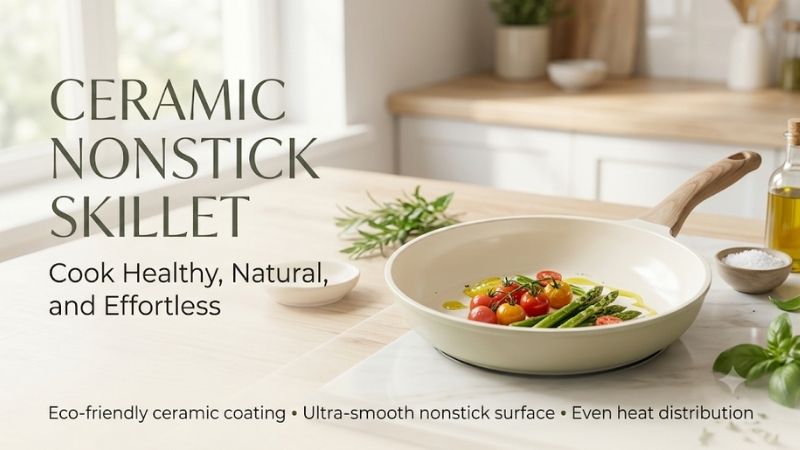
GreenPan Valencia Pro – Best overall ceramic nonstick option
The GreenPan Valencia Pro Ceramic Nonstick Frypan is a versatile choice for home cooks who want ceramic food release with durable construction and induction compatibility. Its hard-anodized aluminum body, reinforced ceramic coating, and Magneto induction base make it suitable for everyday breakfast and dinner recipes.
GreenPan’s Valencia Pro collection uses hard-anodized aluminum to support fast, relatively even heating.
This is useful for delicate foods that require careful temperature management, including eggs, pancakes, and fish.
The ceramic coating is designed to release food without requiring large quantities of oil.
However, using a small amount of butter or cooking oil can improve results and help preserve the surface.
One major advantage is the Magneto induction base.
Not every ceramic-coated aluminum skillet works on an induction cooktop.
The Valencia Pro is specifically designed for induction as well as gas, electric, and other compatible heat sources.
Its reinforced construction also aims to improve resistance to ordinary kitchen wear.
However, buyers should distinguish scratch resistance from unlimited durability.
Even a reinforced ceramic coating can lose release performance after repeated overheating or aggressive cleaning.
The manufacturer permits metal utensils on the collection but recommends silicone tools to extend coating life.
This is an important practical distinction.
A skillet can meet a metal-utensil compatibility claim while still benefiting from gentler handling.
GreenPan lists an oven rating up to 600°F for the Valencia Pro frying pans, although everyday ceramic cooking generally benefits from much lower stovetop temperatures.
The collection is dishwasher-safe, but handwashing is recommended.
The 11-inch version is particularly appealing for households preparing several portions without moving to an oversized 12-inch skillet.
Advantages: Induction-ready base, hard-anodized construction, reinforced ceramic coating, versatile sizes, and generous oven rating.
Limitations: Coating performance can decline with misuse, premium pricing compared with budget pans, and handwashing is preferable.
Best for: Home cooks who want an induction-compatible ceramic skillet with strong everyday versatility.
OXO Ceramic Professional Frying Pan – Best for practical handling
The OXO Ceramic Professional Frying Pan combines a hard-anodized aluminum body with a diamond-reinforced ceramic coating and an induction-ready base. Its streamlined interior hardware and balanced stainless steel handle make it particularly appealing to cooks who value comfortable handling and straightforward cleaning.
OXO designed this collection for use across common cooking surfaces, including induction.
That compatibility gives buyers flexibility when moving between homes or upgrading a stove.
The hard-anodized aluminum body supports relatively quick heating compared with heavy cast iron cookware.
This is valuable during breakfast, when eggs and pancakes benefit from predictable changes in temperature.
The ceramic coating is made without intentionally added PFAS, according to the manufacturer’s product information.
However, that statement should not be interpreted as a guarantee that the coating will remain perfectly nonstick indefinitely.
All coated cookware requires appropriate care.
OXO’s streamlined rivets are another useful detail.
Traditional exposed rivets can create small areas where food residue collects.
A smoother interior makes ordinary wiping more convenient.
The manufacturer also describes the surface as metal-utensil safe, although gentler silicone or wooden tools remain sensible for protecting the coating.
The Ceramic Professional collection includes multiple sizes, making it easy to choose a compact egg pan or a larger multipurpose skillet.
Users should verify the oven rating for the exact regional model because published limits can differ between product listings and configurations.
One limitation is that the skillet remains a coated product.
It should not be treated like uncoated stainless steel when using aggressive cleaning tools or prolonged extreme heat.
Advantages: Induction compatibility, hard-anodized body, comfortable handle, streamlined rivets, and easy-clean design.
Limitations: Coating requires careful use, oven limits should be checked by model, and premium pricing may exceed basic alternatives.
Best for: Everyday cooks who want a comfortable, easy-to-clean ceramic skillet for multiple cooktops.
Caraway Ceramic-Coated Fry Pan – Best for modern kitchens
The Caraway Ceramic-Coated Fry Pan combines a sleek appearance with a ceramic nonstick cooking surface intended for everyday meals. Its 10.5-inch diameter, aluminum body, stainless steel handle, and induction-compatible base make it suitable for buyers seeking functional cookware that also complements a modern kitchen.
The 10.5-inch size is a practical middle ground.
It provides enough space for a couple of eggs, a moderate portion of vegetables, or several smaller pieces of fish.
The pan’s aluminum body supports relatively responsive heating.
This can be useful for controlling the temperature of delicate foods.
However, ceramic coatings generally perform best when users avoid unnecessary overheating.
A small amount of cooking fat can support food release and reduce stress on the surface.
Caraway specifies that the coating is made without PTFE, PFOA, and PFAS.
The manufacturer also lists compatibility with gas, electric, and induction cooktops.
This is an important advantage for buyers who may eventually change their kitchen appliances.
The pan is oven-safe up to 550°F according to the manufacturer’s specifications.
However, a high oven temperature rating does not mean high burner settings are ideal for everyday nonstick cooking.
Another selling point is the coordinated exterior finish.
The pan is available in several colors, allowing buyers to match other cookware or kitchen accessories.
However, appearance should remain secondary to cooking performance.
Caraway occupies a premium price category, and users should understand that ceramic coatings are consumable surfaces over time.
The coating may gradually become less slippery even when the metal body remains structurally sound.
Advantages: Attractive design, induction compatibility, useful 10.5-inch size, responsive aluminum body, and 550°F oven rating.
Limitations: Premium cost, coating performance changes with wear, and careful heat management is important.
Best for: Buyers who want stylish everyday ceramic cookware with broad stovetop compatibility.
GreenLife Soft Grip Frypan – Best affordable everyday choice
The GreenLife Soft Grip Ceramic Nonstick Frypan is a budget-friendly option designed for simple home cooking. Its aluminum body, ceramic coating, and comfortable handle make it particularly appealing to beginners, students, and people who want an inexpensive pan for eggs and other low-to-medium-heat recipes.
The Soft Grip collection emphasizes straightforward operation.
An aluminum body helps the skillet heat relatively quickly, reducing the time required for ordinary breakfast preparation.
The ceramic coating is designed to release food with modest amounts of cooking fat.
This can make scrambled eggs and pancakes easier to prepare than on an uncoated stainless steel surface.
The handle is designed to remain comfortable during typical stovetop use, although users should still follow all heat-related safety instructions.
The collection includes several sizes, allowing buyers to choose between compact and family-oriented options.
One important limitation is induction compatibility.
The standard GreenLife Soft Grip collection is not designed for induction cooktops.
The manufacturer offers separate induction-compatible lines, including Soft Grip Induction, but shoppers should not confuse these products.
This distinction matters because ceramic coating does not determine induction performance.
The metal base must be suitable for magnetic heating.
The standard Soft Grip collection also has a relatively modest oven rating, depending on the selected model.
Its accessible pricing makes replacement less expensive if the coating eventually loses performance.
However, users should still avoid abrasive cleaning and prolonged high heat.
A low purchase price does not eliminate the value of careful maintenance.
Advantages: Affordable, lightweight, comfortable handle, simple cleaning, and useful everyday sizes.
Limitations: Standard Soft Grip is not induction-compatible, limited high-heat versatility, and coating longevity depends on care.
Best for: Budget-conscious users with gas or conventional electric stoves who mainly prepare quick everyday meals.
Specialty ceramic nonstick skillets for different cooking styles
Some ceramic pans focus on compact design, while others emphasize more substantial construction or compatibility with high-temperature cooking. These differences can matter when buyers want a skillet for more than ordinary eggs and pancakes. The following options offer distinct alternatives to basic aluminum ceramic cookware.
Tramontina Professional Ceramic Fry Pan – Best practical workhorse
The Tramontina Professional Ceramic Fry Pan is intended for cooks who want an accessible ceramic-coated skillet with a conventional professional-style frying-pan shape. Its construction prioritizes a useful cooking surface, uncomplicated handling, and everyday food release rather than premium decorative details.
A professional-style skillet typically features a broad cooking base with sloped walls.
This shape is convenient for turning eggs, sautéing vegetables, and transferring food onto a plate.
The ceramic coating reduces direct contact between ingredients and the metal body.
However, the pan should still be used with appropriate cooking fat.
One advantage of a conventional frying-pan shape is versatility.
A cook can prepare pancakes in the morning and sauté vegetables for dinner without changing equipment.
However, buyers should examine the actual flat cooking diameter.
A skillet marketed as ten inches may have considerably less flat area because of its sloped walls.
This becomes important when preparing several portions simultaneously.
Tramontina offers multiple cookware collections, and construction details differ between them.
Buyers should check the exact Professional Ceramic model rather than assuming specifications from the brand’s stainless steel or conventional nonstick lines.
In particular, induction compatibility and oven temperature limits should be verified on the selected product.
A ceramic coating alone does not guarantee induction compatibility.
The main limitation is that coated cookware is not intended to replace uncoated stainless steel for every high-temperature recipe.
The Tramontina option makes most sense as an everyday skillet for controlled cooking.
Advantages: Practical frying-pan shape, accessible pricing, useful everyday versatility, and ceramic food release.
Limitations: Coating requires care, model-specific compatibility must be checked, and extreme heat is not ideal.
Best for: Home cooks seeking a straightforward ceramic skillet for eggs, vegetables, and ordinary meals.
Cuisinart CastLite Ceramic Nonstick Skillet – Best lightweight cast iron hybrid
The Cuisinart CastLite Ceramic Nonstick Skillet offers an unusual alternative to conventional aluminum ceramic pans. It combines a lightweight cast iron body with a ceramic nonstick interior, giving buyers some of the cooking characteristics of iron while reducing weight and seasoning maintenance.
The CastLite collection is designed to be lighter than traditional cast iron cookware.
This may appeal to cooks who appreciate substantial pans but dislike the weight of conventional iron skillets.
The 10-inch model offers useful capacity for everyday meals.
Its ceramic interior eliminates the need to build a traditional bare-iron seasoning layer.
This simplifies preparation and cleaning for users unfamiliar with cast iron maintenance.
The body also provides different thermal behavior from lightweight aluminum cookware.
Cast iron typically changes temperature more slowly and retains heat effectively once warmed.
That can be useful for certain browning tasks.
However, the ceramic coating remains a coated cooking surface.
Users should still avoid unnecessary high-heat exposure and harsh cleaning methods.
Cuisinart specifies induction compatibility and an oven rating up to 500°F for this model.
That makes it a flexible option for households using modern induction cooktops.
The stainless steel handle provides controlled lifting, although it can become hot during extended cooking or oven use.
One limitation is that a lightweight cast iron hybrid does not behave exactly like either traditional bare cast iron or ordinary aluminum ceramic cookware.
Buyers should select it for its specific combination of characteristics rather than assuming it provides every benefit of both materials without trade-offs.
Advantages: Lightweight cast iron body, ceramic food release, induction compatibility, no traditional seasoning, and 500°F oven rating.
Limitations: Different heating behavior from aluminum, coated-surface care requirements, and potentially greater weight than ordinary ceramic pans.
Best for: Home cooks who want an induction-ready ceramic skillet with a more substantial cast iron construction.
Our Place Always Pan 2.0 – Best multipurpose ceramic design
The Our Place Always Pan 2.0 is designed as a versatile cooking vessel that combines several kitchen functions in one pan. Its ceramic nonstick interior, deeper shape, and coordinated accessories make it especially appealing to buyers who want a compact collection of multipurpose cookware.
The Always Pan differs from a conventional shallow frying pan.
Its deeper walls provide more room for vegetables, saucy dishes, and meals that involve multiple ingredients.
This can be useful in apartments where storage space is limited.
Rather than keeping separate cookware for sautéing and shallow simmering, a single multipurpose vessel may handle several common tasks.
However, a deeper pan introduces trade-offs.
High walls can reduce moisture evaporation when ingredients are crowded.
For recipes requiring a dry, crisp sear, a conventional wide frying pan may be more effective.
The ceramic coating is intended for low-to-medium-heat everyday cooking.
It can simplify preparation of eggs, vegetables, and delicate proteins.
However, the surface is not designed to remain permanently nonstick regardless of use.
Buyers should avoid abrasive cleaning and follow the manufacturer’s current utensil recommendations.
The Always Pan 2.0 is designed for common cooktops, including induction, but exact configuration and accessory specifications should be checked before purchasing.
Its coordinated appearance is also a major part of the product’s appeal.
However, the buyer pays for versatility and styling as well as the cooking vessel itself.
For households that already own several quality pans, the additional functionality may be less valuable.
Advantages: Multipurpose design, deeper vessel, ceramic interior, coordinated accessories, and induction compatibility.
Limitations: Higher price, less ideal for maximum surface browning, and coating requires careful maintenance.
Best for: Small kitchens and households seeking one versatile ceramic-coated vessel for several cooking tasks.
How to choose the right ceramic nonstick cookware
Ceramic-coated pans can appear similar while offering different construction and operating requirements. The most important differences involve metal body material, coating durability, cooking area, and compatibility with the stove. Understanding these features helps buyers avoid paying for claims that do not translate into useful performance.
Understand what ceramic nonstick coatings actually are
Most ceramic nonstick skillets are not made from solid ceramic. They use a metal body, commonly aluminum, covered with a ceramic-like coating created through a specialized manufacturing process. Understanding this distinction helps buyers evaluate durability, temperature limits, and realistic expectations for long-term food release.
Ceramic nonstick coatings commonly use sol-gel technology.
The coating creates a relatively smooth cooking surface that can release food effectively when new.
However, it is different from traditional porcelain enamel fused to cast iron.
It is also different from conventional PTFE-based nonstick cookware.
Many ceramic products are marketed as PFAS-free, but buyers should examine the exact manufacturer’s material claims.
A ceramic label alone does not explain every component of the pan.
The metal body influences heat distribution and induction compatibility.
The coating determines much of the food-release behavior.
Over time, repeated heating and cleaning can change the coating’s performance.
A pan may remain structurally sound while gradually becoming less slippery.
This is one reason ceramic cookware should be considered an everyday tool with a finite coating life rather than a permanent replacement for stainless steel.
Appropriate use can extend service life, but no coating should be expected to perform identically forever.
Choose an appropriate size and cooking surface
The most useful skillet size depends on the number of servings and the types of meals prepared. Compact pans are convenient for eggs, while larger models provide room for fish fillets, pancakes, and family portions. Buyers should compare usable cooking area rather than relying only on the outer diameter.
An eight-inch skillet is convenient for one or two eggs.
It also occupies relatively little storage space.
A ten-inch skillet provides more flexibility for individuals and couples.
It can handle small omelets, vegetables, and moderate portions of meat.
For families, an eleven- or twelve-inch pan may be more practical.
However, a large ceramic skillet requires appropriate burner coverage.
A pan wider than the active heating zone can develop temperature differences across its surface.
This matters for pancakes, which require relatively consistent heat.
The flat cooking diameter is another important measurement.
Sloped walls reduce usable space compared with the nominal rim width.
Buyers should consider whether the pan will be used primarily for breakfast or for complete dinners.
A smaller skillet may be sufficient as a dedicated egg pan.
A larger model is more suitable when it must handle several different meals.
Choose the smallest size that comfortably accommodates normal portions without overcrowding.
Protect the coating with appropriate heat and utensils
Ceramic nonstick coatings are often marketed with impressive temperature ratings, but everyday cooking should not rely on extreme heat. Excessive burner output, unsuitable utensils, and abrasive cleaning can shorten coating life. Gentle use is generally the best strategy for maintaining food-release performance.
Begin by preheating over low or medium heat.
Avoid leaving an empty ceramic pan over a high burner setting for extended periods.
Use a small amount of butter or cooking oil when recommended by the manufacturer.
This helps distribute heat and can reduce stress on the cooking surface.
Avoid aerosol cooking sprays when the manufacturer warns against them.
Some sprays leave residues that become difficult to remove and interfere with food release.
Silicone or wooden utensils are generally sensible choices.
Even when a manufacturer describes a coating as metal-utensil safe, gentler tools can reduce unnecessary abrasion.
Allow the pan to cool before washing.
Avoid plunging a hot skillet into cold water.
For routine cleaning, use warm water, mild dish soap, and a soft sponge.
Do not assume dishwasher compatibility means machine washing is best for coating longevity.
Handwashing is often the more conservative choice.
Long-term value and replacement considerations
A ceramic skillet can be an excellent everyday cooking tool, but buyers should understand how coating wear affects its useful life. Unlike bare cast iron or uncoated stainless steel, a worn ceramic nonstick surface generally cannot be restored through seasoning. Evaluating price and expected usage helps buyers make realistic purchasing decisions.
Know when ceramic nonstick performance is declining
The clearest sign of ceramic coating wear is a gradual loss of food-release performance. Eggs and pancakes that once lifted easily may begin sticking despite appropriate heat and cooking fat. Residue buildup can cause similar symptoms, so the surface should be cleaned properly before assuming that the coating has reached the end of its useful life.
Begin by checking whether the pan has accumulated burned-on oil.
Some residues appear almost invisible but create sticky areas.
Follow the manufacturer’s approved cleaning method.
Avoid aggressive scouring in an attempt to restore the original slippery feeling.
If the surface remains difficult to use after appropriate cleaning, the coating may have deteriorated.
Visible chips, flaking, or serious damage are additional reasons to stop using the cookware and seek manufacturer guidance.
A ceramic pan cannot be restored in the same manner as a seasoned cast iron skillet.
Applying oil and heating it repeatedly does not recreate the original manufactured coating.
For households using nonstick cookware daily, replacement may eventually be necessary.
Consider this ongoing cost when comparing inexpensive and premium options.
Decide when ceramic is better than stainless steel or cast iron
Ceramic cookware is especially useful for delicate foods and convenient cleanup, but it is not the best material for every cooking task. Stainless steel excels at browning and pan sauces, while cast iron provides substantial heat retention and traditional durability. The ideal kitchen may use different pans for different recipes.
A ceramic skillet is particularly convenient for eggs, pancakes, and delicate fish.
These foods benefit from a relatively forgiving cooking surface.
Stainless steel is often preferable for high-temperature searing and developing fond.
The browned residue can be used to prepare flavorful sauces.
Traditional cast iron is useful for heavy searing, baking, and recipes that benefit from stored heat.
However, it requires seasoning maintenance.
A ceramic skillet generally avoids that process, but its coating has a finite service life.
For someone building a minimal kitchen, a ceramic pan and stainless steel skillet can complement each other.
The ceramic pan handles delicate everyday foods.
The stainless steel pan manages demanding searing and acidic sauces.
Buy cookware based on actual meals rather than expecting one surface to perform every task equally well.
Conclusion
The best ceramic nonstick skillet depends on cooking habits, stove compatibility, and budget. GreenPan Valencia Pro provides strong all-around versatility, while OXO Ceramic Professional emphasizes practical handling and Caraway offers refined styling. GreenLife and Tramontina suit budget-conscious buyers, Cuisinart CastLite provides a distinctive lightweight iron alternative, and Our Place offers multipurpose convenience. Choose an appropriate size, verify induction compatibility, and protect the coating with moderate heat and gentle cleaning.
Write Your Review
No reviews yet. Be the first to share your experience!