
A well-chosen deep saute pan combines the broad browning surface of a skillet with the taller sides of a pot. That combination makes it useful for chicken cutlets, vegetables, saucy pasta, and shallow braises. We compare six options across different materials and capacities so you can match the pan to your cooking habits.
Best deep saute pan options for everyday cooking
A deep sauté pan earns its place in the kitchen by handling cooking methods that would normally require multiple vessels. Straight sides contain liquids, a broad bottom supports browning, and a fitted lid allows gentle finishing. The following stainless steel models offer different approaches to heat distribution, capacity, and daily convenience.
All-Clad D3 Stainless 3-Quart Sauté Pan – Best overall stainless steel choice
The All-Clad D3 Stainless 3-Quart Sauté Pan combines fully bonded tri-ply construction with a practical shape for browning and simmering. Its aluminum core extends through the body, helping distribute heat across the cooking surface, while the stainless steel interior supports searing, deglazing, and developing flavorful pan sauces.
One reason this model stands out is the versatility of its 3-quart capacity. It is large enough for several chicken portions or a modest one-pan dinner without becoming difficult to handle on a standard stovetop.
The straight-sided design helps contain splattering oil and prevents sauces from spilling as easily as they might in a shallow skillet. Its included lid allows the pan to transition from uncovered sautéing to covered simmering.
Fully clad stainless steel offers a meaningful advantage when cooking techniques require more than simple heating. After browning chicken, for example, the pan can be deglazed with stock to release caramelized cooking residues and produce a sauce.
The helper handle is another valuable feature. It provides additional control when transferring a pan filled with hot ingredients, reducing dependence on the long handle alone.
However, this is not a nonstick pan. Delicate ingredients may adhere when the surface is insufficiently preheated or the cooking temperature is poorly controlled.
The D3 is therefore most appealing to cooks who enjoy developing flavor and are comfortable learning stainless steel cooking techniques.
Advantages: Fully clad construction, durable stainless steel interior, induction compatibility, and useful helper handle.
Limitations: Requires proper preheating and cleaning technique; 3 quarts may be restrictive for large households.
Best for: Home cooks who want a durable multipurpose pan for sautéing, browning, and building sauces.
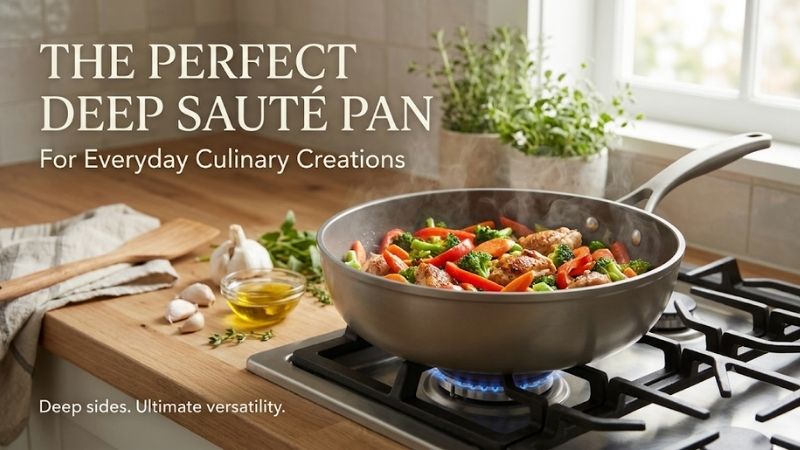
Made In Stainless Clad 3.5-Quart Sauté Pan – Best premium construction
The Made In Stainless Clad 3.5-Quart Sauté Pan is designed for cooks who prioritize responsive heat control and substantial construction. Its five-ply metal body provides a durable cooking surface with good thermal distribution, while the broad base makes it practical for browning ingredients before simmering or braising.
Compared with basic stainless steel cookware that uses only an encapsulated aluminum base, the Made In design extends its layered construction through the vessel.
This is useful when recipes involve several stages. A cook might brown sausage, sauté onions, add tomatoes, and simmer the complete mixture without switching cookware.
The pan’s 3.5-quart capacity offers slightly more room than many traditional 3-quart models. This additional volume is helpful for sauces that need stirring space or ingredients that release liquid during cooking.
Its stainless steel surface also tolerates the scraping and deglazing techniques used to build flavorful pan sauces. Browning residues can be loosened with stock or another suitable liquid, allowing the finished dish to retain flavor developed during the initial cooking stage.
The pan is well suited to induction and conventional stovetops. Its oven capability also makes it useful for recipes that begin with searing and finish with slower cooking.
The most significant drawbacks are price and weight. Buyers preparing only small, simple meals may not benefit enough from the premium construction to justify the additional expense.
Advantages: Five-ply construction, excellent versatility, durable cooking surface, and generous everyday capacity.
Limitations: Premium price, greater weight than lightweight alternatives, and a learning curve for stainless steel cooking.
Best for: Serious home cooks who frequently prepare layered one-pan recipes.
Tramontina Signature Tri-Ply Clad Deep Sauté Pan – Best practical value
The Tramontina Signature Tri-Ply Clad Deep Sauté Pan offers a more accessible route to fully clad stainless steel cookware. Its bonded metal construction combines stainless steel surfaces with an aluminum core, making it suitable for recipes that require sautéing, simmering, reducing liquids, and moving between different heat levels.
The appeal of this collection is its emphasis on practical performance rather than decorative features.
A broad base provides room for browning ingredients, while taller sidewalls help contain vegetables, sauces, and cooking liquids. This makes the pan particularly useful for dishes that begin dry and finish with added moisture.
For example, a cook can brown chicken thighs, remove them temporarily, soften onions and garlic, then return the chicken with broth and cover the pan for a gentle braise.
The stainless steel interior supports that sequence without exposing a nonstick coating to repeated high-temperature cooking.
The fitted lid also expands the pan’s versatility for steaming, covered simmering, and moisture retention.
As with other tri-ply stainless steel pans, food release depends on proper temperature management. Beginning with adequate preheating and allowing proteins to develop a crust can reduce unnecessary sticking.
Buyers should verify the capacity and dimensions of the specific Signature configuration because different sizes and product variants may be sold.
Advantages: Fully clad construction, multipurpose cooking performance, induction-compatible design, and competitive value.
Limitations: Not naturally nonstick, and larger versions require more cabinet space.
Best for: Home cooks seeking stainless steel versatility without moving directly into premium pricing.
Versatile deep saute pan choices for larger recipes
Larger portions, saucy dishes, and family meals create demands that a compact sauté pan may not handle efficiently. Additional capacity can prevent overflowing and support more generous servings, although larger cookware also takes longer to heat and requires greater storage space. These models emphasize volume, convenience, or easier food release.
Cuisinart Chef’s Classic Stainless 5.5-Quart – Best for larger households
The Cuisinart Chef’s Classic Stainless 5.5-Quart Sauté Pan provides substantial capacity for cooks who regularly prepare larger meals. Its broad cooking surface, tall sides, fitted lid, and helper handle make it a practical option for combining sautéing and simmering without transferring ingredients between several pots.
This pan differs from fully clad models because its heat-conductive aluminum component is concentrated in an encapsulated base rather than extending throughout the sidewalls.
For many everyday tasks, that construction is sufficient. The base distributes heat during browning, while the stainless steel interior allows the cook to scrape and deglaze without worrying about a delicate nonstick coating.
The 5.5-quart volume is useful for recipes such as chicken in tomato sauce, large batches of sautéed vegetables, or substantial pasta dishes.
However, the usable browning area remains finite. A generous quart rating does not mean every ingredient can be seared at once.
For large portions of meat, browning in batches is still the better approach. Once the proteins are browned, the full batch can be returned to the pan with sauce or liquid for finishing.
The helper handle becomes especially valuable when the pan is full, since the combined weight of cookware and food can be substantial.
Its primary trade-off is responsiveness. The encapsulated-base design does not distribute heat through the entire vessel in the same way as fully clad cookware.
Advantages: Generous capacity, stainless steel interior, included lid, helper handle, and approachable pricing.
Limitations: Bulkier storage footprint and less comprehensive heat distribution than fully clad alternatives.
Best for: Families who prioritize large one-pan meals and practical capacity.
GreenPan Valencia Pro Ceramic 4.5-Quart – Best ceramic nonstick option
The GreenPan Valencia Pro Ceramic 4.5-Quart Sauté Pan is designed for cooks who want the capacity of a deep pan without the same level of sticking associated with uncoated stainless steel. Its hard-anodized body, ceramic nonstick interior, induction-compatible base, and glass lid support a range of everyday meals.
The ceramic surface is particularly convenient for cooking ingredients that require gentle handling. Fish, vegetables, and certain egg-based dishes can be easier to prepare when the surface releases food without aggressive scraping.
Its 4.5-quart capacity also makes it suitable for saucy recipes. A cook could sauté mushrooms, add vegetables and broth, and finish the mixture under the lid in the same vessel.
The glass lid allows the cooking process to be monitored without frequently exposing the food to open air.
One advantage of this model is its ability to bridge the gap between a conventional frying pan and a larger cooking pot. It can accommodate shallow braises, vegetables, and moderate quantities of pasta sauce.
However, the ceramic coating imposes important limitations. High-temperature cooking, abrasive utensils, and repeated overheating may reduce its nonstick performance.
Although the cookware has a relatively high manufacturer-stated oven temperature rating, gentle everyday heat remains a better choice when coating longevity is a priority.
Advantages: Ceramic nonstick convenience, induction compatibility, generous capacity, and easy cleanup.
Limitations: Coating durability requires care, and the pan is not ideal for aggressive high-temperature searing.
Best for: Households that prefer ceramic nonstick cookware for family-sized one-pan meals.
ZWILLING Spirit 3-Ply Sauté Pan – Best balanced everyday alternative
The ZWILLING Spirit 3-Ply Sauté Pan is a useful choice for cooks who want fully clad stainless steel construction without choosing one of the most expensive premium lines. Its aluminum-core body supports consistent heating, while the stainless steel interior allows browning, simmering, and deglazing during everyday meal preparation.
The Spirit collection is designed around the advantages of tri-ply cookware: a durable cooking surface, an aluminum heat-distribution layer, and compatibility with a variety of stovetops.
Its sauté pan is available in different capacities, including configurations suitable for smaller households and larger meals.
A practical feature is the flared pouring rim. When transferring sauce or cooking liquid, a well-designed rim can reduce drips and improve control.
The included glass lid is also useful for recipes that require covered simmering. It makes it easier to observe bubbling and moisture levels without continuously lifting the lid.
Unlike a conventional nonstick sauté pan, stainless steel can develop the browned residues that contribute flavor to pan sauces.
The trade-off is that users must be comfortable managing preheating, cooking fat, and temperature.
This is particularly important when sautéing protein. Food may initially cling to stainless steel before releasing more easily as browning develops.
Advantages: Fully clad tri-ply body, induction compatibility, durable interior, and convenient pouring design.
Limitations: Requires stainless steel cooking technique, and capacity should be selected carefully.
Best for: Home cooks seeking a versatile stainless steel sauté pan with balanced construction and handling.
How to choose a deep saute pan for your cooking style
Choosing the correct sauté pan requires more than comparing quart capacities. Pan diameter determines browning space, wall height influences liquid retention, and construction affects heating behavior. Handles and lids also shape everyday convenience. The best model balances these characteristics around the specific dishes you prepare most frequently.
What capacity is best for daily cooking and family meals?
Capacity determines how much liquid and food a sauté pan can hold, but it does not directly describe how much food can be browned at once. A pan with substantial depth may hold a large volume of sauce while still offering a relatively modest flat cooking area for meat, vegetables, and other ingredients.
For one- or two-person households, a 3-quart pan is often sufficient for daily meals, vegetables, and modest portions of protein.
A 3.5- to 4.5-quart model provides additional flexibility for recipes involving pasta, broth, or multiple servings.
Larger 5- to 5.5-quart pans are useful for households that prepare substantial family meals or cook several portions for later use.
However, extra capacity comes with disadvantages. Larger pans occupy more storage space, take more room on the stovetop, and become heavy when filled.
When choosing, consider both the number of servings and the type of recipe. Shallow browning depends primarily on base area, while soups and braises benefit from greater volume.
A balanced medium-sized sauté pan often makes more sense than the largest model available.
Should a deep saute pan be stainless steel or nonstick?
Material selection changes how a sauté pan handles heat, develops flavor, and responds to cleaning. Stainless steel supports browning and deglazing, while coated cookware reduces food adhesion and can simplify cleanup. Neither option is universally better, so the choice should reflect how the pan will be used most often.
Stainless steel is particularly suitable for recipes that begin with searing meat or developing browned residues. Those residues can be dissolved into a sauce, adding depth to the finished dish.
A nonstick pan is convenient for delicate ingredients and low-to-medium-temperature cooking. It requires less effort to prevent sticking but demands more care with utensils and heat.
Ceramic nonstick is another option for buyers who prefer avoiding intentionally added PFAS in the cooking surface.
For cooks who regularly prepare meat-based sauces, stainless steel is usually the more flexible long-term choice.
For households prioritizing easy cleanup, tender fish, and vegetable dishes, a coated sauté pan may be more convenient.
There is also value in owning both types if they serve genuinely different cooking needs, although small kitchens may benefit from choosing one versatile stainless steel pan.
Why do lid fit, helper handles, and wall height matter?
Small design details can determine whether a sauté pan feels convenient or frustrating during everyday cooking. A well-fitting lid retains moisture, a helper handle improves control when lifting heavy food, and appropriately tall sidewalls reduce splattering while preserving access to the cooking surface.
A lid allows the pan to perform more than sautéing. Covered simmering, shallow braising, and steaming become possible without transferring ingredients to another pot.
Glass lids are convenient for monitoring food, while stainless steel lids may provide different durability and oven-use advantages depending on the model.
Helper handles are particularly useful once the pan exceeds approximately 4 quarts. Hot liquid and substantial portions can make lifting the cookware by one long handle awkward.
Wall height should also match cooking habits. Tall sides contain sauces and vegetables, but excessively narrow, deep pans sacrifice useful browning area.
Finally, consider pouring behavior. A broad rim and balanced weight make it easier to transfer sauces without spilling.
These practical features can justify a slightly higher price when they improve everyday safety and convenience.
Conclusion
A good deep saute pan should provide enough browning area, cooking volume, and heat control for the meals you prepare regularly. All-Clad D3 is a strong all-around stainless steel choice, Made In offers premium five-ply construction, and Tramontina provides a practical value option. Cuisinart suits larger recipes, GreenPan offers ceramic nonstick convenience, and ZWILLING delivers balanced tri-ply versatility. For most households, a well-built 3- to 4.5-quart pan offers the best combination of daily usefulness and manageable size.
Write Your Review
No reviews yet. Be the first to share your experience!