
Choosing removable handle cookware for small kitchens can make cramped cabinets, narrow drawers, and limited countertops easier to manage. Detachable handles allow compatible pans to nest while supporting everyday cooking. This guide explains how to choose practical materials, suitable sizes, reliable locking systems, and space-saving configurations.
- Quick answer: What cookware works best in a small kitchen?
- Why removable handles matter in small kitchens
- Choosing the right cookware configuration
- Choosing cookware materials for limited storage
- How to evaluate a removable handle system
- Measuring your kitchen before purchasing
- Practical cooking scenarios for small kitchens
- Common buying mistakes in small kitchens
- Frequently Asked Questions
- Conclusion
Quick answer: What cookware works best in a small kitchen?
The most practical cookware for a small kitchen usually combines two or three useful cooking vessels with secure detachable handles and nesting-friendly shapes. Rather than purchasing the largest available collection, choose pieces that perform your everyday cooking tasks while fitting comfortably in existing cabinets, drawers, and cooking areas.
For many individuals or couples, a compact arrangement includes a small frying pan, a medium frying pan, and a saucepan.
A typical configuration might use an 8-inch skillet, a 10-inch skillet, and a 2- to 3-quart saucepan.
However, these are starting points rather than universal requirements.
Someone who prepares mostly soups and pasta may benefit more from a saucepan and a larger pot.
A person who regularly cooks eggs, chicken, and vegetables may prioritize frying pans.
A detachable-handle system becomes most useful when the cookware bodies can nest securely and the removed handles have a convenient storage location.
Coated aluminum cookware is appealing for lightweight handling and easy food release, while stainless steel provides an alternative for buyers who prefer an uncoated cooking surface.
The best system is one that reduces clutter without making cooking, lifting, cleaning, or storage unnecessarily complicated.
Why removable handles matter in small kitchens
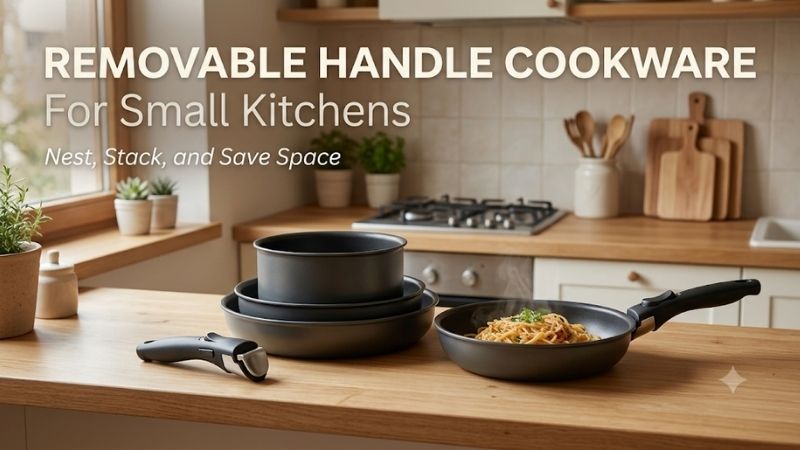
Traditional cookware requires storage space for both the cooking vessel and its permanently attached handle. This arrangement can be inconvenient in apartments, studio kitchens, RVs, and other environments with limited cabinetry. Detachable handles address the problem by allowing the cookware body to be stored separately from the gripping mechanism.
Reducing wasted cabinet space
Long skillet handles often prevent cookware from fitting neatly into cabinets that would otherwise accommodate the circular pan bodies.
Even when several frying pans can be stacked, their handles may extend in different directions.
This arrangement makes storage less efficient and can interfere with cabinet doors.
Removing the handles eliminates much of that horizontal obstruction.
Compatible pans can often be nested with their bodies positioned directly over one another.
The advantage becomes particularly noticeable when cookware is stored in a narrow cupboard or deep pull-out drawer.
However, actual space savings depend on the cookware’s diameter, wall height, and nesting profile.
A set of large pots will still require considerable volume even when the handles are removed.
The goal should be to reduce wasted space rather than assuming detachable cookware will make every cabinet problem disappear.
Measure the available cabinet area before buying.
Creating a more organized cooking area
A compact kitchen can become crowded quickly when several pots and pans are positioned on neighboring burners.
Long handles may overlap, extend beyond the edge of the stove, or interfere with nearby utensils.
Detachable handles can reduce some of this congestion when removed according to the manufacturer’s instructions.
For example, a saucepan can remain on a burner without a long handle extending across the adjacent cooking area.
However, this does not mean it is safe to move cookware without a proper grip.
The handle should be securely attached whenever the vessel needs to be lifted or repositioned.
Hot cookware without attached handles should never be treated as easy to grab.
Use the manufacturer-approved method for moving the vessel.
Keeping handles detached when they are not required can simplify the workspace, provided the cookware remains stable and safe.
Making oven transfers more convenient
Certain detachable-handle cookware systems are designed for stovetop-to-oven cooking.
The handle is used to move the pan and then removed before the cookware body enters the oven.
This arrangement may improve oven clearance, particularly when a long fixed handle would interfere with oven walls or nearby cooking vessels.
A compact frying pan can be useful for skillet frittatas, baked vegetables, and oven-finished proteins.
However, the cookware body must be specifically approved for the intended oven temperature.
A removable handle does not establish oven compatibility by itself.
Coatings, lids, seals, and other components can impose additional restrictions.
Some cookware bodies tolerate higher temperatures than their corresponding lids or accessories.
Never place the detachable handle inside the oven unless the manufacturer explicitly approves that use.
For small kitchens, oven compatibility can reduce the need to store a separate baking vessel for certain recipes.
Choosing the right cookware configuration
A small kitchen benefits from a carefully selected collection rather than a large assortment of specialized pans. The ideal configuration depends on household size, cooking frequency, preferred recipes, and the availability of convenient storage. Buyers should distinguish between genuinely useful cooking vessels and accessories that inflate a set’s advertised piece count.
Two-piece configurations for minimal kitchens
A small household may not need more than a frying pan and a saucepan to complete many everyday cooking tasks.
The frying pan can handle eggs, vegetables, delicate proteins, and sautéed ingredients.
The saucepan is useful for heating liquids, cooking oatmeal, preparing sauces, and making small quantities of soup.
This arrangement is particularly practical for studio apartments where cabinet space is extremely limited.
A removable handle shared between compatible cookware bodies can reduce storage clutter.
However, using one handle for multiple vessels requires deliberate planning.
You may need to transfer the handle between cookware pieces while preparing a meal.
Never attempt to disconnect the handle while lifting a filled vessel.
If you regularly cook with both pans simultaneously, purchasing an additional compatible handle may improve convenience.
Choose this minimal configuration when cooking needs are straightforward and storage space is more important than owning multiple specialized vessels.
Three-piece configurations for everyday flexibility
A three-vessel setup provides greater flexibility without occupying as much space as a large cookware collection.
For many small households, this might include an 8-inch frying pan, a 10-inch frying pan, and a medium saucepan.
The smaller skillet is suitable for individual portions and simple breakfasts.
The larger skillet can handle moderate quantities of vegetables, chicken, or other ingredients that need more cooking surface.
The saucepan supports liquid-based recipes.
Together, these vessels cover a broad range of common meals.
A detachable-handle design allows the two frying pans to nest when their shapes are compatible.
The saucepan may also fit into the stack, depending on the product design.
Before purchasing, compare the actual dimensions of the cookware rather than assuming all pieces from one set nest perfectly.
Protect coated cooking surfaces during storage.
For many apartment kitchens, three appropriately selected vessels offer a useful balance between practicality and organization.
Complete cookware sets for larger households
Families or people who cook several dishes simultaneously may benefit from a more extensive detachable-handle collection.
A larger configuration might include multiple frying pans, saucepans, and a stockpot.
Additional vessels can be useful when preparing pasta, soup, vegetables, and proteins at the same time.
However, large cookware sets require careful evaluation.
Manufacturers may count lids, utensils, detachable handles, and storage accessories as individual pieces.
Consequently, an advertised 18-piece collection may contain far fewer than 18 actual pots and pans.
Review the contents before buying.
Consider whether you will use every vessel regularly.
An unused pan still occupies cabinet space, even when it nests efficiently.
A complete cookware set may make sense for someone furnishing an entire kitchen, but it is less compelling when existing cookware already meets most cooking requirements.
Purchase enough capacity for normal cooking rather than preparing for occasional situations that rarely occur.
Choosing cookware materials for limited storage
Storage efficiency should not come at the expense of cooking performance or maintenance convenience. Detachable-handle cookware is available with different body materials and cooking surfaces, including stainless steel, coated aluminum, and ceramic nonstick systems. Each option presents trade-offs involving weight, heat management, cleaning, durability, and suitability for particular recipes.
Stainless steel for long-term versatility
Stainless steel is useful for buyers who want an uncoated cooking surface suitable for a range of everyday recipes.
It works well for sautéing vegetables, browning proteins, and preparing pan sauces when appropriate cooking techniques are used.
Many stainless steel products incorporate aluminum or other conductive layers to improve heat distribution.
The exact construction determines how the pan behaves on different burners.
For small kitchens, stainless steel has an additional advantage: its uncoated interior does not require the same degree of protection as delicate nonstick coatings.
Nevertheless, nesting cookware can still cause scratches and cosmetic damage.
Protective storage separators may remain useful.
Stainless steel is often heavier than lightweight aluminum cookware of comparable size.
Buyers should therefore consider handling comfort, particularly when using removable grips.
An appropriate detachable-handle stainless steel system can be a practical long-term choice for people who enjoy varied cooking methods and prefer not to depend on nonstick coatings.
Nonstick aluminum for lightweight everyday cooking
Aluminum cookware is often relatively lightweight and responds efficiently to changes in heating conditions.
When combined with a suitable nonstick coating, it becomes convenient for eggs, pancakes, vegetables, and other foods where easy release is important.
These characteristics appeal to people preparing quick meals in smaller kitchens.
A lightweight pan may also be easier to move between cabinets, sinks, and cooking surfaces.
However, the cooking surface requires appropriate care.
Avoid overheating empty nonstick pans and follow the manufacturer’s instructions regarding utensils and cleaning.
Not every aluminum pan is induction-compatible.
Induction models generally require a suitable magnetic base.
The removable handle mechanism must also be designed for the exact cookware model.
For buyers who prioritize convenience over high-temperature searing, coated aluminum is a practical option.
Ceramic nonstick for convenient daily meals
Ceramic nonstick cookware typically uses an inorganic-based coating applied to a metal cooking vessel.
It appeals to buyers looking for an alternative to conventional PTFE-based nonstick systems.
Some ceramic cookware collections feature removable handles and matching nesting designs.
These products can be useful for cooking eggs, vegetables, sauces, and other everyday meals.
However, ceramic nonstick coatings are not all identical.
Their composition, heat tolerance, and long-term food-release characteristics depend on the product.
A ceramic label should not be interpreted as a guarantee of unlimited durability or universal safety.
Follow the manufacturer’s recommendations about cooking temperatures, utensils, and cleaning.
Avoid assuming that higher heat always produces better results.
For most ordinary meals, controlled moderate heating is preferable to unnecessarily aggressive burner settings.
When selecting ceramic detachable-handle cookware, prioritize clear care instructions and compatible replacement parts.
How to evaluate a removable handle system
The detachable handle is the defining feature of this cookware category, but it also introduces a component that requires careful evaluation. The connection must be secure, straightforward to operate, and appropriate for the weight of the loaded vessel. A storage-friendly design becomes inconvenient if the handle is unreliable or difficult to attach during cooking.
Look for a secure locking mechanism
A suitable handle should attach positively to the cookware body and remain secure during intended lifting and transport.
Different manufacturers use mechanical clamps, locking levers, buttons, and multi-stage release systems.
The important consideration is whether the handle can be attached correctly and whether the user can confirm that it has locked.
Read the operating instructions before first use.
Do not attempt to improvise the connection or force the handle onto incompatible cookware.
Some systems require the user to press a lever until the mechanism reaches a defined locked position.
Others employ a separate safety release.
A secure attachment becomes especially important when a pan contains hot liquid or heavy ingredients.
Never press release buttons while carrying a loaded vessel.
If the handle slips or shows visible damage, discontinue use until the issue has been resolved.
Understand handle weight and load limits
A detachable handle may feel secure when attached to an empty frying pan but encounter substantially greater forces when the vessel is filled with food.
The weight of liquid, ingredients, and cookware all contribute to the load.
Manufacturers may specify maximum supported loads or particular handling instructions.
These requirements should be followed carefully.
Do not assume that one handle can safely lift every conceivable pot size.
For larger cookware vessels, a second approved gripping point may be necessary.
Handle balance is also important.
A narrow grip or awkward attachment angle can make a heavy saucepan difficult to control.
Buyers who prepare large quantities of soup or stew should pay particular attention to lifting instructions.
When in doubt, select cookware with a handling arrangement suitable for its intended capacity.
Check compatibility with replacement handles
A detachable-handle cookware collection is most useful when compatible replacement parts remain obtainable.
Mechanical components can become damaged through excessive heat exposure, incorrect cleaning, or ordinary wear.
A missing handle can make an otherwise functional cookware collection inconvenient to use.
Before investing in several vessels, investigate whether the manufacturer sells replacement handles.
Confirm compatibility with the specific cookware series.
Similar-looking handles from different brands should not be treated as interchangeable.
Even products from the same manufacturer may use different mechanisms across product generations.
Avoid modifying a handle or attempting to repair a damaged locking mechanism without manufacturer authorization.
If a replacement cannot be obtained, the long-term convenience of the entire cookware system may be affected.
Consider whether one or two handles are needed
A cookware set may include several pans but only one removable handle.
This can be sufficient for buyers who generally prepare one dish at a time.
However, a shared handle becomes less convenient when multiple pans must be moved during the same meal.
For example, cooking pasta in one pot while preparing sauce in another may require switching the handle between vessels.
The process must be performed safely, with each pot resting on a stable surface before detachment.
Never attempt to move a hot vessel without an approved gripping method.
An additional compatible handle may improve convenience for households that regularly use several cookware pieces simultaneously.
The extra handle occupies some storage space, but the benefit may outweigh the small increase in clutter.
Choose the number of handles according to real cooking habits rather than automatically accepting the minimum included with the set.
Measuring your kitchen before purchasing
Small-kitchen cookware shopping should begin with measurements. Product photographs can make a set appear compact, but the actual body diameter, nesting height, lid dimensions, and accessory storage requirements determine whether it fits. Measuring your cabinets and drawers before purchasing reduces the risk of buying cookware that is technically stackable but unsuitable for your available space.
Measure cabinet depth and width
Begin by identifying where the cookware will be stored.
Measure the usable interior width and depth, accounting for hinges, door frames, shelf supports, and other obstructions.
A pan’s advertised diameter may refer to its upper cooking rim rather than its full outer dimensions.
Pouring lips, helper handles, and protective edges may extend farther.
For detachable-handle cookware, focus on the overall dimensions of the vessel after the handle is removed.
A 10-inch skillet may fit easily into a cabinet that cannot accommodate the same pan with a long fixed handle.
However, large stockpots still require sufficient width and height.
Compare the manufacturer’s actual dimensions with your measurements.
Do not assume that cookware will fit because the nominal diameter appears smaller than the cabinet opening.
Account for nesting height
Nesting cookware reduces the space occupied by multiple vessels, but it does not eliminate their combined height.
The amount of vertical space required depends on how the bases and sidewalls overlap.
Some pans nest deeply, while others remain partially elevated because of their rims or shapes.
Protective pads may add a small amount of height between pieces.
Lids and detachable handles also require separate storage arrangements.
Before buying a large set, compare the manufacturer’s stacked dimensions when available.
If the retailer does not publish them, request measurements or examine the product in person.
Consider how the cookware will be accessed.
A tall stack may fit inside a cabinet but become inconvenient if the bottom vessel is needed frequently.
Efficient storage should minimize unnecessary handling.
Plan storage for lids and accessories
Detachable handles solve only one part of the cookware storage problem.
Glass lids, storage covers, protective pads, and other accessories can occupy considerable space.
A cookware set with several large lids may require a dedicated organizer or additional shelf.
Some lids feature low-profile knobs or designs that make stacking easier.
Others have tall handles that prevent compact storage.
Consider whether the cookware collection uses one lid across several compatible vessels or provides a separate lid for each pan.
Shared lids can reduce accessory count, but their fit must be confirmed.
Do not assume that similarly sized cookware from different brands accepts interchangeable lids.
A practical small-kitchen setup should provide an obvious storage location for every component.
Otherwise, the cookware may save space while its accessories create clutter elsewhere.
Practical cooking scenarios for small kitchens
The best cookware configuration becomes clearer when evaluated against real meals. A small household preparing breakfast and simple dinners has different requirements from someone who cooks several dishes simultaneously. Detachable handles should support those routines through appropriate pan sizes, safe lifting, and convenient cleaning rather than encouraging unnecessary purchases.
Breakfast and quick weekday meals
For people preparing breakfast before work, a small nonstick frying pan can be particularly useful.
Eggs, pancakes, vegetables, and other simple dishes generally do not require an extensive cookware collection.
An 8-inch skillet may be suitable for one person’s breakfast.
A 10-inch skillet offers more flexibility for preparing several portions.
If the cookware uses a detachable handle, the pan can be returned to a compact drawer after cleaning and drying.
A lightweight body may be convenient for everyday handling.
However, a small pan should not be overloaded.
Crowding ingredients can interfere with effective cooking and increase the risk of food spilling over the sides.
Choose a configuration that matches the portions prepared most often.
For quick weekday cooking, simplicity is generally more valuable than having many specialized pieces.
One-pan dinners and oven finishing
A medium skillet can support a variety of simple dinners, including sautéed vegetables, chicken, fish, and certain baked dishes.
Detachable-handle cookware may be especially useful when a recipe begins on the stovetop and finishes in an oven.
The handle can be removed before the pan enters the oven when the manufacturer requires this.
This arrangement may reduce the need for a separate oven dish.
However, not every removable-handle skillet is suitable for high oven temperatures.
Check the exact model’s limits.
Use appropriate dry oven mitts or manufacturer-approved handles when removing hot cookware.
Remember that the pan body will remain hot even after the detachable handle is removed.
Do not place hot cookware directly on vulnerable countertops.
A suitable heat-resistant trivet should be prepared before the pan leaves the oven.
Meal preparation for several days
People who prepare meals in advance may benefit from a larger saucepan or stockpot in addition to a frying pan.
The larger vessel can hold soup, sauce, grains, or other foods prepared in batches.
A detachable handle may make the pot easier to store after cooking.
Some cookware systems also include compatible food-storage lids.
However, storage accessories must be used according to their intended purpose.
Do not place plastic storage lids inside an oven.
Cooked food should be cooled and refrigerated promptly according to established food-safety guidance.
Avoid leaving large quantities of cooked food at room temperature for extended periods.
When refrigerating leftovers, use containers and portion sizes that allow appropriate cooling.
A detachable-handle saucepan may be convenient for certain storage tasks, but it should not replace safe food-handling practices.
Common buying mistakes in small kitchens
A compact cookware purchase can create new problems when buyers underestimate practical requirements. Oversized sets, incompatible handles, unsuitable coatings, and poorly designed storage arrangements can reduce the intended benefits. The most effective way to avoid disappointment is to evaluate the cookware as a complete cooking and storage system.
Buying too many cookware pieces
A large cookware set may appear economical when compared with the combined prices of individual pots and pans.
However, the purchase only represents good value when the included vessels will be used regularly.
A household with limited storage may struggle to accommodate an extensive collection, even if the cookware nests efficiently.
Before purchasing, identify the cooking tasks that currently require additional equipment.
If you already own a reliable stockpot, another large pot may be unnecessary.
Likewise, several nearly identical frying pans may provide little practical benefit.
Choose fewer, more useful pieces when possible.
Storage efficiency depends partly on reducing the total number of objects in the kitchen.
Assuming every detachable pan is induction-compatible
Induction compatibility depends on the cookware base rather than its removable-handle mechanism.
Some aluminum cookware includes magnetic layers that allow operation on induction burners.
Other aluminum pans do not.
Stainless steel cookware also varies in construction and may not always support induction.
Before buying, confirm that the exact cookware model is approved for your cooktop.
Do not assume that every item within a collection has identical compatibility.
If the manufacturer provides base-diameter information, compare it with the requirements of your induction burner.
Choosing a suitable pan avoids the expense and inconvenience of returning incompatible cookware.
Ignoring cleaning and maintenance requirements
Detachable cookware often makes cleaning easier because long handles no longer obstruct the sink or dishwasher.
However, the handle itself may require hand washing.
Some locking mechanisms contain components that should not be submerged.
Coated cookware may also need gentle cleaning to preserve the surface.
Do not assume that a dishwasher-safe pan body means every accompanying accessory is dishwasher-safe.
Read the instructions for each component.
Dry cookware before nesting it, especially when the storage arrangement can trap moisture between surfaces.
Use protective separators when necessary.
Regular maintenance helps preserve both the cooking surface and the handle mechanism.
Choosing storage convenience over safe handling
A removable-handle system should not be purchased solely because it creates an attractive stack of cookware.
The handle must be comfortable to operate and secure enough for its intended load.
A small saucepan filled with hot liquid requires reliable control.
Larger vessels may need additional gripping support.
If a handle feels awkward or difficult to lock, the cookware may not suit the user’s physical requirements.
Consider how frequently the vessel will be lifted, carried, or transferred between appliances.
The best cookware should feel manageable during cooking, not merely convenient when stored.
Frequently Asked Questions
Small-kitchen buyers often need practical answers about cookware quantity, handle reliability, oven safety, and whether detachable systems offer meaningful advantages over conventional pans. These questions help clarify how a compact cookware collection can support everyday cooking without adding unnecessary complexity or compromising safe handling.
Is removable handle cookware worth buying for an apartment?
Removable-handle cookware can be worthwhile when conventional handles interfere with cabinet storage, drawer organization, or nearby cooking equipment.
The greatest benefit usually comes from combining detachable grips with cookware bodies that nest efficiently.
However, a large collection may still occupy considerable space.
Buy only the vessel sizes and configurations needed for your usual meals.
What is the ideal cookware set for a small kitchen?
For many individuals or couples, two or three useful cooking vessels provide a practical starting point.
A small skillet, medium skillet, and saucepan can handle numerous everyday dishes.
Households preparing larger meals may require a stockpot or additional saucepan.
Choose actual cooking capacity and useful vessel types over advertised package counts.
Can removable handle cookware go in the dishwasher?
Dishwasher compatibility varies by manufacturer and component.
Some cookware bodies are dishwasher-safe, while the detachable handles require hand washing.
Coated cookware may benefit from gentler cleaning even when dishwasher use is technically permitted.
Check the instructions for the cookware body, handle, and lids separately.
Never assume an entire collection follows the same cleaning requirements.
Can detachable cookware be used in a small oven?
Certain removable-handle cookware bodies are suitable for oven cooking after their handles are detached.
This can improve clearance inside compact ovens.
However, oven compatibility depends on the exact model’s temperature rating and intended appliance types.
A cookware body approved for a conventional oven is not automatically suitable for every countertop oven or broiler.
Confirm the manufacturer’s instructions before use.
Are removable handles interchangeable between brands?
Removable cookware handles should not be treated as universally interchangeable.
Different manufacturers use distinct locking mechanisms, clamp shapes, and attachment requirements.
A handle that appears to fit may not provide a secure connection.
Use only a handle approved for the exact cookware model or compatible product family.
If the handle is damaged, replace it with a manufacturer-approved component.
Is ceramic or stainless steel better for a small kitchen?
Ceramic nonstick cookware can be convenient for eggs, vegetables, and other everyday meals where easy food release is a priority.
Stainless steel offers an uncoated cooking surface suitable for browning, sautéing, and preparing pan sauces.
Neither material is universally better.
Choose ceramic nonstick when convenience is the main priority and stainless steel when versatility and uncoated-surface cooking matter more.
Conclusion
Choosing removable handle cookware for small kitchens starts with identifying the cookware pieces you actually need. For many households, two or three compatible pans provide greater practical value than an oversized collection. Prioritize secure locking handles, appropriate cooking materials, suitable stovetop and oven compatibility, and cookware bodies that nest safely. Measure your storage space, verify replacement-handle availability, and select a system that makes everyday cooking easier without creating additional clutter.







Write Your Review
No reviews yet. Be the first to share your experience!