
Choosing stackable pots and pans for beginners should be about simplicity, not collecting as many pieces as possible. A well-planned starter set saves storage space, handles everyday recipes, and remains easy to clean. This guide explains the essential cookware, materials, designs, and buying mistakes first-time shoppers should understand.
What beginners need from stackable pots and pans
Beginners benefit most from cookware that supports everyday meals without requiring complicated handling or maintenance. A useful starter collection should cover basic frying, boiling, simmering, and reheating while fitting comfortably into available cabinets. Storage efficiency matters, but it should never come at the expense of cooking safety.
The ideal purchase depends on household size, available burners, cooking frequency, and personal preferences.
Someone cooking alone may need only three cooking vessels, while a household preparing family dinners could benefit from a larger collection.
For most beginners, however, a carefully selected small set offers better value than an oversized assortment.
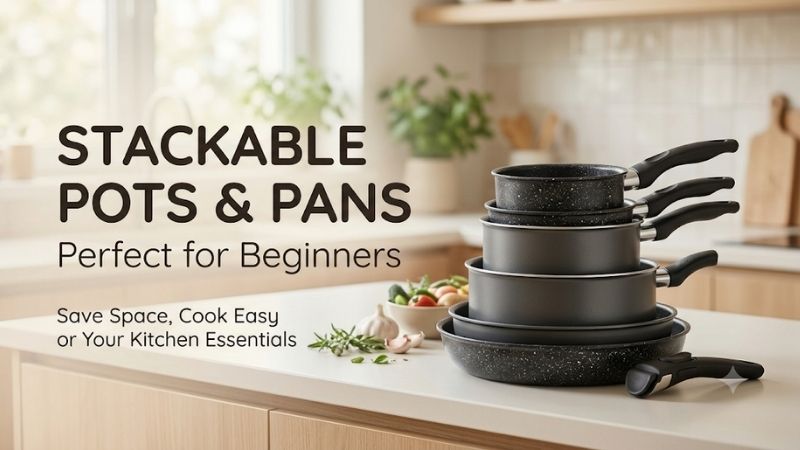
Start with three essential cooking vessels
A beginner kitchen does not require an extensive collection of specialized pans. A medium frying pan, a practical saucepan, and a larger cooking pot can cover a surprisingly wide range of recipes, including breakfast, pasta, rice, vegetables, soup, and simple one-pan dinners.
A frying pan measuring approximately 10 inches is a versatile starting point for one or two people.
It can handle eggs, pancakes, vegetables, ground meat, and smaller portions of chicken or fish.
A 2- or 3-quart saucepan works well for oatmeal, rice, soup, reheating, and preparing sauces.
A larger pot, typically around 5 or 6 quarts, is useful for pasta, soup, and batch cooking.
These capacities are general shopping guidelines rather than exact requirements.
If your household cooks for four or more people, a wider skillet and larger pot may be more useful.
The main objective is to avoid buying several cooking vessels that perform nearly identical tasks.
Beginners should prioritize familiar shapes and sizes that work with common recipes.
Specialized grill pans, tiny saucepans, and oversized stockpots can be purchased later when a genuine need appears.
Understand the difference between stacking and nesting
Stackable cookware is a broad category that includes several distinct storage approaches. Some sets place pans directly above one another using compatible shapes, while others use dedicated handles, protective contact points, or removable components to reduce the space occupied inside a cabinet.
Nesting generally means that smaller cookware bodies fit inside larger ones.
This can substantially reduce storage height, although handles and lids may still create obstacles.
A structured stacking design may hold cookware in separate layers without the pan interiors touching.
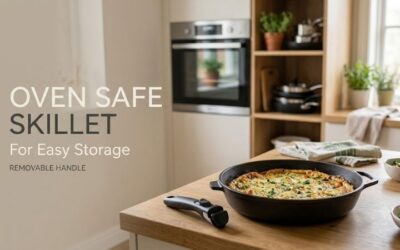
Removable-handle systems eliminate protruding handles while the cookware is stored.
Each method has advantages.
Conventional nesting is easy to understand but may require protective separators.
Structured stacking can help prevent scratching but depends on matching pieces.
Removable handles create flexibility but introduce an additional component that must be correctly attached during cooking.
For beginners, the simplest system is often the one that requires the fewest steps before preparing a meal.
Consider whether you want the convenience of fixed handles or are willing to manage detachable accessories in exchange for a smaller storage footprint.
Choose cookware that feels manageable when filled
An empty pan may feel lightweight in a store, but its actual handling characteristics change when it contains water, hot oil, or a substantial quantity of food. Beginners should consider total working weight, handle balance, and grip comfort instead of judging cookware solely by its material or appearance.
A large pot of boiling water can become difficult to lift even when its empty weight seems reasonable.
Look for handles that provide sufficient room for a secure grip.
For larger vessels, two side handles can make controlled lifting easier.
Consider the distance between the cooktop and the sink, particularly if you frequently prepare pasta.
A pot that feels unstable or awkward increases the risk of spills.
The same principle applies to removable-handle cookware. A detachable handle must be rated and correctly locked for the filled vessel.
Avoid choosing an unnecessarily heavy set simply because it feels substantial.
A beginner should be able to lift, position, wash, and store each piece comfortably.
When possible, examine the cookware physically before purchasing and imagine handling it with an oven mitt or while carrying several servings of food.
How to buy stackable pots and pans for beginners
The most useful buying criteria are material, cooking-surface compatibility, storage dimensions, and the actual assortment of included pieces. Brand reputation can help narrow the search, but beginners should examine how the cookware will work in their own kitchen rather than rely on broad claims about durability or professional performance.
Compare stainless steel and nonstick cooking surfaces
Stainless steel and nonstick cookware serve different purposes, and neither is automatically the better choice for every beginner. Stainless steel is useful for browning, deglazing, and long-term uncoated use, while nonstick cookware reduces the difficulty of cooking delicate foods and usually requires less scrubbing.
A stainless steel skillet can develop flavorful browned residue when searing meat.
That residue can be released with liquid and incorporated into a pan sauce.
However, stainless steel requires some practice with preheating, oil, and temperature control.
A nonstick skillet is often more forgiving for eggs, fish, and pancakes.
It can also simplify cleanup after a quick breakfast.
The trade-off is coating care.
Nonstick cookware should not be overheated, and its surface can deteriorate with abrasive cleaning or unsuitable utensils.
A useful beginner arrangement is to combine a nonstick frying pan with stainless steel saucepans and a stockpot.
This provides easy-release cooking where it matters while retaining durable uncoated vessels for boiling and simmering.
Some coordinated sets use the same material for every piece. That can still be convenient, provided the buyer understands the limitations.
Evaluate traditional and ceramic nonstick coatings
Not all nonstick cookware uses the same coating technology. Traditional PTFE coatings and ceramic-based nonstick coatings can both provide easy food release, but they differ in formulation and may respond differently to repeated heating, cleaning, and abrasion over their useful lives.
PTFE cookware is familiar to many home cooks because it can release delicate foods with relatively little added fat.
Its temperature limits must be respected, and excessive empty-pan heating should be avoided.
Ceramic nonstick cookware is often marketed as an alternative to conventional PTFE surfaces.
The term ceramic usually describes a coating applied to a metal pan rather than a cookware body made entirely from ceramic.
Ceramic nonstick performance can decline with use, particularly when the surface experiences repeated high heat or abrasive handling.
Neither coating should be assumed to last indefinitely.
Beginners should focus on the manufacturer’s actual instructions rather than marketing descriptions such as scratch-proof or completely chemical-free.
Using moderate cooking temperatures, suitable utensils, and gentle cleaning practices is usually a better strategy than attempting to test a coating’s advertised toughness.
Check your stovetop before buying
Cookware compatibility depends on the heating technology beneath the pan. Gas, radiant electric, and induction cooktops have different requirements, and a stackable storage design does not guarantee that the cookware will function properly on every cooking surface.
Gas burners provide flame contact and accept a wide range of conventional cookware designs.
Radiant electric glass-top stoves benefit from smooth, flat cookware bases that contact the heated surface effectively.
Induction cooking requires cookware with an appropriate magnetic base.
A pan made entirely from nonmagnetic aluminum may work on gas or radiant electric heat but not on an induction burner.
Some aluminum cookware includes an induction-compatible magnetic base.
Check the manufacturer’s compatibility statement for the specific model.
For glass-top stoves, inspect the cookware bottom for burrs, rough edges, or warping.
Avoid dragging pans across the glass surface.
If you may change appliances in the future, purchasing induction-compatible cookware can provide additional flexibility.
However, there is no reason to pay extra for compatibility that you are certain you will never use unless other product features justify the purchase.
Measure storage space before choosing a set
Compact cookware only solves a storage problem when the assembled stack fits the kitchen’s available dimensions. Beginners often focus on the number of pieces or the advertised space reduction without checking the maximum stack height, largest pan diameter, or clearance required for handles and lids.
Measure the internal cabinet width, depth, and height.
Pay attention to hinges, drawer runners, shelf supports, and other obstructions that reduce usable space.
For a drawer, measure the distance between the drawer base and the underside of the countertop or frame.
For a cabinet, consider the height required to lift the upper pan out of the stack.
A tall nesting system may consume little shelf space but become inconvenient when frequently used cookware sits underneath several heavy pieces.
The ideal arrangement keeps everyday cookware near the top or front.
Consider setting aside space for a lid organizer or protective separators.
Do not overlook the largest pan’s exterior dimensions, which may differ significantly from its advertised cooking diameter.
When comparing two sets, use their actual stored dimensions whenever available instead of relying on promotional space-saving percentages.
Decide whether removable handles are worth it
Detachable-handle cookware can make a remarkable difference in narrow cabinets because long handles no longer determine the space occupied by stored cookware. However, this convenience requires a secure locking system, compatible pan bodies, and consistent handling habits that some beginners may find unnecessary.
A removable handle is especially useful in RVs, small apartments, and kitchens where several pans need to fit into a single narrow drawer.
It may also be helpful when cookware is stored inside other cookware.
Before purchasing, examine how the handle attaches and releases.
The locking system should be intuitive and clearly documented.
Confirm how much weight the manufacturer allows the handle to support.
Check whether replacement handles are available.
Do not assume that a detachable handle from one product line fits another.
During cooking, confirm the connection before lifting a filled pan.
Never leave a heavy pot balanced in an unsafe position while attempting to attach the handle.
If convenience and simplicity matter more than compactness, fixed-handle cookware may still be the better beginner choice.
The best storage innovation is one that does not create avoidable handling risks.
Calculate value from usable pieces, not box count
Cookware manufacturers frequently include lids, steamers, and accessories in the total advertised piece count. A 12-piece package may contain only six cooking vessels, while a smaller set may provide nearly everything a beginner needs for daily meals.
Begin by identifying the actual pots and pans.
Count lids separately.
Then evaluate whether the included pieces overlap in function.
Two frying pans of meaningfully different sizes can be useful.
Three almost identical small saucepans may provide less practical value.
A large stockpot is valuable for someone who prepares soups or pasta for a family but may remain unused in a single-person household.
Consider cookware quality, replacement availability, and care requirements alongside purchase price.
An inexpensive set is not necessarily economical if its design makes cooking frustrating or if the pieces wear out quickly.
Conversely, expensive professional cookware is not necessary for someone who primarily reheats food and cooks simple breakfasts.
A smaller collection with the right materials and sizes often provides the strongest starting value.
Practical starter setups for different households
Beginners do not all need the same cookware configuration. Apartment residents may prioritize compactness, families often need larger cooking capacities, and people with limited experience may prefer easy-release surfaces. Matching the assortment to the household’s actual cooking pattern produces a more useful purchase than following a universal checklist.
A compact setup for one person
Someone cooking for one generally benefits from a small number of multipurpose pieces rather than a full family-size cookware collection. The most important requirements are manageable portions, easy cleanup, and storage that does not occupy an entire cabinet.
A practical setup includes a medium frying pan, a small or medium saucepan, and a larger pot only if batch cooking is common.
The frying pan can handle breakfast, vegetables, and individual portions of protein.
The saucepan can prepare oatmeal, rice, soup, and sauces.
If most meals are small, a large stockpot may be unnecessary.
Instead, a deeper sauté pan can provide additional flexibility.
For limited storage, look for compatible nesting cookware or a coordinated saucepan set.
A detachable-handle design may help where cabinet width is especially restricted.
Avoid buying a 15-piece assortment simply because the cost per piece appears low.
The unused cookware still consumes storage space and makes organization harder.
A balanced setup for couples
A two-person household often needs more cooking flexibility than a single-person kitchen but may still have limited cabinet space. The ideal assortment should support simultaneous preparation of a main course and side dish without requiring a full collection of oversized stockpots and specialty pans.
A 10-inch skillet is a reasonable everyday choice.
A smaller skillet can be useful for breakfasts, but it is not essential if cabinet space is limited.
A 2- or 3-quart saucepan handles grains, vegetables, and reheating.
A larger covered pot supports pasta and soup.
For couples who prepare meat and vegetables simultaneously, a sauté pan can be a valuable addition.
Choose a set with compatible lids and a storage design that allows frequent access to the frying pan.
A coordinated six- to eight-piece package may be sufficient, depending on how the manufacturer counts lids.
Prioritize sturdy handles, practical pan dimensions, and straightforward cleaning.
A stack that looks attractive but requires rearranging every piece before dinner will quickly become frustrating.
A versatile setup for growing families
Families preparing several portions at once need greater cooking capacity and often use multiple burners simultaneously. Although compact storage remains useful, cookware size should not be reduced so aggressively that meals require multiple cooking batches or overcrowded pans.
A larger skillet, approximately 12 inches across, can provide additional space for proteins and vegetables.
A medium skillet remains useful for smaller tasks.
Two different saucepan sizes allow side dishes and sauces to cook independently.
A 6- to 8-quart stockpot is practical for larger batches of soup or pasta.
Choose a stacking system that supports these vessels without placing excessive weight on delicate coatings.
Fixed handles may be convenient when multiple people share cooking duties because no additional attachment steps are required.
Consider the weight of large cookware when filled.
Lids should be easy to identify and retrieve.
For a growing family, a coordinated collection with replacement options can be preferable to a narrowly specialized system that becomes difficult to expand.
A flexible setup for renters and RV owners
Renters and RV owners may face unusual storage restrictions, including shallow cabinets, narrow drawers, and limited countertop space. A practical cookware collection should reduce protruding handles, avoid unnecessary accessories, and remain easy to pack securely when needed.
Detachable-handle cookware can be especially useful in this environment.
Without permanent handles, compatible cookware bodies can occupy a smaller storage area.
However, secure handle attachment becomes particularly important when cooking in confined spaces.
For RV travel, cookware must be stowed so that it cannot shift during movement.
Protective separators can reduce damage from vibration.
Do not store heavy cookware where it may fall when a cabinet opens.
Confirm compatibility with the RV’s actual cooking appliance and follow ventilation and electrical safety instructions.
If cooking space is extremely limited, a deep skillet and a medium saucepan may be more useful than several specialized pans.
The goal is to maintain a functional kitchen with minimal storage complexity.
Common beginner mistakes to avoid
A beginner cookware purchase can disappoint even when the products themselves are well made. Problems often arise because shoppers misunderstand what a set contains, assume universal appliance compatibility, or prioritize compact storage over ordinary cooking convenience. Evaluating these issues before buying prevents unnecessary expense.
Buying too many pieces at once
Large cookware bundles can appear attractive because the average price per piece seems low. However, many first-time buyers discover that they repeatedly use the same skillet and saucepan while the rest of the collection remains untouched.
Start with the meals you already know how to prepare.
Identify the vessels required for those meals.
If you regularly cook pasta, you probably need a suitable pot.
If you rarely make elaborate sauces, several small saucepans may add little benefit.
Specialized cookware can be purchased when your cooking habits expand.
This gradual approach also allows you to discover which materials and handle designs you prefer.
Ignoring cleaning and coating maintenance
A stackable design does not eliminate normal cookware maintenance. In fact, nesting several pans creates additional opportunities for moisture or debris to become trapped between surfaces when cookware is stored carelessly.
Wash cookware according to the manufacturer’s instructions.
Dry each piece before stacking.
Avoid abrasive utensils and cleaning pads on vulnerable coatings.
Do not place sharp accessories inside nonstick cookware.
Inspect detachable-handle mechanisms and lid contact points.
Use appropriate protective pads whenever the storage design requires them.
Good storage habits help preserve the cookware’s practical usefulness and prevent the organizational system from becoming another source of damage.
Assuming oven and dishwasher compatibility
Cookware materials, handle construction, lids, and coatings all influence whether a product can safely enter an oven or dishwasher. A pan that looks like stainless steel may have heat-sensitive components, while a detachable-handle system may require removing certain accessories before oven use.
Never assume the oven limit applies equally to the lid and pan body.
Some glass lids have lower temperature limits.
Silicone grips, plastic components, and detachable handles may introduce additional restrictions.
Dishwasher-safe labeling also does not guarantee that repeated machine washing is the best method for preserving a nonstick coating.
Check the specific manufacturer’s instructions before using unfamiliar cookware.
This is especially important when purchasing a set that contains different materials.
Frequently asked questions
First-time cookware shoppers often have similar concerns about set size, maintenance, cooking performance, and whether space-saving designs are practical for daily use. These answers focus on choosing a manageable starter collection that remains useful as cooking skills develop.
How many pots and pans does a beginner really need?
Three well-chosen cooking vessels can cover many basic meals: one medium frying pan, one saucepan, and one larger pot. A second skillet or saucepan becomes useful when the household prepares multiple dishes simultaneously.
The number of pieces printed on the package matters less than the actual assortment.
Begin with the cookware required for your normal recipes and expand gradually.
Is stainless steel too difficult for beginners?
Stainless steel requires more attention to heat management than a typical nonstick skillet, but it is not too difficult for beginners. With practice, it can support browning, simmering, and pan sauces without relying on a nonstick coating.
Preheat the pan appropriately and add cooking fat as needed.
Allow proteins to develop a crust before attempting to release them.
Stainless steel saucepans are especially approachable for boiling and simmering.
A mixed-material starter collection can make the learning process easier.
Should beginners buy detachable-handle cookware?
Detachable handles can be worthwhile when storage space is severely limited, but they are not necessary for every beginner kitchen. Their benefits depend on a reliable locking mechanism, easy access to the handle, and confidence using the system safely.
Buyers should check the exact model’s instructions and handle weight limits.
If standard cookware fits comfortably, fixed handles may provide a simpler experience.
Are expensive stackable cookware sets worth buying?
Premium cookware can offer better construction, more durable components, or carefully engineered storage systems, but a high price does not guarantee that the assortment matches your needs.
Compare materials, included vessels, handle design, care requirements, and replacement-part availability.
A modestly priced set with three useful pans may deliver better practical value than a premium collection containing several unnecessary pieces.
Can beginners mix stackable cookware with existing pans?
Yes, a kitchen can combine stackable cookware with ordinary pans. However, the specialized nesting arrangement may only work correctly with the matching components supplied by the manufacturer.
Use separate organizers for incompatible cookware.
Avoid forcing unrelated pots into an engineered stack.
If space is the main concern, a mixed collection can still work well when shelves and drawers are organized deliberately.
Conclusion
The smartest way to buy stackable pots and pans for beginners is to choose a small collection that matches actual cooking needs. Start with a versatile frying pan, saucepan, and larger pot, then evaluate stainless steel versus nonstick surfaces, fixed versus detachable handles, and compatibility with your stove. Measure your cabinets before purchasing and prioritize easy cleaning, secure handling, and useful cookware sizes. A manageable starter set will usually serve you better than an oversized collection purchased solely for its advertised piece count.

Write Your Review
No reviews yet. Be the first to share your experience!