
Choosing an induction cookware set for entertaining requires more cooking capacity and flexibility than selecting pots and pans for occasional individual meals. The ideal collection should support preparing multiple dishes, accommodating larger portions, and keeping cooking tasks organized. This guide explains which cookware sizes, materials, and configurations are most useful when hosting guests.
- What makes induction cookware suitable for entertaining?
- Choosing the right cookware pieces for entertaining
- Best materials for induction entertaining cookware
- Choosing cookware capacity for different guest counts
- Important induction compatibility considerations
- Cookware set configurations worth considering
- Organizing an entertaining meal on an induction stove
- Common buying mistakes for entertaining cookware
- Frequently Asked Questions
- Conclusion
What makes induction cookware suitable for entertaining?
Entertaining cookware should provide enough capacity to prepare multiple dishes without excessive overcrowding or complicated scheduling. Large skillets, substantial sauté pans, stockpots, and useful saucepans help organize cooking tasks, while induction-compatible bases ensure the vessels operate correctly on the stove.
A household cooking for two people may need only a few essential pans.
Hosting six or eight guests is different because several dishes may need to be prepared or finished around the same time.
The cook may need one pan for searing meat, another for vegetables, and a saucepan for gravy or a separate sauce.
A larger stockpot may be necessary for pasta, soup, or batch cooking.
However, buying the largest possible cookware set is not automatically the best solution.
The collection should match available induction cooking zones, oven space, and storage capacity.
Choosing the right cookware pieces for entertaining
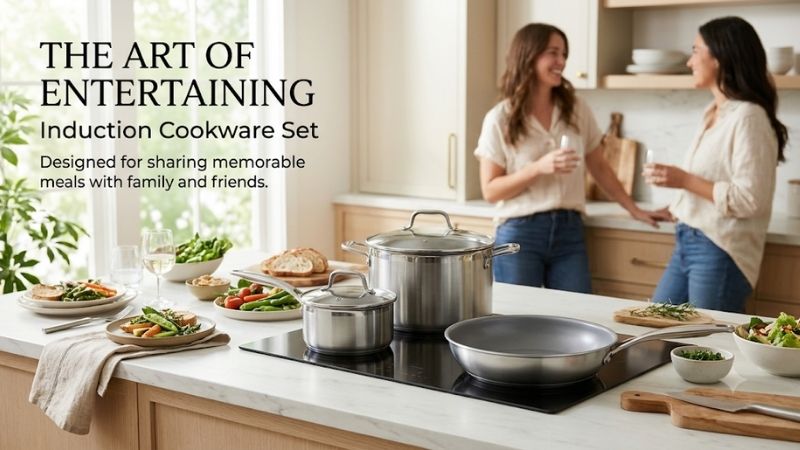
The most useful entertaining collection contains cooking vessels with complementary functions rather than several similarly sized pans. A large skillet, deep sauté pan, medium saucepan, and substantial stockpot provide flexibility for preparing main dishes, sides, and sauces simultaneously.
Large skillets for proteins and vegetables
Large skillets are particularly useful when preparing several portions of meat, fish, or vegetables. A wider cooking surface provides room to arrange ingredients without excessive crowding, supporting browning and helping prevent moisture from accumulating around the food.
The All-Clad D3 Everyday Family-Sized Set includes 10.5- and 12.5-inch skillets.
This gives cooks flexibility when preparing different quantities.
A smaller skillet may handle an appetizer while the larger one prepares the main protein.
However, the actual cooking surface is smaller than the advertised rim diameter.
The induction burner must also support the base.
Choose a large skillet only when the cooktop and available storage make it practical.
Sauté pans for larger one-pan dishes
A sauté pan combines a broad cooking surface with relatively straight sides, providing additional capacity for ingredients and sauces. This makes it useful for entertaining dishes such as braised chicken, sautéed vegetables, and meals that begin with browning before liquid is added.
The All-Clad D3 Everyday Family-Sized Set includes a substantial sauté pan.
A deep sauté pan can be useful when serving several guests because it accommodates ingredients that might overflow a shallow skillet.
However, larger sauté pans become heavy when loaded with food.
A helper handle may improve control when transferring cookware.
Choose a sauté pan with sufficient cooking area rather than relying exclusively on its nominal capacity.
Stockpots for pasta, soup, and larger batches
A stockpot is one of the most important entertaining vessels because it provides space for soup, pasta, stocks, and other liquid-heavy recipes. Its capacity should suit the number of guests without creating unnecessary weight or handling difficulty.
An 8-quart stockpot can be useful for many family gatherings.
The All-Clad D3 Everyday Family-Sized Set includes an 8-quart option.
However, the exact amount of food that can be prepared depends on the required water volume and safe fill level.
A large pot filled with hot liquid is heavy.
Plan where it will be placed after cooking and whether it can be drained or transferred safely.
Sauce pans for gravies and side dishes
Saucepans support tasks such as heating gravy, cooking grains, preparing reductions, and warming sauces. For entertaining, having both a smaller and a medium saucepan can prevent conflicts when several dishes need attention.
A 2-quart saucepan can handle modest quantities of sauce.
A 3- or 4-quart saucepan supports larger side dishes and liquid preparations.
However, the exact sizes should reflect the recipes normally served.
Choose cookware with lids when simmering or holding moisture is important.
Avoid purchasing extra saucepans that duplicate sizes already available.
Best materials for induction entertaining cookware
Cookware material influences heat distribution, surface durability, cleaning, and compatibility with induction burners. Stainless steel is a strong general-purpose choice for entertaining because it supports browning, boiling, and sauces, although some delicate recipes may benefit from a separate nonstick pan.
Fully clad stainless steel
Fully clad stainless steel cookware uses bonded metal layers throughout the cooking vessel. An aluminum core can help distribute heat, while the stainless steel cooking surface supports browning and developing pan sauces.
The All-Clad D3 and Tramontina Tri-Ply Clad collections are examples.
Both use multilayer construction and induction-compatible exteriors.
Fully clad cookware can be useful when preparing dishes that begin with searing and finish with simmering.
However, the actual thermal response depends on layer thickness, pan dimensions, and cooktop settings.
Fully clad construction is not a substitute for correct heating technique.
Five-ply stainless steel
Five-ply stainless steel cookware uses additional bonded layers in its construction. This can influence heat retention and temperature response, although a greater number of layers does not automatically establish superior performance.
The All-Clad D5 collection provides this type of construction.
For entertaining, the value of five-ply cookware depends on the specific recipes and the cook’s preferences.
A high-quality three-ply pan may already perform very well.
Buyers should consider weight, handling, and cost rather than assuming that five-ply construction is necessary.
Nonstick cookware for delicate dishes
Nonstick pans can complement stainless steel sets when preparing eggs, delicate fish, or foods prone to sticking. However, they typically have coating-specific restrictions concerning temperature, utensils, and cleaning.
For entertaining, a single appropriately sized nonstick skillet may be sufficient.
There is no requirement for every cooking vessel to have a nonstick surface.
Stainless steel remains useful for browning and sauces, while a coated pan can handle more delicate ingredients.
This combination may be more practical than purchasing a large fully coated collection.
Choosing cookware capacity for different guest counts
Guest count influences cookware requirements, but the type of meal matters just as much. A pasta dinner, a roast with vegetables, and a multi-course meal have different equipment needs. The goal is to match vessel size to actual recipes rather than choosing cookware based solely on the number of people invited.
Cooking for four to six people
For a moderate gathering, a 10- or 12-inch skillet, medium sauté pan, and suitable stockpot may provide enough capacity for many recipes.
The cookware should be selected according to the portion size and ingredients.
A large skillet is useful for meat or vegetables.
A saucepan handles sauces.
A stockpot can prepare pasta or soup.
If the meal includes oven dishes, some stovetop equipment can remain available for finishing other components.
Cooking for six to eight people
Larger gatherings may justify a 12-inch skillet, a deep sauté pan, and an 8-quart stockpot.
However, crowded cooking surfaces can reduce browning and increase cooking time.
It may be more effective to prepare food in batches.
Use the oven when appropriate.
Plan which dishes need the burners simultaneously.
Do not attempt to fit all portions into one pan if doing so compromises cooking quality.
Cooking for larger groups
Entertaining more than eight guests may require specialized equipment or advance preparation.
Large stockpots and sauté pans can help, but the stove’s cooking-zone dimensions still impose limits.
The household may benefit from preparing certain dishes ahead of time.
Cold dishes, baked foods, and foods that can be safely reheated can reduce pressure on the stovetop.
Avoid relying exclusively on oversized pans that the induction burner cannot support effectively.
Important induction compatibility considerations
Induction cookware must have a suitable magnetic base and fit the cooktop’s supported cooking zones. A collection may include cookware with different base diameters, so buyers should check both the smallest saucepan and the largest skillet rather than assuming every piece will work equally well on every burner.
Confirm magnetic base construction
Look for explicit manufacturer induction compatibility.
The All-Clad D3, All-Clad D5, Tramontina Tri-Ply Clad, and Cuisinart MultiClad Pro collections discussed here are induction-compatible.
However, other lines from the same manufacturers may differ.
Do not rely solely on stainless steel appearance.
Match cookware to induction zones
A large skillet may extend beyond the most effective heating area of a small induction burner.
This can influence how quickly the outer cooking area heats.
Check the cooktop manufacturer’s recommended cookware sizes.
Use compatible cooking zones.
Avoid placing large cookware where it interferes with controls or neighboring burners.
Protect the glass surface
Entertaining often involves moving heavy cookware frequently.
Lift pots and pans rather than dragging them.
Keep the bases clean.
Avoid dropping heavy cookware.
Follow the cooktop manufacturer’s guidance concerning weight and surface protection.
Cookware set configurations worth considering
Different cookware collections offer different capacities and piece arrangements, making some better suited to entertaining than others. Buyers should examine included skillets, stockpots, and saucepans carefully because advertised piece count alone cannot establish whether a set meets the demands of hosting.
All-Clad D3 Everyday Family-Sized 10-Piece Set
This collection is particularly relevant because it includes larger skillets and an 8-quart stockpot.
Its fully bonded tri-ply construction supports induction cooking.
The 12.5-inch skillet provides useful cooking space for substantial portions.
However, the set requires more cabinet space than a compact starter collection.
It is most appropriate for households that regularly prepare larger meals.
Cuisinart MultiClad Pro 12-Piece Set
The Cuisinart MultiClad Pro 12-Piece Set provides a broad selection of cookware for boiling, sautéing, simmering, and frying.
Its triple-ply construction supports induction use.
Stainless steel lids allow additional flexibility in suitable oven cooking.
The larger assortment is useful when several dishes must be prepared simultaneously.
However, buyers should confirm that the collection does not duplicate cookware they already own.
Tramontina Tri-Ply Clad 12-Piece Set
The Tramontina Tri-Ply Clad Stainless Steel 12-Piece Set uses fully clad construction with a magnetic exterior.
It provides cookware for several household tasks.
The tempered glass lids allow some visual monitoring.
Its induction compatibility makes it relevant for entertaining kitchens.
However, buyers should follow the lower oven-temperature limits associated with the referenced glass-lid configuration.
All-Clad D5 Brushed Stainless 10-Piece Set
The D5 Brushed Stainless collection is an option for experienced cooks who want premium bonded stainless steel cookware.
It supports induction cooking and provides several essential vessel types.
However, a higher price does not guarantee that every recipe will benefit from its particular construction.
Consider whether the included sizes match your entertaining needs.
Organizing an entertaining meal on an induction stove
Good cookware is only one part of efficient entertaining. Coordinating preparation times, burner use, oven availability, and safe serving temperatures helps reduce last-minute pressure. A carefully planned cooking sequence can make a modest cookware collection more useful than a much larger set used without organization.
Plan which dishes need the burners
List the dishes that require stovetop attention.
Determine whether they need a skillet, saucepan, sauté pan, or stockpot.
Identify tasks that can be completed in advance.
Avoid scheduling every dish to finish on the same burner simultaneously.
Prepare ingredients before guests arrive
Wash and cut appropriate vegetables.
Measure ingredients.
Prepare sauces or other components when safe and suitable.
Keep perishable foods refrigerated until needed.
This organization reduces the amount of time spent searching for ingredients while cookware is hot.
Cook proteins in manageable batches
Overcrowding can increase moisture and reduce browning.
Choose a suitable skillet.
Allow food enough space to make contact with the cooking surface.
Cook in batches when necessary.
Use a food thermometer to verify safe internal temperatures.
For poultry, the USDA recommends 165°F.
Coordinate sauces and side dishes
Use small saucepans for sauces and larger pots for grains, pasta, or soups.
Adjust the induction power as needed.
Avoid leaving cookware unattended.
Remember that different pots may respond differently to the same displayed power setting.
Keep prepared food at safe temperatures
When serving food over an extended period, observe appropriate food-holding guidance.
Keep hot foods at 140°F or above when holding them hot.
Keep cold perishable foods at 40°F or below.
Do not leave perishable food at room temperature for more than two hours, or more than one hour above 90°F.
Common buying mistakes for entertaining cookware
Buyers sometimes prioritize piece count or appearance rather than actual cooking capacity and available stove space. This can result in a collection with several small pans but no suitable stockpot, or cookware so large that it becomes difficult to use safely.
Choosing too many small pieces
A fourteen-piece collection may include numerous lids and saucepans but lack the large skillet or stockpot needed for entertaining.
Examine every included vessel.
Prioritize functional variety.
Avoid duplication.
Ignoring large-pan burner compatibility
An oversized skillet may not distribute heat as expected on a small induction zone.
Compare base diameter with cooktop guidance.
Do not assume larger cookware always provides better results.
Overlooking storage and cleaning
A large cookware collection requires space for pans, lids, and accessories.
Measure available cabinets.
Consider how cookware will be stacked or organized.
Choose cleaning requirements that match your household’s routine.
Frequently Asked Questions
Induction cookware for entertaining raises questions about ideal set size, magnetic compatibility, and whether premium cookware makes a meaningful difference during large meal preparation. These practical considerations help determine whether a family-size collection is appropriate.
What cookware size is best for entertaining six people?
A large skillet, medium-to-large sauté pan, useful saucepans, and a stockpot provide flexibility for many six-person meals. Exact sizes depend on the recipes and portion quantities.
Is stainless steel good for entertaining?
Yes. Stainless steel supports boiling, sautéing, browning, and sauce preparation.
However, it requires correct preheating and cooking technique.
Do I need an eight-quart stockpot?
An eight-quart stockpot is useful for soups, pasta, and larger batches, but smaller households may not need that capacity regularly.
Choose according to normal cooking quantities.
Is three-ply or five-ply better for induction?
Both constructions can perform well when designed for induction.
The best choice depends on actual construction, weight, cooking needs, and budget.
Can I use stainless steel cookware in the oven?
Many stainless steel pans are oven-compatible, but temperature limits vary by product and lid construction.
Always check the exact manufacturer’s instructions.
Conclusion
The right induction cookware set for entertaining should provide enough cooking capacity to handle multiple dishes without overwhelming your stove or storage space. A family-size collection with a large skillet, deep sauté pan, practical saucepans, and substantial stockpot is a strong starting point. The All-Clad D3 Everyday Family-Sized Set is particularly relevant for larger meals, while Cuisinart MultiClad Pro and Tramontina Tri-Ply Clad offer alternative assortments. Verify magnetic compatibility, base dimensions, safe handling, and oven-temperature limits before buying. A thoughtfully selected cookware collection, combined with advance meal planning, is more valuable than an oversized set filled with rarely used pieces.

Write Your Review
No reviews yet. Be the first to share your experience!