
A pasta pot with strainer combines boiling and draining functions, reducing the need for a separate colander. Some designs use removable baskets, while others rely on locking lids with drainage openings. The best choice depends on capacity, handling safety, stove compatibility, and storage space. This guide compares six real cookware options.
Quick verdict: Which pasta pot with strainer is best?
The most useful pasta pot should simplify draining without forcing the cook to manage more hot water than necessary. Removable inserts allow pasta to be lifted from the cooking water, while locking strainer lids let the pot drain over a sink. These approaches offer different advantages depending on batch size and the cook’s lifting preferences.
| Category | Recommended product | Main advantage |
|---|---|---|
| Best overall removable insert | All-Clad 6-Quart Stainless Steel Pasta Pot | Practical size and integrated colander |
| Best locking insert | Tramontina Gourmet 6-Quart Pasta Cooker | Secure draining arrangement |
| Best large family set | Cuisinart Chef’s Classic 12-Quart Pasta/Steamer Set | Large capacity and multiple inserts |
| Best multipurpose 8-quart system | All-Clad Simply Strain Multipot | Deep removable insert |
| Best for large-batch pasta | All-Clad Simply Strain 12-Quart Multipot | Additional capacity |
| Best straining-lid alternative | Bialetti Oval Pasta Pot with Strainer Lid | Compact integrated lid design |
For many households, a six-quart stainless steel pasta pot with a removable strainer offers a practical balance between capacity and handling.
Quick comparison table
Pasta pots with integrated straining mechanisms differ in capacity, construction, and draining method. A removable basket can reduce the need to tilt a full pot, while a strainer lid eliminates a separate insert but requires safe handling of the entire hot vessel. These distinctions are important when comparing products.
| Product | Capacity | Straining method | Induction | Main trade-off |
|---|---|---|---|---|
| All-Clad Stainless Steel Pasta Pot | 6 qt | Removable perforated insert | Yes | Insert reduces available cooking space |
| Tramontina Gourmet Pasta Cooker | 6 qt | Locking strainer insert | Yes | Additional parts |
| Cuisinart Chef’s Classic Pasta/Steamer | 12 qt | Removable pasta insert | Yes | Large storage footprint |
| All-Clad Simply Strain Multipot | 8 qt | Deep perforated insert | Yes | Heavy for small meals |
| All-Clad Simply Strain Multipot | 12 qt | Deep perforated insert | Yes | Requires substantial storage |
| Bialetti Oval Pasta Pot | 5.5 qt | Locking strainer lid | No, for referenced nonstick model | Entire pot must be tilted |
How we selected these pasta pots
The selection process prioritizes identifiable products, manufacturer-supported specifications, drainage mechanisms, and practical cooking requirements. Capacity, insert design, induction compatibility, cleaning instructions, and safe handling were considered. The recommendations are editorial assessments rather than results from personally conducted boiling or drainage tests.
Pasta cooking places different demands on cookware than many other boiling tasks.
Long strands need enough room to soften and become submerged, while shorter shapes require sufficient water circulation to avoid clumping.
Draining is also important because lifting a large quantity of hot water can be difficult or hazardous.
A removable strainer can change how the cook manages that weight.
A locking lid may reduce the number of components but does not eliminate the need to lift and tilt the vessel.
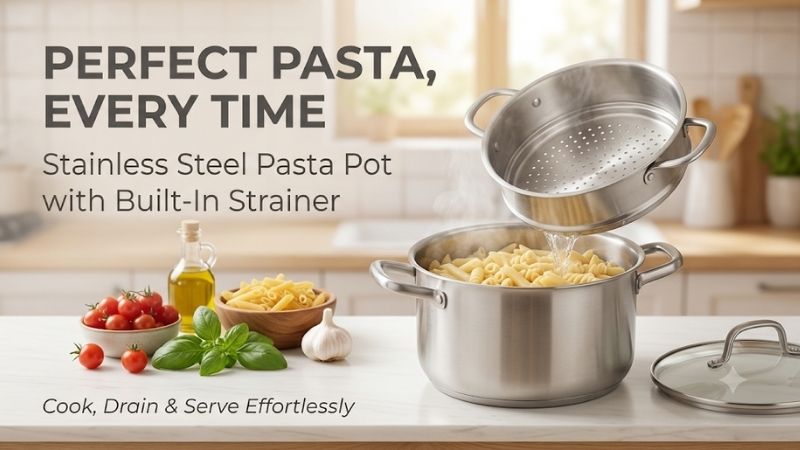
Detailed pasta pot recommendations
These six pasta pots cover compact everyday cooking, induction-compatible stainless steel systems, and larger multipots for substantial batches. Each has a distinct capacity or drainage arrangement, although the two All-Clad Simply Strain options belong to the same product family and mainly differ in volume.
All-Clad 6-Quart Stainless Steel Pasta Pot — Best overall
The All-Clad 6-Quart Stainless Steel Pasta Pot with Perforated Insert and Lid, model E414S664, combines an 18/10 stainless steel cooking surface with a bonded base and removable perforated insert. Its six-quart capacity makes it suitable for ordinary household pasta portions without requiring a very large stockpot.
Best for: Everyday pasta preparation and smaller family meals.
Why we picked it: It combines a practical capacity with a removable insert and manufacturer-listed induction compatibility.
Key specifications:
-
Capacity: 6 quarts.
-
Model: E414S664.
-
Stainless steel construction.
-
Bonded base.
-
Removable perforated insert.
-
Stainless steel lid.
-
Induction compatible.
-
Dishwasher safe.
Features and practical performance
The removable insert allows cooked pasta to be lifted while much of the boiling water remains inside the pot.
This can reduce the need to pour an entire vessel of water into a sink.
However, lifting wet pasta still requires controlled handling.
The insert also occupies space within the pot, which affects the amount of pasta and water available for cooking.
What makes it different: A practical six-quart design with a dedicated perforated colander.
Pros:
-
Induction compatible.
-
Useful everyday capacity.
-
Removable draining insert.
Cons:
-
Additional insert requires cleaning.
-
Full-length spaghetti may need careful handling.
Buy if: You want a dedicated stainless steel pasta pot for regular use.
Skip if: You prefer the simplest possible single-pot design.
Tramontina Gourmet 6-Quart Pasta Cooker — Best locking insert
The Tramontina Gourmet 3-Piece 6-Quart Stainless Steel Pasta Cooker combines an 18/10 stainless steel pot, a tempered glass lid, and a locking strainer insert. Its magnetic three-ply base supports induction cooking, while its removable draining arrangement provides an alternative to using a separate sink colander.
Best for: Buyers who want a locking strainer system.
Why we picked it: The combination of six-quart capacity and a dedicated locking insert addresses everyday pasta preparation.
Key specifications:
-
Capacity: 6 quarts.
-
Stainless steel construction.
-
Magnetic three-ply base.
-
Locking strainer insert.
-
Tempered glass lid.
-
Induction compatible.
-
Dishwasher safe.
-
Oven safe up to 500°F without the glass lid and 350°F with the lid.
Features and practical performance
The locking insert is intended to make draining more controlled.
Stainless steel construction supports ordinary pasta boiling and preparation of other foods.
The glass lid offers some visibility into the pot during cooking.
However, users should not assume the insert eliminates the risk of hot-water splashing.
Follow the manufacturer’s locking and draining instructions carefully.
What makes it different: A designated locking strainer within a medium-capacity pasta system.
Pros:
-
Integrated draining mechanism.
-
Induction-compatible base.
-
Multipurpose stainless steel pot.
Cons:
-
More components to store.
-
Locking mechanism requires correct use.
Buy if: You prefer a dedicated locking arrangement.
Skip if: You want to avoid additional insert components.
Cuisinart Chef’s Classic 12-Quart Pasta/Steamer Set — Best family capacity
The Cuisinart Chef’s Classic 12-Quart Pasta/Steamer 4-Piece Set, model 77-412P1, provides a large stainless steel pot and accessories for pasta and steaming. Its aluminum-encapsulated induction-ready base, measurement markings, and substantial capacity make it relevant for households cooking larger quantities.
Best for: Large families and substantial meal preparation.
Why we picked it: The set provides more capacity and cooking functions than a compact everyday pasta pot.
Key specifications:
-
Capacity: 12 quarts.
-
Four-piece configuration.
-
Stainless steel construction.
-
Aluminum-encapsulated base.
-
Pasta and steaming accessories.
-
Induction ready.
-
Dishwasher safe.
Features and practical performance
The removable pasta insert supports draining without pouring the entire pot.
Its substantial capacity is useful for larger quantities of pasta.
The steaming component extends the system’s usefulness for vegetables and other foods.
However, the large pot occupies significant storage space.
Its weight and dimensions must also be considered when filled with water.
What makes it different: Large capacity and multiple cooking accessories.
Pros:
-
Suitable for larger batches.
-
Multipurpose.
-
Induction compatible.
Cons:
-
Bulky.
-
Unnecessary for single-person portions.
Buy if: You cook large amounts of pasta regularly.
Skip if: You have limited storage or cook small servings.
All-Clad Simply Strain 8-Quart Multipot — Best versatile multipot
The All-Clad Simply Strain Stainless Steel 8-Quart Multipot includes a deep perforated insert designed for pasta, vegetables, and other foods that benefit from boiling and draining. Its stainless steel body, large handles, and induction-compatible base make it a versatile cooking system for households seeking more capacity than a typical six-quart pasta pot.
Best for: Medium-to-large households and multipurpose cooking.
Why we picked it: The insert accommodates draining and steaming functions within one cooking system.
Key specifications:
-
Capacity: 8 quarts.
-
Stainless steel body.
-
Deep perforated insert.
-
Induction compatible.
-
Dishwasher safe.
-
Oven safe up to 600°F.
Features and practical performance
The basket allows water to drain back into the pot when lifted.
The outer pot can be used for stocks and soups without the insert.
The system provides additional capacity for family meals.
However, buyers should consider whether the insert leaves enough usable water volume for their preferred pasta portions.
What makes it different: A versatile deep insert in an eight-quart pot.
Pros:
-
Multiple cooking functions.
-
Induction compatible.
-
Substantial capacity.
Cons:
-
Additional storage requirements.
-
Larger than necessary for some households.
Buy if: You prepare pasta and other boiled foods regularly.
Skip if: You rarely need more than a small saucepan.
All-Clad Simply Strain 12-Quart Multipot — Best for large batches
The All-Clad Simply Strain 12-Quart Stainless Steel Multipot belongs to the same product family as the eight-quart version but provides additional volume for larger cooking tasks. Its deep removable insert and stainless steel construction make it more appropriate for substantial quantities of pasta, vegetables, and other foods requiring boiling or straining.
Best for: Large-batch cooking and entertaining.
Why we picked it: Its capacity provides more room for substantial meals than smaller multipots.
Key characteristics:
-
Capacity: 12 quarts.
-
Stainless steel construction.
-
Deep removable strainer insert.
-
Induction-compatible product family.
-
Multipurpose boiling and draining design.
Features and practical performance
The larger pot allows cooks to prepare more food in one batch.
However, the additional capacity creates handling challenges.
A large vessel containing boiling water can become extremely heavy.
The deep insert reduces the need to tilt the entire pot when draining, but the lifted contents remain hot and potentially heavy.
What makes it different: Larger capacity within the Simply Strain family.
Pros:
-
Suitable for substantial portions.
-
Multipurpose.
-
Removable insert.
Cons:
-
Bulky and heavy.
-
More expensive and less convenient for small meals.
Buy if: You frequently cook for a crowd.
Skip if: You mainly prepare one or two servings.
Bialetti Oval Pasta Pot with Strainer Lid — Best locking-lid alternative
The Bialetti Oval Pasta Pot with Strainer Lid uses an elongated cooking shape intended to accommodate pasta strands and a locking lid with drainage openings. The commonly sold 5.5-quart nonstick aluminum version provides a different approach from removable insert systems, allowing water to be drained through the lid.
Best for: Buyers who prefer integrated lid drainage.
Why we picked it: Its oval shape and locking strainer lid are distinct from round stainless steel multipots.
Key characteristics:
-
Capacity: approximately 5.5 quarts.
-
Oval cooking shape.
-
Nonstick aluminum construction.
-
Locking strainer lid.
-
Hand wash only for the referenced model.
-
Not induction compatible.
Features and practical performance
The oval cooking area can accommodate long pasta strands before they soften.
The integrated lid allows water to drain without a separate basket.
However, the entire pot must be lifted and tilted.
That makes secure lid attachment and careful handling essential.
Users should avoid overfilling the vessel.
What makes it different: An oval shape with integrated straining-lid drainage.
Pros:
-
No separate colander insert.
-
Shape accommodates long pasta.
-
Compact integrated design.
Cons:
-
Requires tilting the full hot pot.
-
Not induction compatible.
Buy if: You prefer a straining lid and use a compatible stove.
Skip if: You want induction compatibility or avoid lifting hot water.
Buying guide: How to choose a pasta pot with strainer
The most important purchasing factors are capacity, draining design, pot construction, compatibility, and safe handling. A removable insert may be useful for large quantities, while a locking lid can simplify storage. Buyers should consider how much pasta they normally prepare and whether the pot will serve other cooking purposes.
Removable inserts versus locking strainer lids
Removable strainer inserts allow the cook to lift pasta out of the water, while locking lids let hot water drain through dedicated openings as the pot is tilted. These mechanisms differ significantly in handling requirements.
A removable insert can leave the cooking water inside the pot.
This is useful when preparing successive batches or reserving some pasta water.
However, the lifted insert must be held securely.
A locking lid avoids an additional basket but requires lifting and tilting the entire vessel.
Choose according to weight, grip comfort, and cooking habits.
Choosing capacity for different households
Pasta pot capacity should match the quantity of pasta and water used. A larger pot provides room for water circulation, but it also creates additional handling and storage requirements.
For many households, a six-quart pot is a practical size.
Larger families may benefit from eight- or twelve-quart systems.
However, a very large pot is unnecessary when preparing small servings.
Consider whether a multipurpose stockpot could reduce the need for additional cookware.
Stainless steel versus nonstick aluminum
Stainless steel pasta pots offer durable uncoated cooking surfaces suitable for boiling water and preparing a range of foods. Nonstick aluminum pots may be lighter but have coating restrictions and are not automatically compatible with induction.
Stainless steel is often a practical long-term choice.
However, the material label alone does not establish induction compatibility.
Check the base construction and exact model specifications.
Handle design and drainage safety
Draining pasta involves hot water and steam, making handle design one of the most important safety considerations. Even a well-designed pot can become hazardous when filled beyond its intended capacity or handled without appropriate protection.
Use oven mitts when necessary.
Avoid draining toward your body.
Ensure locking lids or inserts are secured correctly.
Never allow children near the draining area.
How to cook and drain pasta more effectively
Good pasta preparation depends on using sufficient water, controlling the boil, stirring appropriately, and draining safely. A special strainer mechanism can make the final step more convenient, but it cannot compensate for overcrowding, inadequate water, or incorrect cooking time.
Bring water to a controlled boil
Fill the pot according to its usable capacity and the pasta recipe. Avoid exceeding the manufacturer’s recommended fill level, especially when a strainer insert occupies part of the interior.
Place the pot securely on the burner.
Cover with a lid while heating when appropriate.
Bring the water to a boil before adding pasta unless the recipe specifies another method.
Adjust heat to avoid excessive boilover.
Add pasta and prevent sticking
Pasta can stick together when strands or pieces are not separated as they enter the water. Stirring early in the cooking process helps distribute the pasta and prevent clumping.
Add pasta carefully.
Stir using a suitable utensil.
Maintain an appropriate boil.
Follow the package’s approximate cooking guidance, then assess doneness.
Avoid relying solely on a timer.
Reserve pasta water when useful
Starchy pasta water can help bind certain sauces and adjust their consistency. When a removable insert is used, the remaining water stays in the base pot, making it convenient to reserve a small amount before disposal.
Use a suitable heat-resistant container.
Avoid reaching into boiling water.
Reserve only the amount needed for the sauce.
Handle the remaining water carefully.
Drain without unnecessary risk
Before draining, ensure the sink area is clear and the lid or insert is secured according to the manufacturer’s instructions. Hot steam and splashing water can cause burns, especially when the pot is large.
For removable baskets, lift slowly and allow water to drain back into the pot.
For locking lids, verify the lock before tilting.
Keep your face and hands away from escaping steam.
Never rush the draining process.
Frequently Asked Questions
Buyers commonly ask whether dedicated pasta pots are necessary, how removable baskets compare with strainer lids, and whether large multipots are practical for ordinary meals. The answers depend on how frequently pasta is prepared and whether integrated draining provides meaningful convenience.
Is a pasta pot with strainer worth buying?
It can be worthwhile when pasta is cooked frequently and integrated draining simplifies the process. However, a regular saucepan or stockpot with a separate colander remains a perfectly workable alternative.
Is a removable pasta basket safer than a locking lid?
Both methods involve hot water and require proper handling. A removable basket avoids tilting the full vessel, while a locking lid allows drainage without removing an insert.
The safest option depends on the user’s handling ability and correct use of the design.
Can I use a pasta pot for vegetables?
Yes. Many pasta pots can boil vegetables, and removable inserts can support draining or steaming when configured correctly.
Follow appropriate cooking instructions for the intended method.
Can I cook pasta in an induction-compatible stockpot?
Yes. A compatible stockpot can cook pasta successfully even without an integrated strainer. The strainer is primarily a convenience feature, not a requirement for proper cooking.
How do I clean a pasta strainer insert?
Rinse and wash the insert according to its manufacturer’s instructions. Pay attention to perforations where starch and food particles may remain.
Dry the components before storage.
Conclusion
A good pasta pot with strainer should match your normal serving sizes, simplify drainage, and remain safe to handle when filled with hot water. The All-Clad 6-Quart Pasta Pot and Tramontina Gourmet 6-Quart Pasta Cooker are practical medium-capacity options, while larger Cuisinart and All-Clad multipots suit family cooking. The Bialetti oval design offers a different straining-lid approach for compatible non-induction stovetops. Choose based on draining mechanism, usable capacity, induction compatibility, and storage space rather than assuming the largest pot is the most convenient.




Write Your Review
No reviews yet. Be the first to share your experience!