
A stainless steel frying pan for families should provide enough room for several servings while remaining comfortable, durable, and easy to clean. The best choice depends on the number of people at the table, stove size, cooking techniques, and whether you frequently prepare one-pan dinners. This guide explains how to choose a skillet that works for busy household routines.
Choose the right stainless steel frying pan for families
Family cooking usually involves larger portions, repeated heating, and dishes that combine proteins with vegetables or sauces. A suitable skillet needs enough usable cooking area without becoming awkward to lift or clean. Pan diameter, depth, and shape should be evaluated together rather than assuming that the largest available model is automatically best.
Match pan diameter to household size and serving portions
The diameter of a frying pan influences how many ingredients can cook at once. A skillet that is too small may require several batches, while an oversized model can be difficult to heat evenly on a compact burner. Families should consider typical meal portions, flat cooking area, and the available stovetop before purchasing.
For households of two or three people, a 10-inch stainless steel skillet may provide sufficient room for many ordinary meals.
However, families preparing several chicken breasts, pork chops, or fish fillets will often benefit from a 12-inch model.
The difference is especially noticeable when cooking proteins that need direct contact with the pan.
Crowding reduces the amount of exposed cooking surface and encourages moisture to accumulate.
For example, four chicken thighs placed tightly in a small skillet may release enough liquid to slow browning.
A larger pan allows more separation, helping moisture evaporate and making it easier to form a golden crust.
The advertised diameter is not the same as the flat cooking area.
Most frying pans have sloped walls, so the usable base can be considerably narrower than the rim.
When comparing models, look for measurements of the actual cooking surface.
Families that prepare generous portions may prefer a pan with a broad base rather than a model with dramatically flared walls.
However, a large skillet must still fit the stove.
A 12-inch pan placed over a very small burner may develop a hotter center and cooler outer areas.
For most families of four, a 12-inch fully clad frying pan is a reasonable starting point, provided the burner and storage space accommodate it.
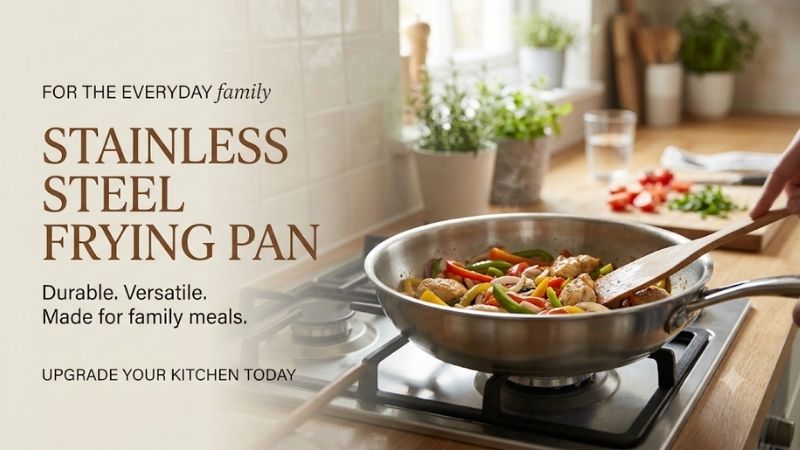
Consider deeper sides for one-pan family meals
A traditional frying pan has relatively low, sloping sides that make flipping, turning, and reducing liquids convenient. For families who prepare substantial one-pan meals, slightly deeper sides can be helpful. They provide more room for vegetables, sauces, and proteins while reducing the likelihood of spills during stirring.
Consider a family dinner of sautéed chicken, mushrooms, spinach, and a light cream sauce.
A shallow pan can handle the initial browning, but adding several cups of vegetables and liquid may leave little space for stirring.
A skillet with moderately higher walls provides additional flexibility.
However, deeper sides are not always better.
Tall, nearly vertical walls can trap more steam around food, particularly when the pan is crowded.
This may reduce the efficiency of browning compared with a wide, open frying pan.
Families should decide whether searing or one-pan cooking represents the more common use.
If the household frequently prepares saucy meals, a sauté pan with straight sides may be a better companion to a conventional skillet.
It is not always necessary to force one frying pan to perform every kitchen task.
A moderately deep frying pan offers a useful compromise, especially in kitchens with limited storage.
The most practical shape provides enough volume for normal meals without making the pan difficult to clean or maneuver.
Evaluate pan weight and helper handles carefully
A family-sized stainless steel skillet becomes substantially heavier when filled with food. While a solid pan may feel reassuringly durable, excessive weight can make routine handling uncomfortable. Buyers should consider how the handle feels when tilting, lifting, and transferring the pan between the stove, oven, and serving area.
A 12-inch skillet may seem manageable when empty, but several portions of meat and vegetables add considerable weight.
This becomes especially important when the pan contains hot cooking liquid.
A handle should provide a secure grip without forcing the wrist into an uncomfortable angle.
Some manufacturers use narrow, contoured handles, while others prefer rounded designs.
Neither style is universally better.
Cooks with smaller hands may prefer a different shape from those who regularly lift heavy cookware.
A helper handle positioned opposite the primary handle can improve control during lifting.
This is particularly useful when moving a loaded pan into or out of the oven.
However, helper handles also become hot and require appropriate protection.
Families should not rely on one-handed lifting when the pan is heavily loaded.
A stable two-handed grip may be safer.
Buyers should also consider storage.
Long handles and helper handles can complicate stacking in shallow cabinets.
The ideal pan balances durable construction with comfortable everyday movement.
Construction features that matter in family cookware
Stainless steel pans vary in the materials and techniques used to distribute heat. These construction differences affect how the pan responds to burner adjustments, how it handles larger quantities of food, and how easily the surface can be cleaned. Understanding the fundamentals helps families make informed choices without paying for unnecessary specifications.
Understand fully clad stainless steel construction
Fully clad cookware bonds conductive materials throughout the base and walls of the pan. This design is widely used in quality stainless steel frying pans because stainless steel alone does not distribute heat as effectively as aluminum or copper. For families, reliable heat distribution can make large meals easier to manage.
A typical three-ply skillet contains an aluminum core between stainless steel layers.
The interior stainless steel surface provides durability and direct contact with food.
The aluminum layer helps distribute heat more efficiently.
The exterior layer supports strength and may provide compatibility with induction cooking, depending on the material.
Five-ply pans use additional layers, but a higher ply count does not automatically mean better performance.
Thickness, layer composition, and manufacturing quality influence how heat moves through the pan.
A lighter fully clad skillet may respond quickly to temperature adjustments.
A thicker model may change temperature more gradually.
When cooking large family portions, the key is maintaining appropriate heat rather than simply buying the thickest possible pan.
A substantial skillet can be useful for searing several pieces of meat, but it may be less convenient for tossing vegetables.
Fully clad cookware can also transfer heat into the lower walls, which is helpful for sautéing.
For a versatile family frying pan, fully clad construction is usually a sensible feature to prioritize.
Compare three-ply and five-ply cookware realistically
Three-ply and five-ply are common descriptions in stainless steel cookware marketing. Buyers sometimes assume that five layers must provide superior cooking results, but performance depends on how the layers are constructed. Families should evaluate practical differences in heating response, weight, and price rather than using ply count as the sole criterion.
A well-made three-ply pan can provide excellent browning and temperature control.
The All-Clad D3 and Tramontina Tri-Ply Clad are examples of established three-ply designs.
Five-ply options, such as Made In Stainless Clad, use additional metal layers.
The extra construction can influence heating behavior and structural characteristics.
However, it does not guarantee that every five-ply pan outperforms every three-ply model.
For example, a household preparing sautéed vegetables may appreciate a responsive pan that cools relatively quickly when the burner is lowered.
A family searing thicker pieces of meat may prefer a heavier pan that changes temperature less abruptly.
Both approaches can work when the user understands the skillet.
The most meaningful comparison includes flat cooking diameter, overall weight, handle comfort, and compatibility with the stove.
Price should also be considered.
A moderately priced three-ply pan may provide better value than an expensive five-ply model if both satisfy the household’s cooking requirements.
Families should pay for practical improvements rather than layer counts alone.
Check induction compatibility and oven temperature limits
A family skillet may be used on a gas stove, electric range, induction cooktop, or inside the oven. Compatibility should be confirmed before purchasing because not every stainless steel construction behaves identically on every heat source. The manufacturer’s temperature limits also determine whether certain stovetop-to-oven recipes are appropriate.
Induction cooktops require cookware with an appropriately magnetic base.
Many modern stainless steel frying pans are designed for induction, but buyers should verify compatibility with the exact model.
A pan can contain stainless steel without necessarily working efficiently on induction.
The base must interact correctly with the cooktop’s magnetic field.
Pan size also matters.
Some induction burners require a minimum base diameter for reliable detection.
For oven use, check the published maximum temperature for the entire pan.
The handle, lid, and any detachable accessories may have different limits.
A stainless steel skillet with a metal handle may tolerate temperatures unsuitable for a model with silicone or plastic components.
For example, a recipe requiring an oven finish at 425°F should only be attempted when the pan is rated for that temperature.
Broiler compatibility must be checked separately rather than assumed.
Families should also remember that handles remain hot after leaving the oven.
A reliable oven mitt and stable landing area are essential.
Cooking performance for busy family kitchens
A family frying pan should handle more than one type of meal. From chicken thighs and vegetables to pasta sauces and breakfast dishes, versatility comes from combining appropriate pan construction with practical cooking technique. Understanding how stainless steel behaves helps households get better results while reducing the frustration of sticking and uneven browning.
Prevent sticking when cooking chicken, fish, and eggs
Stainless steel cookware is durable and versatile, but it does not have the effortless release of a conventional coated nonstick skillet. Food may stick when the surface is too cool, overheated, or inadequately lubricated. Understanding these factors is especially important when cooking several portions for family meals.
Begin by heating the pan gradually over medium heat.
Avoid placing a cold, oversized skillet over maximum heat in an attempt to accelerate the process.
Once the surface reaches an appropriate cooking temperature, add a suitable amount of oil.
Allow the oil to spread and become fluid without smoking excessively.
Pat chicken, fish, and other proteins dry before cooking.
Surface moisture creates steam and delays the formation of a browned crust.
Place the food in the pan and give it time to cook.
Trying to move a chicken thigh immediately may tear the developing crust.
As browning progresses, the food often releases more easily.
Eggs are more delicate because their proteins can adhere strongly to stainless steel.
They generally require careful heat management and sufficient fat.
For households preparing eggs every morning, keeping a separate conventional nonstick or well-seasoned carbon steel pan may be more convenient.
Stainless steel remains especially useful for meats, vegetables, and sauces.
Learning these distinctions can make family meal preparation much less frustrating.
Sear larger portions without overcrowding the surface
Successful searing requires direct contact between food and a sufficiently hot cooking surface. Large family portions can create challenges because ingredients release moisture and lower the pan’s temperature. A properly sized stainless steel skillet helps, but cooking in batches may still be necessary for the best results.
Consider preparing six chicken cutlets for dinner.
Even a large 12-inch skillet may not accommodate every piece with adequate separation.
Trying to cook all six simultaneously can cause moisture to collect.
Instead of developing an evenly browned exterior, the cutlets may cook in their own juices.
Dividing the ingredients into two batches can produce better results.
Keep the first batch warm using a food-safe method while the remaining portions cook.
Avoid stacking hot food tightly if preserving crispness is important.
For vegetables, cook dense ingredients first and add delicate greens later.
This allows different ingredients to receive the heat they need without excessive moisture accumulation.
Use the browned residue left in the pan to build a sauce when appropriate.
After removing the protein, add stock or another suitable liquid to dissolve flavorful fond.
This technique creates a cohesive meal without requiring a separate sauce pan.
The ability to sear and deglaze effectively is one of stainless steel’s greatest advantages for family cooking.
Use one skillet for acidic sauces and oven-finished meals
A stainless steel frying pan is especially useful when recipes include acidic ingredients or require a transition from stovetop cooking to oven finishing. Unlike seasoned carbon steel or traditional uncoated cast iron, stainless steel does not rely on a polymerized oil layer that acidic foods can gradually strip.
For example, a family may prepare chicken cutlets with tomatoes, garlic, and white wine.
The chicken can be browned first, then removed while the sauce ingredients cook.
Tomatoes and wine can help dissolve browned residue from the pan, adding flavor to the finished dish.
Stainless steel is well suited to this process because ordinary acidic cooking does not remove a seasoning layer.
The same skillet may also be used for recipes that begin with searing and finish in the oven.
However, oven temperature compatibility must be verified first.
A heavy pan can be difficult to move when filled with sauce or vegetables.
Use appropriate mitts and avoid placing a hot handle where another family member might grab it accidentally.
For delicate fish, moderate heat and careful handling remain important.
Stainless steel does not eliminate the need for technique, but it supports a wide range of ingredients and cooking methods.
That versatility can reduce the number of specialized pans a family needs.
Maintenance, storage, and long-term value
Family cookware is used frequently, making cleaning convenience and durability important purchasing factors. Stainless steel is relatively low-maintenance compared with seasoned iron cookware, but it still benefits from appropriate handling. Simple routines can reduce discoloration, prevent unnecessary wear, and preserve reliable cooking performance.
Clean browned food residue without damaging the pan
A stainless steel pan may develop stuck-on residue after searing, particularly when proteins or sugary sauces remain on the cooking surface. This is normal and does not necessarily indicate poor cookware quality. Gentle cleaning techniques can remove residue without relying on aggressive scraping or inappropriate chemical treatments.
Allow the pan to cool enough for safe handling before washing.
Avoid placing a very hot skillet directly into cold water because rapid temperature changes can contribute to warping.
For ordinary residue, warm water, dish soap, and a nonabrasive sponge are often sufficient.
If food remains attached, allow the pan to soak according to the manufacturer’s care instructions.
Another option is controlled deglazing while cooking, which can loosen browned deposits and incorporate flavor into sauces.
For stubborn discoloration, use a cleaning product approved for the cookware material.
Avoid steel wool or aggressive abrasives when the manufacturer advises against them.
Some stainless steel pans develop rainbow-colored heat marks or cosmetic staining.
These changes do not necessarily mean the pan is damaged.
Check whether the product is dishwasher-safe, but consider handwashing if the manufacturer recommends it for preserving the finish.
Clean the handle attachments and any rivets carefully.
A regular maintenance routine prevents small deposits from accumulating into more difficult cleaning problems.
Prevent warping through sensible temperature management
Warping can occur when cookware experiences extreme or uneven temperature changes. Larger frying pans may be particularly vulnerable to poor heating habits because their broad bases cover different temperature zones. Gradual heating, appropriate burner selection, and avoiding sudden cooling help protect the pan’s long-term shape.
Begin by selecting a burner suited to the skillet’s base diameter.
A very small burner under a wide pan can create significant differences in temperature between the center and edges.
This may contribute to uneven cooking and additional thermal stress.
Avoid heating an empty pan over maximum heat for extended periods.
Stainless steel cookware can tolerate substantial temperatures, but that does not mean uncontrolled heating is beneficial.
For most everyday cooking, moderate preheating provides sufficient preparation.
When using induction, follow the cooktop and cookware instructions regarding power settings.
Some high-output induction systems can increase pan temperature rapidly.
After cooking, allow the skillet to cool naturally before washing.
Do not place a very hot pan in a sink filled with cold water.
Inspect the cooking base periodically, especially if the pan begins rocking on a flat surface.
A warped base can reduce contact with certain cooktops and cause cooking oil to collect unevenly.
Good temperature management protects cookware while improving food quality.
Choose long-term value over unnecessary premium features
A family frying pan is a frequently used household tool, so long-term value matters more than an impressive product description. Higher prices may reflect construction quality, finishing, brand reputation, or specialized design. The best purchase is the pan that meets daily cooking needs without unnecessary expense or inconvenience.
Begin by identifying the most common family meals.
If the household regularly prepares chicken, vegetables, and pan sauces, a 12-inch fully clad skillet is a sensible investment.
If breakfast mainly consists of delicate eggs, stainless steel may not replace every other pan.
A family should also consider whether a matching lid is included.
A lid can support certain simmering and steaming tasks, but not every frying pan requires one.
Check warranty terms and manufacturer care guidance.
A durable uncoated stainless steel pan can remain useful for many years when maintained properly.
However, a premium price does not automatically guarantee better cooking results.
Tramontina and Cuisinart offer practical options for budget-conscious buyers.
Made In, All-Clad, and other premium manufacturers may appeal to households that prioritize particular handles, finishes, or construction details.
The most meaningful investment is a pan that the family can comfortably use every day.
Conclusion
The best stainless steel frying pan for families should match household serving size, stove compatibility, and everyday meal preparation. A 12-inch fully clad skillet is a practical choice for many families of four, while smaller households may prefer a lighter 10-inch model. Prioritize comfortable handling, usable cooking area, reliable construction, and easy cleaning. With proper heat management, a quality stainless steel pan can become one of the most versatile pieces of cookware in a family kitchen.
Write Your Review
No reviews yet. Be the first to share your experience!