
Choosing a pasta pot with strainer for induction cooking requires more than selecting stainless steel cookware. The base must be compatible with an induction burner, while the pot and draining mechanism should handle pasta safely and efficiently. This guide explains how to compare construction, capacity, strainer types, and everyday usability.
- What makes a pasta pot compatible with induction?
- How to identify an induction-ready pasta pot
- Choosing the best strainer design for induction cooking
- Best induction-compatible pasta pot configurations
- Choosing the right pot capacity for induction cooking
- How to cook pasta efficiently on an induction stove
- Common mistakes when buying induction pasta cookware
- Cleaning and maintaining induction pasta pots
- Frequently Asked Questions
- Conclusion
What makes a pasta pot compatible with induction?
An induction-compatible pasta pot must have a base containing material that interacts appropriately with the induction cooktop’s magnetic field. Stainless steel cookware is not universally induction-compatible because different steel grades and base constructions have different magnetic properties. Buyers should confirm the manufacturer’s compatibility statement rather than relying on appearance.
Induction cooktops generate heat in suitable cookware through electromagnetic interaction.
The cooking surface itself does not function like a traditional exposed electric heating element, although it can become hot from contact with the cookware.
For a pasta pot, this means the base construction is especially important.
A compatible pot should also have a stable, sufficiently flat bottom.
The removable pasta strainer does not need to be magnetic because it is heated by the surrounding water rather than directly by the induction burner.
A stainless steel strainer can therefore work inside an induction-compatible pot even when its own construction would not activate an induction zone.
How to identify an induction-ready pasta pot
Induction compatibility should be verified using manufacturer specifications, product markings, and the requirements of the cooktop itself. A pot may contain stainless steel yet lack a suitable magnetic base, while a compatible encapsulated or multilayer construction can support induction heating even when other layers are not magnetic.
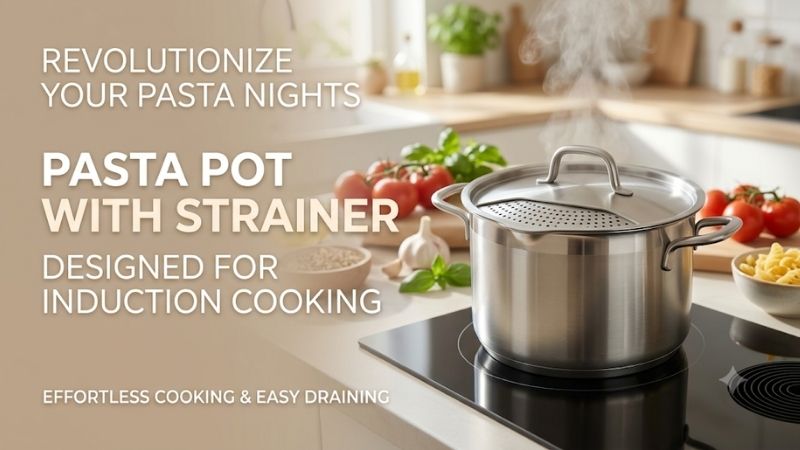
Look for explicit induction compatibility
The most reliable purchasing approach is to choose cookware whose manufacturer explicitly lists induction among its supported heating methods. Generic descriptions such as stainless steel, professional cookware, or heavy-duty construction do not provide enough information to establish compatibility.
The All-Clad 6-Quart Stainless Steel Pasta Pot with Perforated Insert is manufacturer-listed as compatible with induction.
The Tramontina Gourmet 6-Quart Stainless Steel Pasta Cooker also uses a magnetic three-ply base designed for induction.
These are more reliable examples than assuming an unidentified stainless steel pot will work.
Check the exact model because different product lines within the same brand can use different base constructions.
Understand magnetic stainless steel bases
Many induction-compatible pots use magnetic stainless steel in the bottom layer combined with aluminum or other conductive metals that help distribute heat. This construction allows the base to interact with the induction cooktop while retaining some of the thermal benefits of a multilayer design.
The Tramontina Gourmet 6-Quart Pasta Cooker uses a magnetic three-ply base.
The Cuisinart Chef’s Classic 12-Quart Pasta/Steamer Set includes an induction-ready encapsulated base.
These approaches provide different configurations for achieving compatible heating.
However, the presence of multiple layers does not automatically guarantee superior boiling performance in every situation.
Actual heating depends on the burner, base diameter, water volume, and power settings.
Use the magnet test carefully
A household magnet can provide a useful preliminary indication of whether a pot’s base contains magnetic material. If the magnet adheres firmly to the cooking base, induction compatibility may be more likely, but this test alone cannot verify every aspect of proper operation.
Some induction cooktops require particular minimum base dimensions.
A pot may also have an uneven base or other characteristics that reduce effective performance.
Manufacturer specifications and cooktop guidance remain more reliable than a simple magnet test.
Use the test as an initial screening method, not a substitute for checking compatibility.
Check base diameter and cooking-zone requirements
Induction cooktops may not recognize cookware whose magnetic base is too small for the cooking zone. A very large pot can also extend beyond the most effective heating area, affecting how heat is distributed through the contents.
Check the actual base diameter rather than relying only on the pot’s rim diameter.
Review the cooktop manufacturer’s recommended cookware dimensions.
Use a stable, flat-bottom vessel.
Avoid placing cookware in a way that interferes with adjacent controls or cooking zones.
Choosing the best strainer design for induction cooking
Induction compatibility concerns the pot base, but draining convenience depends on the strainer design. Integrated pasta systems commonly use removable perforated baskets or locking lids. These options affect storage requirements, safe handling, and whether the cooking water can remain inside the pot.
Removable pasta strainer inserts
A removable insert sits inside the water-holding pot and allows pasta to be lifted after cooking. Perforations in the basket permit the hot water to drain back into the vessel, potentially reducing the need to tilt a large pot over the sink.
The All-Clad 6-Quart Pasta Pot uses this arrangement.
The All-Clad Simply Strain Multipot family also includes deep removable inserts.
These systems are useful when cooking several batches or reserving some pasta water for sauces.
However, the basket occupies space within the pot.
Buyers should therefore distinguish total pot capacity from the amount of pasta and water that can be used with the insert installed.
Locking strainer inserts
A locking strainer system provides an additional securing mechanism intended to stabilize the draining component. This may be useful when controlling hot pasta and water, although actual handling requirements depend on the specific design.
The Tramontina Gourmet 6-Quart Stainless Steel Pasta Cooker includes a locking strainer insert.
It also offers a tempered glass lid and magnetic three-ply base.
The combination is attractive for households that want a purpose-built pasta cooking arrangement.
However, the insert must be secured and operated according to the manufacturer’s instructions.
A locking mechanism does not eliminate burn risks.
Locking strainer lids
Locking strainer lids incorporate drainage openings into the lid, allowing water to pour out while the pasta remains inside the vessel. This design avoids a separate removable basket but requires tilting the entire pot.
Some nonstick aluminum pasta pots use this format.
However, not every model is induction-compatible.
For example, the commonly sold nonstick Bialetti Oval Pasta Pot with Strainer Lid is not induction-compatible.
Buyers should not assume that an integrated strainer lid guarantees suitability for induction cooking.
Verify the exact pot base before purchasing.
Which strainer design is safest?
No strainer mechanism eliminates the hazards associated with boiling water. Removable inserts allow draining without tipping the whole pot, but the lifted basket and contents remain hot. Locking lids reduce separate components but require handling the entire vessel.
Choose according to your ability to lift and control the cookware.
For large quantities, a removable basket may reduce the amount of water moved.
For smaller portions, a properly secured lid can be convenient.
In all cases, use heat protection and follow the manufacturer’s instructions.
Best induction-compatible pasta pot configurations
Several real cookware systems provide induction compatibility together with integrated straining features. The following examples illustrate practical differences in capacity, construction, and draining method. They are not presented as a comprehensive product ranking, but they can help buyers understand which specifications matter when choosing an induction-ready pasta pot.
All-Clad 6-Quart Stainless Steel Pasta Pot
The All-Clad 6-Quart Stainless Steel Pasta Pot with Perforated Insert and Lid is a practical medium-capacity option. Its bonded base supports induction cooking, and its removable insert provides an integrated way to drain pasta without pouring the entire pot of boiling water into the sink.
This arrangement is useful for ordinary household meals.
The stainless steel construction is also suitable for boiling vegetables or preparing other foods when the insert is removed.
The manufacturer lists dishwasher compatibility.
Its main limitation is that the removable basket reduces the usable interior space.
For households that regularly cook large quantities of spaghetti, a wider or taller configuration may be preferable.
Tramontina Gourmet 6-Quart Pasta Cooker
The Tramontina Gourmet 6-Quart Pasta Cooker combines a magnetic three-ply base, stainless steel construction, and a locking strainer insert. It is suitable for induction and other common cooking surfaces, making it relevant to households that may change stoves in the future.
The six-quart capacity offers a practical compromise for many families.
Its removable insert provides a designated draining arrangement.
The tempered glass lid is useful for monitoring cooking conditions, although steam and condensation can obscure visibility.
The manufacturer lists dishwasher compatibility and separate oven-temperature limits depending on whether the glass lid is used.
For pasta cooking, the most important advantages remain base compatibility and convenient drainage rather than high oven-temperature capability.
Cuisinart Chef’s Classic 12-Quart Pasta/Steamer Set
The Cuisinart Chef’s Classic 12-Quart Pasta/Steamer Set offers substantially greater capacity than a typical six-quart pasta cooker. Its stainless steel construction, aluminum-encapsulated induction-ready base, and included accessories make it suitable for households preparing larger meals.
The removable pasta insert can reduce the need to pour the entire pot into a sink.
The steaming accessory provides additional versatility.
However, the large pot requires more storage space and is relatively heavy when filled.
The size is best justified by regular family cooking or entertaining rather than occasional small portions.
All-Clad Simply Strain 8-Quart Multipot
The All-Clad Simply Strain 8-Quart Stainless Steel Multipot uses a deep removable perforated insert and an induction-compatible base. It is intended for pasta, vegetables, and other multipurpose cooking tasks.
The additional capacity can be convenient for households preparing several servings.
The removable insert allows cooking water to drain back into the pot.
The stainless steel system is also manufacturer-listed as dishwasher-safe.
However, its larger footprint and additional insert may make it less convenient than a compact six-quart pasta cooker when preparing small meals.
Choosing the right pot capacity for induction cooking
Capacity should be based on the amount of pasta regularly prepared, the dimensions of the induction cooking zone, and how comfortably the cook can manage the filled pot. Larger cookware provides more water volume but increases total weight and storage requirements.
Small households and everyday portions
For one or two people, a medium pasta pot may be more practical than a large stockpot. The objective is to provide enough room for water circulation and pasta movement without requiring unnecessarily large quantities of water.
A six-quart pasta system may already provide more than enough capacity for many small meals.
When using a removable basket, account for the space occupied by the insert.
Check the manufacturer’s recommended fill level.
Avoid assuming that the pot’s nominal capacity is entirely available once accessories are installed.
Family cooking and multiple servings
Families preparing several portions may benefit from six- to eight-quart systems, depending on pasta shape and quantity. A larger vessel can provide space for movement and reduce crowding, but it must still fit the cooktop.
An eight-quart multipot may be useful for batch cooking.
However, its larger base may not align perfectly with every induction zone.
Choose a pot that fits the available cooking surface and allows safe lifting.
Large batches and entertaining
Twelve-quart pasta systems are more suitable for households that regularly prepare substantial quantities. Their large capacity can support family gatherings and meal preparation, but they are bulky and can be difficult to move when filled.
Consider whether the stove provides appropriate support.
Check cabinet dimensions.
Avoid filling beyond the manufacturer’s recommendations.
Use a draining method that minimizes unnecessary movement of boiling water.
How to cook pasta efficiently on an induction stove
Induction cooking offers responsive power control, but pasta preparation still depends on water volume, pasta quantity, pot construction, and cooking technique. The goal is to bring water to a suitable boil, prevent overcrowding, and maintain enough heat for consistent cooking without unnecessary boilovers.
Choose the appropriate induction cooking zone
Place the pot on a cooking zone that supports its magnetic base dimensions. The vessel should sit flat and stable, and its handles should not interfere with nearby burners or controls.
Confirm that the cooktop recognizes the pot.
Use the manufacturer’s recommended power setting.
Avoid placing an oversized pot across unsuitable cooking zones unless the cooktop specifically supports that arrangement.
Heat water without overfilling
Fill the pot with an appropriate volume of water for the pasta quantity and cookware design. A removable strainer insert reduces usable space, so pay attention to the actual water level after installing it.
Avoid exceeding the maximum recommended fill level.
Use a suitable lid while heating when appropriate.
Monitor the pot as it approaches boiling.
Do not leave the stove unattended.
Add pasta and maintain cooking conditions
Once the water reaches the appropriate stage, add pasta according to the recipe or package instructions. Stirring shortly after adding pasta can reduce clumping, particularly with long strands and starch-rich varieties.
Adjust the power setting to maintain an appropriate boil.
Avoid unnecessary boilovers.
Check pasta texture near the recommended cooking time.
Do not assume every induction stove produces identical cooking times.
Drain pasta carefully
Before draining, turn off or reduce the heat as appropriate and ensure the draining area is safe. If the system uses a removable insert, lift it slowly and let water drain back into the pot.
Use oven mitts or other suitable heat protection.
Keep hands and face away from steam.
For locking systems, verify the mechanism before handling.
Never rush or shake a heavy basket of boiling pasta.
Common mistakes when buying induction pasta cookware
Many purchasing errors come from assuming that stainless steel automatically means induction compatibility or focusing on pot capacity without considering its drainage arrangement. These mistakes can result in cookware that does not operate correctly or is unnecessarily difficult to use.
Assuming every stainless steel pot works on induction
Stainless steel is not a single magnetic material with universal induction compatibility. Some grades and constructions may not interact adequately with an induction cooktop.
Choose models explicitly listed as induction-compatible.
Check the base construction.
Avoid relying exclusively on photographs or generic product descriptions.
Ignoring insert capacity
A pot advertised as six quarts may offer less usable space when a large removable insert is installed. The insert must fit inside the base pot while leaving room for boiling water.
Consider normal pasta portions.
Evaluate insert depth and shape.
For long pasta, check whether the vessel offers sufficient usable height.
Choosing an oversized pot
Large pots can be inconvenient to wash, lift, and store. They may also exceed the ideal dimensions of an induction burner.
Buy according to everyday needs.
Consider whether a six-quart system can already meet most household requirements.
Cleaning and maintaining induction pasta pots
Proper care helps preserve stainless steel cookware and maintain stable contact with induction cooking surfaces. Pasta water can leave starch deposits or mineral marks, while repeated heating may produce discoloration. These effects do not necessarily indicate damage, but they should be addressed using manufacturer-approved cleaning methods.
Cleaning stainless steel pots
Allow the cookware to cool sufficiently before washing. Use suitable detergent and a soft sponge or manufacturer-approved cleaning tool to remove starch residue and food particles.
Avoid sudden cooling of a very hot pot.
Do not use inappropriate abrasive tools that may damage the surface.
For stubborn deposits, follow the manufacturer’s recommended cleaning method.
Maintaining perforated inserts
Removable pasta inserts can trap food particles inside their drainage openings. Thorough washing is important because residue left in these areas can dry and become more difficult to remove.
Rinse the insert promptly when safe.
Clean the perforations thoroughly.
Check handle attachment areas for trapped residue.
Dry the insert before storage.
Protecting the induction cooking surface
A heavy pot should be placed carefully on a glass induction surface to avoid scratching or impact damage. The underside of the cookware should remain clean and free from debris that could interfere with contact.
Avoid dragging heavy pots across the glass.
Lift them when repositioning.
Check cookware stability before filling with water.
Follow the cooktop manufacturer’s weight and cleaning guidance.
Frequently Asked Questions
Induction pasta cookware raises practical questions about magnetic compatibility, removable inserts, boiling performance, and safe handling. Understanding these issues helps buyers select a pot that works reliably with their stove rather than assuming every stainless steel pasta cooker is interchangeable.
Does a pasta strainer insert need to be magnetic?
No. The removable insert does not need to interact directly with the induction cooktop because the water-holding pot provides the heating interface.
The base pot must be compatible with the induction burner.
Can I use a regular stainless steel pasta pot on induction?
Only when its base is induction-compatible. Some stainless steel pots contain nonmagnetic constructions that may not work correctly.
Check manufacturer specifications before purchasing.
Is a six-quart pasta pot large enough for a family?
A six-quart system may be suitable for many family meals, depending on the pasta quantity, shape, and space occupied by the insert. Large households or frequent batch cooks may prefer greater capacity.
Does induction cook pasta faster?
Induction can heat compatible cookware efficiently and offers responsive power control, but actual time to boiling and cooking depends on stove power, water volume, cookware construction, and cooking conditions.
It is not possible to guarantee a universal time saving without comparing specific equipment under equivalent conditions.
Can an induction pasta pot steam vegetables?
Many induction-compatible pasta systems can steam vegetables when they include a suitable steaming accessory or insert configured to keep food above the water. A deep pasta strainer is not automatically equivalent to a shallow steamer basket.
Follow manufacturer instructions for the intended cooking method.
Conclusion
The best pasta pot with strainer for induction cooking combines a manufacturer-confirmed magnetic base with a draining system that suits your household. A six-quart stainless steel pot with a removable insert is a practical starting point for everyday meals, while eight- and twelve-quart multipots better serve larger cooking batches. The All-Clad, Tramontina, and Cuisinart systems discussed here illustrate different combinations of capacity and draining functionality. Prioritize genuine induction compatibility, stable base dimensions, manageable weight, and safe removal of hot pasta. A properly chosen pot should simplify cooking without introducing unnecessary lifting or storage problems.








Write Your Review
No reviews yet. Be the first to share your experience!