
A ceramic nonstick skillet for induction cooking needs more than a slippery coating: its base must work with a magnetic cooktop and heat predictably. This guide shows how to verify induction compatibility, select the right size, protect the ceramic surface, and decide when an induction-ready pan offers worthwhile everyday value.
What makes ceramic nonstick cookware induction compatible?
Induction cooktops heat suitable cookware through electromagnetic energy rather than relying on a conventional exposed heating element. Because many ceramic nonstick pans use aluminum bodies, compatibility depends on additional magnetic construction. Understanding this distinction helps buyers avoid purchasing cookware that appears suitable but cannot activate an induction burner.
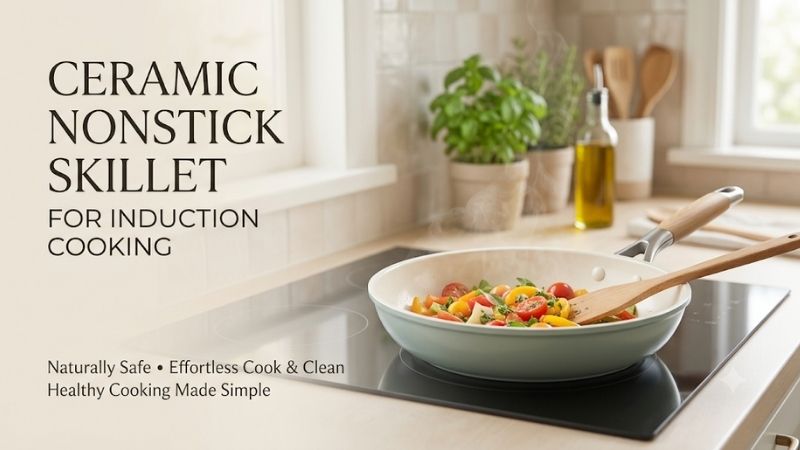
Understand how magnetic induction bases actually work
Induction compatibility depends on whether the cookware contains an appropriate magnetic material in its base. Aluminum is commonly used in ceramic nonstick pans because it distributes heat effectively, but ordinary aluminum alone does not work on conventional induction cooktops. Manufacturers therefore add suitable magnetic components to certain cookware designs.
An induction cooktop produces an alternating magnetic field beneath its cooking surface.
When compatible cookware is positioned over the active heating zone, the field generates heat in the cookware itself.
The process differs from a conventional electric burner, which heats a surface that transfers energy to the pan.
Because induction requires suitable magnetic properties, not every metal cooking vessel will operate.
Cast iron generally works because its iron content is magnetic.
Many stainless steel pans also work, depending on their alloy and base construction.
Aluminum ceramic nonstick pans require an appropriate induction-compatible base.
Some manufacturers use bonded stainless steel plates.
Others incorporate specialized magnetic materials into their base design.
GreenPan’s Valencia Pro collection, for example, uses a Magneto induction base.
The ceramic coating does not create induction compatibility.
It serves a different function by providing food release.
When shopping, evaluate the pan’s base construction and published heat-source compatibility separately from its coating claims.
A product marketed simply as ceramic cookware may still be unsuitable for induction.
Verify compatibility before purchasing a skillet
Induction compatibility should be confirmed through manufacturer specifications rather than general product descriptions or assumptions about the brand. Some cookware companies sell both induction-ready and non-induction collections with similar names. Checking the exact model prevents frustration and unnecessary returns.
Look for a clear statement that the selected skillet works on induction cooktops.
Many manufacturers include an induction symbol on the packaging or product specifications.
If the information is missing, contact the manufacturer rather than assuming compatibility.
A simple magnet test can provide useful preliminary information.
A magnet that adheres firmly to the base suggests the presence of suitable magnetic material.
However, a magnet test alone does not guarantee optimal performance.
Cooktop recognition also depends on base dimensions, construction, and the appliance’s detection system.
The GreenLife range illustrates why exact product identification matters.
The standard Soft Grip ceramic collection is not generally induction-compatible.
The separate Soft Grip Induction collection is specifically designed for induction use.
Buying the wrong version can create a significant compatibility problem.
Similarly, some manufacturers update product lines over time.
A newer version may have different base construction from an older model with a similar appearance.
Check the product code when possible.
For online purchases, review the full specifications rather than relying solely on a headline or promotional photograph.
Avoid confusing ceramic coatings with solid ceramic cookware
The term ceramic can refer to several very different materials and manufacturing methods. Most ceramic nonstick frying pans are metal cookware with a specialized coating rather than solid ceramic vessels. Understanding this distinction is important because the underlying metal determines induction compatibility and influences heating behavior.
Many ceramic nonstick pans use aluminum bodies covered with a sol-gel coating.
This coating creates the food-release surface.
The aluminum beneath it distributes heat.
An induction-compatible model adds a magnetic base or other suitable construction.
A solid ceramic cooking vessel behaves differently and may not work with induction at all.
Porcelain-enameled cast iron is another distinct category.
It uses cast iron covered with a glass-like enamel finish.
The iron body generally supports induction compatibility, while the enamel protects the surface.
These differences explain why two products described as ceramic cookware can have very different cooking characteristics.
Buyers should examine the entire material specification.
A ceramic coating does not automatically imply induction readiness, high-temperature suitability, or permanent nonstick performance.
It also does not determine the pan’s weight.
An aluminum ceramic skillet may feel relatively light.
A ceramic-coated cast iron hybrid can be noticeably heavier.
Understanding the construction prevents misleading comparisons between products that share only a broad coating description.
How to choose a ceramic nonstick skillet for induction cooking
The best induction-ready ceramic skillet should fit the cooktop’s heating zone, provide enough flat cooking space, and remain comfortable during normal use. It should also respond predictably to power adjustments and tolerate appropriate cleaning. Matching these features to everyday meals is more useful than choosing solely by appearance or advertised coating technology.
Choose a flat base that matches the induction burner
Induction cooktops rely on the relationship between the cookware base and the active heating zone. A skillet that is too small may not be recognized by some burners, while an oversized pan may develop uneven temperatures beyond the effective heating area. Buyers should compare the actual base diameter with cooktop requirements.
Begin by checking the induction cooktop manual.
Manufacturers often specify minimum and recommended pan diameters for different heating zones.
A small eight-inch skillet may have a much narrower magnetic base than its rim measurement suggests.
That distinction is important because induction detection typically depends on the base rather than the upper diameter.
A twelve-inch frying pan may also create problems when placed over a small heating zone.
The center can receive more effective heating than the outer cooking area.
This may produce uneven pancakes or inconsistent browning.
For many home kitchens, a ten- or eleven-inch skillet provides a useful compromise.
It offers sufficient cooking area for ordinary meals while fitting common household induction burners.
However, cooktop dimensions vary.
A portable induction unit may have a smaller effective heating area than a full-size induction range.
Before purchasing, compare the pan’s flat base dimensions with the cooktop’s guidance.
Choosing compatible dimensions can improve heating consistency and reduce cooking frustration.
Evaluate pan thickness and temperature responsiveness
Ceramic nonstick skillets can differ considerably in thickness and metal construction. These differences influence how quickly the cooking surface responds to induction power changes and how evenly heat spreads across the base. Buyers should consider the pan’s design rather than assuming all induction-compatible ceramic models perform identically.
Aluminum is commonly used because it conducts heat effectively.
When paired with an appropriate magnetic base, it can provide a useful combination of induction compatibility and responsive heating.
Hard-anodized aluminum may also offer improved structural durability.
However, the quality and thickness of the induction base remain important.
A poorly designed base can create uneven temperatures or become susceptible to deformation.
Some products use stay-flat technologies intended to reduce changes in base shape during heating.
GreenPan Valencia Pro is one example of a collection emphasizing this feature.
However, no pan should be treated as immune to thermal stress.
Induction can increase cookware temperature rapidly, especially at high power settings.
Gradual preheating is advisable for ceramic-coated cookware.
A thicker pan may feel more substantial and distribute heat differently from a lightweight alternative.
However, greater weight does not automatically produce better results.
Choose construction that supports ordinary cooking temperatures and predictable response without making the skillet unnecessarily difficult to handle.
Compare eight-inch, ten-inch, and twelve-inch sizes
Skillet diameter should match both the number of servings and the induction cooking zone. A compact pan may be convenient for eggs, while larger models provide room for family meals. However, buying the largest available diameter can create uneven heating and unnecessary storage demands.
An eight-inch skillet is particularly useful for one or two eggs.
It occupies relatively little space and can be comfortable to clean.
However, the magnetic base may be too small for some induction burners.
Check the cooktop’s minimum pan detection requirements before purchasing.
A ten-inch skillet offers additional versatility.
It can accommodate a small omelet, moderate portions of vegetables, or several pancakes depending on their size.
For individuals and couples, this is often a practical everyday choice.
An eleven-inch skillet provides additional room without reaching the full size of a family pan.
The GreenPan Valencia Pro collection offers this intermediate size.
A twelve-inch skillet is useful when preparing larger portions.
However, it may be less suitable for a compact induction zone.
Also examine the flat cooking diameter.
A pan advertised as twelve inches across the rim can have a substantially smaller base.
For induction cooking, both measurements matter.
The ideal skillet fits the heating zone and provides enough room for normal meals without crowding.
Induction-ready ceramic skillets worth considering
Several established cookware brands offer ceramic-coated pans specifically designed for induction cooking. The models differ in metal construction, weight, oven limits, and handle design. Understanding their practical strengths helps buyers narrow the selection without assuming that the most expensive ceramic skillet is automatically the best.
GreenPan Valencia Pro for versatile daily cooking
GreenPan Valencia Pro is a practical starting point for buyers seeking ceramic nonstick performance on induction. Its hard-anodized aluminum body and Magneto base are designed to combine even heating with magnetic compatibility. Multiple sizes also make the collection suitable for individual breakfasts and larger household meals.
The Valencia Pro offers a diamond-reinforced ceramic coating intended for everyday food release.
This can be useful for eggs, pancakes, and delicate fish.
However, users should still employ appropriate heat settings.
Induction burners can heat compatible cookware quickly, and unnecessary high power may shorten coating life.
The collection includes an 11-inch frying pan that offers useful flexibility for ordinary meals.
Its cooking area is sufficient for many household recipes without the bulk of a very large skillet.
GreenPan also specifies an oven rating up to 600°F for this collection.
However, the high oven rating should not be interpreted as a recommendation to use extreme stovetop heat during normal ceramic cooking.
The manufacturer recommends gentle utensils and handwashing for prolonged coating performance.
The Valencia Pro is a strong choice for households that want one ceramic skillet for several recipes.
Its main trade-off is higher pricing compared with basic non-induction ceramic cookware.
For induction users, however, the specialized base may justify that expense.
OXO Ceramic Professional for comfort and cleaning
OXO Ceramic Professional provides another induction-compatible option with a focus on everyday handling. Its hard-anodized aluminum construction, ceramic coating, and streamlined interior rivets make it appealing to cooks who value comfortable operation and relatively straightforward cleanup.
The induction-ready base allows the skillet to operate on suitable magnetic cooktops.
Its aluminum body supports responsive heating during ordinary meal preparation.
The ceramic coating can simplify cooking delicate foods, particularly when used with modest amounts of oil or butter.
OXO’s streamlined rivets are a useful design feature.
Exposed interior hardware can collect food residue, especially after cooking eggs or sauces.
A smoother interior makes wiping and rinsing easier.
However, the ceramic coating still requires careful maintenance.
Avoid aggressive scrubbing and prolonged exposure to excessive heat.
The collection includes different skillet sizes, making it possible to select a dedicated small egg pan or a larger multipurpose option.
Buyers should confirm the oven temperature limit for the exact model and regional product version.
The OXO design is particularly attractive to people who prioritize grip comfort and low-effort cleanup.
However, a premium ceramic coating does not eliminate the eventual possibility of declining food-release performance.
For long-term value, careful use remains essential regardless of the manufacturer.
Caraway and Cuisinart for different cookware preferences
Caraway and Cuisinart offer induction-compatible ceramic skillets with substantially different construction approaches. Caraway emphasizes a coated aluminum body and refined presentation, while the Cuisinart CastLite uses lightweight cast iron beneath its ceramic surface. The better choice depends on weight, temperature response, and cooking habits.
Caraway’s 10.5-inch Ceramic-Coated Fry Pan combines an aluminum body with an induction-compatible base.
Its relatively responsive construction is useful for eggs, vegetables, and everyday meals.
The manufacturer specifies oven compatibility up to 550°F.
However, routine ceramic cooking should still prioritize moderate stovetop temperatures.
The pan’s decorative finish may appeal to people who want coordinated kitchen equipment.
Cuisinart CastLite takes a different approach.
Its ceramic-coated lightweight cast iron body provides more substantial thermal behavior than a conventional aluminum pan.
The 10-inch model is induction-compatible and rated for oven use up to 500°F.
It also eliminates the need for the traditional seasoning routine associated with bare cast iron.
However, its coating still requires care.
The Cuisinart may be preferable for cooks who appreciate cast iron characteristics.
Caraway may appeal more to buyers who prioritize a modern aluminum skillet and coordinated styling.
Neither construction is universally better.
Choose according to the foods prepared most frequently and the desired handling characteristics.
Cooking safely and maintaining ceramic nonstick cookware
Induction cooking offers precise power adjustment, but it can also heat compatible pans quickly. Ceramic coatings may lose release performance when exposed to repeated overheating or unsuitable cleaning. A simple routine focused on moderate heat, appropriate utensils, and careful washing helps preserve useful performance.
Control induction power instead of overheating the coating
Induction burners can increase cookware temperature rapidly, making power control especially important for ceramic nonstick pans. Users should avoid treating the highest available setting as the default. Most delicate foods cook more predictably over low or medium heat, which also reduces unnecessary stress on the coating.
Begin by positioning the skillet correctly over the induction zone.
Use a low or medium power setting for initial warming.
Avoid preheating an empty ceramic-coated pan for an extended period.
Add a small amount of suitable cooking fat when recommended by the manufacturer.
For eggs, moderate heat helps prevent rapid browning and sticking.
For pancakes, maintaining a consistent temperature is important for even color.
If the first pancake browns too quickly, reduce the power before adding another.
Induction adjustments can change heating output quickly, but the metal body still retains some heat.
A thick pan may not cool immediately when the power setting is reduced.
Avoid repeatedly switching between maximum and minimum power without a clear cooking purpose.
For searing steaks at very high heat, uncoated stainless steel or suitable cast iron may be a better choice.
Ceramic nonstick cookware is generally most valuable for controlled everyday preparation rather than aggressive high-temperature cooking.
Use suitable utensils and cleaning methods
Ceramic nonstick coatings can be damaged by abrasive contact, residue buildup, and unsuitable cleaning habits. Even products described as scratch-resistant benefit from gentle care. Appropriate utensils and routine washing help preserve food release and reduce the need for premature replacement.
Silicone and wooden utensils are practical choices for most ceramic skillets.
They are less likely to scrape the coating than sharp metal edges.
Some manufacturers describe their surfaces as metal-utensil safe.
However, using gentler tools can still reduce unnecessary wear.
Avoid cutting food directly inside the skillet.
After cooking, allow the pan to cool before washing.
Rapid cooling can stress the metal body and potentially affect coating integrity.
Use warm water, mild dish soap, and a soft sponge for ordinary cleaning.
Avoid steel wool and aggressive abrasive cleaners.
If food residue remains, follow the manufacturer’s approved cleaning procedure.
Do not assume that a dishwasher-safe label means machine washing is ideal for long-term coating performance.
Handwashing is often the more conservative approach.
Dry the pan before storage.
When stacking cookware, use a suitable protector to reduce contact between cooking surfaces.
Recognize coating wear and plan for replacement
Ceramic nonstick coatings generally have a finite useful life. Even with careful handling, a pan may gradually lose its original food-release performance. Buyers should understand this limitation before investing heavily, especially when the skillet will be used several times per day.
A common warning sign is that eggs begin sticking despite appropriate temperature and cooking fat.
However, sticking does not always mean the coating has failed.
Burned-on oil can create residue that interferes with release.
Begin by cleaning the skillet according to the manufacturer’s recommendations.
If performance remains poor, coating wear may be responsible.
Visible chips, peeling, or other serious surface damage require additional attention.
Users should consult the manufacturer and discontinue use when the surface is compromised.
Unlike seasoned carbon steel, ceramic coating cannot be restored by repeatedly heating cooking oil.
The original coating is applied during manufacturing.
Replacing a worn ceramic skillet may eventually be necessary.
For frequent users, this ongoing cost should influence the purchase decision.
A moderately priced quality pan may provide better overall value than an expensive model if both require eventual replacement.
Common buying mistakes and long-term value
The most expensive ceramic skillet is not necessarily the right choice for every induction kitchen. Buyers can avoid unnecessary spending by verifying compatibility, choosing an appropriate diameter, and understanding realistic coating durability. A practical purchase should fit everyday cooking habits and the cooktop rather than relying on broad marketing claims.
Avoid buying a non-induction ceramic collection by mistake
One of the most common purchasing mistakes is assuming that every ceramic skillet from a familiar brand works on induction. Manufacturers may sell several collections with similar names, but only certain versions include suitable magnetic bases. Buyers should verify the exact model before completing a purchase.
For example, standard GreenLife Soft Grip cookware is not generally induction-compatible.
The Soft Grip Induction collection is a separate product line.
Confusing the two can result in cookware that the induction cooktop does not recognize.
Check the manufacturer’s description for explicit induction compatibility.
Do not rely solely on the ceramic coating label.
If shopping in a physical store, inspect the bottom of the pan and the packaging.
Look for the appropriate induction symbol.
A magnet test may provide a preliminary indication, but it does not replace official compatibility guidance.
Also compare the base diameter with the cooktop’s minimum detection requirements.
A magnetic pan can still be unsuitable for a particular heating zone if its base is too small.
Careful verification before buying is easier than arranging a return after discovering a compatibility problem.
Compare purchase price with expected coating longevity
Ceramic cookware varies widely in price, but higher cost does not guarantee permanently superior food release. Premium models may offer better handles, construction, base design, or warranty support. Buyers should decide which improvements are meaningful for daily cooking and whether they justify additional spending.
A person who prepares eggs occasionally may be satisfied with a moderately priced induction-ready skillet.
Someone cooking several meals per day may appreciate a more substantial handle and better base construction.
However, all coated surfaces require careful maintenance.
Repeated overheating can shorten useful performance, regardless of brand.
When comparing prices, consider the specific size and whether accessories are included.
A cookware set may appear economical but provide pans that are too small or too large for the household.
Warranty terms should also be reviewed carefully.
Some warranties cover manufacturing defects but exclude ordinary coating wear.
The total cost of ownership depends on how long the pan remains useful under normal conditions.
Buyers should avoid paying a large premium solely for claims of effortless cooking.
A reliable induction base, comfortable handling, and suitable capacity generally provide more practical value.
Decide whether ceramic is the best long-term induction choice
Ceramic nonstick skillets are convenient for delicate foods, but induction kitchens may also benefit from stainless steel and cast iron. Different cookware materials serve different purposes. Buyers should consider whether ceramic will be their primary pan or a specialized companion for recipes that require easy food release.
Ceramic is particularly useful for scrambled eggs, omelets, pancakes, and delicate fish.
These foods benefit from a relatively forgiving cooking surface.
Stainless steel is more appropriate for many high-temperature searing tasks.
It can also create fond for pan sauces without relying on a delicate nonstick coating.
Cast iron offers substantial heat retention and long-term durability.
However, it is heavier and may require seasoning maintenance unless enameled.
A practical induction kitchen may include one ceramic skillet for breakfast and one stainless steel pan for demanding recipes.
This arrangement reduces pressure on the ceramic coating to perform unsuitable tasks.
For people with limited storage, a single well-chosen induction-compatible ceramic skillet may still cover many everyday meals.
However, the buyer should understand its limitations.
The best long-term investment is cookware selected for actual use rather than the expectation that one nonstick surface can replace every cooking tool.
Conclusion
The best ceramic nonstick skillet for induction cooking combines a verified magnetic base, suitable cooking diameter, predictable heating, and a coating that is easy to maintain. GreenPan Valencia Pro and OXO Ceramic Professional are versatile choices, while Caraway offers a stylish aluminum option and Cuisinart CastLite provides a lightweight cast iron alternative. Verify the exact model’s induction compatibility, cook over moderate heat, use gentle utensils, and plan for eventual coating wear.

Write Your Review
No reviews yet. Be the first to share your experience!