
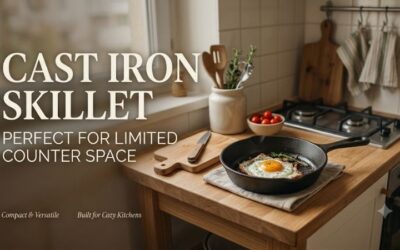
A nonstick frying pan for small spaces should make cooking simpler without monopolizing a narrow cabinet or tiny burner. Diameter alone does not tell the whole story: the handle, base, weight, and storage method matter just as much. Here is how to select one practical pan that earns its place in a compact kitchen.
Why a nonstick frying pan for small spaces needs careful sizing
Small kitchens create challenges that larger cooking spaces rarely encounter. Limited burner clearance, shallow cabinets, narrow countertops, and restricted washing areas all influence which cookware feels convenient. Choosing the right pan means evaluating its complete footprint rather than simply purchasing the smallest available diameter.
Choosing between 8-inch and 10-inch frying pans
An 8-inch frying pan appears ideal for compact kitchens because its cooking surface is small and its body is easy to maneuver. However, choosing the smallest option is not always efficient. A slightly larger 10-inch model may accommodate substantially more food while requiring only a modest increase in cabinet space.
An 8-inch pan is particularly effective for preparing one or two eggs, warming tortillas, or cooking individual servings. Its lightweight construction can also make washing easier in a small sink.
The main disadvantage is limited cooking area. Trying to prepare several ingredients simultaneously may require multiple batches, increasing cooking time and the number of utensils used.
A 10-inch pan provides more flexibility for two-person households. It can accommodate vegetables, pancakes, and modest portions of chicken while remaining manageable on a standard burner.
For someone who owns only one frying pan, a compact 10-inch model is often the better investment. An 8-inch option becomes more attractive when meals are consistently small or storage space is extremely restricted.
Before deciding, measure the actual cooking surface and overall width, including any pouring lips or projecting handles.
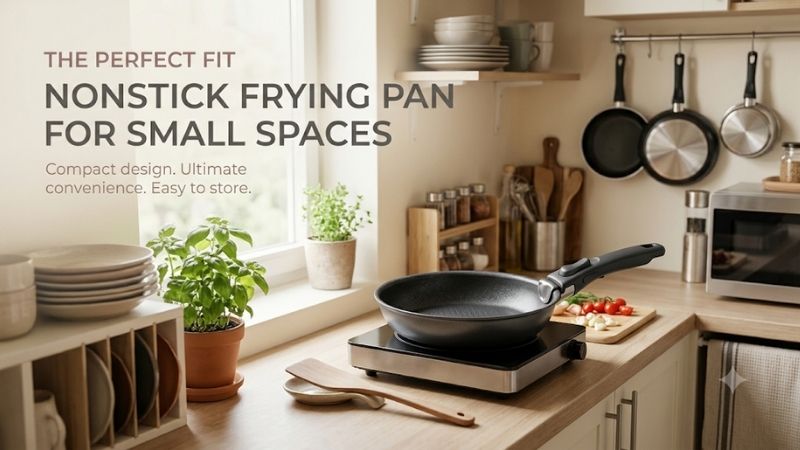
When a nonstick frying pan for small spaces is too small
A frying pan can fit perfectly in a cabinet and still be unsuitable for everyday cooking. If its surface becomes crowded during ordinary meal preparation, ingredients may steam instead of browning, food may cook unevenly, and preparing a complete meal can become unnecessarily time-consuming.
For example, placing several cold chicken pieces into a small pan rapidly lowers the surface temperature. Their released moisture accumulates, preventing effective browning until that liquid evaporates.
Vegetables present a similar problem. Mushrooms, zucchini, and leafy greens release moisture during cooking, so they need enough surface area to avoid becoming crowded.
A practical way to determine the right diameter is to consider your most frequently prepared meal. Choose a pan that accommodates the main ingredients without stacking them excessively.
If you usually prepare one egg and a piece of toast, an 8-inch skillet may be sufficient. If you regularly cook a two-person dinner, a 10-inch option is usually more versatile.
The goal is not maximum capacity. It is enough usable space to cook efficiently without sacrificing storage convenience.
How handle length affects storage and safety
The handle often creates more storage problems than the body of a frying pan. A compact skillet may still be difficult to fit inside a shallow drawer when its handle extends several inches beyond the cooking surface. Handle design also influences lifting, washing, heat exposure, and how comfortably cookware moves around nearby appliances.
A short fixed handle can reduce the overall footprint, but it must provide enough distance from the heated body for safe maneuvering.
Long handles offer leverage when lifting a pan containing food, although they may extend into walkways or obstruct adjacent burners in narrow kitchens.
Detachable handles can be helpful for some compact cookware systems. They allow pans to be stacked more efficiently, but the locking mechanism must be secure and approved for the pan’s intended cooking conditions.
A folding handle is another potential solution, provided it remains rigid while cooking and does not place vulnerable components too close to heat.
For small households, handle comfort should be tested alongside storage dimensions. A pan that fits the cabinet but feels unstable when lifted is not a successful purchase.
Essential features for compact nonstick cookware
Good small-space cookware should reduce the number of problems a home cook needs to manage. A suitable pan must match the burner, release food reliably, resist unnecessary warping, and clean without specialized equipment. The coating and base construction deserve particular attention because a compact pan may be used more frequently than other kitchen tools.
Choosing between ceramic and PTFE nonstick coatings
Ceramic and conventional PTFE coatings offer different approaches to reducing food adhesion. Both can be suitable for compact kitchens, but each requires thoughtful temperature control and gentle cleaning. The better choice depends on cooking habits, material preferences, and expectations about long-term performance.
PTFE-based nonstick surfaces are particularly useful for eggs, pancakes, and delicate fish. They generally offer reliable food release when used within appropriate temperature limits.
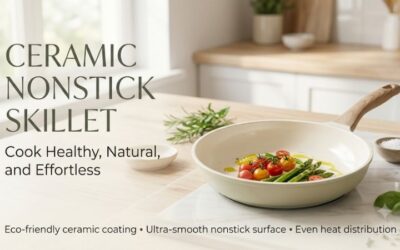
Ceramic coatings provide another option for buyers who prefer surfaces made without intentionally added PFAS. Their initial performance can be excellent, although prolonged high-temperature use and cooking residue may reduce slipperiness.
Neither coating should be treated as indestructible. Metal scraping, abrasive cleaning pads, and repeatedly overheating an empty pan can shorten its useful life.
In a small kitchen where one pan handles most meals, maintenance becomes especially important. Frequent use magnifies the consequences of poor cleaning or temperature habits.
Choose the coating you are comfortable maintaining rather than selecting a pan based only on advertising claims about durability.
Matching the pan base to your stovetop
Stovetop compatibility is especially important in apartments, studio kitchens, and other spaces where cooking equipment may be difficult to replace. Gas burners, conventional electric elements, induction cooktops, and portable cooking appliances transfer heat differently, so a pan that works well on one surface may be unsuitable for another.
Standard aluminum pans generally work with gas and conventional electric heating but may not function on induction without a compatible magnetic base.
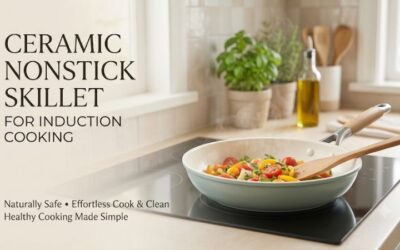
Induction-ready cookware contains suitable magnetic material that allows the cooktop to heat the pan directly.
A flat, stable base is valuable on electric glass surfaces because poor contact can contribute to uneven heating. On portable induction appliances, the base must also meet the device’s minimum and maximum diameter requirements.
Avoid buying a large frying pan for a very small heating element. Significant differences between the burner and pan diameter can lead to uneven results, particularly around the outer cooking surface.
For renters who may move between properties with different stovetops, an induction-compatible model provides greater flexibility.
Choosing materials that balance weight and durability
Weight matters more in a confined kitchen because cookware may need to be lifted around nearby objects, washed in a narrow sink, or stored above shoulder height. A heavy pan can feel reassuring on the stovetop, but unnecessary weight becomes inconvenient when it must be moved and cleaned several times every day.
Basic aluminum frying pans are generally lightweight and responsive to heat changes. They are useful when convenience and easy handling are the highest priorities.
Hard-anodized aluminum provides a more resistant exterior than untreated aluminum and is common in midrange nonstick cookware.
Stainless-clad models often feel more substantial because they contain multiple metal layers. That construction may improve certain heating characteristics but usually increases weight and cost.
A thicker pan is not automatically better. Excessive weight can make a small skillet unpleasant to use, especially for cooks with limited grip strength.
When comparing models, consider whether you can comfortably lift the empty pan with one hand and move it with food inside. A well-balanced design often matters more than the maximum advertised thickness.
How to store a nonstick frying pan for small spaces safely
Space-saving cookware is only useful when it can be stored without damaging the cooking surface or creating daily inconvenience. Scratched coatings, unstable stacks, and awkward cabinet arrangements can make a small kitchen harder to manage. A simple storage plan should protect the pan while keeping the most frequently used tools readily accessible.
Using vertical racks and wall-mounted storage
Vertical storage can free valuable cabinet space by allowing frying pans to stand on their edges instead of occupying entire shelves. Wall-mounted racks, cabinet dividers, and narrow organizers are particularly helpful when several pieces of cookware would otherwise be stacked directly against one another.
A vertical rack should support the pan without placing excessive pressure on its rim or coating.
If the pan has a hanging loop, a securely mounted hook may be useful. The hook must support the cookware’s weight and be positioned away from walking paths and potential head-height obstructions.
Wall storage works best when there is enough clearance for handles and when grease or cooking steam will not continuously soil the cookware.
Inside cabinets, adjustable dividers allow pans to be arranged by size. This makes it easier to retrieve one skillet without lifting every other piece.
The most effective storage system is not necessarily the most elaborate. A stable organizer that prevents contact between coated surfaces can solve most everyday problems.
Stacking cookware without damaging the coating
Stacking can save considerable space, but direct contact between metal cookware and a nonstick interior creates unnecessary wear. Repeated sliding or shifting may produce scratches, especially when rough pan bases, exposed rivets, or sharp edges rub against the coated cooking surface during storage.
Soft pan protectors provide an inexpensive barrier between stacked pieces.
A clean microfiber cloth or purpose-made felt separator can also reduce friction when pans are stored inside one another.
If you use nesting cookware, check that the system was designed to stack without placing damaging pressure on the interior coating. Some collections include features specifically intended to prevent contact.
Avoid storing heavy cast iron or stainless steel pans directly inside a delicate nonstick skillet unless an adequate protective layer is used.
Stacking should also remain stable. A tall, uneven pile is difficult to retrieve and may create a falling hazard when placed on high shelves.
For the smallest kitchens, a combination of vertical storage and protected stacking often works better than relying on either method alone.
Cleaning and maintaining a frequently used compact pan
A frequently used skillet can deteriorate prematurely when convenience encourages careless cleaning. Compact kitchens often have limited counter space for cooling cookware, creating a temptation to rinse a hot pan immediately. A consistent cleaning routine helps preserve the coating and reduces unnecessary replacement costs.
After cooking, allow the pan to cool before washing it with warm water, mild dish soap, and a soft sponge.
Avoid pouring cold water into a very hot pan. Sudden temperature changes may contribute to deformation, particularly in thinner cookware.
For stubborn residue, soak the cooled pan briefly rather than scrubbing aggressively.
Use silicone, wooden, or other coating-compatible utensils during cooking. Even if a manufacturer describes the surface as metal-utensil safe, gentler tools reduce unnecessary abrasion.
Store the pan only after it has dried completely, especially if moisture could remain around rivets or between stacked cookware.
Finally, inspect the cooking surface regularly. Persistent sticking, significant scratches, peeling, or a warped base may indicate that replacement is appropriate.
Conclusion
The ideal nonstick frying pan for small spaces balances cooking capacity, easy handling, and efficient storage. An 8-inch model works well for individual meals, while a compact 10-inch pan offers greater flexibility for most one- or two-person households. Choose a coating that matches your cooking habits, confirm stovetop compatibility, and pay attention to total dimensions rather than diameter alone. With appropriate storage and maintenance, a carefully selected skillet can handle everyday cooking without overwhelming a small kitchen.


Write Your Review
No reviews yet. Be the first to share your experience!