
A deep saute pan for entertaining can turn several separate cooking steps into one controlled workflow, but capacity is not the same as usable browning area. When feeding a crowd, you need the right width, sturdy handles, a reliable lid, and enough room for sauce. This guide shows how to choose, cook, and serve confidently.
What a deep saute pan for entertaining must do well
Cooking for guests creates different demands from preparing a routine weeknight dinner. Ingredients are often larger in quantity, meal timing becomes more important, and cookware may need to move from the stovetop to the oven or serving area. A suitable sauté pan should provide generous capacity without sacrificing control, safety, or flavor development.
Choosing enough capacity for the number of guests
A sauté pan used for entertaining needs enough volume to hold ingredients comfortably while leaving room for stirring and simmering. Choosing the correct capacity helps prevent spills, limits unnecessary batch transfers, and makes it easier to coordinate the main dish with side dishes that may be cooking simultaneously.
A 3-quart sauté pan can work well for smaller gatherings, especially when the main dish consists of protein served with separate vegetables or sides.
For four to six guests, a 4- to 5-quart model may offer greater flexibility. It can accommodate larger quantities of sauce, vegetables, and braised ingredients without filling the pan to the rim.
When preparing food for eight or more people, a 5- to 6-quart pan becomes attractive, although the exact requirement depends heavily on the recipe.
Capacity should never be treated as a guaranteed serving count. A 5-quart pan might hold a generous quantity of stew, but it cannot necessarily brown eight large chicken pieces simultaneously.
Leave adequate headroom when recipes contain substantial liquid. Boiling, stirring, and ingredient displacement can cause spills if the cookware is filled too close to its maximum volume.
For entertaining, a moderately oversized pan is often preferable to one operating at its practical limit.
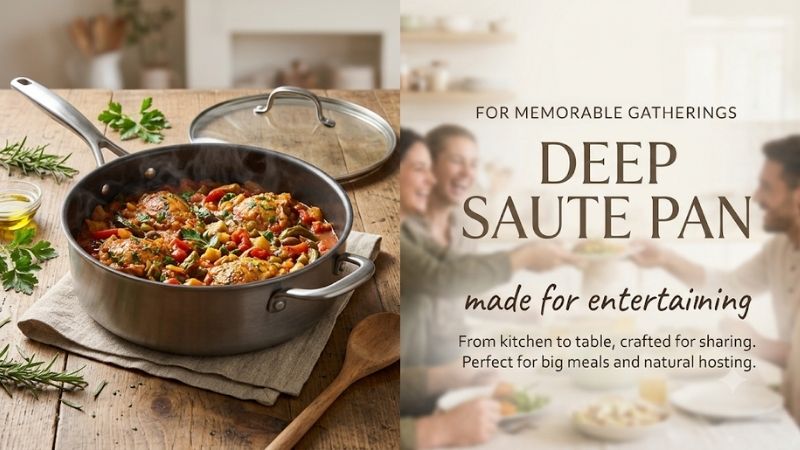
Why a wide cooking surface matters more than depth alone
Depth helps contain food and liquids, but the width of the cooking surface largely determines how efficiently ingredients can be browned. A tall, narrow pan may have impressive capacity while offering insufficient space for searing several portions of meat, reducing vegetables, or developing the caramelized flavors expected in many entertaining dishes.
Browning requires moisture to evaporate efficiently. When too many ingredients occupy a small surface, released water accumulates and lowers the cooking temperature.
A wide base allows more food to contact the heated metal directly. This improves the conditions for developing a browned exterior before additional ingredients or liquids are introduced.
For example, preparing chicken thighs for six guests in a narrow pan may require several batches. A wider pan reduces the number of batches, although crowding should still be avoided.
Base diameter must also match the stovetop. A pan that extends far beyond the heating area may cook unevenly around its perimeter.
When comparing products, look for measurements of the flat cooking surface rather than relying only on the overall rim diameter.
An effective entertaining pan balances sufficient depth for sauces with enough width for practical browning.
Selecting handles that support heavy meals safely
A large sauté pan can become surprisingly heavy once filled with meat, vegetables, and cooking liquid. Safe handling is therefore a major purchasing consideration. A secure main handle, sturdy helper handle, and comfortable gripping surfaces make it easier to transfer cookware without sudden tilting or accidental contact with hot contents.
Long handles provide leverage and allow the pan to be positioned over a burner without touching the heated body.
However, long handles alone may not provide adequate control when lifting several quarts of food.
A helper handle on the opposite side distributes the load between two hands. This becomes especially useful when removing a pan from the oven or carrying it toward the serving area.
Check how the handles are attached. Riveted or otherwise securely engineered connections should feel rigid and free from movement.
Metal handles often become hot during oven cooking, and even designs described as stay-cool can heat up during extended stovetop use. Oven mitts or dry heat-resistant towels should always be available.
For families who entertain regularly, handle design is not merely a comfort feature. It directly affects safe and confident movement.
Matching pan materials to your entertaining menu
The right cookware material depends on whether your guests will be served seared proteins, delicate vegetables, creamy sauces, or slow-simmered dishes. Material affects browning, heat response, cleaning requirements, and compatibility with kitchen equipment. A pan should support the cooking method rather than force the recipe to adapt to its limitations.
When stainless steel is the better choice for entertaining
Stainless steel sauté pans are especially useful for entertaining menus that depend on strong browning, flavorful sauces, and repeated cooking stages. Their uncoated surfaces tolerate techniques such as deglazing and scraping, making them versatile when preparing meat, vegetables, and sauces in one vessel.
Consider a dinner featuring chicken thighs with mushroom cream sauce.
The chicken can first be browned in the pan, creating flavorful residues on the cooking surface. After removing the chicken, mushrooms and aromatics can be sautéed in the same vessel.
Stock can then be added to loosen the browned residues and incorporate their flavor into the finished sauce.
A fully clad stainless steel pan is particularly useful when even heat distribution across the cooking surface is important.
Stainless steel also avoids the coating limitations associated with nonstick cookware. Appropriate metal utensils can be used for stirring and deglazing without damaging a delicate interior finish.
The trade-off is technique. Food may stick if the pan is not preheated appropriately, and the surface generally requires more cleaning effort than nonstick alternatives.
For hosts who enjoy complex, flavor-driven recipes, stainless steel is often the stronger choice.
When nonstick cookware makes hosting easier
Nonstick sauté pans can simplify entertaining when the menu includes delicate ingredients or recipes that do not require aggressive browning. Their easy-release surfaces reduce the amount of food left behind, making them particularly convenient for fish, vegetables, and dishes prepared over gentle or moderate heat.
A nonstick pan is useful for cooking delicate fish fillets that might tear when moved.
It can also make preparation easier when a recipe includes ingredients that are prone to sticking, such as certain cheese-based mixtures or lightly coated vegetables.
Ceramic and conventional PTFE nonstick pans both offer these advantages, but their coatings have different care requirements.
Avoid selecting a nonstick model solely because it advertises high-temperature oven compatibility. The coating’s long-term performance still benefits from controlled heating.
Nonstick cookware is also less suitable for recipes requiring aggressive scraping, prolonged empty preheating, or extremely high-temperature searing.
For entertaining menus centered on gentle cooking and easy cleanup, a nonstick sauté pan can be practical. For dishes involving deeply browned meat and pan sauces, stainless steel usually offers greater flexibility.
How lids and oven compatibility expand menu options
A fitted lid and appropriate oven compatibility allow a sauté pan to handle more than one cooking method. This is valuable when entertaining because ingredients can be started on the stovetop, covered for simmering, or transferred to the oven while attention shifts to appetizers, side dishes, and serving preparations.
A lid is useful for maintaining moisture during braising. After browning meat, the cook can add liquid, cover the pan, and reduce the heat for gradual cooking.
It also helps control evaporation. A tightly covered dish retains more moisture, while an uncovered pan encourages sauce reduction.
Oven compatibility creates additional flexibility. A dish can begin with stovetop browning and finish in the oven, freeing the burners for other preparations.
However, the temperature rating of the pan body may differ from that of its lid, handle, or other components.
Glass lids frequently have different limitations from stainless steel lids. Buyers should verify the specifications of each component rather than relying on a single advertised temperature.
For frequent entertaining, a pan with a secure lid and suitable oven capability can replace several separate cooking vessels during meal preparation.
Planning meals with a deep saute pan for entertaining
The cookware itself is only one part of successful entertaining. Batch size, cooking order, holding temperature, and serving arrangements can have a greater effect on the final meal than premium materials. Planning how the pan will be used helps prevent overcrowding, overcooking, and last-minute pressure when guests are ready to eat.
Preparing ingredients in batches without losing flavor
Cooking in batches is often necessary even with a large sauté pan. The goal is to preserve enough cooking surface for proper browning while keeping the preparation process organized. A reliable sequence allows each portion to develop flavor before everything is combined for the final simmer or sauce-making stage.
Begin by preparing ingredients before turning on the stove. Trim meat, cut vegetables, measure seasonings, and organize liquids so that cooking can proceed without interruptions.
Preheat the pan appropriately for its material, then add a manageable quantity of food.
Allow proteins to develop their initial crust before attempting to move them. Turning too early can reduce browning and cause sticking, especially in stainless steel cookware.
Once the first batch is browned, transfer it to a suitable holding dish and repeat the process.
After completing the batches, use the remaining cooking residues as the foundation for a sauce when the recipe calls for one.
Return the ingredients to the pan for the final cooking stage, ensuring that the combined quantity still fits safely.
Batch cooking may seem less convenient than filling the pan immediately, but it often produces noticeably better texture and flavor.
Coordinating cooking times when serving multiple dishes
Entertaining becomes difficult when every dish requires attention at the same moment. A deep sauté pan can help simplify scheduling because it supports advance preparation, covered simmering, and final reheating. However, ingredients with different cooking requirements should not automatically be combined at the beginning.
Start by identifying the dish that requires the longest cooking time. Slow-simmered sauces and braised proteins can often be prepared before quick vegetables or garnishes.
Choose recipes that tolerate resting or controlled reheating. A tomato-based chicken dish, for example, is often easier to coordinate than delicate fish that should be served immediately.
Use the lid to manage moisture during holding, but do not assume that a covered pan can maintain safe temperatures indefinitely without an appropriate heat source.
For food safety, hot dishes intended for holding should generally remain at 135°F or above. Refrigerate perishable leftovers promptly rather than leaving them at room temperature for extended periods.
When several dishes are involved, the sauté pan should ideally handle the main course while simpler sides use other appliances.
This approach reduces simultaneous stovetop activity and makes serving more predictable.
Serving directly from the pan and managing cleanup
A well-designed sauté pan can double as a serving vessel for casual gatherings, reducing the need to transfer hot food into another dish. However, serving directly from cookware requires attention to heat protection, presentation, utensil compatibility, and the stability of the surface beneath the pan.
Choose a heat-resistant trivet that can safely support the full weight of the cookware and food.
Avoid placing a hot pan directly on a wooden table, delicate countertop, or decorative surface that might be damaged by heat.
For a casual family gathering, serving a one-pan pasta or braised dish directly from the sauté pan can feel practical and inviting.
For more formal meals, a separate serving dish may provide better presentation and easier access for guests.
Use utensils appropriate for the cooking surface. Silicone or wooden serving tools are generally preferable for coated pans.
After the meal, allow the cookware to cool before washing. Stainless steel may require soaking to loosen browned residues, while nonstick surfaces should be cleaned with soft materials.
Plan storage space before purchasing oversized cookware. A large pan that performs well during gatherings can become inconvenient if it cannot fit inside available cabinets.
Conclusion
Choosing a deep saute pan for entertaining means balancing usable browning area, cooking capacity, material, and safe handling. A 4- to 5-quart model is often a versatile choice for small gatherings, while larger households may benefit from additional capacity. Stainless steel is ideal for searing and developing rich sauces, whereas nonstick cookware offers convenience for delicate foods. Prioritize a broad base, secure helper handle, fitted lid, and cooking techniques that allow food to be prepared in manageable batches.

Write Your Review
No reviews yet. Be the first to share your experience!