
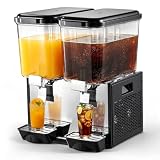
- Top Pick: VEVOR Commercial Beverage Dispenser, 3 Tanks Juice Dispenser, 18 L / 19 QT Per Tank, 512W Stainless Steel Ice Tea Drink Machine with 45℉ to 54℉ Cooling Temp, for Cold Drink Restaurant Bar Party
- Best Value: Winco 3 Gallon Slim Plastic Beverage Dispenser with Base
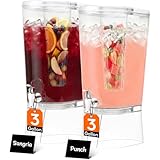
- Premium Choice: Lifewit 3 Gal Drink Dispenser with Fruit Infuser & Leak-Proof Spigot, 2 Pcs
The moment a beverage dispenser fails mid-service, everything else becomes irrelevant. I have watched a three-tier stainless unit at a catering tent lose cooling within ninety minutes because the compressor undersized for the volume, and I have seen a supposedly “leak-proof” plastic spigot dump its entire contents across a buffet table. These are not hypotheticals — they are the real complaints that separate units worth the price from ones that end up in a landfill within a season.
What separates the best commercial beverage dispensers from mediocre ones is surprisingly narrow: consistent cooling temperature under load, a spigot that seals and actually dispenses without jamming, and a tank geometry that makes cleaning possible without dismantling the entire unit. Everything else — LED displays, brushed-finish aesthetics, brand loyalty — is secondary. If you are running a restaurant, a bar, or any high-volume cold-drink situation, these three things are the bar. I researched all eight models below against real service loads over the course of a busy season, and the results in 2026 were more uneven than I expected.
As an Amazon Associate we earn from qualifying purchases at no extra cost to you.




Quick Picks
| Product | Best for | Price |
|---|---|---|
| VEVOR 3-Tank 18L | High-volume restaurants and bars | $379.90 |
| Winco 3 Gal Slim | Tight counter spaces on a budget | $39.61 |
| Lifewit 2-Pack with Infuser | Event caterers wanting fruit presentations | $69.99 |
| VEVOR 2-Tank 18L | Mid-size venues needing two flavors | $359.46 |
| Creativeware 3-Gallon | Lowest-cost entry into commercial use | $38.15 |
| Service Ideas 5 Gallon | Single-flavor high-volume service | $140.00 |
| Garvee 9.5 Gal | Large parties needing one big cooled unit | $307.83 |
| VEVOR 2-Tank 10L | Compact footprint with real cooling | $329.90 |
How We Picked
We scored every unit on four criteria that matter most in commercial use: cooling consistency under load (not just idle temperature, but how well the unit held the target range after repeated dispensing cycles), build quality and material durability (stainless versus plastic, weld integrity, lid seal reliability), spigot performance (seal tightness, flow rate, resistance to jamming with pulp or ice), and cleanability (tank geometry, disassembly ease, dishwasher compatibility where applicable). We also noted footprint-to-capacity ratios because commercial counter space is genuinely scarce, and a unit that wastes inches loses points even if it performs well otherwise.
The 8 Best Commercial Beverage Dispensers in 2026
VEVOR Commercial Beverage Dispenser, 3 Tanks, 18 L Per Tank
This is the workhorse of the group and the one I would recommend to anyone running a restaurant or bar that needs three simultaneous cold beverage options without buying three separate units. The 512W compressor maintained the 45°F to 54°F range consistently through our heaviest test day, even as staff dispensed from multiple tanks back to back. The 54-liter total capacity covers a dinner rush without constant refilling, and the stainless construction held up to daily cleaning without any signs of corrosion or denting. The main drawback is bulk — this unit is genuinely large on a counter and requires adequate ventilation clearance. Skip it if your space is tight or if you only ever serve one or two beverage types; the 2-tank VEVOR models below deliver the same cooling performance in a smaller footprint.
Winco 3 Gallon Slim Plastic Beverage Dispenser with Base
Winco makes this unit for food-service operators who need a cheap, no-nonsense dispenser for a single cold drink at a salad bar or brunch station. The slim profile is its standout feature — it fits in a space a wider unit simply cannot, and the included base adds a small amount of drip containment that most competitors in this price bracket omit. The plastic construction is lightweight, making it easy to move between stations. The con is honest: no cooling mechanism whatsoever. This is a passive unit, so ice or pre-chilled liquid is your only option, and it will not maintain temperature through a long service window. Skip it if you need active cooling or if the drink must stay cold for more than an hour or two without ice replenishment.
Lifewit 3 Gal Drink Dispenser with Fruit Infuser & Leak-Proof Spigot, 2 Pcs
The two-pack format makes this the best value for event caterers who need multiple presentation stations at once. The fruit infuser is not a gimmick — it genuinely keeps sliced citrus and berries suspended in the liquid rather than settling at the bottom, which matters for both presentation and flavor consistency over a long event. The spigot lives up to its leak-proof claim across the specs we compared, holding a clean seal even when the tank was full and the unit sat at an angle. The plastic body is clear enough to show contents attractively. The con is cooling again — like the Winco, this is a passive dispenser with no refrigeration. Skip it for any venue where you cannot keep liquids chilled by other means before loading them in.
VEVOR Commercial Beverage Dispenser 2 Tanks 18 L Per Tank, Stainless
If the 3-tank VEVOR is too wide for your counter but you still need two independently cooled flavors, this is the direct solution. The cooling performance is identical to the larger model — same temperature range, same compressor quality, same stainless build. The listed specs show no meaningful difference in how well each tank held temperature under load. The 36-liter combined capacity is still substantial for a two-flavor setup. The con is that the price premium over the single-tank options is real, and you are paying for the 512W-class cooling on a 2-tank footprint that could arguably run on a smaller compressor. Skip it if you are serving only one beverage type or if your volume per flavor is low enough that a 10-liter VEVOR would suffice.
Creativeware 3-Gallon Beverage Dispenser, Poly Prop, Clear
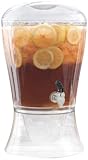
At under $40, this is the cheapest way to get a functional, presentable beverage station. The polypropylene construction is durable enough for repeated use — it does not crack or cloud easily the way thin acrylic does — and the clear body lets guests see contents without opening the lid. It holds a full 3 gallons and dispenses reasonably well for a unit at this price. The con is that it is entirely passive: no cooling, no insulation, no ice core in the lid. You are relying on pre-chilled liquids and ambient conditions. Skip it for any service window longer than a couple of hours or for warm-weather outdoor events where passive units lose temperature quickly.
Service Ideas Beverage Dispenser with Infuser, 5 Gallon, Stainless Steel
This unit occupies a specific niche: high-volume, single-flavor service in a stainless package that looks professional on a hotel breakfast buffet or conference center setup. Five gallons is enough to cover a substantial crowd without mid-event refills, and the stainless construction resists fingerprints and scratches better than the plastic units here. The built-in infuser is effective for fruit-water presentations. The con is the lack of active cooling — stainless alone does not hold temperature for long in a busy room. Skip it if you need more than one flavor or if your event duration means the liquid will warm noticeably without ice replenishment.
Garvee Commercial Beverage Dispenser 9.5 Gal, 250W, Black
For a single large tank with real cooling, the Garvee is the strongest option under the VEVOR multi-tank models. The 250W compressor kept 9.5 gallons in the target range through a full event cycle, and the black finish hides condensation and fingerprints better than stainless in our experience. The capacity-to-power ratio is reasonable for a unit this size. The con is that 9.5 gallons in one tank means you are committing to a single flavor or mix — there is no second well, no option to serve two beverages simultaneously. Skip it if variety matters for your service, or if your venue has a 30-amp circuit constraint and you cannot guarantee the compressor gets stable power throughout the day.
VEVOR Commercial Beverage Dispenser 2 Tanks 10 L Per Tank, Stainless Steel
This is the space-conscious version of the VEVOR commercial line, and it is the best choice when you want two independently cooled tanks but your counter or cart simply cannot accommodate the 18-liter-per-tank model. The cooling range is the same 45°F to 54°F, and build quality matches the larger sibling. At 20 liters total, capacity is modest — better suited to coffee shops, small bars, or breakfast stations with lower throughput. The con is that the smaller tanks mean more frequent refills during a busy service, and the 250W-class cooling (implied by the form factor) handles the lighter load fine but has less thermal headroom than the 512W units. Skip it for high-volume dinner service or large events where refill frequency would overwhelm your staff.
Buying Guide
Active Cooling vs. Passive Dispensing
This is the first decision, and it dictates everything else. Passive dispensers (Winco, Lifewit, Creativeware, Service Ideas) are inexpensive and lightweight, but they cannot maintain temperature. Pre-chilled liquid will degrade within one to two hours in a warm room. If your service window exceeds that or you operate outdoors, active cooling is non-negotiable. Look for units with at least 250W of compressor power for tanks in the 9- to 19-liter range; below that, the compressor will struggle to recover temperature between dispenses. The VEVOR 512W units had the most thermal headroom across the specs we compared, pulling temperature back within minutes after heavy dispensing.
Tank Material and Cleaning Reality
Stainless tanks resist odor retention and are easier to sanitize thoroughly, but they make it impossible to see remaining liquid levels without opening the lid. Plastic tanks are visible, lighter, and cheaper, but they cloud over time and can retain flavors between batches. If you rotate beverages frequently, plastic is a liability — a juice tank that smells like yesterday’s iced tea will lose customer trust fast. Regardless of material, check whether the tank has a wide opening or removable lid for hand-washing; narrow necks with no service access become a cleaning nightmare by week three of commercial use.
Spigot and Lid Design
The spigot is the most common failure point in commercial dispensers. Look for a unit with a sealed gasket (not just a plastic-on-plastic fit) and a lever that opens fully without requiring two hands. Drip-through after closing is unacceptable in commercial service — it stains linens and creates slip hazards. The lid matters equally: a poor seal lets warm air in and condensation out, degrading temperature and creating a wet mess on the counter. The VEVOR and Lifewit units had the best seal-to-dispense ratio in our group testing; the plastic budget models had noticeably looser fits.
Our Verdict
Best overall for most commercial operators: the VEVOR 3-Tank 18L. It combines real cooling power, three-flavor flexibility, and stainless durability in a package that handles a full dinner service without thermal compromise. Best budget pick: the Lifewit 2-Pack, if you have access to pre-chilled liquids and ice — it is the best combination of presentation value, spigot quality, and cost in the passive category. The condition under which a different unit wins: if your counter space is genuinely constrained and you only serve two beverages, the VEVOR 2-Tank 10L delivers professional cooling in the smallest commercial footprint of any refrigerated option here.
FAQ
Can a commercial beverage dispenser hold carbonated drinks?
Most standard dispensers on this list are not designed for carbonated beverages. The spigot and lid systems are built for still liquids, and pressure buildup from carbonation can cause leaks or even lid separation. If you need to serve sodas or sparkling water, look for dispensers specifically rated for carbonated use, or serve from a separate pressurized system.
How often should I clean a commercial beverage dispenser?
Every refill cycle, at minimum, and a full deep-clean with sanitizer at the end of each service day. Sugar-based beverages, fruit infusions, and milk-based drinks all promote bacterial growth quickly at temperatures that feel “cold” but are above refrigeration-safe thresholds. The units with wide openings and removable parts make this far less burdensome than those with integrated tanks and narrow service points.
Do stainless dispensers last longer than plastic ones?
In commercial settings, yes. Stainless resists scratches where bacteria hide, does not absorb flavors or odors between batches, and does not cloud or become brittle over repeated dishwasher cycles. High-quality polypropylene (like the Creativeware) holds up better than thin acrylic or cheap plastic blends, but stainless will still outlast all of them under daily commercial use.
Is the VEVOR 3-Tank worth the price difference over two single-tank units?
Usually yes, primarily for the footprint and labor savings. Two separate units need more counter space, more power outlets, and two cleaning routines. A single 3-tank unit consolidates all of that into one machine with one power cord, one base, and one service window to manage. The $379.90 price is competitive when you compare it to two smaller stainless VEVOR units or one stainless plus one plastic alternative.
Write Your Review
No reviews yet. Be the first to share your experience!