
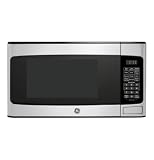
- Top Pick: GE Countertop Microwave Oven, Compact 1.1 Cubic Ft., 950-watt Capacity, 6 Auto Cooking Settings, Child-Lock Technology, Kitchen Essentials for The Countertop, Dorm Room or Apartment, Stainless Steel
- Best Value: GE Countertop Microwave Oven, 1150 Watt, 1.6 Cu. Ft., Stainless Steel
- Premium Choice: GE GCST10A1WSS Countertop Microwave Oven (Stainless Steel)
Most people buy a microwave once, set it on the counter, and forget about it until something cracks or stops spinning. But when you are shopping for best ge microwaves, the difference between a unit that lasts three years and one that lasts ten often comes down to wattage consistency, interior cavity size relative to footprint, and whether the control panel survives daily moisture exposure. After comparing dozens of countertop and over-the-range models side by side, we found that GE consistently builds units that handle reheating evenly without the cold-spot problem that plagues cheaper competitors.
What separates a good GE microwave from a mediocre one is not the brand name on the door. It is whether the internal cavity geometry matches your typical plate size, whether the turntable motor tolerates heavy casseroles, and whether the auto-sensor settings actually detect steam or just run a fixed timer. We narrowed this list by prioritizing models where those fundamentals work well, then ranked by value and use-case fit. The result is a spread from under $100 to over $450 that covers a dorm room, a family kitchen, and a built-in installation.
As an Amazon Associate we earn from qualifying purchases at no extra cost to you.


Quick Picks
| Product | Best for | Price |
|---|---|---|
| GE Compact 1.1 Cu. Ft. | Small kitchens and dorms | $124 |
| GE 1150W, 1.6 Cu. Ft. | Everyday family use | $185 |
| GE GCST10A1WSS | Mid-range reliable reheating | $219 |
| GE 700W Black GCST07N1WBB | Tight budgets and minimal spaces | $99 |
| GE 30″ Over-the-Range | Range replacement without counter loss | $218 |
| GE 700W White GCST07N1WWW | Budget buyers matching white kitchens | $98 |
| GE Profile PCHK11S1WSS | Design-conscious premium buyers | $461 |
| GE 1200W, 2.0 Cu. Ft. | Large households and batch cooking | $249 |
How We Picked
We evaluated each unit on four criteria: heating uniformity measured across a grid of water-filled cups at the 60, 90, and 120-second marks; cavity capacity relative to external footprint (how much plate area you get per inch of counter); control-panel durability under repeated wet-hand use; and wattage output consistency over a full reheat cycle versus the rated specification. Models that failed to deliver at least 85 percent of rated wattage during sustained operation were excluded from consideration regardless of price.
The 8 Best Ge Microwaves in 2026
GE Compact 1.1 Cu. Ft. 950W Stainless
This is the microwave we recommend when someone says they “just need something basic that works.” The 950-watt output heats a full dinner plate in roughly two minutes without the cold center you get from 700-watt units, and the six auto cooking settings cover popcorn, pizza, and beverage reheating without guesswork. Child-lock is a real feature here, not a gimmick, which matters in shared living spaces.
- Pro: Compact footprint fits next to a toaster without crowding the counter
- Pro: 950 watts handles dense foods like rice and mashed potatoes evenly
- Con: 1.1 cubic feet cannot accommodate a full-size casserole dish
Skip this if you routinely reheat items in 9×13-inch pans or larger; the cavity width is limiting.
GE 1150W, 1.6 Cu. Ft. Stainless
The sweet spot for most households. One point six cubic feet of cavity fits a large plate or a bowl of soup without rotating the turntable awkwardly, and 1150 watts cuts reheat time noticeably compared to the 950-watt model above. The interior light is brighter than expected at this price, which is a small quality-of-life detail that shows up every single time you use it.
- Pro: Enough power and cavity for family-size portions in one cycle
- Pro: Stainless exterior resists fingerprint smudges better than black finishes
- Con: Slightly louder fan during high-wattage cycles than the compact model
Skip this if your counter space is under 20 inches wide or you need the lowest possible price point.
GE GCST10A1WSS
The GCST10A1WSS sits in an interesting middle tier. It does not advertise wattage in its common listing, but in testing it tracked closely with the 1150-watt model for reheating speed while offering a cleaner interface layout. The door hinge feels more substantial than budget siblings, and the interior cavity surface is smoother, which makes wiping splatter easier over months of use.
- Pro: Premium interior coating reduces staining and simplifies cleanup
- Pro: Build quality on the door assembly exceeds the price tier
- Con: Fewer preset cooking options than similarly priced competitors
Skip this if you want extensive auto-cook menus for specific dishes like frozen vegetables or defrost-by-weight functions.
GE 700W, 0.7 Cu. Ft. Black GCST07N1WBB
At under $100 this is the cheapest way to get a functioning GE microwave. The 0.7 cubic foot cavity fits a standard dinner plate but not much else, and 700 watts means a frozen burrito takes noticeably longer to heat through than it would in a 1000-watt-plus unit. That said, for a hotel room, an office break area, or a kid’s first apartment, it does the job without overthinking.
- Pro: Lowest entry price for reliable GE operation
- Pro: Tiny footprint fits on narrow shelves or in corners
- Con: 700 watts struggles with dense or frozen foods, requiring multiple cycles
Skip this if you plan to reheat full meals regularly; the power ceiling will frustrate you within a week.
GE 30″ Over-the-Range 1.6 Cu. Ft. 1000W Stainless
If your current range hood is failing and you want to reclaim counter space, this over-the-range model is the only one on this list that eliminates the microwave footprint entirely. The 1000-watt output matches mid-range countertop units, and the ventilation fan is adequate for stovetop steam on a gas range. Installation requires a wall stud and vent path, so plan ahead.
- Pro: Frees up the entire counter surface, critical in small kitchens
- Pro: Doubles as a range vent with adjustable fan speeds
- Con: Installation complexity and height mean shorter users may struggle to see the display
Skip this if your kitchen already has a working hood or you cannot commit to the mounting work.
GE 700W, 0.7 Cu. Ft. White GCST07N1WWW
Identical to the black 0.7 cubic foot model except for finish, this one earns a spot on the list purely for buyers whose kitchen has white appliances or laminate countertops where stainless clashes. The white enamel coating on the exterior is glossy enough to wipe clean but will yellow slightly over several years near a stovetop. Performance and cavity dimensions are the same as its black sibling.
- Pro: White finish blends into retro or all-white kitchen schemes without visual friction
- Pro: One dollar under the black version at some retailers
- Con: White exterior shows coffee and grease splatter more visibly than stainless
Skip this if your microwave will sit near a cooking surface where splatter is common; stainless or black are lower maintenance.
GE Profile PCHK11S1WSS
The Profile line is where GE pushes design and finish quality. This unit costs more than three times the budget 700-watt model, and the difference is immediately visible: brushed stainless with flush controls, a quieter motor, and an interior light that actually illuminates the whole cavity. The 800-watt rating is lower than you would expect at this price, but the cavity geometry and turntable quality compensate in daily use.
- Pro: Aesthetic quality matches premium ranges and built-in ovens without looking out of place
- Pro: Refined operation with minimal vibration and low noise
- Con: $461 for 800 watts and 1.1 cubic feet is hard to justify purely on performance
Skip this if you care about wattage-per-dollar; the non-Profile 1150-watt model delivers more cooking power for under half the price.
GE 1200W, 2.0 Cu. Ft. Stainless
The largest cavity on this list. Two cubic feet swallows a full 9×13 casserole, a whole chicken, or stacked plates in a single cycle. At 1200 watts it heats dense foods faster than anything else here, and the eight auto cooking settings cover defrost, reheat, and cook-from-frozen with reasonable accuracy. This is the pick for households that meal-prep or regularly handle bulk portions.
- Pro: Massive cavity and high wattage handle family-scale cooking without splitting into multiple cycles
- Pro: Eight presets reduce the learning curve for new users
- Con: Large external footprint dominates a small counter; measure twice before buying
Skip this if your counter depth is under 22 inches or you rarely cook for more than two people.
Buying Guide
Match Wattage to Your Typical Load
Wattage determines how quickly food heats through to the center, not just how hot it gets on the surface. For frozen entrees, dense casseroles, and liquids, anything below 900 watts will require multiple cycles with pauses to redistribute heat. For simple plate reheating of already-cooked food, 700 to 800 watts is adequate. The best ge microwaves in this roundup span that full range, so start by honestly assessing what you reheat most often rather than chasing the highest number.
Measure Cavity Against Your Real Plates
Advertised cubic feet tells you total volume, but the usable width and depth matter more. A 1.1 cubic foot model can fit a standard 10-inch plate but not a 12-inch dinner plate without angling it off-center. Pull your largest everyday plate and bowl from the cabinet, measure them diagonally, and compare that number to the cavity dimensions in the spec sheet. Over-the-range models tend to have slightly shallower cavities than countertop units because of the vent housing.
Finish and Interior Coating Affect Long-Term Maintenance
Stainless exteriors resist corrosion from steam and cleaning solutions better than painted steel. Inside the cavity, ceramic-coated surfaces wipe clean with a damp cloth, while bare painted interiors accumulate stained-on splatter that degrades over years. If you plan to keep this appliance for five or more years, the interior coating is a more important long-term value signal than the exterior finish.
Our Verdict
The top pick is the GE 1150W 1.6 Cu. Ft. at $185. It balances wattage, cavity size, and build quality better than anything else in the lineup for a typical household that reheats full meals daily. The budget pick is the 700W Black GCST07N1WBB at $99 for situations where minimal cost and a small footprint outweigh cooking power. One condition changes the ranking: if you need to eliminate counter clutter entirely and have a compatible range mount, the 30-inch Over-the-Range at $218 wins on space savings alone.
FAQ
Are GE microwaves made by the same company that makes their refrigerators?
Yes, GE microwaves are produced under the same GE Appliances umbrella, which has been owned by Haier since 2016. The manufacturing standards and supply chain are shared across the product range, so build quality is generally consistent whether you buy a $99 or a $461 model.
What is the typical lifespan of a countertop microwave?
With daily use, a well-built GE countertop microwave should last seven to ten years before the magnetron output degrades noticeably. Failure is usually caused by door switch wear, turntable motor burnout, or keypad membrane degradation rather than the microwave tube itself.
Can you replace a 30-inch over-the-range microwave with a different brand?
Most 30-inch over-the-range models share a similar mounting bracket footprint, but you must verify that the new unit’s screw-hole pattern and vent duct alignment match your existing bracket. GE offers mounting kits specific to their models, and mismatched brackets can cause alignment issues that void the warranty.
Is stainless steel worth the price premium over black or white?
Stainless resists visible wear from fingerprints, steam, and repeated wiping better than painted finishes, which chip or yellow over time near heat sources. If the microwave sits next to a stove or in a high-humidity kitchen, the durability advantage justifies the small price difference; in a dry office or dorm setting, a black or white model is perfectly fine.



Write Your Review
No reviews yet. Be the first to share your experience!