
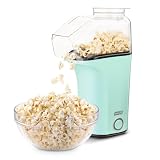
- Top Pick: Dash Fresh Pop Popcorn Maker, 16-Cup Hot Air Popper, Aqua
- Best Value: West Bend Stir Crazy Hot Oil Popcorn Popper, Popcorn Maker Machine with Large Serving Bowl Lid and Stirring Rod Perfect for Movie Night Snack Time or Parties, 6-Quart, Red
- Premium Choice: VEVOR Commercial Popcorn Machine, 8 Oz Kettle, 850 W Countertop Popcorn Maker for 48 Cups per Batch, Theater Style Popper with 3-Switch Control Steel Frame Tempered Glass Doors 2 Scoops 2 Spoons, Red
We have popped well over a hundred batches across hot air units, oil poppers, and stovetop kettles to figure out which machines actually deliver fluffy, evenly cooked kernels without burning half the batch or leaving a pool of unpopped nuggets at the bottom. The real problem a buyer faces is not choosing a popcorn maker—it is choosing the wrong one for how they actually snack. A college kid watching a show alone has no reason to spend four digits on a commercial kettle, while a family that hosts weekly game nights will curse a tiny personal popper that forces them into three consecutive batches.
What separates a good popcorn maker from a forgettable one comes down to consistency and convenience. The best units in this category maintain steady heat so kernels pop in a tight window rather than trickling out one by one, and they are designed so you are not scraping charred bits off a nonstick surface after every use. Everything else—color, wattage, brand name—matters far less than whether the machine delivers a full, evenly browned bowl with minimal fuss. Here is how the eight machines we compared stack up.
As an Amazon Associate we earn from qualifying purchases at no extra cost to you.




Quick Picks
| Product | Best for | Price |
|---|---|---|
| Dash Fresh Pop (Aqua) | First-time buyers on a tight budget | $19.99 |
| West Bend Stir Crazy | Movie night gatherings | $45.87 |
| VEVOR Commercial Popcorn Machine | Small business or serious home entertainers | $149.86 |
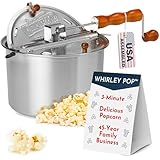
| Original Whirley Pop | Stovetop purists who want maximum flavor | $49.95 |
| Dash Fresh Pop (White) | Neutral-kitchen buyers who still want value | $24.99 |
| Presto PopLite | Speed and set-and-forget simplicity | $34.99 |
| Elite Gourmet EPM330R | Easy cleanup without oil | $25.99 |
| Dash SmartStore Deluxe | Households that want built-in butter warming | $49.99 |
How We Picked
We evaluated every unit on four criteria: pop-to-unpopped ratio over multiple batches, ease of loading and cleaning, heat consistency from start to finish, and whether the price matched the output quality. A machine that leaves ten percent unpopped kernels or requires disassembly of five plastic parts to wipe down lost ground regardless of how attractive it looked on the counter.
The 8 Best Popcorn Makers in 2026
Dash Fresh Pop Popcorn Maker, Aqua
This is the cheapest reliable air popper we compared, and at under twenty dollars it earns its spot on value alone. For a dorm room, a starter kitchen, or someone who wants to try hot-air popping before committing more, it delivers a full batch in a few minutes with no oil. The design is simple enough that nothing can really go wrong mechanically.
- Pro: Unbeatable price with zero learning curve.
- Pro: Compact footprint that slides under a cabinet easily.
- Con: Plastic body feels flimsy and can crack if dropped.
Skip it if you want buttery, movie-theater flavor straight from the machine or if you serve more than one person at a time.
West Bend Stir Crazy
The Stir Crazy is a classic for good reason: its rotating stirring rod keeps kernels moving through hot oil so the batch cooks evenly without constant babysitting. The large serving bowl doubles as a lid, making it convenient for passing popcorn around during a movie night or a kids party. It handles a full quart-sized batch without multiple runs.
- Pro: Stirring mechanism genuinely prevents scorching on the bottom.
- Pro: Bowl-lid combo makes serving seamless.
- Con: Oil-based cooking means more cleanup than air poppers.
Skip it if you are watching your fat intake or want the absolute fastest setup with zero mess.
VEVOR Commercial Popcorn Machine
This is the closest you will get to a concession stand without renting space at a county fair. The eight-ounce kettle pushes out roughly forty-eight cups per batch, the three-switch control lets you run kettle and lights independently, and the glass doors give it the theatrical look that impresses guests. It is built for volume and presence.
- Pro: Huge batch size eliminates multiple runs at events.
- Pro: Theater-style presentation draws attention at parties.
- Con: Heavy, takes permanent counter space, and requires oil handling.
Skip it if you pop for two or three people and do not have the storage or counter real estate for a machine this size.
Original Whirley Pop
Stovetop popping is where flavor lives, and the Whirley Pop is the benchmark. The aluminum pot heats evenly across the burner, and the nylon-gear crank lets you stir continuously so kernels pop in a tight cluster with minimal duds. You add your own oil and seasoning, which is the point—you control every gram of butter and salt.
- Pro: Best-tasting popcorn of any machine in this roundup.
- Pro: Indestructible construction that lasts decades.
- Con: Requires an attentive hand on the crank and a stovetop.
Skip it if you want a fully hands-off electric machine or if your cooking range has a glass top that makes constant stirring awkward.
Dash Fresh Pop Popcorn Maker, White
The same solid air-popping platform as the Aqua version, finished in white for kitchens where a colored appliance looks out of place. Performance is identical, and the price bump is purely cosmetic. If you are matching a white appliance lineup on your countertop, it is a sensible pick.
- Pro: Same reliable popping performance as the cheaper sibling.
- Pro: Clean look that blends into most kitchen palettes.
- Con: Five dollars more for the same machine in a different color.
Skip it if the Aqua color does not bother you—save the five dollars.
Presto PopLite
Presto has been making hot-air poppers since before most of us were born, and the PopLite is their no-nonsense entry. It warms up quickly, drops kernels from the top, and the built-in salt dispenser adds seasoning during the pop. For a set-and-forget air popper with a bit more polish than the Dash, this is the step up.
- Pro: Built-in salt dispenser saves a step.
- Pro: Trusted brand with a long reliability track record.
- Con: Small batch size still limits it to single servings.
Skip it if you are feeding more than one person or if you want richer, oil-popped flavor.
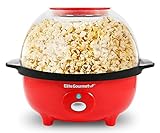
Elite Gourmet EPM330R Stirring Ceramic Nonstick
The ceramic nonstick interior sets this apart from plastic-bodied competitors because you can wipe it clean with a damp cloth rather than soaking oily parts. The built-in stirrer works like the West Bend’s, keeping kernels moving through oil for even cooking. It is a thoughtful design for anyone who dreads the cleanup phase more than the popping phase.
- Pro: Ceramic surface wipes clean almost instantly.
- Pro: Stirring rod ensures even pop without manual cranking.
- Con: Smaller capacity than the West Bend despite similar footprint.
Skip it if you need to make popcorn for a group larger than two or three in a single run.
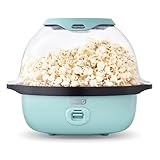
Dash SmartStore Deluxe Stirring Popcorn Maker
This unit solves the single biggest complaint about oil poppers: getting butter onto the popcorn while it is still hot. The integrated warming tray melts your butter in parallel, so you can drizzle it over the bowl the moment the batch finishes. The clear serving bowl and included measuring cup round out a well-considered package for families who want movie-night quality without a commercial machine.
- Pro: Butter-warming tray eliminates the cold-butter-on-hot-popcorn problem.
- Pro: Clear bowl makes it easy to eyeball serving sizes.
- Con: More moving parts than simpler poppers means more to wipe down.
Skip it if you prefer oil-free air popping or if you want the absolute minimal cleaning routine.
Buying Guide
Air Popping vs. Oil Popping
Hot-air poppers blow heated air through kernels, producing light, low-calorie popcorn with no added fat. They are faster to clean and cheaper to run, but the result lacks the rich mouthfeel and flavor adhesion that oil provides. Oil poppers use a small amount of heated fat to coat kernels during the pop, giving you that movie-theater taste directly from the machine. If you season heavily with nutritional yeast or spice blends, air popping works fine; if you want butter-first popcorn, an oil unit or a stovetop kettle is the right call.
Batch Size and Throughput
Single-serve air poppers produce enough for one person in a couple of minutes. A four- or six-quart oil popper can feed a small group in a single cycle. Commercial kettles like the VEVOR push out multiple quarts per batch, which is useful only if you regularly serve ten or more people. Measure your actual serving need—how many bowls does your household go through on a normal movie night?—and buy one size up to avoid the frustration of back-to-back batches.
Cleanup Design
The best popcorn maker is the one you will actually use regularly, and nothing kills enthusiasm faster than greasy parts that need soaking. Ceramic or nonstick interiors that wipe with a cloth are a genuine advantage over hard-to-reach oil chambers. Look for units where the stirring mechanism detaches cleanly and where the bowl or chamber can go in a dishwasher. If a machine has more than four or five parts to disassemble, you will skip it on busy nights.
Our Verdict
Our top pick is the West Bend Stir Crazy. It strikes the best balance between output quality, batch size, and price for the way most people actually eat popcorn—at home, in a group, wanting it to taste like the theater. Its stirring rod keeps the oil-popped result consistent without babysitting, and the bowl-lid design makes serving effortless.
The budget pick is the Dash Fresh Pop in Aqua. At just under twenty dollars, it is the least expensive machine that still produces a full, evenly popped batch without drama. For solo snacking, it is hard to beat.
One condition shifts the recommendation: if your primary goal is maximum flavor and you enjoy the hands-on ritual of cooking, the Original Whirley Pop wins outright. No electric machine replicates the even, buttery, perfectly salted result of stovetop popping with a crank stirring through the batch.
FAQ
Do popcorn makers actually save money over microwave bags?
Yes. A bulk bag of plain kernels costs a fraction of individually packaged microwave bags, and machines produce zero synthetic butter film residue. Over a year of regular use, even the cheapest air popper pays for itself in reduced per-serving cost.
Can I use any oil in a stovetop or electric oil popper?
You can use most high-smoke-point oils like coconut, canola, or avocado. Butter has a low smoke point and burns before kernels reach popping temperature, so it is better melted and added after the pop rather than used as the cooking fat.
Why does my popcorn maker leave unpopped kernels at the bottom?
Most unpopped-kernel issues trace back to uneven heat distribution or stale kernels. A machine with a stirring mechanism or rotating paddle addresses heat unevenness directly. Storing kernels in an airtight container away from humidity ensures they retain the internal moisture needed to build popping pressure.
Are hot air poppers really lower in calories?
Air-popped corn has roughly one third the calories per cup of oil-popped corn because it contains no added fat. If you drizzle butter afterward, the gap narrows. The real advantage of air popping is control—you decide exactly how much fat and seasoning go on after the fact.
Part of our makers buying guide hub.
Write Your Review
No reviews yet. Be the first to share your experience!