
- Top Pick: Fieldpiece SM482V Wireless 4-Port SMAN Refrigerant Manifold with Vacuum Gauge – Air Conditioning/Refrigerant Digital Gauges for HVAC & Refrigeration
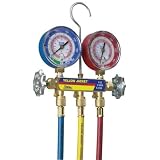
- Best Value: Yellow Jacket 42036 2-Valve Series 41 A2L Manifold, (psi °F) R32/454B/410A, 3-1/8" Gauges (60" Plus II R/Y/B Hoses)
- Premium Choice: Elitech HVAC Digital Manifold Gauge Set DMG-2SE with Hoses & R410A Adapters
There is a specific frustration that comes from watching a needle settle two pounds off where it should be, knowing the system you are servicing is either overcharged or undercharged by a margin you cannot confirm. Cheap manifolds are the culprit far more often than the technician’s hand. The aluminum valve bodies warp under moderate pressure, the rubber hoses kink and crack within a single season, and the dial faces fog up from the first hot day of summer service. You end up chasing ghosts in your readings when what you actually need is a manifold that tells you the truth, repeatably, all day long.
Good refrigeration gauges share a few non-negotiable traits. Brass valve bodies resist thermal expansion that shifts zero. Dial graduations are fine enough that you can interpolate between marks without guessing. Hose fittings seal cleanly without cross-threading, and the refrigerant compatibility actually matches the systems in your area. Digital options add the promise of eliminating parallax error and reading drift, but they introduce battery dependency and sometimes sluggish refresh rates that slow down a charging procedure. The right pick depends entirely on whether you value speed, durability, or refrigerant range above the others.
As an Amazon Associate we earn from qualifying purchases at no extra cost to you.



Quick Picks
| Product | Best for | Price |
|---|---|---|
| Fieldpiece SM482V Wireless | Pro techs who want wireless freedom | $796.39 |
| Yellow Jacket 42036 A2L | A2L refrigerant service work | $185 |
| Elitech DMG-2SE with Hoses | Budget digital kit with accessories | $69.99 |
| Elitech DMG-2SE Standalone | Lowest-cost digital manifold | $45.99 |
| OMT 3-Way AC Gauges | Automotive and legacy R134a work | $35.99 |
| Yellow Jacket 42004 | Reliable analog for common refrigerants | $168.77 |
| Mastercool 59161 | Brass-body durability mid-range | $80.32 |
| OMT AC Gauge Set Multi-Kit | Complete hose kit for multiple legacy refrigerants | $47.99 |
How We Picked
We evaluated each manifold on four criteria: accuracy and zero-shift resistance after thermal cycling, build quality of the valve body and hose fittings, breadth of refrigerant compatibility (especially as A2L refrigerants enter the market and old R-22 systems remain in service), and overall value relative to the price tier. A manifold that nails the first three but costs triple what a technician needs it to cost still loses the comparison.
The 8 Best Refrigeration Gauges in 2026
Fieldpiece SM482V Wireless 4-Port SMAN
The SM482V is built for the technician who is tired of tripping over hoses and wants to position a gauge set where it is visible rather than where the hose reaches. Its four wireless ports pair with a handheld display and stream superheat, subcool, and vacuum simultaneously. The standout strengths are the four-port flexibility that handles heat pump reversing valve checks alongside conventional cooling, and the vacuum gauge module that eliminates the need for a separate micron reader. The one weakness is the price, which places it firmly in fleet-equipment territory and out of reach for solo operators or occasional users. Skip this if your daily work does not involve heat pumps or if your truck budget cannot absorb nearly eight hundred dollars in a single tool.
Yellow Jacket 42036 Series 41 A2L Manifold
As R-32 and R-454B replace R-410A in new equipment, having a manifold rated specifically for these mildly flammable refrigerants becomes a safety requirement rather than a convenience. The 42036 carries those ratings with clearly marked dial faces and includes 60-inch Plus II hoses in standard color coding. Two advantages stand out: the 3-1/8-inch dials are readable at arm’s length even in low light, and the included hose set is among the most flexible and kink-resistant in this price range. The drawback is that it covers only A2L and R-410A, so if your service mix includes legacy R-22 or R-134a you still need a second manifold. Skip this if your fleet is mostly older equipment still on R-22.
Elitech HVAC Digital Manifold Gauge Set DMG-2SE
Elitech’s DMG-2SE kit hits the sweet spot for a technician or homeowner who wants digital readouts without committing four figures. The included hoses and R-410A adapters mean you are productive on unboxing day rather than sourcing accessories separately. Pros include the saturated temperature calculation built into the display, which removes the need to carry a separate PT chart, and the dual-gauge setup that reads high and low sides simultaneously. The main con is the hose quality relative to the price — they are functional but noticeably stiffer than Yellow Jacket or Fieldpiece equivalents, which makes them harder to route through tight service panels. Skip this if you work in confined mechanical rooms where hose flexibility is a daily annoyance.
Elitech DMG-2SE Standalone Digital Gauge
At under fifty dollars, this standalone unit is the entry point into digital manifold work for anyone who already owns service hoses. The DMG-2SE reads R-410A and R-454B pressures and converts them to saturated temperature on the fly, which is the single most useful function a digital gauge provides during a charging procedure. Strengths are its compact footprint and the clarity of the LCD display in direct sunlight. The weak point is that without a protective case or rubber boot, the housing feels plasticky and vulnerable to the drops that HVAC work inevitably involves. Skip this if you do not already have compatible hoses and adapters; the savings disappear once you source them separately.
OMT 3-Way AC Gauges for R134a/R12/R22/R502
This OMT unit targets the automotive and light commercial segment where R-134a still dominates and older refrigerants linger in legacy systems. The 3-way configuration with a center vacuum port keeps it relevant for evacuation checks without a separate pump adapter. It is genuinely inexpensive, and the 5-foot hoses cover the distance from a car’s service ports to a manifold resting on the fender. The downside is build consistency: individual units vary noticeably in dial calibration, so you may need to zero-check it against a known-good manifold before trusting a reading. Skip this for commercial refrigeration or heat pump work where accuracy margins are tighter.
Yellow Jacket 42004 Series 41 Manifold
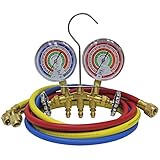
The 42004 is the analog workhorse that many technicians keep in a second truck bag precisely because it has no batteries, no firmware, and no screens to crack. The 3-1/8-inch dials are well-marked for R-22, R-404A, and R-410A, covering the bulk of legacy and transition-era residential systems. Pros include the brass valve body that resists thermal drift and the reputation for long service life under field abuse. The con is that at nearly $169 you are paying Yellow Jacket’s name premium over functionally similar brass manifolds that cost half as much. Skip this if budget is the primary constraint and you can accept a lesser-known brand with comparable internals.
Mastercool 59161 2-Way Brass Manifold
Mastercool has been producing service tools for decades, and the 59161 is a straightforward 2-way brass manifold for R-22 and R-404A that sits comfortably in the mid-range bracket. The brass body provides the thermal stability that aluminum manifolds lack, and the 2-way design keeps weight and bulk down for technicians who prefer minimal tool real estate on the job. Strengths are the solid feel of the valve knobs and the included 5-foot hoses that are serviceable without being exceptional. The weak point is the dial markings for R-404A are harder to read quickly compared to Yellow Jacket’s larger faces, which adds a moment of fumbling during fast charging work. Skip this if your systems are primarily R-410A or R-32.
OMT AC Gauge Set for R134a/R12/R22/R502
This set rounds out the OMT lineup with the most complete hose and adapter package at the budget tier. Five-foot hoses in blue, red, and yellow come pre-attached, and the multi-refrigerant dial covers every legacy refrigerant you are likely to encounter on older commercial equipment or automotive systems. Pros are the all-in-one convenience and the genuinely low price that makes it acceptable as a backup or loaner manifold. The con is that the gauge faces are smaller and less legible than dedicated HVAC manifolds, which slows down accurate reading at arm’s length. Skip this if you need a primary daily-driver manifold for residential heat pump or R-410A systems.
Buying Guide
Brass vs Aluminum Valve Bodies
The manifold body material determines whether your zero point drifts during a service call. Aluminum bodies flex and expand when the system pressures you are measuring exceed the ambient temperature the valve was calibrated at, which means a manifold that reads correctly at the truck may read a few pounds high once it has been sitting in a mechanical room. Brass is heavier and costs more but holds its calibration across the temperature ranges that define real field work. If you see a manifold under $40 with no mention of brass, assume aluminum and plan for periodic zero-checks.
Hose Quality and Connection Repeatability
Hoses are the component most technicians replace first on any new manifold, which means their included quality directly affects your true cost of ownership. Good hoses are made from reinforced rubber that stays flexible at low ambient temperatures and resists kinking when routed through tight panels. The swivel fittings at both ends matter as much as the tube itself: a fitting that seizes after three seasons of use turns every hook-up into a cross-thread risk. Look for hoses described as “Plus II” or similar if flexibility is a priority, and budget for a replacement set within the first year regardless.
A2L Compatibility and Future-Proofing
Refrigerant regulations are pushing R-32 and R-454B into new residential and light commercial equipment, and these refrigerants require manifolds rated for their pressure and mild flammability. A manifold designed for R-410A may physically fit an R-32 service port, but its materials and seals are not certified for that application and can degrade under the different pressure curve. If you install or service equipment manufactured in the last two years, an A2L-rated manifold is not optional. Confirm the dial explicitly lists R-32 or R-454B; if it only shows R-410A, treat it as legacy-compatible only.
Our Verdict
The overall top pick is the Yellow Jacket 42036 Series 41 A2L Manifold. It balances build quality, hose inclusion, dial readability, and forward refrigerant coverage better than anything else at $185, making it the single manifold a technician should buy if forced to choose only one for the next five years of service work. The best budget digital option is the Elitech DMG-2SE Standalone at $45.99, provided you already own compatible hoses — it delivers the saturated temperature calculation that saves the most time per charge cycle. The Fieldpiece SM482V wins outright if your work involves heat pumps with reversing valves or if you need wireless convenience to speed up diagnostics on multi-system commercial jobs where cable routing wastes more labor minutes than the price premium costs.
FAQ
Do I need a separate micron gauge?
If you routinely evacuate systems to below 500 microns, yes. Most manifold gauges with a center vacuum port read only in inches of mercury or rough micron ranges and lack the accuracy that a dedicated thermocouple vacuum gauge provides. The Fieldpiece SM482V includes a vacuum module that narrows this gap, but a standalone micron gauge still outperforms it for tight evacuation targets.
Can I use an R-410A manifold on an R-32 system?
Physically the fittings may match, but you should not. R-32 operates at higher peak pressures than R-410A, and its mild flammability class requires manifolds with specific internal materials and port design that are certified for A2L service. Using a non-rated manifold risks seal degradation and inaccurate readings that mask a real overcharge condition.
How often should I calibrate a manifold gauge set?
For analog manifolds, zero-checking against a known-good reference or dead-weight tester annually is the minimum for anyone whose readings affect charge decisions. Digital units benefit from similar checks because their pressure transducers can drift independently even when the display looks stable. If a needle sits above zero with both valves closed and no pressure applied, the manifold is telling you it needs replacement, not calibration.
Is a digital gauge really faster than analog?
During charging, yes, because the digital gauge calculates saturated temperature automatically and eliminates the mental step of reading a PT chart. During diagnosis of a restriction or airflow issue where you are comparing multiple readings rapidly, some techs find analog dials faster because the eye tracks needle movement more naturally than it parses changing digits on a refresh-delayed LCD.








Write Your Review
No reviews yet. Be the first to share your experience!