
- Top Pick: Mueller Vegetable Chopper (MC-920 GW) — most versatile
- Runner-up: OXO Good Grips Vegetable Chopper — best for small jobs
- Also consider: Vidalia Chop Wizard — simplest classic
A manual vegetable chopper will not replace a good chef’s knife, but it solves a specific, everyday problem: turning onions, peppers, carrots and potatoes into even pieces quickly, with the mess contained in one box and your fingers kept away from the blade. Push-down dicers force food through a steel grid for uniform cubes, press choppers mince with a rotating blade, and pull-cord models spin blades inside a small bowl. None of them needs an outlet, a counter footprint worth planning around, or more than a rinse and a scrub to clean.
- Quick picks
- 1. Fullstar The Original Pro Chopper — best overall
- 2. Mueller Vegetable Chopper (MC-920 GW) — most versatile
- 3. OXO Good Grips Vegetable Chopper — best for small jobs
- 4. Vidalia Chop Wizard — simplest classic
- 5. Kuhn Rikon Pull Chop — best pull-cord design
- How to choose a manual vegetable chopper
- FAQ
- Final verdict
This guide covers manual choppers only. That is a deliberate line: electric mini choppers are a different tool, built around a motor and an S-blade, and they mince and puree more than they dice. The five tools below are the manual designs that come up again and again for home prep — two multi-blade dicer stations, a simple press chopper, the original grid dicer that started the category, and a pull-cord model for small jobs. Each one is matched to the cook it suits, with the limitations stated plainly.
As an Amazon Associate, we earn from qualifying purchases.
Quick picks
- Best overall: Fullstar The Original Pro Chopper — the classic 4-in-1 grid dicer with a generous container and blades for dicing, slicing and spiralizing.
- Most versatile: Mueller Vegetable Chopper (MC-920 GW) — nine interchangeable blades covering dicing, slicing, grating and chopping in one station.
- Best for small jobs: OXO Good Grips Vegetable Chopper — a compact press chopper for a single onion, a handful of nuts or a quick mirepoix.
- Simplest classic: Vidalia Chop Wizard — the original two-part grid dicer with a 2-cup base that doubles as a measuring cup.
- Best pull-cord design: Kuhn Rikon Pull Chop — a cord-driven 2-cup chopper that controls texture by the number of pulls.
1. Fullstar The Original Pro Chopper — best overall
The Fullstar Pro Chopper is the design most people picture when they think of a vegetable chopper: a hinged lid with pusher teeth that drives food down through a stainless steel grid into a clear container. The 4-in-1 set swaps between blades for dicing, slicing and spiralizing, so the same station that cubes onions for soup can ribbon a zucchini for a salad. The catch container holds 4 cups (1.2 litres), which is enough for a family-size batch of salsa or a sheet pan of diced vegetables without stopping to empty it.
Specs
- Operation: manual push-down grid dicer
- Blades: 4 interchangeable stainless steel blades, rust resistant
- Container capacity: 4 cups (1.2 L)
- Body material: BPA-free ABS plastic
- Dimensions: 8 x 3 x 4.48 inches
- Weight: 2 lb
- Care: dishwasher safe
- Safety: locking lid with integrated pusher teeth
Who it suits: Home cooks who dice onions, peppers and potatoes several times a week and want uniform pieces for soups, salsas, salads and meal prep.
Limitations: Produce has to be cut down to fit the grid first, so a whole onion still needs a knife before the chopper takes over. Very hard vegetables need a firm, confident press, and the extra spiralizer blades are more parts to store and wash.
2. Mueller Vegetable Chopper (MC-920 GW) — most versatile

Mueller’s chopper station goes wider than dicing. Nine interchangeable stainless steel blades cover dicing, slicing, grating and chopping, with a V-shaped slicing blade in the mix, and everything drops into the included container. At just over 11 inches long it is the biggest tool in this guide, and it behaves like a small prep station rather than a single-purpose gadget. For cooks who currently own a box grater, a basic slicer and a dicer, it can plausibly replace all three.
Specs
- Operation: manual, press and interchangeable blade station
- Blades: 9 interchangeable stainless steel blades
- Functions: dicing, slicing, grating and chopping
- Container: included catch container
- Dimensions: 11.18 x 5.47 x 5.2 inches
- Weight: 1.97 lb
- Model: MC-920 GW (Mueller Austria)
- Care: dishwasher safe
Who it suits: Batch cooks and salad makers who want one tool for diced onions, sliced potatoes, grated cheese and chopped vegetables, and who have the drawer space for the blade set.
Limitations: Nine blades means nine parts to wash, dry and store, and the blades that are not in use still need a home. The slicing functions call for care and the food holder, and the larger footprint will crowd a small drawer.
3. OXO Good Grips Vegetable Chopper — best for small jobs

The OXO takes the opposite approach to the big dicer stations. You load food into the catcher cup, and each press of the knob rotates the stainless steel blade inside, chopping the contents a little finer every time. There are no grids to swap and no dice to aim for — it produces an honest rough chop or mince, which is exactly what garlic, herbs, nuts, celery and a single onion usually need. The catcher cup carries measurement markings, and the whole unit comes apart for cleaning.
Specs
- Operation: manual press chopper
- Blade: stainless steel blade that rotates with each press of the knob
- Cup: catcher cup with measurement markings
- Model: 11339900
- Care: dishwasher safe, comes apart for cleaning
- Design: enclosed cup keeps pieces contained while chopping
Who it suits: Small households, cooks with limited storage, and anyone who mostly chops one onion, a few cloves of garlic or a handful of nuts at a time.
Limitations: It does not dice. Pieces are chopped, not cubed, and they get less uniform the finer you go. The cup is sized for small batches, so a big soup base means working in rounds.
4. Vidalia Chop Wizard — simplest classic
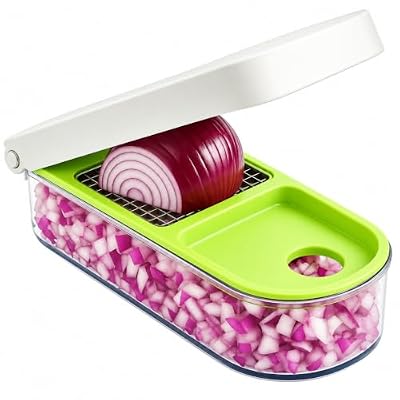
The Chop Wizard is the original as-seen-on-TV grid dicer, and its appeal is that there is almost nothing to learn: place food on the grid, press the lid, and the pieces fall into the 2-cup base. That base doubles as a measuring cup, which is handy when a recipe calls for two cups of diced onion. The stainless steel blades sit under a hinged lid, so your hands never touch the cutting grid during use.
Specs
- Operation: manual push-down grid dicer
- Blades: stainless steel
- Base capacity: 2 cups, doubles as a measuring cup
- Model: VOWR-2
- Manufacturer: National Express
- Care: dishwasher safe
Who it suits: Cooks who want one straightforward dicing tool with no blade library to manage, and anyone outfitting a first kitchen, a cabin or an RV.
Limitations: The 2-cup base fills quickly on big jobs, and the grid size is fixed, so there is one dice style rather than a range. Hard vegetables still need to be pre-cut into pieces the grid can accept, and the press takes real force on dense produce like sweet potato.
5. Kuhn Rikon Pull Chop — best pull-cord design
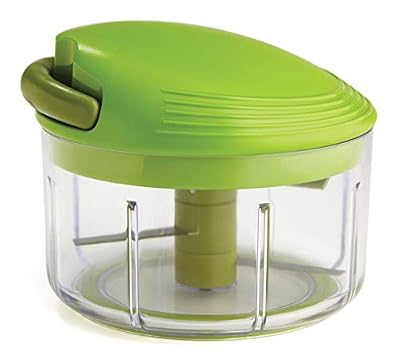
The Pull Chop replaces pressing with pulling. A cord in the lid spins a removable three-blade rotor inside a 2-cup bowl, and the texture is controlled by how many times you pull: a few pulls for a coarse chop, more for a fine mince. It is the fastest of the five for garlic, herbs, shallots and small amounts of onion, and the non-slip base keeps the bowl steady on the counter while you work.
Specs
- Operation: manual pull-cord mechanism
- Capacity: 2 cups (500 ml)
- Blade: removable three-blade rotor
- Base: non-slip
- Model: 27401
- Colour: green
Who it suits: Cooks who prep small amounts often — garlic, herbs, chillies, nuts, baby food portions — and cooks who find pressing down on a lid uncomfortable and prefer a pulling motion.
Limitations: The 2-cup bowl is strictly small-batch, and results are a chop, not a dice, with some variation in piece size. The lid houses the cord mechanism, so it is wiped clean rather than soaked or submerged.
How to choose a manual vegetable chopper
Start with the mechanism. Grid dicers (Fullstar, Mueller, Vidalia) are the only manual tools that produce true uniform cubes, because the grid defines the cut. Press choppers with a rotating blade (OXO) and pull-cord choppers (Kuhn Rikon) chop and mince instead — faster and simpler, but the pieces vary. If your goal is even dice for soups and salads, buy a grid. If your goal is minced garlic and herbs with no tears, buy a press or pull design.
Count the blades honestly. More blades mean more cuts, but also more washing and more storage. A 4-in-1 covers the needs of most kitchens; a nine-blade station earns its space only if you genuinely grate, slice and julienne as well as dice.
Check container size against your cooking. Two cups is plenty for nightly cooking for one or two people. Regular family meal prep points to the 4-cup Fullstar or the Mueller station, so you are not stopping mid-onion to empty the box.
Think about cleaning before you buy. Grids trap food in the squares, which is why good sets include a cleaning tool or a pusher with teeth that clear the grid. Most parts here are dishwasher safe, but blades stay sharper for longer with a quick hand wash, and lids containing a mechanism should be wiped rather than soaked.
Pre-cutting is part of the deal. Every push-down dicer needs produce trimmed to fit its grid, and dense vegetables need a firm press. If grip strength or pressing force is a concern, a pull-cord chopper or a smaller grid area will be easier to live with.
FAQ
Are manual vegetable choppers better than electric choppers?
They do different jobs. Manual grid dicers produce uniform cubes that electric mini choppers cannot, because an electric S-blade minces and purees. Manual tools also need no outlet and clean up faster. Electric choppers win for large volumes of fine mince, nut butters and purees.
Can a manual chopper handle hard vegetables like carrots, potatoes and sweet potatoes?
Yes, with preparation. Cut hard vegetables into slices or chunks that fit the grid first, centre them on the blades, and press in one firm motion. Forcing an oversized piece through a grid is how blades bend and lids crack.
Are the blades and containers dishwasher safe?
On the models in this guide, the containers and blades are listed as dishwasher safe. Two habits extend blade life: rinse grids straight after use so food does not dry into the squares, and wipe clean any lid that contains a spring or cord mechanism instead of soaking it.
What is the difference between a dicer and a press chopper?
A dicer pushes food once through a fixed grid, producing even cubes of a set size. A press chopper keeps food in a cup and chops it repeatedly with a rotating blade, so pieces get finer the more you press but never perfectly uniform. Choose the dicer for presentation and even cooking, the press chopper for speed on rustic chops and minces.
Final verdict
For most kitchens, the Fullstar The Original Pro Chopper is the manual vegetable chopper to buy: a proven grid design, a useful 4-cup container and enough blades to cover daily dicing without overwhelming the drawer. Cooks who want one station for dicing, slicing and grating should step up to the Mueller MC-920 GW. For small, frequent jobs, the OXO press chopper and the Kuhn Rikon Pull Chop are faster to grab and easier to clean, while the Vidalia Chop Wizard remains the simplest, most affordable route to an even dice.






Write Your Review
No reviews yet. Be the first to share your experience!