
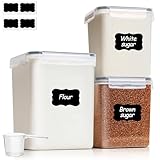
- Top Pick: ComSaf Airtight Flour and Sugar Container 2.6Qt & 5.5Qt 3Pack, Wide Mouth
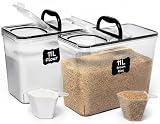
- Best Value: Shazo 2 PC (11L | 372 oz) Flour Sugar Storage Containers with Spout Lid & Easy Carry Handle – BPA Free Extra Large Airtight Food Storage Containers with Lids – Rice Canisters Sets for Kitchen & Pantry
- Premium Choice: Vtopmart 10 PCS Flour and Sugar Storage Container Sets for Advanced Baker
Few kitchen frustrations match the disappointment of opening your pantry to bake a batch of cookies, only to find your brown sugar has turned into a solid brick of concrete, or worse, that pantry pests have invaded your all-purpose flour. Most home bakers buy food storage sets based on aesthetic appeal or sheer number of pieces, only to realize the containers are either too small to hold a standard bag of flour, too narrow for a measuring cup, or not actually airtight.
When searching for the ultimate buying guide for airtight sugar and flour container sets, it is easy to get overwhelmed by the sheer volume of options. In the past, buyers accepted flimsy latches and clouding plastics as the norm. But as we look at kitchen organization in 2026, engineering advancements have brought us ultra-durable, BPA-free, and modular storage solutions that preserve ingredient freshness for months. To find a set that genuinely serves your kitchen, you must look past marketing buzzwords and focus on the physical specs: volume capacity, seal mechanics, and opening clearance.
As an Amazon Associate we earn from qualifying purchases at no extra cost to you.


Decide These 3 Things First
Before you begin browsing dimensions and lid types, you need to establish a baseline for your kitchen’s specific workflow. Answering these three questions first will instantly eliminate 80% of the container sets on the market, saving you from buyer’s remorse.
- What is your purchasing volume? Do you buy standard 5-pound bags of flour and sugar from the local grocery store, or do you buy 10- to 20-pound bulk sacks from warehouse clubs? A standard 5-pound bag of flour does not fit into a standard 5-pound container due to density and aeration; you must size up.
- Where will they live? Measure your storage space before buying. If you have deep pantry shelves, you will want deep, stackable rectangular containers. If you store your baking essentials on pull-out drawers, you need low-profile containers with transparent lids so you can see the contents from above. If they sit on your countertop, UV protection and aesthetics (like glass or premium matte plastics) become priorities.
- How do you measure ingredients? Are you a “scoop and sweep” baker who dips a dry measuring cup directly into the container, or do you pour your ingredients onto a digital kitchen scale? If you scoop, narrow-neck bottles are your enemy; you need a wide-mouth container with an opening of at least 5 inches.
1. Capacity and the “Five-Pound Bag” Rule
The single most common mistake buyers make is purchasing a container labeled “5 lbs” and assuming it will hold a 5-pound bag of flour. Flour is highly aerated. When poured from the bag, it looses density and expands. While a 5-pound bag of granulated sugar is dense and fits comfortably in a 3-quart (approximately 12-cup) container, a 5-pound bag of all-purpose flour requires a container with a capacity of at least 4.5 to 5 quarts (18 to 20 cups) to prevent messy overflows.
If you purchase bulk, look for oversized canisters. For example, an 11-liter (approx. 11.6-quart) heavy-duty container can easily hold up to 12 pounds of flour or 15 pounds of rice. When evaluating a multi-piece set, ignore the piece count and look at the individual capacities. A “10-piece set” that includes six 0.5-quart containers is virtually useless for a serious baker; you want a set that prioritizes 4-quart to 6-quart vessels.
2. Material Composition and Durability
Airtight containers generally fall into three material categories, each with distinct performance metrics:
- ABS and SAN Plastic (Premium/Mid-Range): Acrylonitrile Butadiene Styrene (ABS) and Styrene Acrylonitrile (SAN) are the gold standards for clear plastic containers. They offer glass-like clarity, high impact resistance, and do not retain odors or stains. Look for a wall thickness of at least 2.0mm to prevent flexing when gripped.
- Polypropylene (PP) Plastic (Budget): Often slightly cloudy or matte, polypropylene is highly flexible and virtually indestructible. While it may scratch more easily than SAN plastic, it is highly dishwasher-safe and chemically inert. Wall thicknesses typically range from 1.2mm to 1.8mm.
- Borosilicate Glass: The premier choice for plastic-free kitchens. Borosilicate glass resists thermal shock (safe from freezer to boiling water) and maintains pristine clarity forever. However, glass is heavy—a empty 5-quart glass jar can weigh upwards of 3.5 pounds, making it difficult to maneuver when filled with 5 pounds of flour.
3. Lid Construction and Seal Integrity
An airtight seal is only as good as its mechanical closure and gasket thickness. Look for food-grade silicone gaskets that are at least 3mm thick. There are three primary locking mechanisms used to compress these gaskets:
Side-Locking Latches: These lids feature four independent latches that snap downward over the rim of the container. They provide incredibly high mechanical pressure, ensuring an airtight seal even if the container is dropped. They are highly durable but require two hands to operate.
Push-Button/Pop-Up Seals: Popularized by premium brands, these lids use a central button mechanism that expands a internal silicone gasket outward against the container walls when pressed. They offer convenient one-handed operation but have more moving parts that can trap water during washing.
Clamp-Top Wire Bails: Typically found on glass jars, these metal latching systems offer high compression and a classic farmhouse aesthetic. However, cheap wire bails can bend over time, reducing the seal’s effectiveness.
4. Ergonomics and Accessibility
A container filled with 5 pounds of sugar weighs nearly 6 pounds. If the container is a smooth, wide cylinder with no grip points, it is highly prone to slipping out of soapy or flour-dusted hands. Look for containers designed with integrated molded indents, contoured side walls, or heavy-duty carrying handles integrated directly into the lid system.
Furthermore, accessibility dictates how clean your kitchen stays. A wide-mouth opening (minimum of 4.75 inches across) allows you to sweep a 1-cup measuring scoop flat against the rim for an accurate measurement. If you prefer pouring, look for dual-action lids that feature a secondary, smaller pour spout with a secure flip-cap, allowing you to dispense sugar or flour directly into mixing bowls without removing the entire lid.
5. Price Tiers and Value Mapping
When shopping for an airtight sugar and flour container set, you will generally find options grouped into three price brackets. Understanding what you get at each level helps you avoid overpaying:
- Budget ($15 – $25): Usually consists of 3-piece to 5-piece sets made of thinner polypropylene plastic. They rely on simple snap-on lids or basic four-hinge latches. While functional, they may scratch easily, and the gaskets are often thin and prone to slipping out of their grooves.
- Mid-Range ($25 – $45): This is the sweet spot for most home bakers. You can find comprehensive 10-piece modular plastic sets or high-quality 2-pack extra-large bulk canisters. Materials upgrade to thick, BPA-free SAN plastic or mid-weight borosilicate glass, featuring robust silicone seals and integrated pour spouts.
- Premium ($45 – $80+): At this tier, you are paying for advanced engineering, brand-name modular systems, or heavy-duty glass sets with stainless steel accents. These containers offer pristine, glass-like clarity, patented one-touch pop-up lid mechanisms, and specialized accessories like integrated leveling bars or terra cotta brown sugar savers that attach directly to the underside of the lid.
6. Maintenance, Washing, and Gasket Care
Flour dust is incredibly fine and works its way into every crevice. If your containers are not easy to clean, mold can develop in hidden areas. Look for lids with completely removable silicone gaskets. If a gasket is permanently glued or molded into the lid, moisture can get trapped underneath during washing, leading to black mold growth that is impossible to sanitize.
While many plastics claim to be dishwasher-safe, extreme heat in the bottom rack of a dishwasher can warp lids and degrade silicone gaskets over time. For maximum longevity, plan to hand-wash the lids and gaskets in warm, soapy water, allowing them to dry completely for 24 hours before refilling them with dry ingredients. Damp flour in a sealed container is a recipe for spoilage.
Spec Checklist
Use this quick-reference specification table to compare what features you should expect at different price points when shopping for your storage set.
| Specification | Budget Tier ($15–$25) | Mid-Range Tier ($25–$45) | Premium Tier ($45–$80+) |
|---|---|---|---|
| Primary Material | Thin Polypropylene (PP) | Thick SAN Plastic or Borosilicate Glass | Heavy-Duty Tritan, Glass, or Stainless Steel |
| Wall Thickness | 1.0mm – 1.5mm | 1.8mm – 2.2mm | 2.5mm – 3.0mm+ |
| Seal Type | Basic Press-On or 2-Side Latches | 4-Side Locking Latches with 3mm Gasket | Pop-Up Push Button or Tension Clamps |
| Mouth Width | Under 4 inches (narrow) | 4.5 to 5 inches (standard scoop) | 5.5+ inches (extra-wide/easy access) |
| Dishwasher Safe | Top-rack only (warping risk) | Yes (containers); Hand-wash lids recommended | 100% Dishwasher safe (all components) |
| Typical Piece Count | 3 to 5 pieces (mixed sizes) | 6 to 10 pieces (modular sizes) | 5 to 7 pieces (specialized large sizes) |
Red Flags
When evaluating product listings and retail packaging, watch out for these common warning signs that indicate a container set may not perform well over time:
- “Filler-Heavy” Sets: A listing advertising a “24-Piece Set” for $20 is almost always a trap. In the storage industry, “pieces” usually refers to containers and lids separately (meaning it is actually a 12-piece set). Furthermore, the vast majority of those containers will be tiny 0.25-quart cups that cannot hold more than a handful of chocolate chips, leaving you with no functional space for your actual flour and sugar.
- Non-Removable Gaskets: If the product photos or reviews indicate that the rubber or silicone ring inside the lid cannot be pulled out for cleaning, avoid it. Flour dust and moisture will eventually bypass the seal and rot underneath it.
- Polystyrene Construction: Some ultra-cheap, crystal-clear containers are made of polystyrene. This plastic is incredibly brittle. If dropped on a tile kitchen floor while full, it will shatter like glass, ruining your ingredients and creating a safety hazard. Look specifically for “BPA-Free ABS, SAN, or PP” plastics.
- Lids that Require Excessive Force: If a latching lid requires you to put your entire body weight onto the container to snap it shut, the plastic tabs are under too much tension. They will fatigue and snap off within a few months of regular use.
FAQ
How many quarts do I need to hold a standard 5 lb bag of flour?
You need a container with a capacity of at least 4.5 to 5 quarts (equivalent to 18 to 20 cups or roughly 4.7 liters). Because flour traps air and fluffs up when poured, a smaller 4-quart container will overflow if you try to dump the entire 5-pound bag in at once. Sizing up to 5 quarts also leaves comfortable clearance at the top so you can scoop out flour without spilling it over the edges.
Can I wash airtight lids in the dishwasher?
While many manufacturers label their lids as dishwasher-safe, it is highly recommended to hand-wash them. The intense heat and high-pressure water of a dishwasher can warp the plastic housing, degrade the elasticity of the silicone gaskets, and trap water inside complex locking mechanisms (like pop-up buttons). Hand-washing and letting them air-dry completely ensures the airtight seal remains intact for years.
How do I keep brown sugar from hardening in these containers?
To keep brown sugar soft, you need a container with a flawless, high-compression airtight seal (such as a 4-hinge locking system) to prevent moisture from escaping. For added insurance, look for container systems that accommodate a terra cotta brown sugar saver. You soak the small clay disc in water for 15 minutes, wipe it dry, and snap it into the lid or place it directly in the sugar to maintain perfect humidity levels.
What is the difference between air-resistant and truly airtight?
Air-resistant containers (like classic ceramic canisters with loose-fitting wooden lids) slow down dust and pests but still allow ambient air and humidity to cycle in and out, which causes sugar to clump and flour to spoil. A truly airtight container uses a compressed silicone gasket to form a hermetic seal. You can test this by submersing a sealed, empty container in water; if no air bubbles escape and no water enters, it is truly airtight.
Ready to decide? Our #1 pick for 2026 is the Primary Material.
Live price & availability on Amazon.


Write Your Review
No reviews yet. Be the first to share your experience!