
An espresso tamper for small kitchens should make puck preparation consistent without requiring a large collection of accessories. The right tamper depends on your filter basket’s actual dimensions, handle comfort, base design, and preparation space. A compact tamper can work just as well as a larger one, but poor sizing can make level tamping difficult. This guide explains how to choose a practical tamper for a small home espresso station.
- Quick Verdict: Which Espresso Tamper Is Best for Small Kitchens?
- What Does an Espresso Tamper Do?
- Tamper Diameter: The Most Important Compatibility Check
- Flat vs. Convex Tamper Bases
- Standard Tampers vs. Self-Leveling Tampers
- Calibrated and Spring-Loaded Tampers
- Choosing the Right Handle
- Tamping Stations and Small Kitchens
- A Practical Tamping Workflow
- Tamping Problems and Troubleshooting
- Choosing for Different Home Espresso Setups
- Cost and Long-Term Value
- Common Buying Mistakes
- Frequently Asked Questions
- Conclusion
Quick Verdict: Which Espresso Tamper Is Best for Small Kitchens?
For most home baristas, a flat-bottom stainless steel tamper that fits the actual filter basket comfortably is the best starting choice.
If you struggle to keep the tamper level, a suitable self-leveling or guided tamper may be worthwhile.
A calibrated spring-loaded tamper can also make the physical tamping motion more repeatable, although it is not essential for producing good espresso.
| Tamper Type | Best For | Main Advantage | Main Trade-Off |
|---|---|---|---|
| Standard flat-base tamper | Most home baristas | Simple, durable, compact | Requires level technique |
| Self-leveling tamper | Beginners seeking alignment assistance | Helps guide a level press | Additional mechanisms and size |
| Spring-loaded calibrated tamper | Users wanting repeatable feedback | Defined resistance or force behavior | May cost more |
| Palm tamper | Low-profile preparation | Compact handle design | Grip and clearance depend on model |
| Adjustable-depth tamper | Specific puck-height workflows | Controls travel depth | Requires careful setup |
| Combination distributor/tamper | Reducing separate accessories | Two functions in one tool | May compromise ergonomics |
Best overall approach: Purchase the correct diameter first. Then choose a handle and guidance system that make level, comfortable tamping easy to repeat.
What Does an Espresso Tamper Do?
Understanding Coffee Puck Compression
An espresso tamper compresses ground coffee inside a portafilter basket.
The process reduces the loose spaces between particles and creates a more stable coffee bed.
This helps prepare the grounds for pressurized water during extraction.
However, tamping is only one part of puck preparation.
Grind size, coffee dose, distribution, basket geometry, and the espresso machine’s brewing conditions also matter.
A tamper cannot compensate for every problem caused by an unsuitable grinder or unevenly distributed grounds.
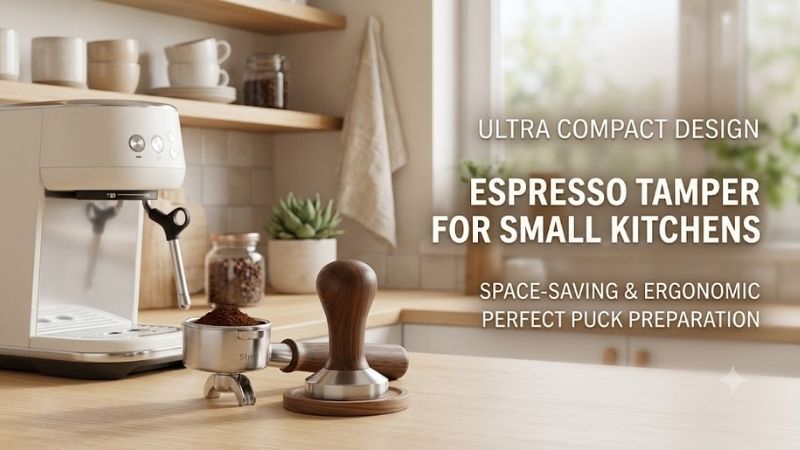
Why Level Tamping Matters
If one side of the coffee bed is compressed differently from the other, the puck may be less uniform.
Water can follow preferential paths through a poorly prepared bed.
However, tamping angle is not the only cause of channeling.
Distribution, coffee particle characteristics, and water delivery also contribute.
The goal is a repeatable, level tamp rather than a complicated movement.
How Much Pressure Is Necessary?
Beginners often encounter recommendations involving 20, 30, or 40 pounds of tamping force.
However, there is no universal requirement to apply exactly one number.
Once the coffee bed has been compressed sufficiently, substantially greater force may have limited additional benefit.
A comfortable, firm, level tamp performed consistently is generally more useful than trying to hit an arbitrary force target.
Excessive physical effort can also make repeated preparation uncomfortable.
Why a Tamper Is Different From a Distribution Tool
A tamper compresses the coffee.
A distribution tool helps arrange loose grounds before compression.
A needle-style distribution tool can break up clumps and redistribute coffee.
A rotating surface leveler performs a different action near the top of the basket.
These accessories are not identical, and not every espresso setup requires all of them.
For a small kitchen, begin with the essential tamper and add distribution tools only when they solve a demonstrated workflow problem.
Tamper Diameter: The Most Important Compatibility Check
Understanding Nominal Portafilter Sizes
Espresso equipment commonly uses size classes such as 51 mm, 54 mm, and 58 mm.
However, the nominal portafilter size does not always reveal the exact internal dimensions of the filter basket.
Basket walls, coatings, and tapering can affect the fit.
A tamper should be selected for the basket actually being used, not only the machine’s brand.
Common Basket Size Categories
| Basket Size Class | Common Tamper Consideration |
|---|---|
| 49–51 mm | Often found on smaller or specialty espresso systems; verify exact basket |
| 53–54 mm | Used by various compact home espresso systems |
| 58 mm | Common in many professional-style espresso machines |
| Precision baskets | May benefit from a closely matched base, subject to basket tolerance |
| Aftermarket baskets | May differ from the original basket’s dimensions |
These are general categories rather than universal compatibility rules.
Why Too-Small Tampers Can Be Inconvenient
A tamper substantially smaller than the basket can leave a wider perimeter that is not compressed in the same way as the center.
However, a small gap does not automatically cause channeling.
Extraction depends on the whole puck preparation process.
Choose a reasonably close fit when appropriate.
Why Too-Large Tampers Are a Problem
An oversized tamper can bind against the basket wall.
It may become difficult to remove.
A close-fitting tamper can also interact with particular basket shapes in unwanted ways.
Never force a tamper into the basket.
How to Check Fit
If possible, consult the basket manufacturer’s recommended tamper diameter.
For a precision basket, measure the internal diameter at the appropriate location with suitable calipers.
Ensure the base can enter and leave smoothly.
Do not rely solely on an online listing claiming compatibility with every machine from a certain brand.
Why 58.5 mm Is Not Universal
Certain precision baskets in the 58-mm class can accommodate tampers close to 58.4 or 58.5 mm.
However, the correct diameter varies.
A 58.5-mm tamper is not automatically an upgrade over a 58-mm tamper for every basket.
The basket’s actual internal dimensions should determine the choice.
Flat vs. Convex Tamper Bases
Flat Bases
Flat-bottom tampers are widely used.
They create a level compression surface when handled correctly.
For most home baristas, a flat base is the sensible starting design.
It is straightforward and compatible with many common preparation techniques.
Convex Bases
Convex tampers have a shaped bottom.
Different designs may compress the grounds differently near the center and edges.
However, there is no universal evidence that convex tampers produce better espresso in every setup.
A flat base is generally easier for beginners to understand.
Patterned and Specialty Bases
Some tampers have textured or patterned surfaces.
These may change the appearance of the compressed coffee bed.
However, decorative patterns should not be assumed to improve extraction.
Unless there is a specific, demonstrated benefit for your equipment, a simple flat base is usually a better-value purchase.
Base Material
Stainless steel is common because it is durable and can be manufactured with a smooth surface.
Other materials and coatings are available.
However, base flatness, dimensions, and finish matter more than appearance alone.
Standard Tampers vs. Self-Leveling Tampers
Traditional Tamper Technique
A standard tamper requires the user to guide the base into the basket.
The operator must keep the pressure approximately perpendicular to the basket.
This becomes easier with practice.
A basic tamper is compact and contains few mechanical parts.
How Self-Leveling Tampers Work
Self-leveling tampers typically use a collar, flange, or other guide that references the portafilter basket rim.
This can help keep the compression movement aligned.
However, a self-leveling design still requires proper coffee distribution and compatible basket geometry.
It should not be considered a complete solution to every extraction problem.
Benefits for Beginners
Guided tampers can reduce uncertainty about tilt.
They may also make the movement easier for multiple household members to repeat.
However, they often have larger upper components than simple tampers.
For limited counter space, check storage dimensions.
Possible Drawbacks
A collar may collect coffee residue.
Some mechanisms require adjustment or periodic cleaning.
A poorly matched guide can interfere with the basket or portafilter.
Is Self-Leveling Worth the Extra Cost?
It can be worthwhile if tamping angle is a consistent difficulty.
If you already tamp comfortably and level, a simple flat-base model may be sufficient.
Calibrated and Spring-Loaded Tampers
What Is a Calibrated Tamper?
Some tampers use a spring or mechanical feedback mechanism that responds when a particular force is reached.
This can make the motion feel more repeatable.
However, the advertised force does not guarantee better espresso.
Understanding Force Ratings
Products may use values such as 15, 25, or 30 pounds.
These settings are not universal requirements for espresso.
A well-distributed coffee bed compressed firmly and level may perform adequately across a range of forces.
Avoid choosing solely by the largest force number.
Advantages for Shared Households
A guided mechanical action may make preparation more consistent when several people use the same machine.
However, grind and dose still need to be controlled.
Maintenance Considerations
Springs and moving components may need cleaning or replacement.
A standard solid tamper generally has fewer potential maintenance points.
Is a Calibrated Tamper Necessary?
No.
It is an optional convenience accessory.
For a beginner on a budget, correct diameter and comfortable ergonomics are higher priorities.
Choosing the Right Handle
Handle Height
A tall handle can offer a familiar grip.
However, it adds storage height.
For a shallow drawer or compact coffee station, a lower-profile design may be easier to accommodate.
Handle Shape
Rounded, tapered, and cylindrical handles feel different.
Choose one that allows comfortable downward pressure without awkward wrist positioning.
Palm Tampers
A palm tamper uses a low-profile top that rests against the hand.
This can save some storage height.
However, it may not suit everyone’s hand size or preferred motion.
Wood vs. Metal Handles
Wood handles can provide a warm tactile feel.
Metal handles may offer a different weight and appearance.
However, neither material guarantees better extraction.
Choose based on comfort, durability, and cleaning requirements.
Weight
A heavy tamper may feel stable, but excessive weight is not necessary for proper compression.
A lighter tool may be more comfortable during repeated use.
Balance is more important than maximum mass.
Tamping Stations and Small Kitchens
Do You Need a Tamping Mat?
A tamping mat can protect the countertop and provide a defined preparation area.
However, it is not mandatory.
Its usefulness depends on the portafilter design and countertop surface.
Corner Tamping Mats
Some mats are designed to fit over a counter edge.
These may help position the portafilter.
However, they require a compatible countertop profile.
Compact Tamping Stands
A small stand can support the portafilter while tamping.
This may be useful for a bottomless or unevenly balanced portafilter.
However, it occupies additional space.
Multifunction Stations
Some stations hold a tamper, distribution tool, dosing funnel, and portafilter.
These can organize accessories.
However, elaborate stations may occupy more room than the tools themselves.
For a small kitchen, a simple tray or drawer organizer may be sufficient.
Protecting the Countertop
Tamping involves downward pressure.
Use a suitable stable surface.
Avoid unsupported glass shelves, fragile countertops, or unstable carts.
A Practical Tamping Workflow
Step 1: Choose the Correct Basket
Confirm that the basket and tamper are compatible.
Inspect the basket for damage.
Step 2: Measure the Coffee Dose
Use the grinder and a suitable scale.
Follow the recipe and basket capacity.
For example, an 18-gram dose may be appropriate for certain double-shot baskets, but not every basket.
Step 3: Distribute the Grounds
Ensure that the coffee bed is reasonably uniform before tamping.
Use an appropriate distribution method.
Step 4: Position the Portafilter
Place it securely on a suitable surface or tamping station.
Prevent tipping.
Step 5: Insert the Tamper
Lower the base into the basket.
Keep it aligned with the coffee bed.
Step 6: Apply Firm, Level Pressure
Compress the grounds with a comfortable, repeatable motion.
Do not force the basket or use an unnecessarily aggressive technique.
Step 7: Release Carefully
Lift the tamper straight out.
Avoid dragging it along the coffee surface.
Step 8: Inspect the Basket Rim
Remove stray coffee grounds from the rim.
This helps maintain a clean sealing surface when inserting the portafilter.
Step 9: Brew Promptly
Follow the espresso machine’s instructions.
Observe the extraction and adjust the recipe based on the result.
Step 10: Clean the Tamper
Wipe away coffee residue.
Store the tool safely.
Tamping Problems and Troubleshooting
Uneven Coffee Surface
If the tamped surface appears noticeably sloped, review your grip and alignment.
A self-leveling tamper may be useful.
However, also check that the grounds were distributed before tamping.
Grounds Sticking to the Tamper
Ground coffee may adhere to the tamper because of moisture, static, or surface conditions.
Keep the base clean and dry as appropriate.
Do not add lubricants or unapproved coatings.
Tamper Binding
If the tamper sticks in the basket, stop using force.
Check size compatibility and basket geometry.
A close-fitting tamper should still be removable safely.
Cracked Puck Surface
Visible cracks may indicate a preparation issue.
However, appearance alone does not prove how a shot will extract.
Review distribution, dose, and tamping technique.
Channeling
If extraction appears uneven, do not assume that tamping force is the only cause.
Grind, dose, distribution, basket fit, water delivery, and pressure all matter.
Make controlled adjustments.
Choosing for Different Home Espresso Setups
Compact Espresso Machines
Many compact domestic machines use smaller basket size classes.
Confirm exact tamper compatibility.
Professional-Style 58-mm Machines
A suitable flat tamper with a closely matched base may be appropriate.
However, precision basket tolerances vary.
Manual Lever Espresso Makers
Some lever machines use proprietary or unusually sized baskets.
Check the exact system.
Shared Household Espresso Stations
A guided tamper may help multiple users produce a similar tamping motion.
Minimalist Espresso Setups
A single standard tamper and simple counter protection may be sufficient.
Avoid purchasing several accessories before identifying a genuine need.
Cost and Long-Term Value
Basic Tampers
A well-sized flat-base tamper can provide everything necessary for ordinary espresso preparation.
Midrange Tampers
Additional ergonomic features or improved machining may be worthwhile.
However, price alone does not establish better extraction.
Premium Tampers
Premium tools may include self-leveling mechanisms, replaceable bases, or specialized construction.
Evaluate whether these features solve an actual problem.
Replaceable Components
Some tampers allow base replacement.
This may be useful if the base becomes damaged.
Buying Once
For a small kitchen, investing in a comfortable, correctly sized tool can be better than purchasing several inexpensive tampers that do not fit properly.
Common Buying Mistakes
Choosing by Machine Brand Alone
The actual basket dimensions matter.
Buying a Tamper That Is Too Tight
Binding can make puck preparation difficult.
Assuming Heavier Means Better
Tamping quality depends on alignment and technique.
Paying for Calibration Without Understanding It
A force rating is not a universal quality guarantee.
Buying a Large Tamping Station for a Tiny Counter
Organize only the tools you need.
Using Distribution Tools as Substitutes for Proper Tamping
Surface leveling and compression are different tasks.
Frequently Asked Questions
What Size Espresso Tamper Do I Need?
Choose based on the actual inner diameter and design of your filter basket. Nominal sizes such as 54 mm and 58 mm are starting references, not universal exact dimensions.
Is a Self-Leveling Tamper Worth It?
It can help users maintain alignment, especially beginners, but it is not essential for everyone.
How Hard Should I Tamp Espresso?
Apply firm, comfortable, level pressure until the coffee bed is adequately compressed. Hitting an exact force number is generally less important than a consistent technique.
Are Palm Tampers Good for Small Kitchens?
They can be compact, but comfort and compatibility vary. A traditional short-handled tamper may also store easily.
Do I Need a Tamping Mat?
Not necessarily, but a suitable mat can protect the counter and stabilize preparation.
Is a 58.5-mm Tamper Better Than a 58-mm Tamper?
Only when the exact basket supports the closer fit. A larger base can bind in some baskets.
Conclusion
The best espresso tamper for small kitchens is a correctly sized, comfortable tool that produces a level and repeatable tamp without requiring excessive counter space. A flat stainless steel tamper is sufficient for many home baristas, while self-leveling designs offer additional guidance. Verify basket dimensions first, choose practical ergonomics, and avoid paying for mechanisms that do not improve your actual preparation routine.









Write Your Review
No reviews yet. Be the first to share your experience!