
A mini food processor for home cooking can make small preparation tasks easier without taking up the space of a full-size appliance. It can be especially useful for chopping aromatics, preparing herbs, and mixing modest portions of sauces. However, compact processors have important capacity and performance limitations. This guide explains which features matter and when a larger processor may be the better choice.
- Quick Answer: Who Should Buy a Mini Food Processor?
- What Makes a Food Processor Mini?
- How Much Capacity Do You Need?
- Blade Design and Chopping Performance
- Everyday Home Cooking Applications
- Cleaning and Maintenance
- Choosing a Mini Processor for Different Kitchens
- Common Buying Mistakes
- Frequently Asked Questions
- Conclusion
Quick Answer: Who Should Buy a Mini Food Processor?
A mini food processor is a sensible choice for home cooks who regularly prepare small amounts of chopped vegetables, herbs, sauces, or other suitable ingredients.
It is particularly useful in apartments, small kitchens, and households where a full-size processor would be excessive.
Look for a model with:
-
A practical work-bowl capacity.
-
Simple pulse control.
-
A blade assembly suitable for common chopping tasks.
-
An easy-to-clean lid and bowl.
-
Secure bowl locking and safety interlocks.
-
A compact footprint and manageable storage height.
-
Clear instructions for approved ingredients.
-
Accessible replacement components when available.
Do not assume that a mini processor can replace a full-size food processor, blender, or stand mixer.
What Makes a Food Processor Mini?
Mini Processor vs. Full-Size Processor
Mini processors are designed primarily for smaller food quantities.
Many use a simple chopping blade and relatively compact work bowl.
Full-size food processors may accommodate larger batches and offer additional slicing, shredding, and dough-processing accessories.
| Feature | Mini Food Processor | Full-Size Food Processor |
|---|---|---|
| Main purpose | Small chopping and mixing tasks | Larger and more varied preparation |
| Bowl capacity | Generally smaller | Generally larger |
| Counter space | Typically compact | Requires more room |
| Accessories | Often limited | May include multiple discs and blades |
| Cleaning | Fewer large components | More components and surface area |
| Family batch prep | Often requires repeated batches | More suitable for larger quantities |
| Storage | Usually easier | May need dedicated cabinet space |
A mini processor can be highly practical when its capabilities match the portions you actually prepare.
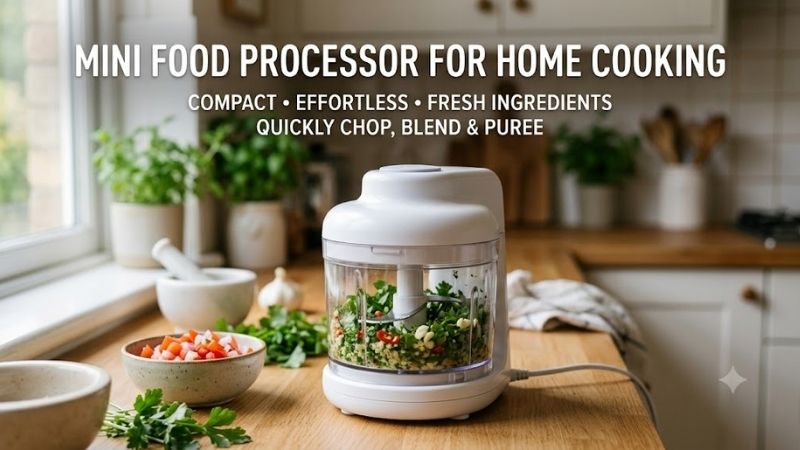
Mini Food Processor vs. Electric Chopper
The terms mini food processor and electric chopper often overlap.
Some compact machines are marketed as choppers because they focus primarily on cutting ingredients into small pieces.
Others support additional mixing, pureeing, or emulsifying tasks.
The product name alone does not establish its capabilities.
Review the manufacturer’s approved functions, included blades, bowl configuration, and operating instructions.
Is a Mini Processor Better Than Manual Chopping?
It depends on the task.
For one garlic clove or a few herb leaves, using a knife may be quicker than assembling and cleaning an appliance.
For repeated preparation of onions, vegetables, nuts, or suitable sauces, a mini processor can reduce manual chopping effort.
The main advantage is convenience for appropriately sized batches, not necessarily superior precision.
How Much Capacity Do You Need?
Choosing the Right Work-Bowl Size
Mini processors are available in a range of small capacities.
Rather than selecting a specific volume based on household size alone, consider your normal ingredients.
For example, a household that routinely prepares small salad dressings may need less capacity than one that frequently chops several vegetables for a dinner recipe.
Remember that the advertised bowl volume may not equal the recommended operating fill level.
Check the limits for chopped ingredients and liquids separately.
Why Overfilling Is a Problem
A food processor needs enough space for ingredients to move around the blade.
Overfilling can reduce chopping consistency, cause ingredients to collect above the blade area, or interfere with normal operation.
Instead of forcing large quantities into a small bowl, process food in batches.
Use the manufacturer’s maximum fill guidance.
If you regularly need several batches for basic family meals, a larger machine may be more practical.
Can a Mini Processor Handle Very Small Quantities?
Some mini processors are effective with small ingredient quantities, but performance depends on blade position and bowl geometry.
Tiny amounts of food may remain outside the blade’s effective cutting area.
For example, one small garlic clove may not circulate as predictably as several appropriately prepared pieces.
Consider whether a small manual chopper, garlic press, or knife would better serve your most frequent tasks.
Blade Design and Chopping Performance
Understanding the Chopping Blade
Most mini food processors use a rotating blade assembly.
The blade cuts ingredients as they move through the bowl.
Chopping consistency depends on ingredient size, moisture content, blade geometry, and processing duration.
A mini processor can be useful for rough chopping, but it may not create evenly sized knife-style pieces.
For delicate recipes where uniform cuts matter, manual chopping may remain preferable.
Pulse Control Matters
Pulse operation gives the user more control over the final texture.
Short pulses allow you to inspect the ingredients between processing intervals.
This is useful when preparing chopped onions, herbs, or vegetables that should retain some texture.
Continuous processing can be appropriate for certain sauces and purees, provided the machine supports those tasks.
A compact processor with reliable pulse control may be more useful than one offering numerous presets that do not match your recipes.
Processing Soft vs. Firm Ingredients
Soft ingredients may become finely processed or pureed quickly.
Firmer vegetables can require additional pulses or smaller starting pieces.
Hard ingredients, frozen foods, and dense mixtures may exceed the capability of some mini processors.
Never assume that a small machine can safely handle ice, coffee beans, or whole hard nuts.
Check the approved ingredient list and processing instructions.
Motor Power and Real Performance
Manufacturers may advertise motor wattage or speed.
However, these numbers do not fully explain chopping quality.
Blade construction, bowl design, motor control, and ingredient movement also matter.
Choose based on documented suitability for your recipes rather than selecting the highest wattage automatically.
Everyday Home Cooking Applications
Chopping Onions and Garlic
A mini processor can help prepare aromatic vegetables for soups, sauces, fillings, and stir-fries.
Cut larger onions into suitable pieces before loading the bowl.
Use short pulses when a chopped texture is desired.
Avoid excessive processing, which can produce a wet or overly fine mixture.
For recipes requiring distinct onion pieces, inspect the texture frequently.
Preparing Fresh Herbs
A mini processor can chop suitable herbs for sauces, dressings, and seasoning mixtures.
However, delicate herbs may cling to the bowl or become excessively fine.
Drying washed herbs when appropriate and using controlled pulses may help.
The exact preparation method depends on the herb and recipe.
For a very small garnish, manual chopping may still be faster.
Making Pesto and Similar Sauces
Some mini processors are suitable for preparing small portions of pesto and other sauces.
These mixtures may include herbs, oil, cheese, nuts, and seasonings.
Check whether the machine supports the intended ingredients and whether the bowl accommodates the required quantity.
Use appropriate food handling and storage practices for fresh ingredients.
Because pesto can contain perishable components, refrigerate it promptly and follow an appropriate storage timeframe.
Mixing Salad Dressings
Certain mini processors can combine dressings and emulsified sauces.
However, their liquid handling capabilities vary.
Some lids include openings intended for adding liquids during processing, while others require the machine to be stopped.
Follow the model’s instructions.
Avoid exceeding the liquid fill level or assuming that every compact chopping bowl is leakproof.
Preparing Small Vegetable Mixes
Mini processors can be convenient for chopping modest quantities of vegetables for omelets, fillings, soups, or casseroles.
For consistent results, group ingredients with similar firmness.
For example, very soft vegetables may process more quickly than dense raw carrots.
Using separate batches can provide better control when textures differ significantly.
Cleaning and Maintenance
Choosing an Easy-to-Clean Bowl
Smooth interior surfaces and accessible corners make routine cleaning more convenient.
Inspect whether food can collect around the central blade shaft, lid rim, and locking mechanisms.
A processor with only a few removable components may be easier to maintain.
However, the blade assembly must remain safe to handle.
Dishwasher-Safe Components
Some mini processor bowls, lids, and blades are dishwasher safe.
Others require handwashing or have specific temperature and rack restrictions.
Check the exact manufacturer’s instructions.
Never submerge the motor base unless explicitly approved.
Cleaning Sharp Blades
Disconnect the processor before removing or handling blades.
Use an appropriate cleaning brush or other manufacturer-approved method.
Avoid leaving exposed blades hidden beneath soapy water, where they may cause accidental cuts.
Dry and store components safely after cleaning.
Preventing Odors
Ingredients such as onions, garlic, and spices can leave odors in certain container materials.
Prompt cleaning can reduce persistent residue.
Avoid abrasive cleaners or strong chemicals that are not approved for the bowl.
If a gasket is removable, follow the manufacturer’s instructions for cleaning and reinstalling it.
Choosing a Mini Processor for Different Kitchens
Best for Apartment Cooking
Prioritize compact dimensions, simple controls, and easy storage.
A smaller processor can be useful when cabinet and countertop space is limited.
Avoid oversized accessory bundles unless they serve a genuine purpose.
Best for One or Two People
A mini processor can be practical for small recipes and occasional meal preparation.
Focus on usable capacity and reliable chopping.
If you frequently prepare larger batches for future meals, compare the time required for repeated processing.
Best for Quick Weeknight Cooking
Choose a model with simple assembly and cleaning.
When a processor can be assembled, used, and washed with minimal effort, it is more likely to become part of the regular cooking routine.
Best for Sauces and Dressings
Check the model’s liquid capacity and suitability for emulsifying or pureeing.
A dedicated small blending container may be more useful than extra chopping accessories.
Common Buying Mistakes
Expecting Full-Size Performance
Mini processors are designed for modest workloads.
They may not support full-size slicing discs, large dough batches, or demanding ingredients.
Buying the Smallest Bowl Without Considering Recipes
An undersized bowl may require repeated batches.
Evaluate common ingredient quantities before buying.
Ignoring Blade Removal and Cleaning
A compact machine is not necessarily easy to clean.
Inspect the blade assembly, lid design, and approved washing procedures.
Assuming All Ingredients Are Suitable
Hard foods, frozen ingredients, and thick mixtures can exceed a model’s capabilities.
Use only approved ingredients and operating methods.
Frequently Asked Questions
Is a Mini Food Processor Worth Buying?
It can be worthwhile for cooks who regularly chop small amounts of vegetables, herbs, nuts, or sauce ingredients. For infrequent preparation, a knife may be sufficient.
Can a Mini Food Processor Chop Onions?
Many models can chop onions when the pieces fit within the bowl and the instructions are followed. Pulse operation helps control texture.
Can a Mini Food Processor Make Hummus?
Some models can process small hummus portions, but thick mixtures may exceed their capabilities. Check manufacturer guidance and avoid overloading the motor.
Can a Mini Processor Replace a Blender?
It can perform certain mixing and pureeing tasks, but it may not be suitable for smoothies, large liquid volumes, or frozen ingredients.
Are Mini Food Processors Easy to Clean?
Many have relatively few components, but cleaning convenience depends on blade design, lid construction, and manufacturer-approved methods.
Should I Buy a Mini or Full-Size Food Processor?
Choose a mini processor for frequent small tasks and compact storage. Choose a full-size processor when you regularly prepare larger batches or need slicing and shredding attachments.
Conclusion
A mini food processor for home cooking is most valuable when its capacity, blade system, and controls match small everyday preparation tasks. Choose a model that handles your usual ingredients without overloading and can be cleaned quickly after use. For apartments and smaller households, a simple mini processor can be a practical kitchen tool, while larger or more demanding recipes may justify a full-size appliance.





Write Your Review
No reviews yet. Be the first to share your experience!