
A mini waffle maker for easy cleaning should prepare small, satisfying breakfasts without leaving batter trapped around hinges, heating plates, and narrow crevices. Compact size alone does not guarantee easy maintenance. This guide explains which plate designs, coatings, cleaning features, and storage options make a mini waffle maker practical for everyday use.
- Quick Verdict: Which Mini Waffle Maker Is Easiest to Clean?
- Understanding Mini Waffle Maker Designs
- Cooking Plate Features That Affect Cleaning
- Choosing the Right Size and Capacity
- Controls and Everyday Cooking Convenience
- How to Clean a Mini Waffle Maker Safely
- Preventing Mess Before It Happens
- Choosing for Different Households
- Common Buying Mistakes
- Frequently Asked Questions
- Conclusion
Quick Verdict: Which Mini Waffle Maker Is Easiest to Clean?
For households that prioritize cleaning convenience, a mini waffle maker with accessible cooking plates, a simple hinge, and effective batter overflow management is a sensible starting point.
Removable plates can simplify washing, but this feature is not universal among mini waffle makers. Many compact models have permanently attached plates, making their surface design and cleaning instructions especially important.
| Feature | Why It Matters | Buying Priority |
|---|---|---|
| Removable plates | Can make food-contact surfaces easier to wash | High, if available |
| Nonstick cooking surface | Helps release waffles with less residue | High |
| Shallow, accessible edges | Reduces difficult-to-reach batter buildup | High |
| Overflow channel | Helps contain excess batter | Useful |
| Simple hinge construction | Limits areas where batter can accumulate | High |
| Cool-touch handling features | Can improve handling convenience | Useful |
| Compact storage | Reduces countertop clutter | High |
| Clear cleaning instructions | Helps protect coatings and electrical components | Essential |
The easiest-to-clean machine is not necessarily the one with the smoothest-looking plates. Waffle-pocket depth, hinge access, and the ability to remove cooked residue all affect maintenance.
Understanding Mini Waffle Maker Designs
What Counts as a Mini Waffle Maker?
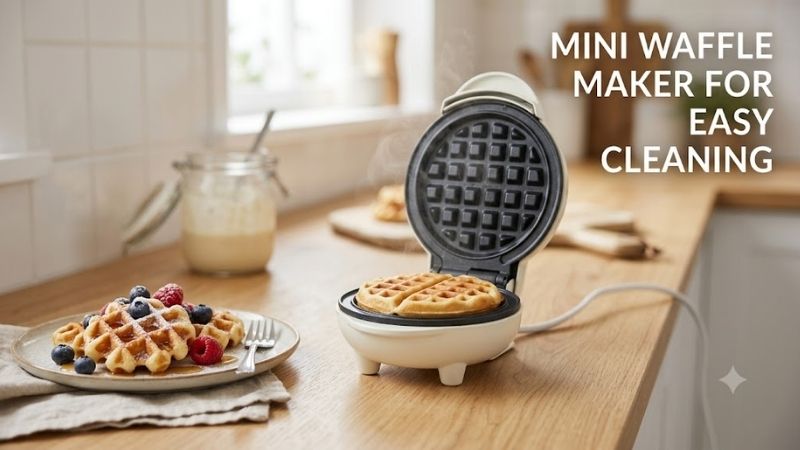
Mini waffle makers are compact electric appliances designed to cook relatively small waffles.
Many produce one waffle per cooking cycle, although their shapes and portion sizes vary.
Some use traditional round plates, while others produce square or specialty-shaped waffles.
A small cooking area can reduce the amount of batter needed per batch, but it may increase the number of cycles required to prepare breakfast for several people.
For single-person households, that trade-off may be acceptable. Families that prepare larger batches should consider whether a full-size waffle maker would save time.
Fixed Plates vs. Removable Plates
Fixed cooking plates remain attached to the appliance during normal cleaning. They are common in compact, inexpensive waffle makers.
Their advantage is simple construction with fewer separate pieces to store. However, washing requires care because the electrical body cannot generally be submerged.
Removable plates can provide better access to the waffle grooves and surrounding edges. Some are dishwasher safe, but only when explicitly approved by the manufacturer.
Removable plates may also increase the appliance’s thickness, number of components, or cost.
For frequent use, easier plate access can be worth the extra complexity.
Mini Waffle Maker vs. Standard Waffle Maker
| Consideration | Mini Waffle Maker | Standard Waffle Maker |
|---|---|---|
| Typical batch | Small portion | Often larger |
| Counter space | Usually limited | Generally greater |
| Cleaning area | Smaller cooking surface | Larger cooking surface |
| Plate removal | Model-dependent | Model-dependent |
| Family meal preparation | May require many cycles | Often more practical |
| Storage | Usually convenient | Requires more room |
A smaller surface can take less time to wipe, but difficult hinge areas may cancel out that advantage.
Choose based on how frequently you cook and how much cleanup you are willing to perform.
Cooking Plate Features That Affect Cleaning
Nonstick Coatings
Nonstick coatings can reduce batter adhesion and make waffle removal easier.
However, their composition and durability vary.
Marketing terms such as ceramic, granite, or chemical-free do not independently establish the exact coating materials or safety characteristics.
Check the manufacturer’s documentation for food-contact materials and care requirements.
Avoid metal utensils unless explicitly approved. Scraping can damage certain coatings, making future waffle release and cleaning more difficult.
Waffle Groove Depth
Deep waffle pockets can create appealing textures but may trap more batter and crumbs.
Shallower plates may be easier to inspect and clean.
However, groove shape is only one factor.
A plate with rounded corners and accessible channels may be easier to maintain than one with narrow grooves and complicated edges.
If cleaning is the primary purchase consideration, inspect the complete plate geometry rather than focusing solely on waffle appearance.
Batter Overflow Channels
An overflow channel can collect small amounts of excess batter before it reaches the hinges or countertop.
This can simplify cleanup when batter quantity varies.
However, overflow channels must also be cleaned.
A narrow channel with difficult corners may collect cooked residue.
Look for an accessible design and follow recommended batter quantities to prevent unnecessary mess.
Hinges and Exterior Seams
Hinges are common areas for batter accumulation.
Some compact waffle makers have exposed hinge mechanisms or narrow gaps near the rear of the plates.
Inspect product photographs and available maintenance instructions.
A simple hinge with minimal surrounding crevices is generally preferable when cleaning convenience matters.
Never attempt to remove hinge covers or electrical components unless the manufacturer specifically authorizes that procedure.
Choosing the Right Size and Capacity
Single-Serving Breakfasts
A mini waffle maker is often practical for one person preparing a small breakfast.
Its compact size may reduce storage requirements and make the appliance easy to retrieve.
However, serving size depends on the finished waffle diameter and thickness.
One miniature waffle may not constitute a complete breakfast.
Consider how many cooking cycles you normally need.
Meal Preparation for Several Days
A mini model can support batch preparation, but repeated cooking cycles may become inconvenient.
For example, preparing a dozen waffles in a single-waffle machine requires at least twelve cooking cycles.
A larger appliance producing several waffles per cycle may be more efficient.
If weekly meal prep is your main purpose, compare batch capacity before prioritizing compact dimensions.
Storage in Small Kitchens
Measure the appliance’s complete exterior dimensions, including handles and protruding parts.
Some designs allow upright storage, but this must be confirmed for the exact model.
Never assume that any waffle maker can be stored vertically.
Wait until the appliance has cooled and been cleaned before putting it away.
Controls and Everyday Cooking Convenience
Ready Indicators
Many mini waffle makers use an indicator light to show that the appliance is heating or has reached a particular operating condition.
However, indicator behavior varies.
Some lights signal preheating rather than finished waffles.
Read the instructions carefully.
Do not assume that a light changing color guarantees complete cooking.
Adjustable Browning Control
Some mini machines have fixed heating behavior, while others offer browning adjustments.
Adjustable controls can be useful for different batters and texture preferences.
However, more settings do not automatically produce better results.
For occasional waffles, a simple model may be sufficient.
Preheating and Batter Quantity
Preheat the appliance according to its instructions.
Add the recommended amount of batter rather than filling every groove to the top.
Batter expands and moves during cooking.
Overfilling can cause overflow, especially with recipes that rise substantially.
A measured portion can improve consistency and reduce cleaning effort.
How to Clean a Mini Waffle Maker Safely
Step 1: Disconnect and Allow It to Cool
Switch off and unplug the appliance according to its instructions.
Allow the cooking plates to cool before cleaning.
Do not touch heated surfaces to check their temperature.
A waffle maker may remain hot after the indicator light turns off.
Step 2: Remove Loose Crumbs
Use an approved soft brush or cleaning tool to remove loose crumbs.
Avoid sharp metal utensils.
For fixed-plate appliances, prevent crumbs and liquids from entering electrical openings.
Step 3: Clean the Cooking Surface
Wipe the plates using the manufacturer’s recommended method.
Some instructions permit a slightly damp cloth, while others specify different approaches.
Avoid soaking the electrical housing.
For removable plates, detach and wash them only according to the approved procedure.
Step 4: Inspect Edges and Hinges
Check the plate edges, overflow channels, and accessible hinge areas.
Remove visible batter residue without forcing tools into narrow electrical gaps.
Do not disassemble the hinge unless the manual explicitly permits it.
Step 5: Dry Before Storage
Allow all cleaned components to dry thoroughly.
Store the appliance in the recommended orientation.
Avoid tightly winding the cord around hot or sharp components.
Preventing Mess Before It Happens
Use the Correct Batter Consistency
Batter viscosity influences how easily it spreads across the plates.
Very thin batter may overflow, while overly thick batter may not distribute evenly.
Follow a recipe suitable for the waffle maker.
Avoid changing liquid quantities dramatically without considering how the batter will behave.
Avoid Excessive Oil
Some waffle recipes and appliances require a small amount of appropriate oil.
Others may not need additional greasing.
Excess oil can collect around plate edges and create sticky residue.
Follow the manufacturer’s instructions and recipe guidance.
Remove Waffles With Suitable Utensils
Use utensils approved for the cooking surface.
Avoid digging into waffle pockets with sharp tools.
If a waffle sticks, do not forcibly scrape the plates.
Allow the appliance to reach a safe condition, then follow the manufacturer’s cleaning instructions.
Clean After Each Use
Food residue becomes harder to remove when repeatedly heated.
Once the appliance has cooled, clean the surfaces before storage.
This is particularly important when using batters containing sugar, cheese, or other ingredients that can burn onto the plates.
Choosing for Different Households
Best for Studio Apartments
A compact fixed-plate model may be practical when storage is the main concern and the cooking surfaces are easy to access.
Choose a simple design with few exterior crevices.
Best for Frequent Breakfast Preparation
A model with easily cleaned plates and useful browning controls may justify a higher purchase price.
Consider how often batter reaches the hinge or outer edges.
Best for Families With Children
Prioritize stable construction, safe handling features, and easy cleaning.
Waffle makers have hot surfaces and should be kept away from young children during operation.
Best for Occasional Use
A simple mini waffle maker can be sufficient when used only occasionally.
Avoid paying for complicated attachments or specialty functions that will rarely be used.
Common Buying Mistakes
Assuming Every Mini Waffle Maker Is Dishwasher Safe
Most electrical appliance bodies cannot be submerged.
Only specifically approved removable components should go into a dishwasher.
Choosing Based Only on Waffle Shape
Decorative plates can create additional corners that trap batter.
Evaluate cleaning access.
Overlooking the Hinge
Batter buildup around the hinge can be more frustrating than residue on the main plates.
Buying Too Little Capacity
A single-waffle machine may be inconvenient for frequent family breakfasts.
Using Abrasive Cleaning Tools
Harsh scrubbers can damage certain coatings.
Follow the exact maintenance instructions.
Frequently Asked Questions
Are Mini Waffle Makers Easy to Clean?
Many are relatively simple to maintain because they have small cooking surfaces. However, fixed plates, deep grooves, and inaccessible hinges can make cleaning difficult.
Can I Wash a Mini Waffle Maker Under Running Water?
Do not wash the electrical body under running water unless the manufacturer explicitly permits it. Follow the approved cleaning method.
Are Removable Plates Worth Paying Extra For?
They can be valuable for frequent use because they provide more direct cleaning access. However, their practical benefit depends on the complete appliance design.
How Do I Remove Stuck Batter?
Let the appliance cool and follow the manufacturer’s recommended cleaning method. Avoid sharp tools and unauthorized soaking.
Can I Put a Mini Waffle Maker in the Dishwasher?
Only removable components specifically labeled dishwasher safe may be washed that way. Never assume the electrical base is dishwasher safe.
Is a Mini Waffle Maker Suitable for Meal Prep?
It can be, but preparing many waffles requires repeated cycles. A multi-waffle appliance may be more convenient for large batches.
Conclusion
The best mini waffle maker for easy cleaning combines accessible plates, manageable waffle grooves, simple hinges, and practical batter control. Removable plates can improve cleaning convenience, but a well-designed fixed-plate model may also be suitable for occasional use. Prioritize easy access to food residue, manufacturer-approved cleaning methods, and sufficient capacity for your breakfast routine.








Write Your Review
No reviews yet. Be the first to share your experience!