
- Top Pick: ComSaf Airtight Flour and Sugar Container 2.6Qt & 5.5Qt 3Pack, Wide Mouth
- Best Value: PrepSolutions Flour Keeper – Airtight Storage Container for Flour, Sugar & Dry Goods, 5 lb Capacity, BPA-Free, Easy Pour Design
- Premium Choice: Homflai 4-Pack 4.2 Qt 5 lb Flour Storage Containers with Scoops & Pop Lids
The Short Answer
To store a standard 5-pound bag of all-purpose flour comfortably, you need a canister with a minimum capacity of 5 quarts (equivalent to 5 liters, 20 cups, or 160 fluid ounces).
While a 5-pound bag of flour mathematically equates to roughly 18 to 19 cups when settled, flour is highly aerated when poured. If you attempt to transfer a fresh bag into a container rated exactly at 4 quarts (16 cups), you will inevitably deal with messy overflows, or you will be forced to pack the flour down tightly, which ruins its texture for baking. Opting for a canister in the 4.7-quart to 5.5-quart range gives you the necessary head space to close the lid securely, store a scoop inside, and level off your measuring cups without spilling flour all over your countertops.
As an Amazon Associate we earn from qualifying purchases at no extra cost to you.
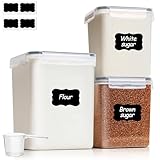


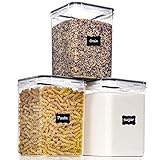
For high-quality airtight options, prices typically range from $15 to $25 for individual specialty containers, while comprehensive 3-pack to 4-pack modular storage sets range from $22 to $60 depending on the materials and lid mechanisms.
Standard Sizes
When shopping for pantry canisters, manufacturers list capacities in quarts, liters, fluid ounces, or cups. To make your organization project seamless, here is a breakdown of standard storage sizes required for common baking dry goods, complete with real-world dimensions.
| Ingredient & Bag Weight | Recommended Canister Volume | Imperial Dimensions (W x D x H) | Metric Dimensions (W x D x H) | Best Material & Features |
|---|---|---|---|---|
| All-Purpose Flour (5 lbs) | 4.7 to 5.5 Quarts (4.4L to 5.2L) | 6.5″ x 6.5″ x 8.5″ to 7.5″ x 7.5″ x 9.5″ | 16.5 x 16.5 x 21.6 cm to 19.0 x 19.0 x 24.1 cm | BPA-free plastic or wide-mouth glass with airtight silicone seals. |
| Granulated Sugar (4 lbs) | 3.0 to 3.5 Quarts (2.8L to 3.3L) | 5.5″ x 5.5″ x 7.5″ to 6.0″ x 6.0″ x 8.0″ | 14.0 x 14.0 x 19.0 cm to 15.2 x 15.2 x 20.3 cm | Airtight plastic or ceramic with flip-top lids. Sugar does not aerate like flour. |
| Brown Sugar (2 lbs) | 1.5 to 2.0 Quarts (1.4L to 1.9L) | 4.5″ x 4.5″ x 6.0″ to 5.0″ x 5.0″ x 7.0″ | 11.4 x 11.4 x 15.2 cm to 12.7 x 12.7 x 17.8 cm | Ultra-airtight plastic with integrated terra cotta clay disk holders. |
| Powdered Sugar (2 lbs) | 1.8 to 2.2 Quarts (1.7L to 2.1L) | 4.8″ x 4.8″ x 6.2″ to 5.2″ x 5.2″ x 7.2″ | 12.2 x 12.2 x 15.7 cm to 13.2 x 13.2 x 18.3 cm | Clear plastic with a built-in dusting spoon or dusting screen. |
| Bulk Flour (10 lbs) | 9.5 to 11.0 Quarts (9.0L to 10.4L) | 8.5″ x 8.5″ x 11.5″ to 9.5″ x 9.5″ x 13.0″ | 21.6 x 21.6 x 29.2 cm to 24.1 x 24.1 x 33.0 cm | Heavy-duty food-grade buckets or large rolling bins. |
How to Measure Your Space
Before purchasing a canister set, you must measure your physical kitchen storage areas. A canister that holds your 5-pound flour bag perfectly is useless if it cannot clear the bottom of your upper cabinets or fit on your pantry shelves. Follow these steps to get precise measurements:
- Measure the Vertical Clearance: Measure the height between your countertop and the bottom of your upper cabinets. Standard clearances range from 18 to 20 inches, but light valances or under-cabinet outlets can reduce this to 15 or 16 inches. Ensure your canister is at least 1.5 inches shorter than this clearance so you can comfortably lift and move it.
- Account for Lid Mechanisms: Do not just measure the body of the canister. Pop-up buttons, locking side latches, and wire-bail clamps can add anywhere from 0.5 inches to 1.5 inches to the overall height. Check the manufacturer’s “total height” specification rather than just the container body height.
- Determine Shelf Depth: Measure the depth of your pantry shelves or cabinets from the back wall to the front edge. Standard upper cabinets are 12 inches deep, while pantry shelves range from 12 to 18 inches deep. Choose square or rectangular canisters to maximize depth, as round canisters leave wasted, empty space in the corners.
- Calculate Reach and Hand Space: If you plan to store canisters on deep pantry shelves, ensure there is at least 2 to 3 inches of headroom above the canister. This allows you to reach in, grab the container, and pull it out without scraping your knuckles on the shelf above.
By Room or Use Case
In 2026, kitchen storage design focuses heavily on maximizing volume efficiency while matching your specific kitchen workflow. Depending on where and how you bake, your canister requirements will change.
The Countertop Baker
If you keep your flour and sugar within arm’s reach next to your stand mixer, aesthetics and physical footprint are your primary concerns. For countertop display, heavy-duty borosilicate glass or glazed ceramic canister sets are ideal. Look for wide-mouth designs (at least 5.5 to 6 inches in diameter) so you can scoop flour directly from the container without making a mess. Glass allows you to monitor inventory levels at a glance. A premium 3-pack glass canister set with airtight bamboo or stainless steel lids, ranging from 2.6 quarts to 5.5 quarts, typically costs between $18 and $30.
The Organized Deep Pantry
For those who prefer to keep countertops clear, deep pantry storage requires space-optimized, highly stackable containers. Rectangular or square BPA-free plastic canisters are the gold standard here. Look for modular designs where two smaller canisters can stack perfectly on top of one larger 5.2-liter (5.5-quart) flour canister. Clear plastic allows you to see the contents from any angle. High-quality 4-pack modular sets with pop-up airtight lids, scoops, and reusable chalkboard labels range from $45 to $60, providing uniform organization that prevents pests and keeps flour fresh for months.
The Compact Apartment Kitchen
In small kitchens with narrow cabinets or limited drawer space, you need a slim-profile canister that maximizes vertical space rather than horizontal space. Look for specialized flour keepers that feature a narrow, ergonomic grip on the body, making them easy to hold with one hand. Many of these compact designs include a built-in leveler bar inside the rim and a secure snap-locking lid with an integrated pour spout. A high-quality, 5-pound-capacity space-saving plastic flour keeper with these integrated baking tools typically costs between $15 and $20.
Common Sizing Mistakes
Avoiding these common pitfalls will save you from returning containers that don’t quite fit your kitchen habits:
- Confusing Weight with Volume: This is the single most common mistake. A 5-pound bag of flour refers to weight, not volume. Flour is light and powdery; 5 pounds of flour occupies about 4.7 to 5 quarts of volume. If you buy a canister labeled “80 ounces” (which is 5 pounds in weight), you are buying a container that only holds 2.5 quarts of volume. Your flour will not fit. Always look for canisters rated for at least 160 to 176 fluid ounces, or 5 to 5.5 quarts.
- Forgetting the Scoop Displacement: If you buy a canister that fits exactly 5 pounds of flour to the very brim, you will not be able to store your measuring scoop inside the container until you have used at least 3 or 4 cups of flour. Buying a slightly oversized canister (5.5 quarts or 176 ounces) ensures there is plenty of room to leave your scoop resting inside.
- Ignoring the “Bag-In” Storage Option: Many home bakers prefer to keep their flour inside its original paper bag to prevent flour dust from coating the inside of the container or to keep track of expiration dates and flour types (like unbleached vs. bread flour). If you want to drop the entire paper bag directly into the canister, you must size up to a 5.5-quart to 6-quart container. The corners of the paper bag require extra structural clearance that standard 4.7-quart containers cannot accommodate.
- Neglecting Lid Gasket Thickness: Some decorative ceramic and metal canister sets have thick silicone gaskets or inner lids that plunge deep into the container neck. This reduces the actual usable storage height by up to an inch. Always verify that the “interior usable volume” matches your needs, rather than relying solely on the exterior dimensions.
FAQ
How many quarts is a 5 lb bag of flour?
A 5-pound bag of all-purpose flour is approximately 4.7 quarts of volume when poured and lightly settled. Because flour contains pocketed air, it expands when transferred. To avoid spills, you should always use a container with a capacity of at least 5.0 to 5.5 quarts (which is roughly 20 to 22 cups).
Can I store flour in its original paper bag inside a canister?
Yes, storing the paper bag inside an airtight canister is an excellent way to keep your pantry clean and preserve the flour’s expiration date and brand info. However, because the paper bag has bulky folded corners, you will need a larger canister—typically 5.5 to 6.0 quarts in volume—to allow the bag to slide in easily without ripping.
Do airtight canisters actually extend the shelf life of flour?
Absolutely. Standard paper flour bags are porous, meaning they expose your flour to humidity, ambient kitchen odors, and pantry pests like weevils. A high-quality canister with a silicone gasket seal blocks moisture and pests, extending the shelf life of white all-purpose flour from 6 months up to 1 year when stored in a cool, dark place.
What is the difference between dry quarts and liquid quarts for canister sizing?
Most canister manufacturers label their capacities using liquid quarts or liters. One liquid quart is approximately 32 fluid ounces, whereas one dry quart is about 37.2 fluid ounces. Because kitchen canisters are standardized to liquid measurements, a “5-quart” canister actually holds 160 fluid ounces of volume, which is the perfect size for a standard 5-pound bag of flour.
Ready to decide? Our #1 pick for 2026 is the All-Purpose Flour (5 lbs).
Live price & availability on Amazon.


Write Your Review
No reviews yet. Be the first to share your experience!