
A stainless steel frying pan is one of the most versatile tools for searing meat, sautéing vegetables, and creating flavorful pan sauces. However, construction, cooking surface, weight, and handle design can make two similar-looking pans perform differently. This guide compares seven worthwhile options and explains how to choose one for everyday cooking.
Best stainless steel frying pan options for everyday cooking
A dependable stainless steel pan should distribute heat predictably, offer enough cooking space, and remain comfortable when transferring food between the stove and oven. Fully clad designs are especially appealing because conductive metal extends through the cookware’s sides. These seven options address different cooking styles and budgets.
Made In Stainless Clad Frying Pan – Best overall versatility
The Made In Stainless Clad Frying Pan is a strong choice for home cooks who want one versatile pan for searing, sautéing, and finishing food in the oven. Its five-ply construction combines stainless steel and aluminum layers, supporting efficient heat distribution without relying on a synthetic nonstick coating.
The 12-inch model is especially practical for preparing family dinners. Its broad cooking surface accommodates several chicken thighs, fish fillets, or vegetable portions without requiring the same amount of batching as a smaller skillet.
This additional working space matters because crowding encourages food to release moisture. Instead of developing a browned exterior, closely packed ingredients may begin steaming. A larger pan helps reduce that problem when the burner is appropriately sized.
The five-ply construction also contributes to predictable temperature management. Aluminum distributes heat more effectively than stainless steel alone, while the stainless steel surfaces provide durability and compatibility with a wide variety of ingredients.
Unlike carbon steel or uncoated cast iron, stainless steel does not depend on a maintained seasoning layer. That makes it particularly useful for cooking tomato-based sauces, wine reductions, and other acidic preparations.
The pan’s handle is shaped for controlled lifting and pouring. Nevertheless, a full 12-inch skillet becomes heavy when loaded with meat, vegetables, and cooking liquid.
One limitation is that stainless steel requires technique. Eggs and delicate fish may stick if the pan is inadequately preheated, improperly oiled, or disturbed before the food releases naturally.
A second consideration is cost. Made In occupies a higher price category than entry-level fully clad cookware, although its construction is intended for prolonged regular use.
Advantages: Five-ply construction, generous cooking area, excellent versatility, induction compatibility, and oven-safe design.
Limitations: Premium pricing, no inherent nonstick coating, and a learning curve for delicate foods.
Best for: Home cooks wanting a versatile, durable skillet for everyday meals and occasional high-temperature cooking.
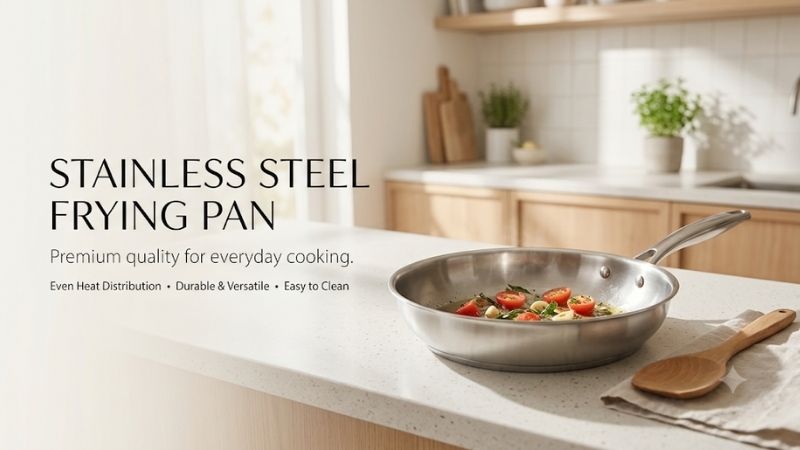
All-Clad D3 Stainless Fry Pan – Best classic premium choice
The All-Clad D3 Stainless Fry Pan is a longstanding favorite among cooks who value fully clad construction and straightforward design. Its three-ply configuration places an aluminum core between stainless steel layers, allowing the pan to respond to heat changes while remaining suitable for everyday stovetop cooking.
The D3 series is especially appealing because it demonstrates that additional metal layers are not always necessary for excellent results. A well-engineered three-ply pan can distribute heat effectively and respond quickly when the burner temperature changes.
For searing chicken breast, begin with moderate heat rather than automatically selecting the highest setting. Once the surface is properly heated, add oil and place the chicken in the pan without overcrowding it.
The stainless steel surface promotes browning and the formation of fond, the flavorful browned residue that collects on the cooking surface. After the meat is removed, a small quantity of stock or another suitable liquid can dissolve that residue and form the basis of a pan sauce.
The D3’s flared sides also make tossing vegetables and moving food with a spatula relatively straightforward.
However, its handle has a distinctive contoured design that some cooks find comfortable and others consider less natural than a rounded alternative.
Buyers should evaluate handle comfort carefully if they frequently lift the pan with one hand.
The D3 is often available in several sizes, with larger versions providing more working room for family cooking.
Like other uncoated stainless steel skillets, it requires appropriate temperature control to prevent unnecessary sticking.
The polished exterior may also show fingerprints and cosmetic discoloration after repeated use. These changes do not necessarily affect cooking performance.
Advantages: Fully clad three-ply construction, responsive heating, durable materials, broad versatility, and established product design.
Limitations: Premium price, polarizing handle geometry, and visible cosmetic staining over time.
Best for: Serious home cooks who want a proven stainless steel skillet without unnecessary features.
Tramontina Tri-Ply Clad Fry Pan – Best budget-friendly value
The Tramontina Tri-Ply Clad Fry Pan provides an accessible alternative to more expensive stainless steel cookware. Its fully clad design combines stainless steel surfaces with an aluminum core, delivering the basic construction benefits that make premium frying pans useful for searing and sautéing.
For buyers entering the stainless steel category, Tramontina offers an opportunity to learn temperature control without committing to a substantially more expensive pan.
The 12-inch version is especially attractive when cooking for several people. It provides enough room for many everyday meals while retaining a familiar frying-pan shape.
A practical example is browning sliced chicken for a weeknight rice bowl. A larger cooking surface allows ingredients to spread out, helping moisture evaporate instead of accumulating beneath the food.
That does not mean the entire pan will heat identically in every kitchen. Burner size, stove design, and pan placement still influence temperature distribution.
Tramontina’s fully clad construction helps move heat across the cooking surface, but users should preheat gradually and avoid placing a very large pan over an undersized burner at maximum heat.
The stainless steel surface can tolerate ordinary cooking utensils without the same coating concerns associated with conventional nonstick cookware.
However, the pan is not naturally nonstick. Users preparing eggs or fish must develop appropriate techniques for preheating and lubrication.
Another limitation is that lower purchase prices do not always include the same finish details, handle preferences, or service arrangements as premium competitors.
Those differences deserve consideration, although they do not automatically undermine cooking performance.
Advantages: Accessible price positioning, fully clad construction, large cooking area, and broad everyday versatility.
Limitations: No nonstick coating, potential handle-preference differences, and fewer premium finishing details.
Best for: Budget-conscious households seeking an affordable introduction to quality stainless steel cookware.
Misen Stainless Steel Frying Pan – Best for comfortable handling
The Misen Stainless Steel Frying Pan appeals to home cooks who want substantial construction and an ergonomic design without moving into the highest luxury price category. Its five-ply stainless steel and aluminum structure is intended to distribute heat effectively across a generously sized cooking surface.
A pan’s handle becomes more important during actual cooking than its appearance may suggest. Lifting a skillet filled with ingredients, tilting it to distribute oil, and transferring it into an oven all require a reliable grip.
Misen emphasizes a rounded handle profile designed for comfortable handling. This may appeal to cooks who dislike sharply contoured stainless steel handles.
The skillet is suitable for browning meats, cooking vegetables, and preparing meals that begin on the stove and finish in the oven.
For example, thick pork chops can be seared on both sides before being transferred to the oven, provided the specific model’s temperature limits are respected.
The broad cooking surface can also help when preparing several portions, although a large pan requires adequate burner coverage.
Five-ply construction should not be interpreted as a guarantee that the pan will outperform every three-ply alternative. Metal thickness, alloy selection, and overall engineering can be just as important.
The stainless steel cooking surface has the usual learning curve associated with uncoated cookware.
Cooking delicate eggs may require additional attention to temperature and oil compared with a conventional nonstick skillet.
Buyers should also consider the weight of the specific size selected. More substantial construction may be welcome during searing but less convenient for frequent tossing.
Advantages: Comfortable handle design, five-ply construction, broad cooking surface, and versatile stovetop performance.
Limitations: Heavier feel than some alternatives and the normal stainless steel learning curve.
Best for: Home cooks who prioritize comfortable handling alongside durable multipurpose performance.
Premium and specialty stainless steel frying pan choices
Premium pans may offer thicker construction, more refined finishing, or details that simplify cleaning. However, higher prices do not automatically translate into better meals. The following options are most worthwhile when their particular advantages solve a recurring problem, such as stubborn residue, demanding searing, or frequent long-term use.
Demeyere Industry Stainless Steel Fry Pan – Best for easy cleaning
The Demeyere Industry Stainless Steel Fry Pan is a premium option for cooks who appreciate substantial construction and carefully finished details. Its multilayer design is intended for responsive heating, while the rivetless cooking interior provides a practical advantage when removing food residue after searing.
Rivets are a common feature in stainless steel skillets, but they can create small areas where food particles accumulate. A rivetless interior removes those obstructions, making the cooking surface easier to access with a sponge or spatula.
This detail becomes particularly useful when cooking dishes that create sticky fond or thick sauces.
For example, after pan-searing chicken and reducing a sauce, residue may collect near the upper edges of a conventional skillet. A smoother interior simplifies wiping and rinsing those areas.
Demeyere’s multilayer construction also makes the pan suitable for demanding stovetop use, including induction cooking when supported by the particular model.
However, a substantial stainless steel pan does not respond instantly to every burner adjustment. Users should still account for the pan’s mass and preheat gradually.
The Industry series is not the same as Demeyere’s heavier Atlantis Proline products, so buyers should compare the correct line rather than treating all Demeyere cookware as identical.
Another consideration is price. A rivetless interior and premium finish can justify extra spending for frequent cooks, but someone preparing occasional meals may not notice enough benefit.
The surface is uncoated stainless steel and still requires proper cooking technique.
Advantages: Rivetless interior, premium construction, strong versatility, and easier access during cleaning.
Limitations: High price, substantial construction, and no synthetic nonstick coating.
Best for: Frequent cooks who value refined construction and straightforward cleanup.
Cuisinart MultiClad Pro Frying Pan – Best practical midrange option
The Cuisinart MultiClad Pro Frying Pan is designed for buyers who want fully clad stainless steel construction at a more approachable price than many premium competitors. Its aluminum-core design provides useful heat distribution, while the familiar shape makes it suitable for common household cooking tasks.
The greatest attraction is the combination of practical construction and relatively accessible pricing.
For many everyday recipes, a properly used midrange stainless steel skillet can produce results that are difficult to distinguish from significantly more expensive alternatives.
Consider cooking sliced mushrooms. The key factors are sufficient pan area, effective preheating, and controlling moisture rather than paying for a particular brand name.
If the mushrooms are crowded, they release moisture faster than it can evaporate. The result may be steaming rather than browning.
With appropriate spacing and heat management, the MultiClad Pro can support the browning needed for sautéed vegetables and pan sauces.
The stainless steel surface is also useful for acidic ingredients because it does not depend on a maintained seasoning layer.
A buyer should still pay attention to cooking-surface diameter rather than relying only on the nominal rim measurement.
The pan’s sloped walls reduce the usable flat area compared with its outer diameter.
Cleaning typically requires more effort than wiping a fresh nonstick coating, particularly after high-temperature searing.
Nevertheless, food residue can often be loosened through soaking or gentle deglazing after the pan has cooled appropriately.
Advantages: Fully clad design, accessible pricing, useful heat distribution, and everyday versatility.
Limitations: Normal stainless steel sticking behavior and less premium refinement than luxury alternatives.
Best for: Home cooks looking for a practical midrange frying pan for regular use.
Heritage Steel Eater Series Fry Pan – Best for long-term value
The Heritage Steel Eater Series Fry Pan provides another compelling option for buyers seeking durable stainless steel cookware. Its fully clad construction and straightforward design make it suitable for households that want reliable performance without paying primarily for decorative details or elaborate branding.
An important consideration when buying stainless steel cookware is how the pan will perform after years of routine use.
Unlike a skillet with a conventional nonstick coating, an uncoated stainless steel frying pan does not depend on a thin synthetic surface that gradually wears away.
Scratches and discoloration can appear, but ordinary cosmetic wear does not necessarily prevent the pan from performing its basic functions.
The Eater Series is suited to browning proteins, sautéing vegetables, and preparing pan sauces.
A useful example is cooking chicken thighs for a family meal. Begin by heating the pan gradually, add a suitable amount of oil, and allow the skin to develop color before attempting to move the meat.
If the chicken resists lifting, it may need more time to form a crust and release naturally.
After cooking, the pan can be deglazed with stock to incorporate browned residue into a sauce.
This is a clear advantage over cooking methods that avoid developing fond.
Buyers should evaluate the skillet’s handle shape, overall weight, and actual flat cooking diameter.
A well-made pan still needs to fit the household’s burners and storage space.
The Eater Series is not automatically the best option for delicate eggs, but it can serve as a dependable primary skillet.
Advantages: Fully clad construction, durable uncoated surface, practical design, and strong long-term versatility.
Limitations: Requires proper temperature control and careful evaluation of size and handle preference.
Best for: Households seeking dependable cookware intended for prolonged everyday use.
How to choose a stainless steel frying pan for your kitchen
The right skillet is determined by more than its brand or the number of bonded layers. Cooking-surface diameter, weight, burner compatibility, and handling comfort can influence daily satisfaction more than small specification differences. Understanding these factors helps buyers invest in features that genuinely improve cooking performance.
Compare fully clad construction with disc-bottom cookware
Stainless steel does not conduct heat as effectively as aluminum or copper, so manufacturers often combine metals to improve performance. Fully clad pans extend conductive layers through the base and walls, while disc-bottom designs concentrate the added material beneath the cooking surface. Each construction has different practical implications.
A fully clad skillet can distribute heat more effectively through its sloped sides. This is useful for sautéing, where ingredients may contact both the center and the lower walls.
Disc-bottom designs can provide good heating across the base, particularly when the conductive disc is appropriately sized.
However, the transition between the disc and the surrounding steel may produce a noticeable difference in temperature.
The importance of this effect depends on the recipe and burner.
For a pan used mainly to simmer sauces or heat liquids, a well-made disc-bottom model may provide adequate performance.
For a multipurpose frying pan used to sear, toss, and sauté, fully clad construction is often more flexible.
Buyers should also understand that three-ply and five-ply labels are not direct quality rankings.
Layer thickness, material selection, and manufacturing consistency matter.
A lightweight three-ply skillet can be more responsive than a thicker alternative.
A heavier five-ply pan may retain heat differently during searing.
Neither characteristic is universally superior.
Choose construction based on cooking habits rather than assuming a higher layer count always provides better value.
Choose between 10-inch and 12-inch frying pans
Pan size affects how many ingredients can brown at once, how comfortably the skillet handles, and whether the burner can heat the surface effectively. A 10-inch pan is often convenient for individuals and couples, while a 12-inch design provides more room for family meals and batch cooking.
The most important measurement is the flat cooking diameter, not just the distance across the top rim.
A skillet advertised as 12 inches may provide a noticeably smaller flat surface because its walls slope outward.
That shape can be useful when tossing food, but it limits how many large pieces of meat can lie flat.
For two servings of chicken or vegetables, a 10-inch model may be sufficient.
For four portions, a 12-inch pan is usually more comfortable.
However, a larger pan does not automatically cook more evenly.
A small burner may heat the center much more intensely than the outer edges.
This can create uneven browning, particularly when cooking several steaks or fish fillets.
Large skillets also require more space for storage and cleaning.
A full pan containing food can be difficult to lift with one hand.
For most households buying only one stainless steel frying pan, a 12-inch size offers valuable flexibility if the stove and storage space can accommodate it.
Learn proper preheating to reduce food sticking
Stainless steel cookware rewards consistent cooking technique. Food sticking is influenced by surface temperature, moisture, oil, and how soon ingredients are moved. Beginners often blame the pan when the actual problem is excessive heat, insufficient preheating, or attempting to flip food before it forms a stable crust.
Start by heating the empty pan gradually over medium heat.
Avoid immediately using the maximum burner setting, especially with an empty fully clad skillet.
Once the pan is appropriately heated, add oil and allow it to spread across the surface.
The oil should look fluid and move easily, but it should not be smoking heavily.
Pat meat or fish dry before placing it in the pan.
Excess surface moisture delays browning because energy must first evaporate the water.
Once the ingredient touches the metal, avoid moving it immediately.
Proteins often release more easily after a browned crust forms.
Eggs require a somewhat different approach because they are delicate and can adhere to stainless steel.
Moderate heat, sufficient fat, and careful timing are particularly important.
After cooking, allow the pan to cool appropriately before washing.
Use warm water, dish soap, and a nonabrasive sponge for ordinary cleaning.
For stubborn browned residue, loosen it through soaking or controlled deglazing instead of scraping aggressively.
Conclusion
The best stainless steel frying pan is one that fits your cooking habits, burner, and budget. Made In offers broad everyday versatility, All-Clad D3 provides classic premium construction, and Tramontina delivers impressive value for beginners. Misen emphasizes handling comfort, Demeyere simplifies interior cleaning, and Cuisinart or Heritage Steel offer practical alternatives. Prioritize sufficient cooking space, fully clad construction, and comfortable weight, then develop proper heat control to get the most from your purchase.
Write Your Review
No reviews yet. Be the first to share your experience!