
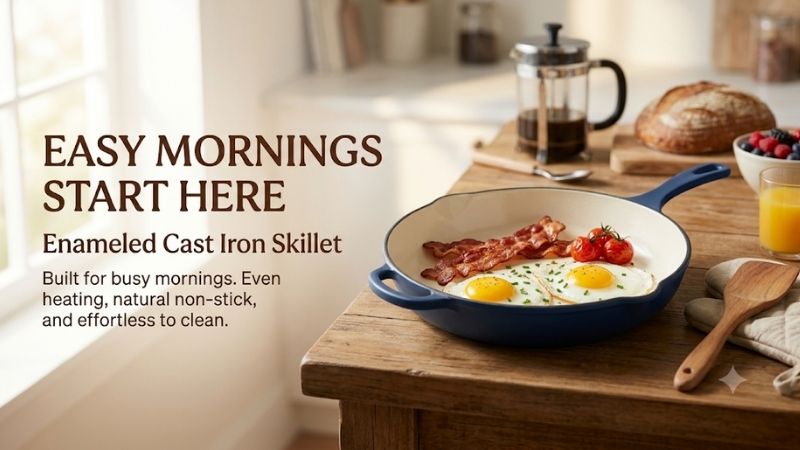
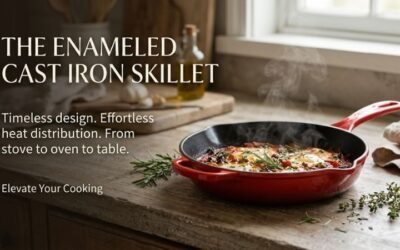
An enameled cast iron skillet for busy mornings can handle eggs, potatoes, and one-pan breakfasts without the seasoning upkeep of bare iron. Still, weight, slow preheating, and food release can affect how quickly breakfast reaches the table. This guide explains what size and shape to buy and how to organize a safe, efficient routine.
Why enameled cast iron can work for busy breakfasts
Morning cooking often involves limited time, multiple dishes, and an immediate need for cleanup. Enameled cast iron offers durability and versatility, but its heavy construction and gradual heating behavior require planning. Understanding these characteristics helps buyers decide whether enamel is genuinely convenient for their breakfast habits.
Understand the benefits of cooking without traditional seasoning
Enameled cast iron removes one of the maintenance responsibilities associated with bare iron cookware. Its protective coating prevents food from contacting the underlying metal directly, eliminating the need to develop and preserve a conventional seasoning layer. This can simplify breakfast cleanup for households with demanding morning routines.
With traditional cast iron, users need to be attentive to moisture and seasoning condition.
A neglected skillet can develop rust, especially when left wet after washing.
Enameled cast iron provides a protective surface that does not require periodic oil seasoning.
This is useful when the cook needs to clean the breakfast dishes quickly before leaving home.
A pan used for eggs and vegetables can generally be washed with suitable dish soap and a soft sponge after cooling.
However, low maintenance should not be confused with no maintenance.
The enamel can still be scratched or chipped through unsuitable handling.
Manufacturers may also have different dishwasher recommendations.
Another advantage is flexibility with acidic ingredients.
Tomatoes, lemon juice, and other acidic foods can be cooked without gradually stripping a seasoning layer.
This makes enamel useful for breakfast recipes involving tomatoes, peppers, or a finishing sauce.
The primary trade-off is that enamel does not develop the same seasoning-based release characteristics as bare iron.
For cooks expecting eggs to slide effortlessly from the first use, a dedicated nonstick skillet may be more appropriate.
Balance heat retention with realistic morning preparation time
Cast iron retains heat effectively once it is warm, but reaching an appropriate cooking temperature takes time. This matters during busy mornings because rushing the preheating process can create hot spots or cause food to stick. A practical breakfast routine should account for the skillet’s heating behavior rather than treating it like lightweight aluminum cookware.
Begin by placing the skillet on a suitable burner over low or medium heat.
Allow it to warm gradually while preparing ingredients.
This approach helps reduce temperature differences across the pan.
Turning the burner to maximum immediately is not necessarily faster in a useful sense.
The center may become excessively hot while the outer cooking area remains cooler.
That can cause eggs to brown unevenly or potatoes to cook inconsistently.
For breakfast potatoes, the skillet’s retained heat is valuable once it reaches the correct temperature.
The pan can support steady browning while the cook turns the pieces.
For delicate scrambled eggs, the same thermal mass may be less convenient.
Cast iron does not cool immediately when the burner setting is reduced.
A cook who overheats the pan may struggle to regain control quickly.
For this reason, enameled cast iron is especially useful for recipes that benefit from a stable medium temperature.
Potatoes, sausage, mushrooms, and certain breakfast sandwiches are strong examples.
If the household prioritizes extremely fast egg preparation, lighter cookware may be a better companion.
The ideal decision reflects the actual breakfast menu rather than assuming one material performs every task equally well.
Choose a skillet that reduces cooking and cleanup steps
A useful breakfast skillet should support several preparation stages without requiring additional equipment. Enameled cast iron can brown ingredients, finish dishes in the oven, and serve food directly at the table. This versatility may reduce washing, provided the chosen skillet is appropriately sized and comfortable to handle.
Consider a breakfast consisting of potatoes, peppers, sausage, and eggs.
The potatoes can be browned first, followed by the sausage and vegetables.
Once the ingredients are nearly ready, eggs can be added and cooked to the preferred doneness.
This approach uses one skillet instead of several separate frying pans.
However, the ingredients must be added in a logical sequence.
Potatoes require more cooking time than delicate eggs.
Adding everything simultaneously may result in undercooked potatoes or overcooked eggs.
A deeper enameled skillet may be useful when preparing substantial breakfast hashes.
Its higher sides reduce the likelihood of food spilling during stirring.
However, deep sides can also retain steam.
For crispy potatoes, cooking uncovered is often preferable.
A skillet that can be transferred to the oven adds further flexibility.
A frittata can begin on the stovetop and finish under controlled oven heat.
Check the manufacturer’s oven temperature limits before using this method.
The best breakfast cookware reduces unnecessary steps while supporting the correct technique for each ingredient.
How to choose an enameled cast iron skillet for busy mornings
Not every enameled skillet is equally convenient for breakfast. Size, handle design, interior finish, and sidewall shape all influence preparation time and cleanup. A practical model should accommodate typical portions without becoming difficult to lift, wash, or store after the morning meal is complete.
Choose an eight-inch, ten-inch, or twelve-inch skillet
Skillet size influences both cooking capacity and heating convenience. A compact model is easier to handle but may require multiple batches, while a larger pan accommodates family breakfasts at the cost of greater weight and storage requirements. Buyers should match diameter to the number of servings prepared most mornings.
An eight-inch skillet can be useful for a single serving.
It may accommodate one or two eggs, a small omelet, or a modest portion of vegetables.
Its compact size reduces the area that must be cleaned after cooking.
However, it can become crowded when preparing a complete breakfast.
A ten-inch skillet offers greater flexibility.
It can accommodate a couple of sausage patties, several eggs, or a more substantial breakfast hash.
For couples, this is often a practical everyday size.
A twelve-inch skillet is more appropriate for families preparing several portions simultaneously.
The additional area helps prevent overcrowding, especially when browning potatoes or meat.
However, large enameled cast iron cookware can become quite heavy.
The pan may be difficult to lift when filled with food.
Burner size also matters.
A large skillet on a small burner can heat unevenly, increasing the need for careful preheating.
For most households, the best size is the one that accommodates normal breakfast portions without requiring excessive handling.
Compare shallow frying pans with deeper covered skillets
Skillet shape influences moisture control, cooking capacity, and ease of turning food. Shallow pans are convenient for flipping eggs and browning potatoes, while deeper models provide more room for substantial breakfast dishes. Covered skillets introduce further versatility but may be less suitable for recipes requiring a crisp surface.
A shallow frying pan encourages moisture to escape during cooking.
This is useful when preparing crispy breakfast potatoes, browned sausage, or pan-fried bread.
The low walls also make it easier to reach beneath delicate ingredients with a spatula.
A deeper skillet provides additional volume.
It can accommodate larger quantities of vegetables or recipes containing sauce.
However, higher walls may retain more steam.
When the pan is crowded, this can interfere with browning.
A covered skillet offers another option.
A lid can help trap heat and moisture when cooking thicker ingredients or finishing a breakfast casserole.
However, covering potatoes continuously may soften their exterior.
A useful technique is to cook covered briefly when needed, then remove the lid to allow moisture to evaporate.
For most everyday breakfast recipes, a moderately shallow skillet provides the strongest balance.
Choose a deeper model when substantial one-pan meals are common.
A covered skillet is most worthwhile when the household regularly prepares dishes that benefit from controlled moisture.
Evaluate handle comfort and lifting safety
Enameled cast iron skillets can be heavy, particularly when filled with hot food. Handle shape, helper grips, and overall balance affect how safely the pan can be lifted and moved. Buyers should examine these features carefully because rushed morning routines can increase the likelihood of careless handling.
A long handle provides leverage when tilting or moving the skillet.
However, it may become hot during cooking.
A short handle reduces the storage footprint but offers less leverage with a loaded pan.
Helper handles are particularly valuable on larger enameled skillets.
They allow users to support the pan with both hands when moving it to the oven or serving area.
However, both handles can become hot.
Appropriate oven mitts should remain close to the cooking station.
Weight should also be considered before purchasing.
A skillet that is comfortable to lift when empty may become inconvenient after adding potatoes, sausage, and other ingredients.
Avoid choosing a pan based solely on its appearance.
A beautiful enameled finish does not compensate for an uncomfortable grip.
Check whether the handle allows sufficient clearance from the stovetop and neighboring burners.
For households with children, avoid positioning the handle where it can be pulled or accidentally struck.
The most practical skillet provides secure handling without requiring awkward movements during normal breakfast preparation.
Cooking common breakfast foods with enameled cast iron
Enameled cast iron can prepare many breakfast dishes, but successful results depend on matching temperature to the ingredients. Potatoes, eggs, bacon, and breakfast vegetables behave differently when exposed to retained heat. Understanding these differences helps cooks plan efficient meal sequences without sacrificing texture.
Cook eggs without excessive sticking or overbrowning
Eggs are among the most demanding foods for enameled cast iron because their proteins can adhere to the cooking surface. Although enamel eliminates seasoning maintenance, it does not provide the same release performance as a dedicated coated nonstick pan. Appropriate preheating and cooking fat remain essential.
For scrambled eggs, begin with gentle heat.
Avoid overheating the empty skillet before adding butter.
Cast iron retains heat, so excessive preheating may cause the eggs to cook too quickly even after the burner is reduced.
Use enough butter or another suitable fat to coat the surface.
Add the beaten eggs once the pan reaches a moderate temperature.
Stir with a suitable utensil, following the manufacturer’s guidance regarding enamel protection.
Silicone or wooden utensils are often practical because they are less likely to damage the finish.
For fried eggs, allow the whites to set before attempting to move them.
Do not assume the eggs will release immediately.
A small amount of sticking may occur, particularly when the pan is too hot.
If the household prepares eggs every morning and prioritizes effortless release, a ceramic nonstick skillet may be more convenient.
Enameled cast iron becomes more attractive when eggs are part of a larger breakfast dish.
A skillet hash topped with eggs, for example, benefits from the pan’s capacity and ability to move into the oven.
Prepare crispy potatoes and breakfast sausage
Potatoes and sausage are excellent candidates for enameled cast iron because they benefit from consistent contact with a heated surface. The pan’s thermal mass supports browning once properly preheated. However, crowding and excess moisture can prevent the crispy results many people expect from a substantial skillet.
For breakfast potatoes, cut the pieces into reasonably uniform sizes.
This helps them cook at similar rates.
If using raw potatoes, consider whether partial precooking would reduce the time required in the skillet.
Drain and dry the potatoes thoroughly before browning.
Moisture on the surface encourages steaming rather than crisping.
Preheat the skillet gradually and add a suitable cooking fat.
Spread the potatoes into a relatively even layer.
Avoid stirring constantly.
Allowing the pieces to remain in contact with the cooking surface helps develop color.
For sausage patties, provide enough space between portions.
Crowding causes moisture and rendered fat to accumulate.
Adjust the burner as necessary rather than allowing the skillet to become excessively hot.
A food thermometer should be used to confirm that sausage reaches a safe internal temperature appropriate to the meat.
Once cooking is complete, allow the skillet to cool before washing.
This combination of browning and thermal stability is one of the strongest reasons to choose enameled cast iron for breakfast.
Make breakfast hashes and oven-finished frittatas
One-pan breakfasts are a natural match for enameled cast iron because the skillet can brown ingredients, combine flavors, and finish cooking in the oven. A well-planned recipe minimizes extra equipment and reduces cleanup. However, ingredient order and moisture control are important for consistent results.
Begin a breakfast hash with ingredients that require the longest cooking time.
Potatoes or dense vegetables should usually enter the skillet before delicate greens.
Once they develop color, add onions, peppers, or cooked proteins as appropriate.
Stir carefully to avoid scraping the enamel with unsuitable utensils.
For a frittata, prepare the vegetables first and remove excess moisture.
Adding watery vegetables directly to eggs can produce a loose or uneven texture.
Pour the egg mixture over the ingredients and allow the base to begin setting.
Transfer the skillet to a preheated oven if the manufacturer approves that use.
Use a temperature suitable for the recipe and verify that the eggs are cooked to the desired safe doneness.
The skillet will remain hot for some time after leaving the oven.
Prepare a heat-safe surface before removing it.
For a busy morning, ingredients such as chopped vegetables can be prepared the previous evening and stored safely in the refrigerator.
Planning ahead often saves more time than buying a different skillet.
Cleaning and organizing the morning cooking routine
A convenient skillet should be manageable after breakfast, not merely perform well while food is cooking. Enameled cast iron eliminates traditional seasoning maintenance, but it still requires appropriate cleaning and careful storage. Organizing ingredients and equipment before cooking can make the entire routine more efficient.
Build a realistic fifteen-minute breakfast workflow
A short breakfast routine depends on preparation, cooking sequence, and choosing recipes suited to the available time. Cast iron’s gradual heating behavior makes planning especially important. Instead of rushing the skillet to maximum temperature, organize ingredients while the pan warms over moderate heat.
Begin by deciding which ingredients can be prepared in advance.
Chopped vegetables, washed potatoes, and measured seasonings can often be organized the previous evening.
Store perishable ingredients safely in the refrigerator.
During the morning, place the skillet on a suitable burner and begin gradual preheating.
While it warms, arrange the ingredients near the cooking area.
Avoid placing packaging or utensils directly beside hot surfaces.
Cook ingredients in order of required time.
For a simple breakfast hash, begin with precooked or par-cooked potatoes.
Add vegetables and cooked proteins when appropriate.
Finish with eggs or a quick garnish.
The exact total time depends on ingredients, serving size, and skillet temperature.
A fifteen-minute goal is realistic for some prepared recipes but not for thick raw potatoes or large portions of meat.
Avoid sacrificing safe cooking temperatures to meet a strict schedule.
For more demanding breakfasts, prepare components in advance or choose a faster cooking method.
The most efficient routine is one that remains safe and repeatable.
Remove food residue without damaging the enamel
Enameled cast iron is easier to maintain than bare iron in several respects, but the coating still requires appropriate handling. Food can adhere when recipes contain eggs, starches, or sugary ingredients. A gentle cleaning method protects the finish and reduces the chance of unnecessary damage during hurried morning cleanup.
Allow the skillet to cool sufficiently before washing.
Do not place a very hot pan directly into cold water.
Sudden temperature changes may stress the enamel.
For ordinary residue, use warm water, dish soap, and a soft sponge.
Avoid aggressive scraping with sharp tools.
If food remains attached, allow the pan to soak according to the manufacturer’s instructions.
Some brands permit dishwasher cleaning, while others recommend handwashing.
Always follow the instructions for the specific product.
For example, Le Creuset permits dishwasher use on certain Signature skillets but recommends handwashing to preserve the finish.
Lodge recommends handwashing its Essential Enamel skillet.
The distinction matters because enamel formulas and product construction differ.
Dry the skillet before storage.
Although enamel reduces rust concerns, chipped or exposed iron may still be vulnerable.
Inspect the cooking surface periodically for damage.
Gentle cleaning is usually faster over the long term than repeatedly dealing with scratches or heavily burned residue.
Decide whether enamel is the right breakfast investment
Enameled cast iron offers versatility and easier maintenance than traditional seasoned iron, but it may not be the fastest option for every breakfast. Buyers should consider what they cook most often and whether the pan’s advantages justify its weight, price, and gradual heating behavior.
For someone preparing eggs and toast every morning, a lightweight ceramic nonstick skillet may be more convenient.
It generally heats more quickly and can provide easier initial food release.
However, ceramic coatings gradually lose nonstick performance with use.
Enameled cast iron offers different advantages.
It is well suited to substantial breakfasts, oven-finished recipes, acidic ingredients, and one-pan meals.
It also avoids the need to maintain traditional iron seasoning.
The trade-offs include weight, preheating time, and less effortless release for delicate eggs.
A premium enameled skillet can be a worthwhile long-term investment when used for lunch and dinner as well.
Someone who only needs a dedicated egg pan may find the expense unnecessary.
Consider whether the skillet will replace other cookware or simply add another heavy item to storage.
The best decision reflects the entire cooking routine rather than breakfast performance alone.
Conclusion
An enameled cast iron skillet for busy mornings is most useful for breakfast hashes, potatoes, sausage, frittatas, and one-pan meals that benefit from steady heat. A ten- or eleven-inch model suits many households, while larger families may need additional cooking space. Choose a comfortable handle, preheat gradually, use appropriate cooking fat, and clean the enamel gently. For quick delicate eggs alone, a lightweight nonstick skillet may remain the more convenient choice.

Write Your Review
No reviews yet. Be the first to share your experience!