
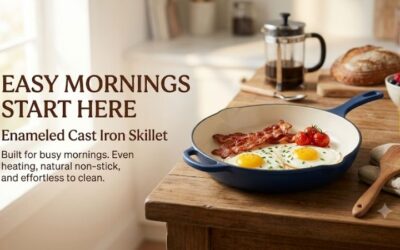
An enameled cast iron skillet offers the heat retention of traditional iron without a seasoning routine, but not every model is equally practical. This roundup compares seven real cookware choices, including budget, premium, deep-sided, and compact pans, then explains what matters for browning, acidic recipes, safe handling, and cleaning.
Best enameled cast iron skillet options for everyday cooking
An everyday enameled skillet should combine dependable heating with comfortable handling and a durable cooking surface. Unlike bare cast iron, enamel does not require traditional seasoning and accommodates acidic ingredients. These options offer different balances of cooking area, price, interior finish, and ease of use.
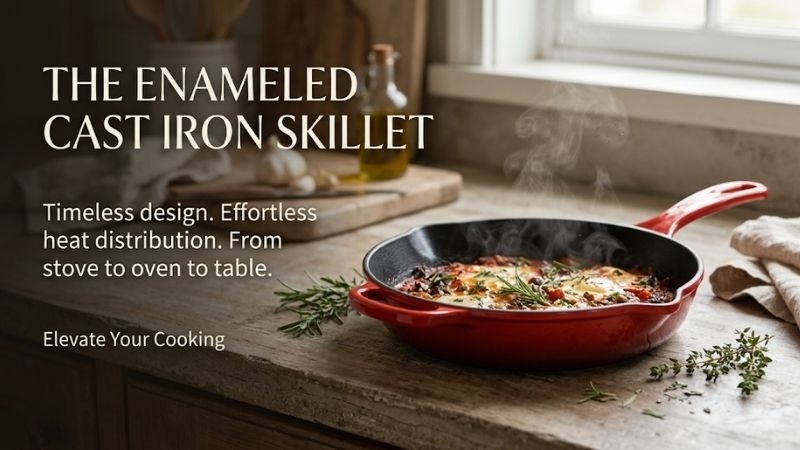
Le Creuset Signature Skillet – Best overall premium choice
The Le Creuset Signature Skillet is an established option for buyers seeking French-made enameled cast iron cookware with a refined finish and versatile cooking performance. Its black satin enamel interior, integrated helper handle, and dual pouring spouts make it suitable for searing, sautéing, oven cooking, and everyday meal preparation.
The 10.25-inch version is a practical size for individuals and couples.
It provides enough room for two moderate portions of meat while remaining easier to accommodate in a conventional kitchen than larger family-sized pans.
The black satin enamel is designed for cooking at higher surface temperatures than many pale enamel interiors used in Dutch ovens.
This makes the skillet useful for browning chicken thighs, cooking pork chops, and preparing vegetables.
However, the enamel should not be confused with conventional synthetic nonstick coating.
Eggs may still adhere if the skillet is heated incorrectly or used without enough cooking fat.
The manufacturer notes that the black surface develops a patina with use. This appearance change is part of its normal cooking behavior and should not be aggressively removed.
The skillet is compatible with gas, electric, ceramic, and induction cooktops.
It is also oven-safe up to 500°F, offering flexibility for recipes that begin with stovetop searing and finish in the oven.
The helper handle provides another gripping point when moving a loaded pan.
This matters because enameled cast iron remains substantial in weight.
Dual pouring spouts make it easier to transfer excess cooking fat or sauces.
One limitation is price. Le Creuset costs considerably more than budget alternatives, and a properly used inexpensive enameled skillet can prepare many of the same meals.
The premium is most worthwhile for buyers who appreciate the finish, design, manufacturer support, and long-term ownership experience.
Advantages: Premium enamel, no seasoning required, induction compatibility, helper handle, dual spouts, and 500°F oven rating.
Limitations: High price, substantial weight, and less effortless food release than dedicated nonstick cookware.
Best for: Frequent home cooks who want a premium multipurpose skillet and prefer low-maintenance enamel over traditional seasoning.
Lodge Essential Enamel 11-Inch Skillet – Best budget value
The Lodge Essential Enamel 11-Inch Skillet offers a more affordable introduction to enameled cast iron cooking. It combines a matte black porcelain-enamel interior with an 11-inch cooking vessel and compatibility with common stovetops, including induction. Its straightforward design prioritizes practical performance over luxury finishing.
The skillet uses a cast iron body covered with porcelain enamel, eliminating the need to build a conventional seasoning layer.
This is convenient for people who dislike the drying and occasional reseasoning routine associated with bare iron.
The matte black interior supports everyday browning and sautéing.
For example, users can cook chicken thighs, mushrooms, or a small skillet dinner without worrying about acidic ingredients stripping a seasoning layer.
The 11-inch diameter provides useful flexibility for households preparing several portions.
However, the actual flat cooking surface is smaller than the advertised rim width, so ingredient spacing remains important.
The Lodge model weighs approximately 5.65 pounds according to the manufacturer’s specifications.
That is substantial enough to require careful handling, particularly when the skillet contains hot food.
Its oven rating reaches 500°F, allowing many stovetop-to-oven recipes.
However, the manufacturer recommends handwashing and advises against metal utensils.
The skillet is also not intended for grills or open-fire cooking.
These restrictions should be taken seriously rather than assuming all cast iron products tolerate identical conditions.
Unlike Lodge’s traditional seasoned cookware manufactured in the United States, the Essential Enamel line is made in China to Lodge specifications.
The lower purchase price can make it attractive to beginners who want an enameled surface without committing to premium European cookware.
Advantages: Accessible pricing, induction compatibility, enamel interior, useful capacity, and 500°F oven rating.
Limitations: Handwashing recommended, no metal utensils recommended, and considerable weight.
Best for: Budget-conscious home cooks who want reliable enameled cast iron without traditional seasoning maintenance.
Staub Traditional Deep Skillet – Best for one-pan dinners
The Staub Traditional Deep Skillet combines a black matte enamel interior with deeper walls than a typical shallow frying pan. Its design is particularly useful for cooks preparing chicken, vegetables, pan sauces, and substantial one-pan meals. The French-made construction emphasizes heat retention and versatile stovetop-to-oven cooking.
The 11-inch version provides a useful balance between cooking area and additional sidewall height.
Deeper walls help contain ingredients when stirring or preparing dishes with moderate amounts of liquid.
This can be valuable for meals involving sautéed mushrooms, onions, chicken, and a finishing sauce.
The matte black enamel does not require conventional seasoning.
Its textured appearance is intended to support browning and gradually develop a cooking patina.
However, it remains an enameled surface rather than bare iron.
Users should follow the manufacturer’s cleaning and utensil guidance to protect the finish.
Staub’s design includes pouring spouts that can help direct cooking liquids when transferring food or draining grease.
The skillet works with induction and other suitable cooking surfaces, making it adaptable to modern kitchens.
It can also be used for oven cooking within the specified temperature limits.
One advantage of the deeper shape is its usefulness beyond simple frying.
A cook can brown chicken first, add vegetables and stock, then complete the recipe in the oven.
However, higher walls can also retain moisture.
When ingredients are crowded, this may reduce evaporation and make achieving a crisp exterior more difficult.
The pan is also heavier and more expensive than many basic frying pans.
For users who mainly cook delicate eggs, a lighter nonstick skillet may be more convenient.
Advantages: Deeper cooking vessel, premium enamel, useful pouring spouts, induction compatibility, and strong one-pan versatility.
Limitations: High price, substantial weight, and slower moisture evaporation when crowded.
Best for: Home cooks preparing sautéed vegetables, chicken dinners, and recipes that combine browning with gentle simmering.
Tramontina Bestow 12-Inch Enameled Skillet – Best large capacity
The Tramontina Bestow 12-Inch Enameled Cast Iron Skillet provides an affordable option for households that need a generous cooking surface. Its heavy-gauge cast iron body, matte black porcelain-enamel interior, and distinctive exterior finish make it suitable for family meals and oven-baked dishes.
The 12-inch diameter gives cooks more room for ingredients than compact eight- or ten-inch skillets.
This is especially useful when preparing several chicken portions or a larger batch of vegetables.
However, buyers should remember that nominal diameter does not represent the entire flat cooking surface.
Sloped sides reduce the amount of space available for direct searing contact.
The skillet’s enameled interior removes the need for traditional seasoning.
It is also useful for dishes containing acidic ingredients that may weaken the seasoning of bare cast iron.
The manufacturer specifies compatibility with gas, electric, and ceramic-glass cooktops.
Induction compatibility is not stated for this particular model, so induction buyers should verify their exact version rather than assuming suitability.
The skillet is oven-safe up to 450°F.
This covers many common baking and roasting recipes, including skillet cornbread and certain oven-finished dinners.
However, its stated limit is lower than the 500°F rating of some competing products.
The large body also requires substantial storage space.
Its width may be inconvenient in a compact kitchen, particularly when the pan is stacked with other heavy cookware.
Another consideration is cleaning. Tramontina specifies handwashing rather than dishwasher cleaning.
For households prioritizing capacity and value, the Bestow offers a practical alternative to premium European models.
Advantages: Generous cooking area, enamel finish, strong heat retention, attractive styling, and accessible price positioning.
Limitations: Heavy and bulky, 450°F oven limit, handwashing requirement, and induction compatibility not specified.
Best for: Families cooking multiple portions and buyers who value capacity more than premium finishing details.
Specialty enameled cast iron skillets for different needs
Some cooks need a skillet that serves a particular purpose beyond ordinary frying. Deeper pans can simplify saucy meals, smaller covered models may support gentle breakfast cooking, and compact alternatives can make enamel more accessible. These options demonstrate how vessel shape and included accessories influence everyday practicality.
Staub 12-Inch Cast Iron Fry Pan – Best for substantial searing
The Staub 12-Inch Cast Iron Fry Pan is designed for home cooks who want a larger enameled cooking surface without moving to a tall Dutch oven or deep braiser. Its substantial iron body and black enamel interior make it a versatile choice for browning meat, cooking vegetables, and preparing oven-finished recipes.
A 12-inch skillet can be especially useful when preparing several portions of steak, chicken, or fish.
The additional diameter allows ingredients to spread out, helping moisture evaporate rather than accumulating beneath the food.
However, cast iron’s heat distribution still requires attention.
A large, heavy skillet needs gradual preheating to reduce differences between the center and edges.
The Staub fry pan uses an enamel surface that does not require traditional seasoning.
This makes it convenient for cooks who want to prepare acidic finishing sauces after browning meat.
For example, a pork chop can be seared, removed, and followed by a sauce containing stock and lemon.
Because the skillet is enameled, the cook does not need to worry about stripping a conventional seasoning layer.
Its black interior also differs from pale enameled cookware.
Dark enamel can make some browning residue less visible, so users may need additional experience judging when fond is developing correctly.
The pan is compatible with appropriate stovetops, including induction.
However, its weight and wide diameter may be inconvenient for smaller burners.
The primary limitation is cost.
This is a premium product, and buyers should consider whether they genuinely need the larger cooking area.
For couples preparing smaller meals, a ten-inch enameled skillet may be easier to handle and store.
Advantages: Large searing surface, premium enamel, no seasoning requirement, oven versatility, and suitability for acidic finishing sauces.
Limitations: Expensive, heavy, and less practical on small burners.
Best for: Households that frequently sear larger portions and appreciate French-made enameled cookware.
Tramontina Bestow 10-Inch Covered Skillet – Best with a lid
The Tramontina Bestow 10-Inch Covered Skillet combines an enameled cooking surface with a fitted lid, making it particularly useful for gentle simmering, steam-assisted cooking, and small one-pan meals. Its compact diameter and covered design provide flexibility for households that want more than ordinary frying.
The inclusion of a lid creates several practical advantages.
After browning food, the cook can reduce the heat and cover the skillet to help retain moisture.
This is useful for dishes such as breakfast potatoes, sautéed vegetables, and small portions of chicken.
The lid includes condensation features intended to direct moisture back toward the food.
However, covering the skillet changes the cooking environment.
Steam accumulates, reducing the crispness of ingredients that would otherwise benefit from dry heat.
For example, potatoes may soften more quickly under a lid but need uncovered cooking afterward to develop a browned exterior.
The matte black porcelain-enamel interior does not require traditional seasoning.
This simplifies maintenance and allows greater flexibility with acidic ingredients.
The 10-inch size is also easier to store than larger family-sized skillets.
However, the lid introduces an additional piece that requires cabinet space.
The manufacturer rates the skillet for oven use up to 450°F.
Buyers should follow this limit for the entire covered assembly.
The manufacturer lists compatibility with gas, electric, and ceramic-glass cooktops. Induction compatibility should be confirmed separately.
This product is a strong option for people who want one covered skillet for small meals.
However, it is not ideal for those who mainly need maximum open cooking area.
Advantages: Included lid, compact diameter, enamel interior, moisture control, and versatility for gentle cooking.
Limitations: Additional storage requirements, 450°F oven limit, and less cooking space than larger models.
Best for: Couples and small households preparing covered breakfast dishes, vegetables, and one-pan meals.
Crock-Pot Artisan 10-Inch Skillet – Best accessible compact option
The Crock-Pot Artisan 10-Inch Enameled Cast Iron Skillet offers another affordable route into enamel cookware. Its compact size, traditional frying-pan shape, and colorful exterior are intended for everyday household cooking rather than premium display or professional kitchen use.
A 10-inch skillet is often more manageable than a 12-inch model.
It occupies less burner space and generally requires less cabinet room, making it practical for apartments and smaller households.
The cast iron body can support steady heat once appropriately preheated.
This is useful for searing moderate portions of meat or preparing a small baked dish.
Its enamel coating removes the need to build and maintain the seasoning found on bare cast iron.
However, enamel should still be treated carefully.
Repeated scraping with unsuitable utensils or exposure to severe thermal shock can damage the coating.
Before purchasing, buyers should verify the exact product’s oven temperature rating and cleaning instructions.
These specifications can vary between product configurations and should not be assumed from the broader Crock-Pot brand.
The skillet’s relatively compact diameter also limits batch size.
Cooking multiple chicken portions may require two rounds, particularly when the goal is a well-browned surface.
For breakfast, the smaller capacity may be sufficient for eggs, potatoes, or individual portions.
However, enameled cast iron does not provide the effortless egg release associated with a fresh ceramic or conventional nonstick coating.
Use appropriate fat and moderate heat.
The Crock-Pot option is most attractive to buyers who want basic enamel convenience without paying for luxury branding.
Advantages: Compact dimensions, accessible positioning, enamel construction, and versatile everyday use.
Limitations: Limited family capacity, model-specific specifications require checking, and enamel needs careful treatment.
Best for: Small households seeking an affordable enameled skillet for ordinary stovetop meals.
Important features when comparing enameled cast iron cookware
The best pan is not necessarily the most expensive or largest. Interior enamel, flat cooking area, weight, and handle design all influence daily satisfaction. Understanding these features helps buyers distinguish meaningful improvements from decorative details and choose cookware that suits their preferred recipes.
Compare black enamel with light-colored interiors
Enameled cast iron can use dark or light interior finishes, and the difference affects how cooks monitor food. Dark matte surfaces are common in skillets designed for browning, while pale interiors make it easier to see fond, color development, and changes in sauces.
Black enamel is used in many Le Creuset, Staub, Lodge, and Tramontina skillets.
It provides a familiar dark cooking surface while protecting the underlying iron.
Some black enamel interiors develop a patina during normal cooking.
This should not be confused with the seasoning process required for bare cast iron.
A pale interior can make it easier to judge whether butter is browning or whether a sauce is beginning to burn.
However, lighter enamel may show stains more visibly.
Color alone does not determine durability.
Manufacturing quality, surface formulation, and user care have a greater influence on long-term performance.
Buyers should also avoid assuming that dark enamel is automatically nonstick.
Both dark and light interiors may require cooking fat and appropriate heat.
Choose the finish that supports your cooking habits and makes cleaning comfortable.
Choose a realistic skillet size and weight
Cast iron cookware becomes increasingly heavy as diameter and wall thickness increase. A large enameled skillet can be useful for family meals but frustrating when washing, storing, or lifting from the oven. Buyers should balance capacity against how frequently the pan will be handled.
A ten-inch skillet is often appropriate for individuals and couples.
An 11-inch model offers additional flexibility without reaching the full size of a large family pan.
A 12-inch skillet provides more room for several meat portions or a substantial one-pan dinner.
However, the weight difference can be significant.
The skillet itself may weigh several pounds before ingredients are added.
A helper handle improves control when lifting a loaded pan.
However, the helper handle may become hot and requires appropriate protection.
Cooking-surface diameter is another essential measurement.
A pan with deeply sloped walls may offer less flat area than expected.
Buyers should also consider burner dimensions.
A large skillet over a small burner can create uneven temperatures.
The ideal size is one that accommodates normal meal portions while remaining comfortable to clean and store.
Understand enamel care and realistic nonstick performance
Enameled cast iron is easier to maintain than bare cast iron in several ways, but it is not maintenance-free. The protective coating removes the need for seasoning and reduces ordinary rust concerns. However, enamel can still be scratched, chipped, or damaged by careless temperature changes.
Use low or medium heat for many everyday recipes.
Avoid unnecessarily heating an empty enameled skillet at maximum burner output.
Add cooking fat before ingredients when recommended by the manufacturer.
For delicate eggs, recognize that enamel does not provide the same effortless release as a dedicated nonstick pan.
Allow food to brown before attempting to move it.
When cleaning, wait until the pan has cooled sufficiently.
Avoid plunging a very hot skillet into cold water.
Follow the manufacturer’s dishwasher and utensil recommendations, which can differ between brands.
Le Creuset permits metal utensils on certain Signature skillet models, while Lodge recommends avoiding them on its Essential Enamel skillet.
These differences illustrate why generalized enamel advice cannot replace product-specific instructions.
Inspect the surface for chips or damage.
If the cooking enamel is compromised, consult the manufacturer before continuing to use the pan.
Good maintenance protects the coating and preserves long-term cooking performance.
Conclusion
The best enameled cast iron skillet depends on budget, cooking capacity, and maintenance preferences. Le Creuset offers premium everyday versatility, Lodge Essential Enamel provides an accessible starting point, and Staub suits cooks who value substantial construction. Tramontina offers useful family-sized and covered options, while Crock-Pot provides a compact alternative. Choose based on flat cooking area, comfortable handling, oven compatibility, and enamel care rather than price or appearance alone.

Write Your Review
No reviews yet. Be the first to share your experience!