
- Best All-in-One Electric Home Brewing Systems: Which Setup Fits Your Routine?
- Shortlist by brewing situation
- Compare capacity, footprint, and control
- What matters beyond the capacity number
- Choose by space, experience, and brewing frequency
- Cleanup and ownership: the part listings often understate
- Bottom line
Quick answer: For most people in 2026, the best all is the Anvil Foundry 10 — our #1 rated choice. See the full ranked comparison, alternatives and buying advice below.
Best All-in-One Electric Home Brewing Systems: Which Setup Fits Your Routine?
The best all-in-one electric home brewing system is the one that fits your usual batch size and available storage while giving you enough temperature control and a manageable cleanup routine. For most homebrewers, a 10-gallon-class system suits frequent 5-gallon batches; a compact 5-gallon-class unit makes more sense for smaller batches or tight spaces. Before choosing, compare the whole workflow—not just the advertised kettle capacity—including grain-basket lifting, pump circulation, and how the system drains and cleans.
Shortlist by brewing situation
- Best for a familiar 5-gallon workflow: Anvil Foundry 10. It offers a roomy kettle for typical 5-gallon batches and can be configured for 120- or 240-volt operation, depending on the version and setup.
- Best for a compact, integrated setup: Grainfather G30. Its 30-liter kettle, recirculation pump, and controller make it a strong fit for brewers who want a coordinated system rather than a collection of separate components.
- Best for a larger kettle and connected controls: BrewZilla 65L Gen 4. Its larger capacity suits bigger batches or extra headroom, but the footprint, grain load, and lifting demands are correspondingly greater.
- Best for a budget-conscious first system: A basic 120-volt all-in-one in the 30- to 40-liter range. These can reduce upfront cost, but slower heating and fewer conveniences may lengthen brew day.
Model specifications and included accessories can vary by generation and market. Confirm the exact version, electrical requirements, and what comes in the box before buying.

Grainfather G30³ All-in-One Electric Homebrewing System, Stainless Steel
Included for 'Best All-in-One Electric Home Brewing Systems' because the listing specifies Stainless Steel, details this guide uses to compare options.
View on Amazon
Brewers Edge Brewer's Edge SERIES 2 MASH AND BOIL With Pump V2 Programmable Electric All-In-One Brewing Kettle 110V
Included for 'Best All-in-One Electric Home Brewing Systems' as a relevant option in this category; details come from the product listing.
View on Amazon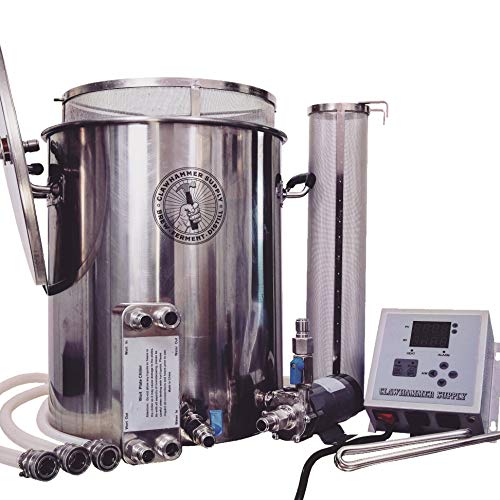
Clawhammer Supply 10.5 Gallon Electric All-in-One Brewing System – Digital, Semi-Automated, 120V, BIAB All Grain & Extract, 304 Stainless Steel
Included for 'Best All-in-One Electric Home Brewing Systems' because the listing specifies Digital and Semi-Automated, details this guide uses to compare options.
View on Amazon
Kegla BrewZilla Gen 4 - Wifi/Rapt Integrated - With Pump - 35L - 110V, Silver
Included for 'Best All-in-One Electric Home Brewing Systems' because the listing specifies Wifi/Rapt Integrated and With Pump, details this guide uses to compare options.
View on AmazonCompare capacity, footprint, and control
| System | Nominal kettle capacity | Typical electrical setup | What to consider |
|---|---|---|---|
| Anvil Foundry 10 | 10.5 US gal (about 40 L) | 120 V or 240 V, depending on configuration | Useful capacity for standard home batches; check the grain basket and lifting arrangement for your space. |
| Grainfather G30 | 30 L (about 8 US gal) | 230 V in many markets; electrical versions vary | Integrated pump and controller; check local voltage and the room needed to lift the malt pipe. |
| BrewZilla 65L Gen 4 | 65 L (about 17 US gal) | Electrical requirements vary by market | More headroom for larger batches, but a larger storage footprint and heavier grain loads. |
These are kettle capacities, not promises of finished beer volume. Grain, water, boil-off, and trub all take up space or reduce what reaches the fermenter. A 5-gallon finished batch needs additional room for mash water and a vigorous boil, so a kettle with comfortable headroom is preferable to one sized exactly to the target volume.
Measure the system’s height with its lid and grain basket removed or raised, as applicable. Also allow room for hoses, a stable place to set a hot basket, and access to a drain or sink. A system that fits under a counter while stored may still be awkward to operate there.
What matters beyond the capacity number
Temperature control and power
Digital controllers make it easier to hold mash rests and repeat recipes, but their usefulness depends on the heating element, temperature sensor placement, and how the wort circulates. A 120-volt system is convenient for many kitchens and garages, though heating and recovery can be slower. A compatible 240-volt system generally offers more heating power, but may require a suitable dedicated outlet and circuit. Check the manufacturer’s electrical instructions and have a qualified electrician assess any uncertain wiring; do not use an adapter to bypass the required circuit.
For repeatability, compare the controller’s step-mash options, timer, and temperature display rather than assuming every digital panel behaves the same. A recirculation return can help even out temperatures, but flow should be adjusted gently: too much suction or a compacted grain bed can restrict circulation.
Pump setup and grain-bed management
An integrated pump saves space and reduces the number of separate pieces to buy. It can recirculate wort during the mash and may assist with transfers, depending on the system. The tradeoff is more parts to rinse: pump head, hoses, fittings, and any screen or filter that catches grain. If a pump is optional, compare the cost and storage of the add-on with the convenience of having it built in.
Do not treat the pump as a substitute for a properly crushed grain bill or a freely draining bed. Start with a modest flow, keep the return submerged or directed as the manual specifies, and stop recirculation if the bed begins to compact. A stuck mash can slow the brew day and strain the pump.
Choose by space, experience, and brewing frequency
| Your situation | Better fit | Why |
|---|---|---|
| Apartment or limited storage; smaller batches | Compact 5-gallon-class system | Less kettle and basket to store and lift; confirm it can still accommodate your intended grain bill. |
| Regular 5-gallon batches; moderate storage | 10-gallon-class system | Provides useful mash and boil headroom without requiring a large-batch kettle. |
| Large batches or frequent high-gravity recipes | 65-liter-class system | Extra capacity helps with volume and grain load, but requires more floor and lifting space. |
| New brewer unsure how often they will brew | Basic system with readily available replacement parts | Limits initial complexity; upgrade accessories only after identifying a real workflow need. |
Batch size should reflect what you actually drink and can ferment, package, and store—not just the largest volume the kettle can hold. Larger systems also mean more water to heat, more grain to handle, and more cleanup, even when brewing a smaller batch.
Cleanup and ownership: the part listings often understate
After brewing, the grain basket is usually the heaviest, messiest item. Let it drain securely, then move spent grain before it dries into a dense mass. Avoid carrying a full, hot basket across a room; arrange a stable landing spot beside the kettle in advance. Check whether the basket handle, pulley, or lifting accessory is included or sold separately.
Rinse the kettle, basket, screens, hoses, and pump promptly. Follow the maker’s guidance for cleaning chemicals and pump operation; do not run a pump dry unless the manual explicitly allows it. Mineral scale can build up on heating surfaces, while wort residue can lodge around fittings and screens. Periodic descaling and inspection help prevent slow heating or restricted flow.
Common wear points are seals, hose connections, pump components, and small filters or screens. Before purchase, look for replacement parts and clear instructions for removing and cleaning the pump head. A system with a slightly lower headline price may cost more in time if its fittings are difficult to access or its parts are hard to source.
Bottom line
Choose a 10-gallon-class system for a practical balance around standard 5-gallon batches, a compact unit if storage and lifting are the constraints, and a 65-liter-class system only if your batch plans justify its extra footprint and grain handling. Then verify voltage, outlet requirements, included pump and lifting accessories, and the cleaning steps for your exact model. Those details shape the brew day more than a single capacity figure.
Ready to decide? Our #1 pick for 2026 is the Anvil Foundry 10.
Live price & availability on Amazon.



Write Your Review
No reviews yet. Be the first to share your experience!