
The best cabinet handles for kitchen use are solid, comfortable pulls with a center-to-center measurement that suits the door or drawer, a finish compatible with your other fixtures, and mounting screws long enough for your cabinet thickness.
- Best cabinet handles for kitchen cabinets by situation
- How cabinet handle sizes are measured
- Grip comfort: the detail listings often omit
- Finish comparison: appearance versus ownership
- Mounting hardware: check before you buy
- A practical way to calculate the quantity and cost
- Installation details that prevent crooked handles
- Durability and maintenance realities
- Final buying recommendation
Best cabinet handles for kitchen cabinets by situation
| Situation | Best choice | Useful specification | Why it works |
|---|---|---|---|
| Lowest-cost update | Die-cast zinc or stainless-steel bar pull | 3 or 4 inch center-to-center; approximately $2–$8 each | Easy to match, widely available, and inexpensive to replace |
| Busy family kitchen | Rounded tubular pull | 5 or 6 inch center-to-center; 10–14 mm diameter | Offers a secure grip without sharp corners |
| Large drawers and pantry doors | Long appliance-style pull | 8–12 inch center-to-center; solid metal construction | Spreads pulling force across a wide drawer front |
| Traditional or transitional kitchen | Footed cup pull or shaped bar pull | 3-inch cup pull or 3–5 inch decorative pull | Adds visual detail while preserving a familiar hand position |
| Modern, minimalist kitchen | Low-profile straight pull | 5–8 inch center-to-center; projection of 20–30 mm | Clean appearance with enough space for fingertips |
| Frequent cooking and cleaning | Brushed stainless steel or satin nickel | Sealed or clear-coated surface | Less likely to show fingerprints than polished finishes |
For most kitchens, a 5-inch center-to-center tubular pull is the safest all-purpose choice. It is large enough for comfortable use on doors and medium drawers, but not so long that it overwhelms standard cabinet fronts.
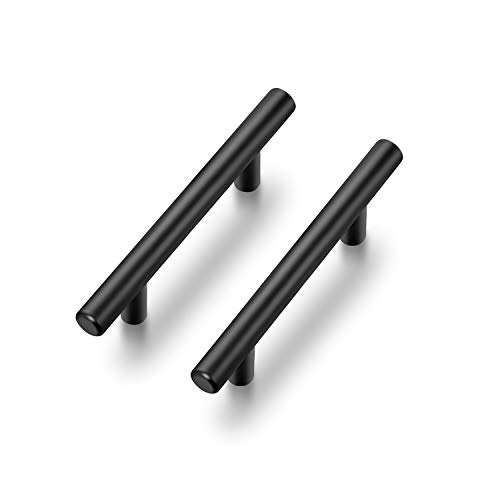
Ravinte Cabinet Handles,5" Length,3" Hole Center,Matte Black,30 Pack
Included for 'Best Cabinet Handles for Kitchen Cabinets' because the listing specifies 5" Length and 3" Hole Center, details this guide uses to compare options.
View on Amazon
Ravinte Cabinet Handles, Brushed Nickel,5" Length,3" Hole Center,30 Pack
Included for 'Best Cabinet Handles for Kitchen Cabinets' because the listing specifies Brushed Nickel and 5" Length, details this guide uses to compare options.
View on Amazon
homdiy 15 Pack Brushed Nickel Cabinet Pulls 3 Inch Handles Stainless Steel Cabinet Hardware for Kitchen and Bathroom Cabinets, 5 Inch Overall Drawer Pull
Included for 'Best Cabinet Handles for Kitchen Cabinets' because the listing specifies 5 Inch Overall Drawer Pull, details this guide uses to compare options.
View on Amazon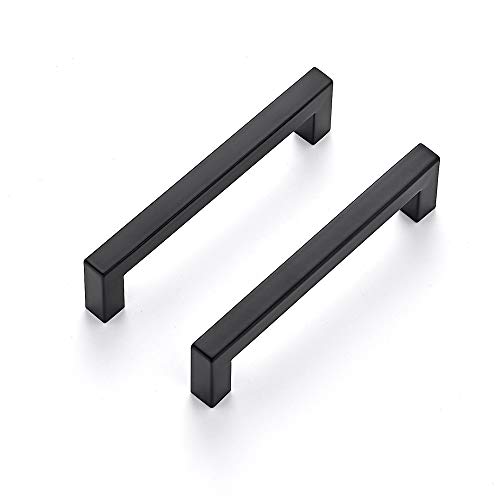
Ravinte Matte Black Square Cabinet Handles Drawer Pulls,5 Inch,30 Pack
Included for 'Best Cabinet Handles for Kitchen Cabinets' because the listing specifies 5 Inch and 30 Pack, details this guide uses to compare options.
View on AmazonHow cabinet handle sizes are measured
Cabinet hardware is usually sized by center-to-center spacing, not by the total length of the handle. This is the distance between the centers of the two screw holes. A pull described as “96 mm” has holes 96 mm apart, even though the complete handle may be about 120–130 mm long.
Common imperial sizes include 3 inches, 4 inches, 5 inches, 6 inches, 8 inches, and 12 inches. Common metric sizes include 76 mm, 96 mm, 128 mm, 160 mm, and 192 mm. The closest imperial and metric measurements are not always interchangeable, so measure existing holes before ordering replacement hardware.
Choosing a proportion that looks intentional
- Small doors and narrow drawers: 3-inch or 4-inch center-to-center pulls usually look balanced.
- Standard base-cabinet drawers: 5-inch or 6-inch pulls provide better leverage and hand clearance.
- Wide drawers: Use an 8-inch or longer pull, or install two smaller pulls if that suits the design.
- Very wide drawers over approximately 30 inches: A long pull helps prevent twisting and concentrates less force on one part of the drawer front.
- Tall pantry doors: A 6–12-inch vertical pull is generally easier to use than a small knob.
There is no requirement for every cabinet pull to have the same overall length. Keeping the finish, shape, and installation alignment consistent matters more. Many designers use shorter pulls on doors and longer pulls on drawers to make the hardware match the scale of each front.
Grip comfort: the detail listings often omit
Comfort depends on more than appearance. Look for a pull with a usable gap of roughly 20–30 mm between the cabinet surface and the inside of the handle. Less space can force your fingertips against the cabinet; much more can feel loose or snag sleeves.
A rounded or gently beveled profile is usually more comfortable than a sharply squared bar. Tubular handles around 10–14 mm in diameter suit most hands. Very thin wire pulls can look delicate but may concentrate pressure on two fingers. Oversized pulls can be attractive on large drawers, yet their extra projection may catch on clothing in a narrow walkway.
For a household with children, older adults, or anyone with limited hand strength, prioritize a pull that can be grasped with several fingers rather than a small knob or flat edge. A pull mounted horizontally on drawers and vertically on doors also gives a predictable grip.
Finish comparison: appearance versus ownership
| Finish | Fingerprint visibility | Cleaning needs | Best match | Potential drawback |
|---|---|---|---|---|
| Brushed stainless steel | Low | Wipe with mild soapy water; dry with the grain | Stainless appliances and contemporary kitchens | May look cooler than brass or bronze fixtures |
| Satin nickel | Low to medium | Soft cloth and diluted dish soap | Transitional and neutral cabinetry | Can vary between manufacturers |
| Matte black | Medium | Gentle wiping; avoid abrasive pads | Modern, farmhouse, and high-contrast schemes | Edges may show wear on inexpensive plated hardware |
| Polished chrome | High | Frequent wiping to remove fingerprints and water spots | Glossy contemporary kitchens | Shows smears easily |
| Unlacquered or living brass | Changes over time | Clean according to the desired patina | Traditional and character-rich kitchens | Color develops unevenly with frequent handling |
| Oil-rubbed bronze | Low to medium | Dry or lightly damp cloth | Dark wood, warm traditional cabinetry | Shade can differ significantly by brand |
Choose the finish according to how you want the kitchen to age. A living finish is designed to change, while a plated or coated finish aims for consistency. Do not use vinegar, bleach, scouring powder, or abrasive sponges unless the manufacturer specifically permits them; these can dull coatings and expose the base metal.
Mounting hardware: check before you buy
Most cabinet pulls include two machine screws, commonly in 8-32 thread size, but the supplied length is not universal. Standard screws are often around 1 inch long, which may be suitable for a typical 3/4-inch cabinet door plus the handle, but not for thick drawer fronts, overlays, or decorative backplates.
Before installation, measure the cabinet front and add the thickness of any backplate or washer. The screw should engage the handle securely without protruding through the inside of the drawer. For a 3/4-inch drawer front and a pull base requiring approximately 1/4 inch of engagement, a screw around 1 inch long may work. A 1 1/2-inch screw could be necessary for a thicker front, but always confirm fit before tightening.
- Look for pulls supplied with at least two screw lengths where possible.
- Buy replacement 8-32 screws in several lengths if your kitchen has mixed door and drawer thicknesses.
- Use washers when a screw head could mark a painted or delicate interior surface.
- Do not force a screw that feels cross-threaded; it can damage the pull or strip the cabinet hardware.
A practical way to calculate the quantity and cost
Count every opening separately. For example, a kitchen with 18 doors and 10 drawers needs 28 handles if each front receives one pull. If you choose hardware costing $6–$14 per piece, the handle budget is:
28 handles × $6–$14 = $168–$392
Add approximately 10% for spare pieces, finish variation, or an installation mistake. In this example, buying three additional handles brings the total to 31, with an estimated hardware cost of $186–$434. The spare is particularly useful because finishes and exact models can be discontinued or change between production batches.
Installation details that prevent crooked handles
- Choose one reference point, such as the center of each drawer front or the upper rail of each door.
- Make a drilling template from a purchased jig or a rigid piece of scrap material. Mark the center-to-center distance precisely.
- Apply painter’s tape to the drilling area to reduce paint chipping, then mark the holes with a sharp pencil or awl.
- Drill from the finished side using a bit slightly larger than the screw shaft, not the screw head.
- Support the back of the panel with scrap wood to reduce blowout as the bit exits.
- Install the handle by hand first, then tighten gently with a screwdriver. Excessive torque can crack a thin drawer front or damage a soft finish.
Do not rely on measuring from the neighboring cabinet alone. Small errors accumulate across a run of doors, and an adjustable template produces more consistent results than repeated ruler measurements.
Durability and maintenance realities
The parts most likely to fail are usually the screws, plated surface, or threaded posts rather than the solid handle itself. Loose hardware often results from repeated movement, an incorrectly sized screw, or a drawer front that flexes. Check the handles after the first few weeks and retighten them gently if needed.
Clean cabinet handles with a soft damp cloth and a small amount of mild dish soap, then dry them. Avoid soaking the hardware, especially around screw joints. If a finish begins to discolor, stop using stronger cleaners; continued abrasion can make the damage permanent. For a hard-working kitchen, solid stainless steel or well-finished brass generally offers better long-term value than very light hollow hardware with a thin decorative coating.
Final buying recommendation
If you want one dependable choice, select solid or substantial stainless steel, satin nickel, or similarly durable bar pulls with 5-inch center-to-center spacing, a rounded 20–30 mm projection, and two screw lengths in the package. Choose 3- or 4-inch pulls for smaller fronts, 8–12-inch pulls for wide drawers and pantry doors, and a living finish only if you are comfortable with visible color changes. The right combination of measurement, grip clearance, finish durability, and correctly sized mounting screws matters more than a fashionable shape.






Write Your Review
No reviews yet. Be the first to share your experience!