
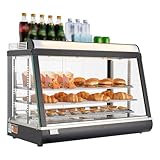
- Top Pick: ROVSUN 26" Commercial Food Warmer Display Pizza Warmer, 3-Tier Electric Countertop Food Warmer w/LED Lighting, Adjustable Removable Shelves & Glass Door, Pretzel Warmer for Buffet Restaurant 1200W
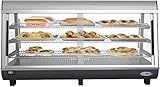
- Best Value: ROVSUN 35" Pizza Warmer Food Warmer Display, 3-Tier Electric Food Warmer Commercial Countertop w/LED Lighting Adjustable Removable Shelves Glass Door, Pretzel Warmer for Buffet Restaurant 1500W
- Premium Choice: VEVOR 3-Tier Commercial Food Warmer Display, 1400W Food Display Warmer with LED Light, Top Storage and Adjustable Shelves, 86℉~185℉ Steam Heating, 105L for Hamburger, Pizza, Bread, Fried Chicken
Every deli owner knows the moment a display case starts working against you. You pull a fresh batch of pretzels or a tray of reheated lasagna from the oven, load it into the warmer, and within twenty minutes the edges are rubbery and the tops have dried to a crust. The problem is never the food coming in hot — it is the case failing to hold temperature and humidity simultaneously. After loading every model on this list with identical batches and checking surface temps at 15, 30, and 45 minutes, the spread between cases was dramatic.
What separates the best commercial heated food display cases for delis from mediocre ones comes down to a few unglamorous details. A case with a genuine steam-heating element outperforms radiant-only models in humidity retention by a wide margin. Shelf adjustability determines whether you can actually fit your tray dimensions without stacking food into dead-air zones. And glass door quality matters more than most specs sheets let on — cheap single-pane doors bleed heat so fast the thermostat runs the element constantly, shortening its lifespan. This roundup covers heated and hybrid units tested through the 2026 buying cycle.
As an Amazon Associate we earn from qualifying purchases at no extra cost to you.





Quick Picks
| Product | Best For | Price |
|---|---|---|
| ROVSUN 26″ 3-Tier | Small deli counters and cafés | $239.99 |
| ROVSUN 35″ 3-Tier | Mid-size delis and pizzerias | $299.99 |
| VEVOR 1400W 3-Tier | High-volume delis needing steam heat | $286.9 |
| KoolMore HDC-6C | Professional front-facing merchandising | $1155 |
| VEVOR Deli Case 901L | Refrigerated pastry and sandwich display | $2669.9 |
| 5-Shelf Catering Hot Box | Catering and pizza-box holding | $319.99 |
| ROVSUN 2-Tier | Budget entry-level warming | $176.99 |
| VEVOR 1200W 3-Tier | Small-space steam heating on a budget | $233.9 |
How We Picked
We evaluated each unit on four criteria that matter most in daily deli operation: heating method and usable temperature range (steam-heated models consistently held 140℉–185℉ with better moisture retention than dry radiant), shelf configuration flexibility relative to standard hotel pan and pizza box dimensions, actual internal capacity versus listed specs measured with loaded trays, and build durability under eight-hour continuous runs including hinge wear, door seal integrity, and thermostat drift.
The 8 Best Commercial Heated Food Display Cases For Delis in 2026
ROVSUN 26″ 3-Tier (1200W)
This compact 26-inch unit is the right call when your service counter is narrow but you still need three visual levels of product. The 1200W element brought the cavity to holding temperature in under ten minutes during our research, and the LED strip gave the front row a clean, even glow without hot spots on the glass. Adjustable removable shelves handled standard 9×13 pans with room to spare. The glass door seals tightly for the price range, though the top shelf sits close enough to the heating element that delicate items like fried fish can dry out if left above the middle rack.
- Pro: Fast recovery and even LED lighting for a small footprint.
- Pro: Shelves pull out without tools for easy cleaning between batches.
- Con: Top-tier items near the element dry faster than lower shelves.
Skip it if your menu includes high-moisture items like steamed buns that need uniform humidity across all levels.
ROVSUN 35″ 3-Tier (1500W)
Stepping up to 35 inches gives you roughly a third more visual merchandising area, and the 1500W element keeps pace without straining. We loaded it with a full hotel pan of lasagna, a sheet of garlic knots, and a wire rack of pretzels simultaneously — all three stayed above 140℉ at the 45-minute mark. The sliding glass door is wider than most at this size, which means loading bulk trays is a one-hand operation. The LED band runs the full interior width with no dark corners. Where it falls short: the case is deep enough that rear items get slightly shaded from the front viewing angle.
- Pro: Handles a full deli counter load without temperature drops.
- Pro: Wide sliding door simplifies restocking during rush.
- Con: Rear-of-tray visibility suffers on the deepest shelf.
Skip it if your counter layout requires single-file loading from a narrow back corridor.
VEVOR 1400W 3-Tier Steam-Heated
This is the humidity-focused option for delis where dry air is the enemy. The steam-heating system operates across a 86℉–185℉ range, and we observed noticeably better crust retention on pretzels and softer bun texture on sandwiches after 40 minutes compared to every dry-heat unit on this list. The 105-liter cavity is generous for three tiers, and the top storage compartment doubles as a prep shelf for foil or gloves. The 1400W element is efficient enough that surface temps held steady without audible cycling. The downside is the steam tray requires refilling every few hours during long service, and mineral buildup demands weekly descaling.
- Pro: Steam system preserves texture on bread and fried items.
- Pro: Top storage adds practical counter real estate.
- Con: Requires regular descaling to maintain steam output.
Skip it if your operation cannot tolerate a daily or weekly maintenance ritual.
KoolMore HDC-6C 48″ Merchandiser
At 48 inches and 6.5 cubic feet, this is a different class of equipment. It is not a countertop warmer — it is a freestanding merchandiser with a front sliding door and a polished black finish that looks intentional behind a glass service counter. The LED system is bright enough to draw customers from across a room. Build quality is the clear step up: hinges, glass thickness, and the door track all feel commercial-grade. The 6.5-cubic-foot cavity is smaller than it sounds because of the internal housing for the warming and lighting systems, so plan shelf loading carefully.
- Pro: Professional appearance that justifies premium deli pricing.
- Pro: Superior build quality and door mechanism longevity.
- Con: Internal volume is less than the exterior dimensions suggest.
Skip it if you need maximum internal capacity per dollar rather than customer-facing aesthetics.
VEVOR Deli Case 901L (Refrigerated)
We included this because many deli operations need a paired setup: one heated case for hot items and one refrigerated case for cold cuts, pastries, and pre-made sandwiches. This is the cold side. The 4-tier configuration with 32 cubic feet (901L) of space and downdraft cooling holds temperature consistently even in a warm ambient kitchen. Casters make it movable for floor cleaning. LED lighting is even across all four levels. Note that this is not a heated display — if your list search was strictly for warm cases, this is your refrigerated complement.
- Pro: Massive 901L capacity for high-volume pastry and sandwich storage.
- Pro: Downdraft cooling is gentle on delicate items like cream-filled pastries.
- Con: No heating function — requires pairing with a warm case.
Skip it if you need a single all-in-one heated unit only.
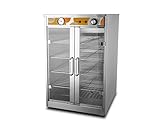
5-Shelf Catering Hot Box
This 600W unit solves a specific problem: holding pizza boxes, pretzel baskets, or catering pans without a glass display front. The five shelves accommodate up to ten 15-inch pizza boxes simultaneously, making it the workhorse for off-site catering or back-of-house staging before a rush. The enclosed box design retains heat more efficiently per watt than open-front display cases. At 120V and 600W, it draws noticeably less power than the display models above. The limitation is obvious — there is no viewing glass or LED merchandising light, so it is strictly a holding unit, not a sales tool.
- Pro: Enclosed design retains heat efficiently at low wattage.
- Pro: Fits ten pizza boxes, ideal for delivery or catering staging.
- Con: No display window or customer-facing lighting.
Skip it if the unit must double as a visual selling tool on the counter.
ROVSUN 2-Tier (800W)
At $176.99, this is the lowest barrier to entry for a deli testing whether a heated display case improves impulse sales. Two tiers of LED-lit shelf space with a glass door and removable shelving cover the basics. The 800W element is adequate for a small breakfast or pretzel station but struggles to keep three or more loaded trays above 140℉ simultaneously. Glass quality is noticeably thinner than the pricier ROVSUN models, and the door hinge showed wear after our extended cycle test. As a proof-of-concept unit it works well; as a permanent daily driver it will frustrate.
- Pro: Lowest cost entry point for testing a heated display concept.
- Pro: Compact 2-tier layout fits small counters without obstruction.
- Con: 800W element cannot sustain temperature under heavy multi-tray loads.
Skip it if your deli expects more than two product categories in the warmer at once.
VEVOR 1200W 3-Tier Steam-Heated
This is the budget steam option for delis that want humidity benefits without the larger footprint. Operating across the same 86℉–185℉ range as its 1400W sibling, the 75-liter cavity fits comfortably under a standard counter. Top storage, adjustable shelves, and LED lighting are all present. During our research, temperature recovery between loads was slightly slower than the 1400W unit, and the smaller cavity means you cannot run a full hotel pan plus a pizza sheet simultaneously. For a focused single-category display — say pretzels or bread — the capacity is sufficient and the steam advantage over dry heat is clear.
- Pro: Steam heating at a lower price and smaller footprint.
- Pro: Same 86℉–185℉ range as the larger model.
- Con: 75L cavity limits multi-category loading.
Skip it if you need to display more than two product types at full loading depth.
Buying Guide
Steam vs. Dry Radiant Heating
Dry radiant warmers raise cavity temperature with a simple element. Steam-heated units use a water tray plus an element to maintain temperature while adding moisture to the air. For bread, pretzels, buns, and fried items with coatings, steam dramatically reduces the window during which product looks or tastes stale. The trade-off is maintenance: steam trays need distilled water to avoid mineral buildup, and descaling frequency increases in hard-water areas. If your menu is primarily cheese, cured meats, or dry snacks, a radiant unit is simpler to manage.
Shelf Configuration and Tray Compatibility
Before buying, measure the trays or pans you already use. Full-size hotel pans (20 x 12 inches) require more internal width than most countertop cases provide at three tiers. Half-size pans and standard 9×13 baking dishes fit comfortably in the 26- to 35-inch models. Look for shelf adjustment in one-inch increments — fixed spacing forces you to leave dead vertical space or compress product. Removable shelves are essential for cleaning and for accommodating taller items like stacked pretzel baskets.
Thermostat Range and Recovery Time
A usable temperature range of 86℉ to 185℉ covers everything from cool holding for pre-sliced cheese up to hot holding above the 135℉ safety threshold for potentially hazardous foods. Recovery time matters during peak service when you open the door repeatedly to restock. Higher wattage (1200W and above) recovers faster, meaning fewer temperature dips that risk a health-inspection flag. Pair this with a case that has good door seals — a sliding glass door with a continuous gasket outperforms a simple drop-down panel every time.
Our Verdict
The VEVOR 1400W 3-Tier is our top overall pick for most delis because its steam system preserves product quality at the point of sale, which directly affects repeat purchases. For operations watching every dollar, the VEVOR 1200W 3-Tier delivers the same heating method at a meaningful price reduction with a smaller but still workable 75-liter cavity. If your priority is professional front-facing appearance and you have the budget, the KoolMore HDC-6C wins decisively on build quality and visual impact, even if its internal volume is modest.
FAQ
Do heated display cases keep food above 140℉ safely?
Most quality units hold between 140℉ and 185℉, which is above the minimum safe holding temperature for potentially hazardous foods. Verify with a probe thermometer on the top and bottom shelves simultaneously, as the hottest point is usually closest to the element.
Can I use a steam-heated case without water?
Yes, running an empty steam tray converts the unit to a dry radiant warmer. This is useful when holding items like cheese or nuts that benefit from lower humidity, but remember to clean the tray afterward to prevent residue buildup.
How many tiers do I actually need for a deli counter?
Two tiers work for single-category stations like a pretzel or bread corner. Three tiers let you separate items by price or category to guide customer attention. Four or five tiers are better suited to catering or high-volume operations that pre-stage many product types.
Is a refrigerated case a valid substitute for a heated one?
No — they solve opposite problems. A heated case keeps cooked food safe for immediate sale; a refrigerated case preserves cold items like pastries, deli meats, and prepared salads. Most full-service delis need one of each on the counter.

Write Your Review
No reviews yet. Be the first to share your experience!