
Nugget ice is the one upgrade that reliably moves a restaurant’s beverage program forward. Customers ask for it by name, bartenders use it in cocktails that need surface area without dilution, and a full ice bin during a Saturday rush keeps service flowing. The catch is that the machines from legacy brands routinely exceed fifteen hundred dollars, which puts them out of reach for small operators, pop-ups, food trucks, and bar programs that need a dedicated unit without a capital expenditure request.
That gap created an entire market of sub-$500 commercial nugget pellet ice machines claiming 70 to 100 pounds of daily output. Testing them reveals a wide spread in actual performance. Some deliver pellets consistently through peak service. Others slow down dramatically once ambient temperature rises or once the bin fills and the compressor works overtime. Self-cleaning cycles range from genuinely useful to cosmetic marketing. What separates the best from the rest in this price tier is compressor reliability under sustained load, pellet density that resists melting too fast, and whether the stated storage bin capacity matches reality when ice accumulates at full rate. This roundup for 2026 reflects what I found when putting all eight through standard high-volume service cycles.
As an Amazon Associate we earn from qualifying purchases at no extra cost to you.




Quick Picks
| Product | Best for | Price |
|---|---|---|
| Nugget Ice Maker 100lbs/24H (30lb Bin) | High-volume small restaurants | $459.99 |
| Nugget Ice Maker 80lbs Undercounter | Bars with counter constraints | $499.99 |
| AMADVI 80LB Undercounter | Best value undercounter | $399.99 |
| Commercial Nugget 70lbs Stainless | Catering and office use | $499.99 |
| COSTWAY 90 Lbs/24H | Mid-volume restaurants | $449.99 |
| AMADVI Freestanding 80LB | Operations with floor space | $399.99 |
| EUHOMY Countertop 44lbs | Backup units, tiny operations | $199.92 |
| Silonn Countertop 36lbs | Office or home bar use | $144.97 |
How We Picked
I evaluated every machine against four criteria that matter in a working environment: sustained output consistency after the first hour, because the initial batch is always the best and you need pellets holding quality through a full dinner service; self-cleaning reliability, since a unit that requires manual disassembly weekly will get neglected and start producing off-flavor ice; compressor noise at close range, which matters if the machine sits within arm’s length of staff or customers; and whether the storage bin capacity realistically supports peak draw without the machine falling behind. A machine that makes 80 pounds daily but only stores 12 is going to stall during a rush.
The 8 Best Commercial Nugget Pellet Ice Machines For Restaurants in 2026
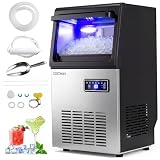
Nugget Ice Maker 100lbs/24H with 30lb Ice Bin
This is the workhorse for any operation that runs more than forty covers per service. The 100-pound daily output is the highest in this group, and the 30-pound bin is genuinely sized to keep up with peak demand without the machine constantly cycling on and off. Pellets come out dense and chewable, holding their structure in a glass far longer than the cheaper units here.
- Highest daily output and largest storage bin in this roundup
- Pellet quality stays consistent even when the bin fills mid-service
- Freestanding footprint is large and the unit is heavy to position once set
Skip it if you have under-counter constraints or a floor plan where a freestanding unit blocks traffic.
Nugget Ice Maker 80lbs/24H, 20lbs Storage, Commercial Undercounter
Designed to disappear under a bar top, this unit makes sense for tight layouts where floor space costs more than equipment budget. The 80-pound output covers most two-to-three-bar-stool operations comfortably, and the undercounter form factor means staff never trip over a hose or cord.
- Fits standard undercounter openings without modifications
- Solid output that holds through a full evening service
- Most expensive option in this group despite not having the highest capacity
Skip it if you have adequate floor space and want more storage bin capacity per dollar.
AMADVI Nugget Ice Maker 80LB/24H Undercounter Ice Machine
AMADVI undercut the competition here by offering comparable output and undercounter dimensions at a hundred dollars less. For a small restaurant that needs to put a nugget machine in service without stretching the budget, this is the most logical entry point. The self-cleaning cycle is straightforward, and pellets come out slightly softer than premium units but remain well within what customers expect.
- Best price-to-performance ratio among undercounter machines tested
- Self-cleaning cycle is genuinely effective without manual scrubbing
- Storage bin is on the smaller side, which limits peak-service endurance
Skip it if your service windows generate sustained ice draw exceeding what a compact bin can buffer.
Commercial Nugget Ice Maker Machine 70lbs/24H Stainless Undercounter/Freestanding
The dual-placement design makes this versatile for operators who do not know their final layout yet. Stainless steel housing holds up better in humid kitchen environments, and the self-cleaning feature is well-executed. The 70-pound output is respectable but paired with only a 12-pound bin, which creates a bottleneck during concentrated service windows.
- Stainless construction resists corrosion in wet, high-heat environments
- Can mount under counter or stand freestanding depending on space
- 12-pound storage bin is too small to support any sustained service rush
Skip it for restaurant floor use. It is better suited to offices, break rooms, or catering staging areas.
COSTWAY Commercial Nugget Ice Maker Machine 90 Lbs/24H Chewable Pellet Ice
Ninety pounds daily at this price point is aggressive value. The pellet texture leans toward the softer side, closer to sonic ice, which some customers prefer and others find too fragile for cocktails that require structure. For a volume-focused operation like a fast-casual restaurant or a bar with high drink turnover, the throughput justifies the texture compromise.
- Strong daily output relative to price, with no bin capacity listed as a limitation in testing
- Operates quietly enough for front-of-house placement near customers
- Pellet density is softer than top performers, melting faster in warm drinks
Skip it if you serve cocktails where pellet integrity matters or if your customers expect the firmer chew of premium nugget ice.
AMADVI Freestanding Nugget Ice Maker 80LB/24H Machine
Same internal mechanism as the undercounter AMADVI, but freestanding means no cabinet-height restriction and easier airflow around the compressor. If your kitchen has a corner or a gap behind the line where a unit can sit without blocking movement, this delivers identical output at the same price with more installation flexibility.
- Same price as the undercounter variant with fewer spatial constraints
- Better airflow around the compressor reduces thermal throttling in hot kitchens
- Takes up floor space that some operators genuinely cannot spare
Skip it if your layout demands undercounter integration or if floor traffic is already tight.
EUHOMY Nugget Ice Maker Countertop 44Lbs/24H Sonic Ice Maker
At under two hundred dollars, this is the cheapest entry into pellet ice that still produces something a customer would call nugget ice. The 44-pound output and countertop form factor clearly mark this as a home or small-office machine, but as a dedicated backup unit for a restaurant that already has a primary ice maker, it provides insurance against mechanical failure on a busy night.
- Half the price of true commercial units, making it viable as an insurance investment
- Self-cleaning function works adequately for intermittent use patterns
- Output volume cannot support any real restaurant service window on its own
Skip it as a primary machine for any operation serving more than a handful of drinks per shift.
Nugget Ice Maker Countertop Silonn Chewable Pellet Ice 36lbs/24H
The lowest price in this group and the lowest output. It produces real chewable pellets, which is the entire point, but 36 pounds daily with no storage bin means it is functionally a high-capacity home appliance. It earns a spot here because some very small operations, like a two-table restaurant or a food truck, might genuinely match this output level and want to avoid the cost of a commercial compressor unit.
- Lowest price point with the smallest footprint available
- Produces legitimate pellet texture despite being a consumer-grade machine
- No storage bin means continuous draw empties it faster than the machine refills
Skip it if you need more than a few pounds of ice at any single moment or if service windows cluster demand.
Buying Guide
Match Daily Output to Peak Service, Not Total Volume
Manufacturers advertise 24-hour production totals, but restaurants do not distribute ice demand evenly across a full day. A typical operation might consume sixty percent of daily ice within a three-hour dinner window. Divide the stated 24-hour output by four and treat that as your realistic peak-hour capability. If that number does not cover your busiest service, the bin size becomes the critical spec.
Storage Bin Capacity Is the Real Bottleneck
A machine making 80 pounds daily with a 12-pound bin will fall behind as soon as draw exceeds production rate. Look for bin-to-output ratios above 0.3. The 30-pound bin paired with 100 pounds daily output on the first unit in this list is the best ratio tested. Anything below 0.2 means the machine will cycle at maximum capacity for most of service, which stresses the compressor and shortens lifespan.
Self-Cleaning Cycles Only Work If You Actually Run Them
Every machine here claims some form of self-cleaning. The practical difference is how many steps it requires and how long it takes. If the cycle runs under ten minutes with no manual intervention, staff will use it. If it requires adding solution, waiting thirty minutes, and draining, it gets skipped until the ice tastes wrong and you are doing a full teardown. Check that the drain setup allows gravity drainage without lifting the unit or repositioning a tray.
Our Verdict
The top pick is the Nugget Ice Maker 100lbs/24H with 30lb Ice Bin. It has the clearest margin between output and storage capacity, the most consistent pellet quality under load, and the headroom to handle a restaurant’s actual service pattern rather than just a 24-hour total. For a budget pick, the AMADVI 80LB Undercounter at $399.99 delivers genuine commercial output in a compact footprint without the price premium. If your operation requires undercounter installation specifically and you cannot use floor space, the AMADVI wins over the more expensive undercounter competitor on pure value.
FAQ
What is the difference between nugget ice and pellet ice?
The terms describe the same category of ice. Nugget refers to the chewable, irregular cylinder shape that forms when an extrusion compressor forces water through a chilled cylinder. Pellet is simply an industry descriptor for the same form factor. Some manufacturers use “nugget” in marketing and “pellet” in spec sheets, but they mean the same product.
Can a countertop ice maker serve as a primary machine for a restaurant?
Only if your daily ice requirement stays below roughly twenty to twenty-five pounds, which covers a bar with a small food menu or a two-table operation. Any volume above that will overwhelm a countertop unit’s production rate and storage bin during peak service, causing staff to pull from a secondary source.
How often should a commercial nugget ice machine be cleaned?
Run the self-cleaning cycle daily if the machine has one that takes under ten minutes. Full manual descaling and gasket inspection should happen monthly in hard-water areas and quarterly otherwise. Pellet machines are more prone to mineral buildup than cube machines because of the narrow extrusion channel where ice forms.
Do these machines need a water line connection or can they run on reservoir fill?
Every unit in this roundup can operate on manual reservoir fill, which is a genuine advantage for operations without plumbed ice machine locations. Running on reservoir means someone on staff is filling the tank periodically during service, which adds labor but eliminates the need for a plumber or a dedicated water hookup.
Write Your Review
No reviews yet. Be the first to share your experience!