
Quick answer: For most people in 2026, the best commercial ozone generator for odor removal is the Compact portable — our #1 rated choice. See the full ranked comparison, alternatives and buying advice below.
- Best Commercial Ozone Generator for Odor Removal: Choose by Space and Use
- Shortlist by situation
- What matters more than the “room coverage” claim
- Commercial-unit comparison: useful spec ranges
- Features that make a unit easier to own
- Safe setup: vacancy is non-negotiable
- Buying decision in one minute
- Bottom line
Best Commercial Ozone Generator for Odor Removal: Choose by Space and Use
The best commercial ozone generator for odor removal is a model with a published ozone-output rating, a timer long enough for your space, and a clear procedure for keeping people and animals out until treatment is complete and the area has been thoroughly ventilated. For most buyers, a mid-output unit with an adjustable timer is more practical than the highest-output machine: it offers flexibility without making room size and exposure control an afterthought.
Shortlist by situation
- Occasional odor treatment in a small, enclosed space: Choose a portable unit with a timer, a carry handle, and a clearly stated output. Avoid relying on a vague “covers up to” claim.
- Frequent use across different rooms or properties: Look for adjustable output or multiple treatment settings, a long timer, replaceable ozone plates, and a protective housing that can tolerate regular transport.
- Large, open, or connected spaces: Consider a higher-output commercial unit only if you can isolate the treatment area and follow the manufacturer’s instructions. Connected rooms, open doorways, and furnishings make simple square-footage estimates unreliable.
- First-time operator or shared workplace: Prioritize a straightforward countdown timer, an unmistakable status indicator, and a process that prevents anyone from entering during treatment. If people cannot be kept out, ozone treatment is not an appropriate choice.
What matters more than the “room coverage” claim
Ozone output is commonly stated in milligrams per hour (mg/h) or grams per hour (g/h); 1 g/h equals 1,000 mg/h. Output tells you how much ozone a machine can produce under stated conditions, not the ozone concentration that will reach every surface in a particular room. Air movement, furnishings, room layout, temperature, humidity, and ozone demand from materials all affect the result.

Powerscale 500,000mg/h Dual-Core Ozone Generator, Commercial Industrial Ozone Machine with Digital Timer for Odor Removal, Heavy Duty Air Purifier for Smoke and Pet Odors in Commercial Spaces
Included for 'Best Commercial Ozone Generator for Odor Removal' because the listing specifies 000mg/h Dual-Core Ozone Generator, details this guide uses to compare options.
View on Amazon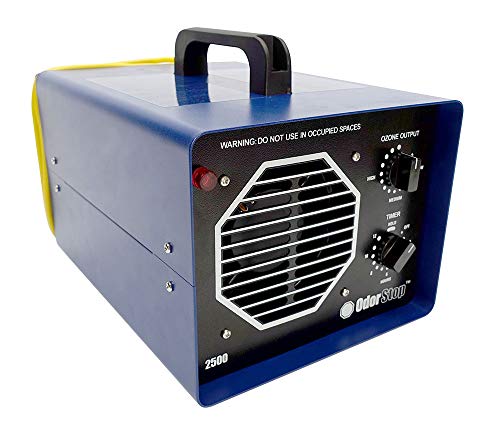
OdorStop Professional Grade Ozone Generators (2500 Sq Ft)
Included for 'Best Commercial Ozone Generator for Odor Removal' as a relevant option in this category; details come from the product listing.
View on Amazon
OdorFree Estate 4000 Ozone Generator for Eliminating Odors from Large Homes & Offices, Townhouses and Commercial Spaces at their Source - Easily Treats Up To 4000 Sq Ft
Included for 'Best Commercial Ozone Generator for Odor Removal' because the listing specifies Townhouses and Commercial Spaces at their Source and Easily Treats Up To 4000 Sq Ft, details this guide uses to compare options.
View on Amazon
Powerscale Ozone Generator, Odor Removal, Digital Timer, OZB3, Industrial
Included for 'Best Commercial Ozone Generator for Odor Removal' because the listing specifies Odor Removal and Digital Timer, details this guide uses to compare options.
View on AmazonRoom-size ratings are therefore best treated as rough guidance, not a guarantee. Check whether a manufacturer specifies room volume, ceiling height, or operating conditions. A rating based on an empty room may not translate to a furnished basement, a vehicle interior, or rooms connected by a hallway. Do not extrapolate a square-foot rating to a larger area without the manufacturer’s guidance.
Commercial-unit comparison: useful spec ranges
The figures below are broad market categories, not specifications for a single brand or model. Confirm output, dimensions, timer range, and replacement-part availability on the exact product label or manual before buying.
| Unit type | Typical stated output | Common advertised room range | Typical timer range | Best fit |
|---|---|---|---|---|
| Compact portable | 3,000–10,000 mg/h | Up to about 500–1,000 sq ft | Up to 2 hours | Small, isolated rooms and occasional use |
| Mid-output commercial | 10,000–30,000 mg/h | About 500–2,000 sq ft | Up to 4 hours | Regular use in varied enclosed spaces |
| High-output commercial | 30,000–60,000 mg/h | About 1,500–4,000 sq ft | Up to 6 hours | Large, controlled treatment areas and experienced operators |
These ranges overlap because manufacturers define coverage differently. A powerful machine is not automatically the better purchase: it can be harder to use conservatively, and a large rating does not make an unsafe setup safe.
Features that make a unit easier to own
Timer and controls
A countdown timer lets you start treatment and leave without staying in the area. Prefer clear, simple controls over complicated settings you cannot interpret. A delayed start can help an operator exit before the generator begins, but it is not a substitute for a locked or controlled entry and a posted warning. Verify whether the timer limits ozone production only or also controls a fan run-on period.
Construction and serviceability
Metal housings generally tolerate transport and repeated commercial handling better than lightweight plastic, though build quality varies. Check that the unit sits securely, has protected controls, and provides ventilation openings that are not easily blocked. Ask whether ozone plates or other generating components are replaceable and whether replacement parts are actually available. A replaceable plate can extend service life, but it is a consumable, not a maintenance-free feature.
What wears first
Ozone-producing plates can lose effectiveness or become dirty over time. Dust buildup, blocked airflow, and careless storage can also shorten the life of a unit. Follow the manual’s cleaning instructions; do not scrape a plate or use solvents unless the manufacturer specifically allows it. Keep a simple log of operating hours and maintenance. If output appears reduced, investigate airflow and the service interval before simply extending treatment time.
Safe setup: vacancy is non-negotiable
Ozone can irritate and injure the lungs. It is not safe to occupy a treated area while a generator is operating, and smell is not a reliable way to decide that re-entry is safe. Follow the device manual and applicable workplace rules; when requirements differ, use the more protective procedure.
- Decide whether ozone is suitable. Address the odor source first—such as spoiled food, smoke residue, a leak, or contaminated material. Ozone does not remove the underlying cause, and some odors require cleaning or professional remediation instead.
- Clear and isolate the area. Remove people, pets, and plants. Prevent entry from adjoining areas, post a warning, and tell anyone responsible for the building. Do not operate the machine where ozone could drift into an occupied space.
- Prepare the room and machine. Follow the manual for placement, electrical supply, and any objects or materials that should be removed. Do not obstruct the air inlet or outlet. Use only the stated timer and settings for the intended application.
- Start the cycle and leave. Set the timer, confirm the treatment area is empty, and exit before ozone generation begins. Never use a generator in an occupied room, vehicle, or shared area.
- Ventilate before re-entry. After the cycle ends, keep the area vacant. Ventilate to the outdoors according to the product instructions and site safety plan. Do not treat a lack of odor as proof of safety; follow any specified wait time or ozone-monitoring requirement. If you cannot verify that the space is safe, do not enter—contact a qualified professional.
Ozone may also damage or degrade certain rubbers, plastics, fabrics, and other materials, especially with repeated exposure. Remove sensitive items when practical and check the material and equipment manufacturers’ guidance.
Buying decision in one minute
| Your situation | What to prioritize | What to avoid |
|---|---|---|
| Low budget, infrequent use, small isolated room | Compact unit, stated mg/h, dependable timer, replaceable plate | Paying extra for an oversized coverage claim |
| Regular use, several room sizes | Mid-output model, adjustable settings, durable housing, parts support | Fixed controls with no service information |
| Large space, experienced operator | Documented output, manufacturer sizing guidance, controlled access, ventilation plan | Assuming a high-output rating makes a connected space safe or evenly treated |
| No way to ensure vacancy or outdoor ventilation | Choose a non-ozone odor-control method or consult a remediation professional | Using ozone anyway or relying on a timer alone for safety |
Bottom line
For most commercial buyers, a mid-output ozone generator with a plainly stated rating, adjustable timer, robust housing, and replaceable generating components is the most versatile choice. Buy by the actual space and operating procedure—not the biggest number on the box. If you cannot reliably keep the area vacant and ventilate it before re-entry, choose another odor-removal approach.
Ready to decide? Our #1 pick for 2026 is the Compact portable.
Live price & availability on Amazon.


Write Your Review
No reviews yet. Be the first to share your experience!