
The best filtered shower heads are the ones that match your main problem: choose a KDF/carbon filter for chlorine and odor, a higher-capacity cartridge for frequent use, and do not expect a shower filter alone to remove most dissolved hard-water minerals.
Quick answer: For most people in 2026, the best filtered shower heads for cleaner water is the Chlorine odor on a normal budget — our #1 rated choice. See the full ranked comparison, alternatives and buying advice below.
Best filtered shower heads by situation
| Situation | Best choice | Why it fits | Main compromise |
|---|---|---|---|
| Chlorine odor on a normal budget | Inline KDF and carbon filter with your existing shower head | Usually the lowest-cost route, often around $25–$60, while preserving your preferred spray pattern | Adds another connection and may reduce flow as the cartridge loads |
| Hard-water residue and frequent showers | Large-capacity inline filter or a whole-bathroom water treatment system | More media and longer service intervals are better suited to heavy use | Higher initial cost; a shower filter will not soften water in the usual sense |
| Renter or beginner installation | Universal filter designed for 1/2-inch shower connections | Typically installs between the shower arm and head with no electrical work or permanent plumbing changes | Thread fit and available wall clearance still need checking |
| Low water pressure | Low-flow filtered head rated near 1.5–1.75 gallons per minute | Can use less water while maintaining a concentrated spray | May feel less forceful than a 2.5-gpm head if the home already has weak pressure |
| Want a handheld and a fixed spray | Filtered shower system with a diverter and handheld hose | More flexible for rinsing, cleaning, and seated bathing | More joints mean more potential leak points and a larger wall footprint |
What shower filters can—and cannot—do
For chlorine concerns, look for a combination of KDF media and activated carbon. KDF, commonly a copper-zinc alloy, is useful in flowing warm water and is often paired with carbon to reduce chlorine taste and odor. Some products also use calcium sulfite, which is specifically marketed for chlorine reduction in hot water. The media combination matters more than a vague “multi-stage” label.
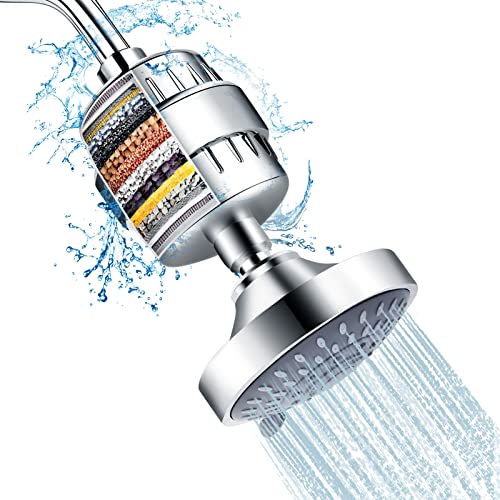
FEELSO Shower Head with Shower Filter, Filtered Shower Head for Hard Water
Included for 'Best Filtered Shower Heads for Cleaner Water' because the listing specifies Filtered Shower Head for Hard Water, details this guide uses to compare options.
View on Amazon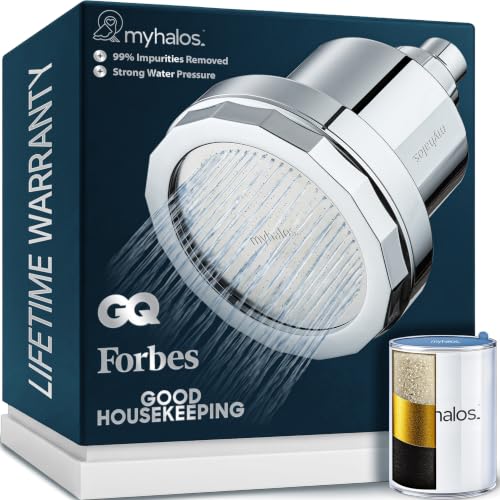
MyHalos® Filtered Shower Head, Shower Head Filter for Hard Water (Chrome)
Included for 'Best Filtered Shower Heads for Cleaner Water' because the listing specifies Shower Head Filter for Hard Water (Chrome), details this guide uses to compare options.
View on Amazon
Afina Filtered Shower Head, High Pressure Rainfall (Chrome)
Included for 'Best Filtered Shower Heads for Cleaner Water' because the listing specifies High Pressure Rainfall (Chrome), details this guide uses to compare options.
View on Amazon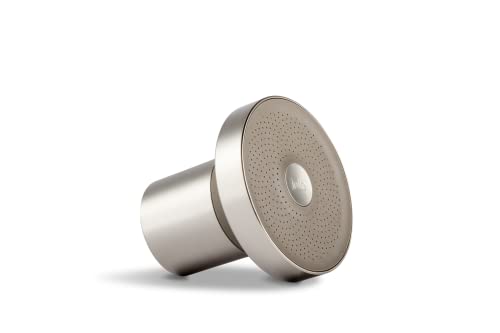
Jolie Filtered Showerhead, High Pressure Shower Filter, Brushed Steel
Included for 'Best Filtered Shower Heads for Cleaner Water' because the listing specifies High Pressure Shower Filter and Brushed Steel, details this guide uses to compare options.
View on AmazonHard water is a different problem. Its calcium and magnesium can leave scale on glass, faucets, and hair. Most shower filters do not remove enough of these dissolved minerals to qualify as water softeners. A small amount of scale-control media may reduce deposits, but it should not be confused with ion-exchange softening. If a test strip shows very hard water, a whole-home softener or professionally selected treatment system is the more relevant solution.
Shower filters also do not reliably remove every contaminant. If you are concerned about a specific substance, test the water and compare that result with the product’s independently documented reduction claims. For skin or respiratory symptoms, seek advice from a qualified healthcare professional rather than treating a shower filter as medical equipment.
Head-to-head: the features that decide performance
| Filter type | Best target | Typical replacement interval | Flow-rate considerations | Ownership notes |
|---|---|---|---|---|
| Activated carbon block or granular carbon | Chlorine, some odors, and some organic compounds | About 3–6 months in a typical household | Can restrict flow when clogged, especially in a fine carbon block | Less effective in hot, fast-moving water than in cold drinking-water applications |
| KDF copper-zinc media | Chlorine and some metal-related concerns | Often 6–12 months, depending on capacity and water use | Usually tolerates shower temperatures well; pressure may fall as sediment accumulates | Check the manufacturer’s stated capacity rather than relying on a calendar alone |
| Calcium sulfite | Chlorine in warm or hot water | Commonly 3–6 months | Often compact, but a small cartridge may have limited total capacity | Useful when chlorine is the priority, not a replacement for softening |
| Vitamin C media | Chlorine reduction | Often 1–3 months, depending on the cartridge | Usually has modest flow impact while fresh | Requires more frequent consumable replacement and careful storage |
Published capacities vary widely. For example, established shower-filter lines from brands such as Aquasana, Culligan, and Sprite commonly specify roughly 10,000 gallons or a six-month service period for particular cartridges, but the exact number depends on the model. Treat capacity and time as competing limits: replace the cartridge when either limit is reached.
Flow rate and spray settings matter more than they appear
In the United States, many conventional shower heads are rated at 2.5 gallons per minute, while water-saving models may be rated at 1.5 or 1.75 gallons per minute. A lower rating does not automatically mean a weak shower; well-designed nozzles can concentrate the stream. It does mean that an already low-pressure plumbing system may feel less satisfying.
For a five-minute shower, the theoretical water use is:
2.5 gpm × 5 minutes = 12.5 gallons
1.75 gpm × 5 minutes = 8.75 gallons
That difference is 3.75 gallons per shower. At two showers per day, a 1.75-gpm head uses about 2,738 fewer gallons per year than a 2.5-gpm head, before accounting for household variation. However, filter life is also affected by use. A 10,000-gallon cartridge serving two people who each take a five-minute shower daily would theoretically last about 1,096 days at 1.75 gpm. Manufacturers still commonly recommend replacing it after six or twelve months because media aging, sediment, and real-world usage make a calendar limit more practical.
Useful spray settings include full, massage, pause, and rinse. A pause button can reduce water waste while shampooing, but do not leave a pressurized shower head paused for long periods if the manufacturer warns against it. More settings also mean more small passages to clean when mineral deposits build up.
Installation: the details that prevent leaks
- Confirm the connection. Most shower heads use a standard 1/2-inch connection, but measure available length and check whether the filter will hit a wall, shelf, or ceiling.
- Remove the old head carefully. Use a wrench on the fitting, not on the decorative arm. Protect plated surfaces with a cloth.
- Flush the filter. Run cold or lukewarm water through a new cartridge for the period specified in its instructions. This removes carbon dust and loose media.
- Use thread tape only where appropriate. Wrap plumber’s PTFE tape around tapered pipe threads, keeping the first thread clear. Do not use excessive tape or force plastic fittings.
- Hand-tighten, then test. Turn the water on slowly and inspect every joint. A quarter-turn with a wrench may help, but overtightening can crack a filter housing.
- Record the installation date. Write it on the housing or set a calendar reminder. A filter that looks clean can still be exhausted.
Inline filters are often easier to install than an integrated filtered head because you can keep a favored head or handheld. Integrated units are tidier, but their proprietary replacement cartridges may cost more and limit spray choices.
Durability and replacement costs
The cartridge is normally the first part to wear out, followed by rubber washers and, in hard-water areas, the spray nozzles. A cartridge may cost roughly $15–$40 for common replacement formats, while a complete filtered head or inline kit often falls in the $30–$150 range. Premium systems can cost more because they use larger housings, proprietary media, or multiple outlets.
Calculate ownership cost rather than comparing only the purchase price. A $40 filter with a $20 cartridge replaced twice a year costs about $80 in the first year, excluding water use. A $70 unit with $30 annual replacement media costs about $100 in its first year. The less expensive-looking product is not necessarily cheaper if its cartridge is small or difficult to find.
To extend service life, clean the spray face monthly with a soft brush and wipe away scale. Avoid soaking an entire filter housing in vinegar unless the instructions allow it; acidic cleaners can damage seals or media. If flow drops suddenly, inspect the inlet screen for sediment before assuming the filter has failed.
Bottom line
For ordinary chlorine odor, choose a reputable KDF-plus-carbon or calcium-sulfite system with a clearly stated capacity, a standard connection, and replacement cartridges that are easy to obtain. For heavy hard-water scale, do not pay extra for claims that imply a shower filter will soften the water; investigate a proper softener or broader treatment system instead. Prioritize the correct flow rate for your plumbing, enough spray control for your routine, and a replacement schedule you will actually follow.
Ready to decide? Our #1 pick for 2026 is the Chlorine odor on a normal budget.
Live price & availability on Amazon.


Write Your Review
No reviews yet. Be the first to share your experience!