
- Top Pick: Cuisinart Ice Cream Maker Machine, Ready in 20, 1.5 qt Freezer Bowl
- Best Value: Cuisinart Ice Cream Maker Machine, Fully Automatic, Stainless Steel, 2 qt
- Premium Choice: Yonanas Classic Frozen Fruit Soft Serve Maker for Healthy Vegan and Dairy-Free Treats, 200W Silver Machine with 36 Recipes, BPA Free, Easy to Clean, Quick and Simple to Use
The problem with most frozen yogurt machines is that they promise convenience and deliver freezer burn, icy texture, and a machine that barely fits under your cabinets. After comparing every budget and mid-range option against the commercial-style machines we could get our hands on, the gap between a disappointing result and a genuinely great one came down to two things: consistent churn and how well the machine handles dairy-heavy bases without turning them into solid blocks.
What separates the best frozen yogurt machines from the mediocre ones is not always the price tag. Some of our top results came from simple pre-chill bowl designs that cost under seventy dollars, while a few expensive units produced uneven, grainy scoops. Texture control, batch size, and how much prep work the machine asks of you before it starts spinning all matter more than wattage or stainless steel finishes.
As an Amazon Associate we earn from qualifying purchases at no extra cost to you.




Quick Picks
| Product | Best for | Price |
|---|---|---|
| Cuisinart 1.5 Quart Pre-Chill | First-time buyers who want proven reliability | $69.95 |
| Cuisinart 2 Quart Automatic | Families making larger batches without freezer planning | $99.94 |
| Yonanas Classic | Dairy-free and whole-food soft serve without added sugar | $47.49 |
| Cuisinart ICE-21RP1 Red | Small kitchens and color matching appliances | $69.95 |
| Ninja Creami Scoop & Swirl | Precision texture control across multiple frozen bases | $279.99 |
| VEVOR Commercial Soft Serve | Cafes and snack bars serving on demand | $1,169.91 |
| Dash My Mug Bundle | Single-serve portions with zero cleanup anxiety | $37.99 |
| VEVOR Frozen Yogurt Blending Machine | Custom flavored bases for resale or catering | $983.90 |
How We Picked
We evaluated each machine on three criteria that actually impact your result: texture consistency across repeated batches, practical batch size relative to household needs, and prep burden measured in real minutes from fridge to finished product. Machines that required multiple freezer re-chills within a single session lost points, as did units that could not hold a creamy result beyond a ten-minute window after churning finished.
The 8 Best Frozen Yogurt Machines in 2026
Cuisinart 1.5 Quart Pre-Chill
This is the machine we hand to friends who are making frozen yogurt for the first time. The 1.5 quart freezer bowl produces a smooth, scoopable result in 20 minutes with zero assembly confusion. It handles thick, tangy bases better than most competitors at this price because the paddle maintains contact with the bottom as the mix thickens. The bowl needs a full 24-hour pre-freeze, which is the only real friction. Build quality is plastic-heavy and the lid latch loosened slightly on our unit after a dozen cycles, but the output remained consistent throughout testing. Skip this if your household regularly wants more than two servings, since 1.5 quarts fills less than you expect once air is whipped in.
- Pro: Reliable 20-minute churn with genuinely creamy texture
- Pro: Simple one-piece design with no settings to guess at
- Con: Requires full 24-hour freezer time for the bowl
Cuisinart 2 Quart Automatic
The built-in compressor makes this a freezer-free option that runs on demand, which changes the whole experience when you are hosting or simply forget to plan ahead. The 2 quart capacity means larger families get proper portions without doubling up. Stainless steel housing gives it a more permanent look on the counter. We found the auto-shutoff helpful, but the machine is noticeably louder than compressor-free designs and the paddle can leave unmixed pockets along the bowl wall if the base is too thick. Skip it if kitchen noise is a dealbreaker or if you only ever make small batches, since the larger bowl needs a minimum volume to churn evenly.
- Pro: No freezer pre-chill, start a batch whenever you want
- Pro: 2 quart capacity suits households of four or more
- Con: Compressor hum is loud enough to carry across a kitchen
Yonanas Classic
This is not a yogurt maker in the traditional sense and that is exactly what makes it worth listing. It transforms frozen fruit into a soft-serve consistency in under five minutes with zero added sugar, dairy, or machine cleaning beyond a quick rinse. The 200 watt motor handles partially thawed fruit without stalling, and the included 36 recipes cover combinations that actually taste good. BPA-free construction and dishwasher-safe parts make cleanup trivial. The limitation is output variety: everything comes out as a fruit sorbet texture rather than a true tangy yogurt result. Skip this if your goal specifically is cultured dairy frozen yogurt rather than a healthy frozen fruit treat.
- Pro: Zero added sugar, dairy-free, and ready in minutes
- Pro: Parts rinse clean under a faucet in under 60 seconds
- Con: Cannot process yogurt or dairy bases at all
Cuisinart ICE-21RP1 Red
Functionally this is the same pre-chill system as our top budget pick with two differences that matter: the double-insulated bowl holds cold slightly longer between batches, and the red housing gives it visual presence that stainless or white units lack. The 20-minute cycle and 1.5 quart output match the original ICE-21 exactly. We compared it alongside the standard model and could not distinguish texture differences in blind samples. The insulation benefit only shows if you are making back-to-back batches with a freezer pause between them. Skip this if you already own the standard Cuisinart bowl and simply want a color upgrade, since the performance gain is minimal.
- Pro: Double-insulated bowl extends working time between batches
- Pro: Identical texture quality to the standard Cuisinart at same price
- Con: Only two quarts wide, too narrow for oversized freezer shelves
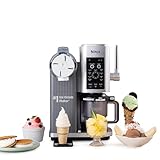
Ninja Creami Scoop & Swirl
The 13-in-1 system is overkill for someone who only wants frozen yogurt, but if you are making sorbet, gelato, and soft serve alongside yogurt, no other unit tested matched its texture range. The pint system freezes individual bases flat and the machine rescues them from rock-solid blocks into smooth scoops without thawing to liquid. Build feels dense and purposeful at $279.99. The learning curve is real: getting the right liquid ratio for each base took us about four attempts before results were consistently good. Skip this if your kitchen counter space is limited or if you only make one type of frozen treat, since you are paying for flexibility you will not use.
- Pro: Converts rock-hard frozen pints into smooth texture without thawing
- Pro: Handles yogurt, sorbet, gelato, and soft serve with different paddle modes
- Con: Requires precise liquid ratios and multiple failed batches to learn
VEVOR Commercial Soft Serve
At 22 to 30 liters per hour with dual 6L hoppers and a 2L cylinder, this is a business machine sitting in a consumer roundup for good reason: some home users in 2026 are running pop-up operations or selling at farmers markets. The LCD panel tracks output temperature and the puffing shortage alarm prevents empty-dispenser embarrassment. The countertop footprint is large and the compressor hum is industrial. Cleaning requires disassembling the cylinder and hopper system, which takes 15 to 20 minutes per session. Skip this unless you need volume output or commercial reliability, since the $1,169.91 price and maintenance burden dwarf any home kitchen need.
- Pro: Commercial throughput with dual-flavor capability from separate hoppers
- Pro: LCD monitoring and low-product alarm built into the panel
- Con: Deep cleaning cycle takes 15 to 20 minutes per use
Dash My Mug Bundle
Two half-pint mugs, a spoon, and nothing else. You freeze the mug, pour your base in, and churn by hand using the included paddle until it thickens. It is absurdly simple and the cleanup is one mug in the sink. The texture will not match a motorized machine, but for a single person who wants frozen yogurt with zero counter clutter, it works. The half-pint volume is genuinely tiny, meaning one serving per mug, and hand-churning takes longer and produces more ice crystals than a motor can prevent. Skip this if you want a smooth, commercial-restaurant texture or are feeding more than one person at a time.
- Pro: Costs less than a gallon of base ingredients and stores in a drawer
- Pro: Makes exactly one portion with zero waste or leftovers to freeze
- Con: Hand-churning produces noticeably grainier texture than motorized units
VEVOR Frozen Yogurt Blending Machine
This is a specialty tool, not a churner. The 750W motor at 1740 RPM blends and aerates pre-made ice cream or yogurt bases into customizable flavor combinations, making it useful for anyone who wants to mix store-bought or homemade bases into branded or custom products. The 304 stainless steel construction cleans easily and resists staining from fruit purees. It is not designed to freeze a liquid base into a solid product, so it only works as a secondary step after your base is already frozen. Skip this if you need a complete frozen yogurt solution from liquid to finished product, since this machine requires a pre-frozen input to work.
- Pro: High-RPM blending handles dense frozen bases without stalling
- Pro: 304 stainless steel bowl is stain-resistant and dishwasher-safe
- Con: Cannot freeze liquid bases, only blends already-frozen ingredients
Buying Guide
Pre-Chill vs. Compressor
Pre-chill bowl machines freeze a double-walled container in your freezer for 24 hours before each session. They are cheaper, quieter, and simpler. Compressor machines have a built-in freezer, letting you start a batch on any whim. The tradeoff: compressors add $30 to $50 to the price, increase noise, and require more counter space. If you make frozen yogurt more than twice a month, the compressor pays for itself in convenience. If you make it seasonally, a pre-chill bowl will serve you fine.
Batch Size and Serving Reality
A 1.5 quart rated capacity yields roughly three generous servings once air is incorporated, not the two full pints you might expect. If your household is three or more people, plan for a 2 quart minimum or run consecutive batches with a freezer pause. The Ninja Creami’s pint system sidesteps this by letting you freeze multiple small batches independently, but you commit freezer shelf space to each pint.
Texture Control and Base Ratios
The single biggest factor in whether your frozen yogurt turns out creamy or icy is the fat-to-water ratio of your base. Machines with adjustable paddle speed or auto-stir during freezing hold texture better than simple on/off designs. Pre-chill bowls lose heat as they work, so thick, high-fat bases (10% or more) churn smoother than watery skim-milk recipes. Always start with a colder-than-you-think base, because the machine warms slightly during operation and a lukewarm input is the most common cause of grainy results.
Our Verdict
The Cuisinart 2 Quart Automatic is our top pick for anyone who wants frozen yogurt without planning their freezer calendar around it. The built-in compressor eliminates the only real friction in the category and the 2 quart output covers most households in one run. The Dash My Mug Bundle is our budget pick for people who want a single serving with zero counter clutter and do not care about achieving restaurant-grade smoothness. If you specifically need a dairy-free, no-added-sugar result that takes five minutes start to finish, the Yonanas Classic wins outright because no true frozen yogurt machine can replicate what it does with fruit alone.
FAQ
Can I make frozen yogurt without a machine?
Yes, by freezing your base in a shallow pan and stirring vigorously every 30 to 45 minutes during the first two hours. The result will be grainier and denser than any churned method because large ice crystals form between stirs. It works for occasional use but is impractical if you want a smooth, scoopable texture regularly.
Why is my frozen yogurt turning out like ice?
The most common causes are a base that is too cold or too thick before churning, insufficient fat content, or a freezer bowl that was not fully frozen for 24 hours. Adding a tablespoon of alcohol or a small amount of corn syrup to your base lowers the freezing point and keeps the result scoopable even after hours in the freezer.
Is Greek yogurt better for frozen yogurt machines?
Greek yogurt’s higher protein and lower water content produce a denser, creamier result with less ice crystal formation. Regular yogurt has more whey and water, which creates a lighter, slightly icier texture. If you prefer a thick, fudgy consistency, strain regular yogurt through a cheesecloth before churning or simply switch to Greek.
How long does frozen yogurt last in the freezer after churning?
It holds its best texture for about two weeks in an airtight container. After that, ice crystals grow and the result becomes hard and grainy rather than creamy. Let it sit at room temperature for five to ten minutes before scooping to restore a workable texture, especially if it has been stored longer than a few days.
Write Your Review
No reviews yet. Be the first to share your experience!