
A convection toaster oven for small kitchens can handle toast, roasted vegetables, frozen foods, and small baked dishes without requiring a full-size oven. However, compact dimensions do not guarantee convenient operation or even cooking. This guide explains how to choose the right capacity, convection system, controls, and countertop setup for everyday use.
- Quick Verdict: Which Convection Toaster Oven Should You Buy?
- Understanding Convection Toaster Ovens
- Measuring a Small Kitchen Before Buying
- Choosing the Right Cooking Capacity
- Convection Performance and Cooking Controls
- Cooking Applications for Small Kitchens
- Cleaning and Maintenance
- Choosing for Different Kitchen Situations
- Common Buying Mistakes
- Frequently Asked Questions
- Conclusion
Quick Verdict: Which Convection Toaster Oven Should You Buy?
For most small kitchens, a compact countertop oven with a convection fan, adjustable temperature settings, removable crumb tray, and practical interior capacity offers a sensible balance of versatility and space efficiency.
Prioritize a model that accommodates your usual meals while leaving enough room for safe ventilation.
| Buying Factor | What to Look For | Why It Matters |
|---|---|---|
| Exterior dimensions | Width, depth, height, and protruding handles | Determines countertop fit |
| Interior capacity | Usable rack and baking-pan dimensions | Determines meal size |
| Convection system | Clearly documented fan-assisted cooking | Supports air circulation |
| Temperature controls | Appropriate settings for your recipes | Improves cooking flexibility |
| Rack positions | Suitable height adjustments | Accommodates different foods |
| Crumb tray | Accessible and removable | Simplifies maintenance |
| Operating clearance | Manufacturer-specified distances | Reduces heat-related risks |
| Accessories | Included, compatible pans and racks | Limits additional purchases |
A compact convection toaster oven is especially useful for one- or two-person households that cook smaller portions regularly.
However, it is not automatically the best solution for large family meals.
Understanding Convection Toaster Ovens
How Does Convection Cooking Work?
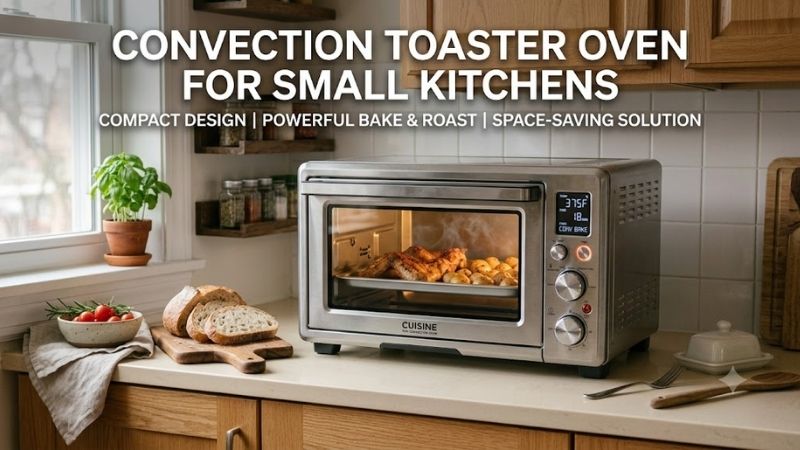
A convection toaster oven uses electric heating elements and a fan to circulate heated air within the cooking chamber.
Air movement can affect how heat reaches food surfaces.
This may support more consistent browning and efficient cooking for certain recipes.
However, the effectiveness of convection depends on fan placement, heating element design, rack position, and food arrangement.
A fan does not guarantee uniform temperatures throughout the chamber.
Some compact models still have hotter and cooler areas.
Convection vs. Conventional Toaster Ovens
A conventional toaster oven relies primarily on heat from its electric elements and the natural movement of heated air.
A convection model adds forced air circulation.
| Feature | Conventional Toaster Oven | Convection Toaster Oven |
|---|---|---|
| Air circulation | Primarily natural convection | Fan-assisted |
| Toasting | Common function | Common function |
| Small-batch baking | Supported on suitable models | Supported on suitable models |
| Roasting | Model-dependent | May benefit from circulating air |
| Moving components | Simpler design | Includes fan system |
| Cleaning | Depends on construction | Fan area may require additional attention |
| Price | Often simpler options available | Additional features may increase cost |
For basic toast and occasional reheating, a conventional model may be sufficient.
If you regularly roast vegetables, prepare small baked dishes, or want broader cooking flexibility, convection can be worthwhile.
Is a Convection Toaster Oven the Same as an Air Fryer?
Not exactly.
Many air fryers and convection toaster ovens use similar principles involving heating elements and circulating air.
However, chamber geometry, airflow velocity, food placement, and controls differ.
Some convection toaster ovens include an air-fry mode.
Others provide ordinary convection baking without a dedicated air-fry setting.
A convection label alone does not prove that the appliance will produce the same results as a particular basket-style air fryer.
Measuring a Small Kitchen Before Buying
Measure the Complete Exterior Footprint
Start by measuring the actual countertop where the oven will operate.
Include available width, depth, and height.
Then compare these measurements with the appliance’s complete exterior dimensions.
Remember that door handles, control knobs, and rear components may extend beyond the main housing.
A machine that fits the available width may still project too far forward and reduce essential food preparation space.
For narrow counters, depth can be as important as width.
Account for Safe Ventilation Clearance
Convection toaster ovens produce substantial heat.
Their ventilation openings and exterior surfaces may become hot during operation.
The oven must have enough clearance from walls, cabinets, and nearby objects.
Required distances vary between models.
Follow the manufacturer’s instructions rather than assuming every compact oven can operate directly beneath wall cabinets.
Never place a countertop oven inside a closed cabinet during operation unless the manufacturer explicitly approves that installation.
Check Door-Opening Space
Some toaster ovens use downward-opening doors.
Others have different door arrangements.
A downward-opening door may extend over the front edge of the countertop when opened.
Check whether you can safely remove hot trays without interference from nearby appliances.
The door must also remain clear of objects that could contact hot glass or metal.
Consider Storage Between Uses
If you plan to store the oven after every use, evaluate its weight and dimensions.
A compact appliance may still be inconvenient to lift.
Check whether your cabinet shelf supports its weight and whether the opening allows easy removal.
Always let the oven cool completely before moving or storing it.
Do not lift it by the door handle unless the manufacturer explicitly permits that method.
Choosing the Right Cooking Capacity
Interior Dimensions Matter More Than Slice Count
Manufacturers sometimes describe toaster oven capacity by the number of bread slices or the diameter of a pizza that fits inside.
These descriptions can help, but they do not reveal every practical limitation.
Bread sizes vary, and a pizza-diameter claim may not tell you whether your preferred baking pan fits comfortably.
Compare the usable interior width, depth, and height.
Account for pan handles and required clearance from heating elements.
Best Capacity for One Person
A small cooking chamber may be sufficient for toast, a single portion of vegetables, or a modest baked meal.
Larger capacity is not automatically necessary.
However, choose enough room to avoid excessive crowding.
Food arranged too tightly can interfere with airflow and change browning.
For individual meals, a compact model that fits your normal dish may be more convenient than a larger countertop oven.
Best Capacity for Two People
A slightly larger chamber can provide additional flexibility for two portions.
Consider whether you prepare meals on one tray or need separate cooking surfaces.
Do not assume that every oven supports simultaneous cooking on multiple racks.
Some models specify a preferred rack position for each cooking function.
When a Larger Oven Makes More Sense
If you regularly prepare family-size casseroles, large baking dishes, or several servings at once, a compact toaster oven may be restrictive.
Repeated batches can reduce convenience.
A larger countertop oven or existing full-size oven may be more suitable.
Choose based on your regular meals rather than occasional cooking ambitions.
Convection Performance and Cooking Controls
Temperature Adjustment
A useful convection toaster oven should offer temperature settings appropriate for its intended cooking functions.
Some models use mechanical dials.
Others use electronic controls.
However, displayed temperature and actual chamber temperature may differ.
Temperature stability depends on sensor placement, heating control, food load, and operating mode.
If baking precision matters, prioritize credible performance evidence rather than assuming a digital display guarantees accuracy.
Convection Fan Control
Certain toaster ovens operate the fan automatically in designated modes.
Others allow the fan to be switched on or off.
Separate fan control may be useful when preparing recipes that benefit from conventional heating.
However, it is not essential for every household.
Choose a model whose cooking programs match your needs.
Cooking Timer and Automatic Shutoff
A timer can help manage cooking duration.
Some ovens stop heating when the timer ends, while others have separate continuous-operation settings.
Read the instructions carefully.
A timer should not replace appropriate supervision, especially when broiling or cooking foods that can burn quickly.
Rack Position
Rack height affects the distance between food and heating elements.
A higher position may promote surface browning during approved broiling tasks.
A central position may be more appropriate for certain baking recipes.
Follow manufacturer instructions for each function.
Do not position oversized food close to exposed heating elements.
Cooking Applications for Small Kitchens
Toasting Bread and Bagels
A convection toaster oven can prepare everyday breakfast items.
However, fan-assisted cooking is not necessarily required for ordinary toast.
Some appliances use a separate toast program.
Use recommended rack positions and settings.
If you only toast bread, a pop-up toaster may be simpler and occupy less space.
Roasting Vegetables
Convection can be useful for roasting small portions of vegetables.
A shallow, suitable pan allows heated air to reach more of the food surface.
Avoid overcrowding the pan.
Large quantities may trap steam and produce softer results.
Cut vegetables into reasonably consistent pieces and follow an appropriate recipe.
Reheating Pizza
A countertop oven can reheat pizza while providing dry heat around the crust.
The result depends on temperature, rack position, and cooking time.
Use an approved tray or rack arrangement.
Monitor the food to avoid excessive browning.
Baking Small Portions
Compact convection ovens can support certain cookies, muffins, and other baked recipes.
However, conventional oven recipes may require adjustments.
Changes to cooking time or temperature should be guided by the recipe and manufacturer’s instructions.
Do not assume that every conventional baking recipe can be transferred directly.
Cooking Meat and Fish
Some compact ovens are suitable for cooking small portions of meat or seafood.
Choose cookware approved for the appliance.
Use a food thermometer to verify safe internal temperatures.
Poultry should reach 165°F, ground meat generally requires 160°F, and fish should reach 145°F or meet applicable safe doneness guidance.
Do not rely solely on exterior browning.
Cleaning and Maintenance
Removable Crumb Tray
An accessible crumb tray is one of the most useful cleaning features.
Crumbs and grease can accumulate beneath the cooking chamber.
Remove and clean the tray according to the manufacturer’s instructions after the appliance has cooled.
Avoid allowing food residue to build up.
Interior Coating and Surfaces
Some ovens have coated interiors, while others use exposed metal surfaces.
Cleaning methods vary.
Do not use abrasive tools or unapproved oven cleaners.
Avoid applying liquids directly to heating elements and electrical components.
Convection Fan Area
Grease and residue may accumulate around ventilation openings and fan housings.
However, the fan assembly is not necessarily user-removable.
Follow the manufacturer’s cleaning instructions.
Never insert utensils into the fan area or attempt unauthorized disassembly.
Accessories and Replacement Parts
Check the availability of compatible racks, pans, and trays.
A compact oven becomes less useful if a damaged accessory cannot be replaced.
Use accessories designed or explicitly approved for the model.
Choosing for Different Kitchen Situations
Studio Apartments
A narrow, compact convection oven may be suitable when safe operating clearance is available.
Prioritize manageable dimensions and simple maintenance.
If counter space is extremely limited, consider whether another appliance would better suit your routine.
Small Family Kitchens
Choose enough interior capacity for normal meals without unnecessarily increasing the countertop footprint.
A model accommodating a practical baking pan may provide more flexibility than one optimized only for toast.
Homes Without a Full-Size Oven
A convection toaster oven can handle a variety of small baking and roasting tasks.
However, it will not necessarily replace every function or capacity of a conventional oven.
Check the recipes you prepare most often.
Kitchens With Existing Air Fryers
If you already own an air fryer, consider whether a convection toaster oven offers a genuinely different benefit.
Toast, small baking dishes, and broader pan compatibility may justify it.
Otherwise, the appliances may duplicate functions.
Common Buying Mistakes
Choosing Only by Exterior Dimensions
A compact footprint is useful only when the appliance also provides suitable interior space and ventilation clearance.
Assuming All Convection Ovens Cook Evenly
Actual performance varies.
A fan does not eliminate every temperature difference.
Ignoring Door and Handle Clearance
The oven needs room to open safely and remove hot cookware.
Buying Too Many Functions
Additional presets may increase cost without improving your normal cooking routine.
Overlooking Cleaning Access
A removable crumb tray and practical interior surfaces can matter more than decorative controls.
Frequently Asked Questions
Is a Convection Toaster Oven Worth It for a Small Kitchen?
It can be worthwhile if you regularly prepare small baked meals, toast, roasted vegetables, and reheated foods. Its value depends on available counter space and cooking habits.
Does Convection Make Food Cook Faster?
It can affect cooking speed, but results depend on the recipe, oven design, and operating conditions. Do not assume every recipe requires the same adjustment.
Can I Put a Convection Toaster Oven Under Cabinets?
Only when the manufacturer explicitly permits that placement and the specified ventilation and heat clearances are maintained.
Is a Convection Toaster Oven Better Than an Air Fryer?
Neither is universally better. A toaster oven may offer flexible baking and tray use, while a basket air fryer may be more convenient for certain air-fried foods.
Can I Use Regular Baking Pans?
Only when their material and dimensions are approved for the oven. Check heating-element clearance and manufacturer instructions.
Are Compact Convection Toaster Ovens Easy to Clean?
Many have removable trays and accessible interiors, but cleaning convenience varies. Inspect the crumb tray, interior surfaces, and manufacturer care requirements.
Conclusion
The best convection toaster oven for small kitchens balances usable cooking capacity, manageable exterior dimensions, dependable controls, and convenient cleaning. Choose a model that accommodates your everyday recipes without consuming unnecessary countertop space. Most importantly, verify operating clearances and cookware compatibility before purchasing, because a compact design does not eliminate heat or ventilation requirements.






Write Your Review
No reviews yet. Be the first to share your experience!